
ENTERTAINMENT
Nolte Wrote Borrowed Time and Still Awaits the Film
Three years after John Nolte’s Borrowed Time, a 2026 review and 660 Amazon ratings keep the novel alive, with no sequel and no movie.

John Nolte’s first novel, Borrowed Time, still has no film three years after its September 26, 2023 release. The 400-page book follows Joshua Mason, an ordinary man who cannot stay dead. Terry O’Brien, a Cape May, New Jersey, columnist, took it up again in October 2026 and called it conservative art that refuses a sermon.
The movie Nolte spent a career asking Hollywood to make is still a paperback. He has not announced a sequel.
An Immortal Man Who Only Wants to Be Left Alone
Mason has been alive for thousands of years. He can die like anyone else, then he comes back in southern Arizona. He never learns why. He learns, early, not to get close to people, because everyone he loves will die and he will not.
Nolte named the shock of modernity the All at Once: for ages almost nothing changed, then cities, cameras, and records arrived so fast that staying unknown got harder every year. Mason’s real enemy is not a villain with a manifesto. It is being seen.
That breaks when he meets Doreen, a motel owner with a disabled grandson. The love story starts with a small gesture, her fingers in her hair, and it costs him the distance he had spent centuries building. Post Hill’s own synopsis is blunt about the bill that follows. To keep Charlie’s crumbling desert motel alive after Doreen begins to die of old age, Mason sells his life on the dark web to rich people who like the ritual of murdering him.
He wanted Borrowed Time to feel like a Western, which is why he put it in the Southwest desert. Mason, he said, is the loner who pays for getting involved. The most dangerous man, in his telling, is the one pushed into action when all he wants is to be left alone.
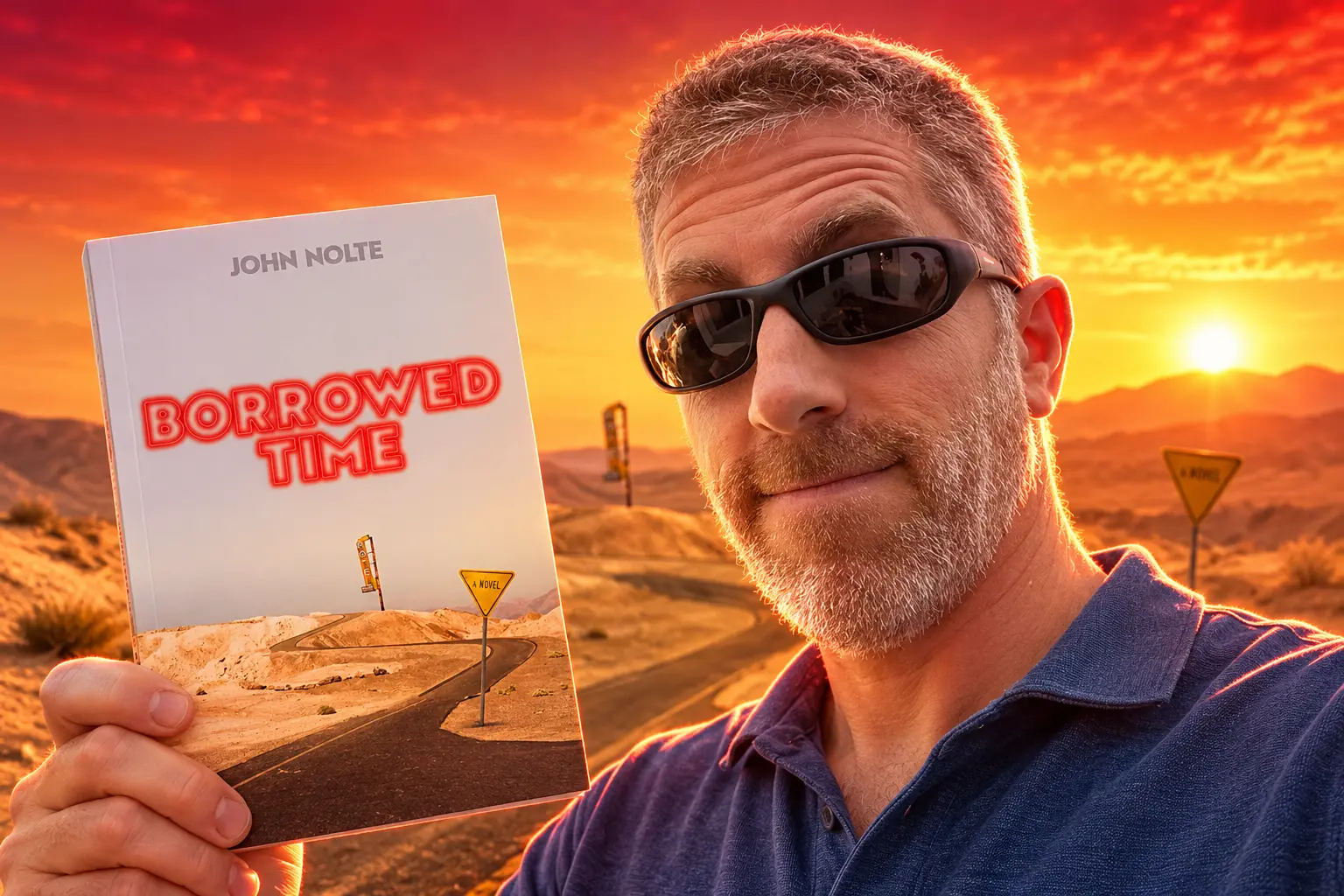
Nolte Named the Spell-Breaking Lecture Years Ago
Nolte is a conservative film critic and columnist, a Midwesterner who chose the South, and a former bill collector who spent lean years in Los Angeles trying to write movies. He posted as Dirty Harry for Libertas, a site tied to the Liberty Film Festival, which Govindini Murty and Jason Apuzzo founded in 2004 as a conservative counter-program to the usual festival circuit.
The late publisher Andrew Breitbart hired him to run a Hollywood site that grew into a national newsroom. Nolte still files near-daily columns on movies and culture. In 2011, after eight years in Los Angeles, he left for the Blue Ridge Mountains of North Carolina. The publisher bio still places him there with Julie, his wife of 33 years as of that 2023 note, two dogs, and a Blu-ray stack that is never large enough.
THE LONG ROAD TO ONE NOVEL
- 2004: The Liberty Film Festival opens in West Hollywood, and Nolte is already in that fight as Dirty Harry on Libertas.
- Late 2000s: Breitbart hires him as the first editor of a Hollywood beat; Nolte becomes a full-time critic of lectures stuffed into popcorn movies.
- 2011: He leaves Los Angeles for North Carolina and keeps the column.
- About 2016 to 2021: He spends five years plotting Mason’s story and gets stuck, hard, on Charlie.
- About 2021 to 2023: Two years of writing, rewrites, and months of block.
- September 26, 2023: Bombardier Books publishes Borrowed Time.
- September 4, 2026: Nolte is still posting the same book, now at 660 Amazon reviews.
O’Brien writes that Nolte warned, some 20 years back, about the Left Wing Sucker Punch, the political message jammed into a film that had been selling itself as entertainment. The original column did not turn up as a clean primary. What did turn up, in Nolte’s own 2023 interviews, is the same complaint in plainer words: Hollywood breaks the spell.
Five Years of Plotting Produced One 400-Page Novel
He told interviewers the book took five years of plotting and two years of writing. The publisher, Bombardier Books, is an imprint built for conservative nonfiction, the kind of house that talks about dropping rhetorical bombs. It still put out a love story about an immortal motel hand.
Simon & Schuster distributes the title and listed the eBook at $11.99. The paperback runs 400 pages under ISBN-13 9781637589281. Tantor shipped an unabridged audiobook the same week, 13 hours and 24 minutes, read by Jim Seybert.
THE BOOK HE SAID HE HAD TO FINISH
- Length: 400 pages in print, with no second volume on any publisher list.
- Time: Five years of plotting, then two years of writing, seven in all.
- Audio: 13 hours 24 minutes, narrated by Jim Seybert for Tantor.
- Launch noise: Before release it hit No. 4 on Amazon’s Movers and Shakers list and a bestseller tag in the lawyers-and-criminals category.
Nolte said his only goal was a page-turner that would not make him a hypocrite. He has spent years hammering studios for stopping a story cold with a speech. Doing the same thing from the right, he said, would be the same sin.
I don’t mind left-wing movies. The horror of woke is how it breaks the storytelling spell with ham-handed political content. Doing that from a right-of-center point of view is committing the same sin, and that’s the last thing I wanted to do.
John Nolte, novelist, September 2023 interview
He also said he did not write the book to change how anyone votes. Great stories are about something, he argued, but that something has to live in theme and character, not in a lecture. His goal, the line Cernovich passed around on launch day, was to write something timeless, not timely.
Charlie almost killed the project. Everything Nolte drafted felt like a lazy take on Lennie from Of Mice and Men. He quit more than once. Then he tried the opposite of his bad ideas, and the character, a seven-year-old mind in a 36-year-old body, opened the rest of the plot. Ernest, the monster in the excerpted middle stretch, arrived whole. Writing him, Nolte said, was joy. The rest was like birthing a beach ball.
He Sold His Life on the Dark Web to Pay the Motel
The money engine is ugly on purpose. Mason’s renewable resource is his own death. For a couple of decades, in Nolte’s telling, he has been selling that death to wealthy clients. The publisher copy adds the turn: when he only wants to mourn Doreen, he finds he has sold his life to people much more dangerous than the usual buyers, and Charlie is not as innocent as he looks.
O’Brien is not kind to that stretch. A character sold as a lovable misfit becomes a cruel sadist. A CIA agent helps a serial killer for political gain. Mason funds the family through the dark web. O’Brien called this the weakest part of the book and still granted Nolte a splash of inner Stephen King. The gore, he wrote, is spectacular. The slide into a Kubrick-style blood orgy did little for him.
That is the hypocrite test in miniature. A critic who hates spell-breaking politics still has to handle violence, genre furniture, and a conspiracy beat without stopping the story to wink. O’Brien thinks the wink shows. He also thinks the book recovers.
Charlie, Doreen, and the Grief Under the Plot
The pages O’Brien ranks highest are not the kills. They are the local legend of how Doreen’s grandson came to be disabled, unraveled in a way that left him uplifted and grieving at once. Grief, he wrote, soaks the novel the way a setting can become a character in a film. He says it is earned.
Nolte has said the book is Christian without a pulpit. It asks about God, faith, good, and evil in ways that, in O’Brien’s read, serve the plot instead of pausing it. Longtime readers will catch the side quests, a jab at the welfare state, a deep mistrust of government, the Nolte-isms. O’Brien compared that weave to Chuck Wendig’s Wanderers, a left-wing allegory that still functioned as a novel. The asides, in this account, do not sink the ship.
Nolte has been open about the real marriage under the fictional one. He loves movies, long RV trips, and, above all, his wife. O’Brien figures that actual love is what fills Joshua and Doreen, equal parts thrill and wreckage. On a podcast after publication, Nolte put the method in one run of sentences.
It’s not political in the sense that it’s partisan. There’s no rhetoric. I didn’t want to commit the same sin that Hollywood is doing now and ruin the readers’ experience by taking you out of it by lecturing and scolding and making some ham-handed political point. It’s my book and it’s my worldview but I worked very hard not to be a hypocrite.
John Nolte, on the Chris Stigall podcast, October 2023
He wanted closing the book to feel like leaving a great movie, dazed on the way back into the parking lot. Mason is, in his own phrase, the ultimate individual in a culture that frowns on that. Anyone who wishes to be left alone, he said, will recognize how the modern world corners him.
What a 2026 Review Still Praises
O’Brien is a longtime columnist on music, sports, movies, and, this time, books. He writes as a fan of Nolte’s criticism and as someone who still misses the old Hollywood of sex and star power. That bias is on the table. So is the verdict he came to anyway.
Borrowed Time, he wrote, is conservative without the right-wing sucker punch, romantic without the melodrama, Christian without the proselytizing. It reads like a screenplay, lean prose with John Ford vistas, no surprise given Nolte’s years around scripts. It is not perfect. It mildly overstays its welcome. The ending will either work or it will not. He still called it a humdinger of a page-turner.
Then he did the thing Nolte spent the interviews refusing to do. If you are a conservative, O’Brien wrote, support conservative art and buy this book. If you are a liberal, shock the squares and grab a copy. If it sells enough, maybe there will be a sequel. The novel may avoid the sucker punch. The last paragraph of the review does not. That gap is the market Nolte walked into, not a hole in Mason’s plot.
Three Years Later, 660 Reviews and No Film
On September 4, 2026, Nolte answered a producer’s dare that conservatives finally make art, because the bar is on the floor, by posting his Amazon link. He wrote, “Did my part.” Then he added the score he wanted next to it.
Did my part…. https://t.co/dogwyqCiT7
660 reviews. 4.7 out of 5 stars. https://t.co/JzcAdTM4B3
— John Ocasio-Rodham Nolte (@NolteNC) September 4, 2026
THE 2023 BOOK IN 2026
| Measure | Launch, 2023 | Afterlife, 2026 |
|---|---|---|
| Format | 400-page novel from Bombardier Books | Same book, no sequel listed |
| Amazon | No. 4 on Movers and Shakers before release | 660 reviews, 4.7 stars, as of September 4 |
| Rank joke | New title in the feed | Hit 13,000 five months in; Nolte said it should have been at 400,000 |
| Film | None announced | None made |
| Author | Called it his first and probably last novel | Still writing daily columns, still posting this one title |
Replies under that September post were small and specific. One reader offered to write the screenplay. Another said he bought it and loved it. A third asked how the next book was coming. Nolte did not answer in the thread. In 2023 he had already said the idea of another novel was intimidating, that this felt like the best thing he would ever write, and that only a new idea that excited him half as much would force his hand. On Facebook five months after release he called it his first and last novel, said it had eaten too much TV time, and joked that the next royalty check might top $0.00. People in publishing, he added, had told him the money is in trilogies. He wanted Mason’s story all there.
Alex Marlow, a conservative editor who has worked alongside him, put the other half of the wager in public on September 14, 2026. It was, he wrote, a sad state of affairs that no center-right filmmaker has tried to turn Borrowed Time into a movie. Readers still compare it to Highlander. A book club was on it as late as July 2026. The live argument on the right is not that the novel failed. It is that a finished, filmed-looking story is sitting in print while the same circle keeps saying someone should compete with Hollywood.
Nolte already competed, on the terms he set, in 400 pages. The reckoning he wanted from the studios is still a link to a listing, a 4.7 from 660 reviews, and a question under his post that he has not answered.

One UI 9.5 Beta Puts the Galaxy S26 on Last Year’s Clock

DBS Puts a 24/7 USDC Window Inside the Bank

European Startups Head for $81 Billion as First Checks Shrink

US Stocks Lost $1.3 Trillion Before Nvidia’s Beat

Home Depot Bets on Finance Chief Richard McPhail as CEO

Aramco Crash Kills 14 Two Days After Oil Restart

Salah Captained Egypt to Their First World Cup Win

Zelda’s 40th Switch 2 Ships Without a Zelda Game

Apple Labor Day Deals Hide June’s Memory Price Hike

El Niño Puts Israel’s Needed Winter Rain on a Flood Clock
-
 BUSINESS5 months ago
Aramco Crash Kills 14 Two Days After Oil Restart
-
 NEWS6 months ago
Salah Captained Egypt to Their First World Cup Win
-
 GAMING2 months ago
Zelda’s 40th Switch 2 Ships Without a Zelda Game
-
 NEWS3 months ago
Apple Labor Day Deals Hide June’s Memory Price Hike
-
 NEWS4 months ago
El Niño Puts Israel’s Needed Winter Rain on a Flood Clock
-

 GAMING2 months ago
Palworld 1.0.4 Adds Palpedia Search After the 1.0 Launch
-

 NEWS4 months ago
Saudi Visa Routes Split Nigerian Travelers Into Two Speeds
-

 BUSINESS9 months ago
BAE’s 60-Year Saudi Franchise Now Runs Through Taif