
NEWS
NASA’s 2028 Moon Landing Now Runs Through Earth Orbit
NASA is keeping a 2028 Moon landing while Artemis III stays in Earth orbit and the lander for that first crew is still unpicked.

NASA is holding a 2028 return to the Moon, and the next crewed flight will not leave Earth orbit. On Oct. 23 at Kennedy Space Center, Administrator Jared Isaacman set Artemis III as a 14-day test in 2027, with four astronauts docking Orion to landers from Blue Origin and SpaceX.
The first south pole landing now sits on Artemis IV. NASA still has not named which company will fly that lander.
LIVE: @NASAAdmin and agency leaders are sharing the latest updates on next year's Artemis III mission and our plans to return astronauts to the surface of the Moon by 2028. https://t.co/G1ya48yeun
— NASA (@NASA) October 23, 2026
Three Rockets Have to Fly in Days
Jeremy Parsons, NASA’s Artemis program manager, told reporters the agency is launching three spacecraft on three different rockets and testing how they operate together, something NASA has never attempted. He called it likely the most complicated launch campaign the agency has ever undertaken. The point of all that traffic is not a landing. It is a rehearsal close to home before anyone is sent a quarter-million miles away.
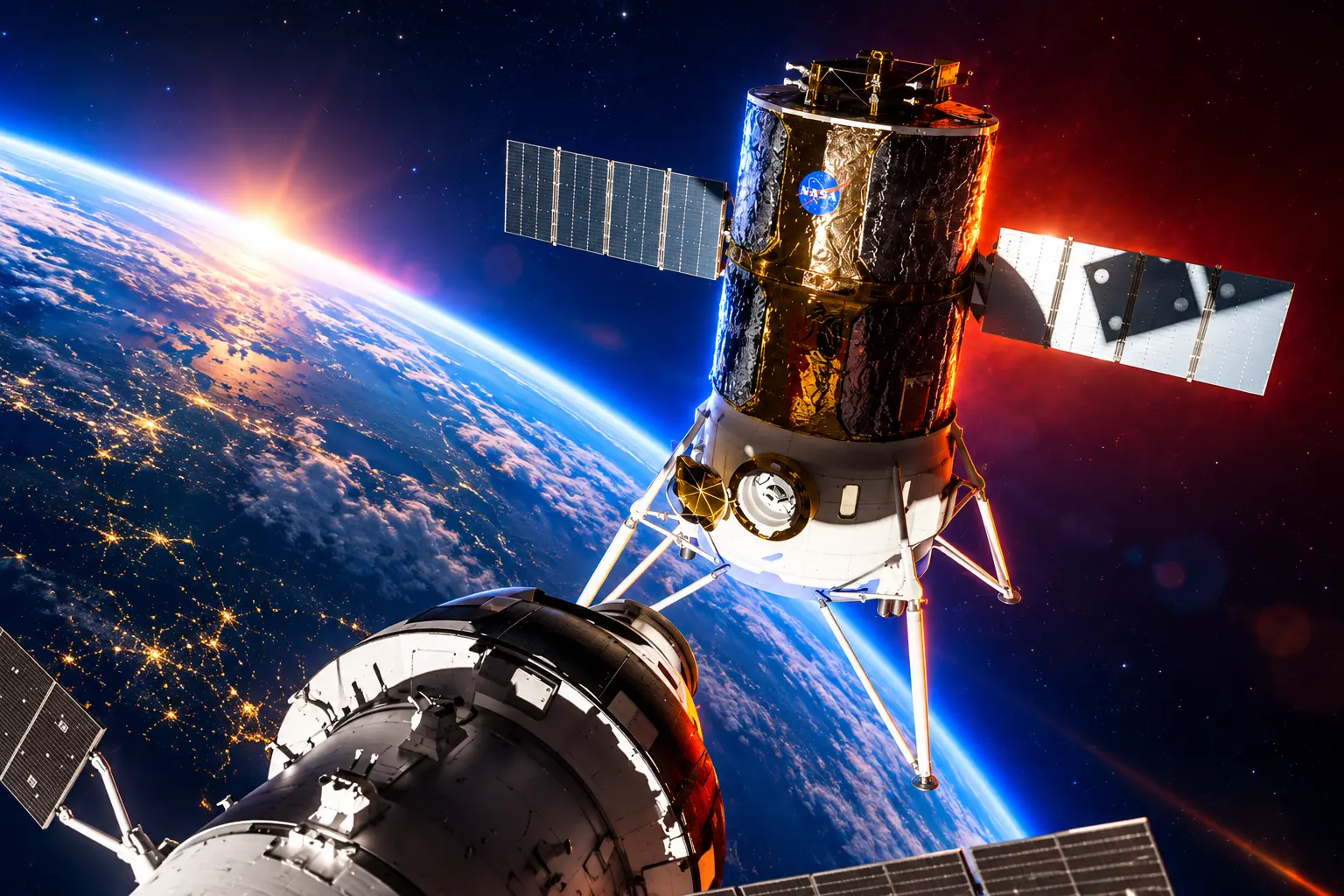
Blue Origin’s New Glenn flies first, lofting a Blue Moon Mark 2 test article into a circular orbit about 273 miles up. That vehicle can wait as long as 30 days, which gives NASA a window to confirm it is healthy. Only days later, the Space Launch System is supposed to send Orion up from Kennedy. Orion starts in an 18 by 1,122-mile ellipse, circularizes near 345 miles, then chases the lander. SpaceX’s Starship Version 3 comes last, because it cannot loiter as long, and it enters a lower orbit at 206 nautical miles.
THE ARTEMIS III LAUNCH ORDER
- New Glenn first: Blue Moon reaches orbit and can wait up to 30 days for a healthy checkout.
- SLS and Orion next: The crew launches from Kennedy days after the lander is cleared.
- First two flight days: The four astronauts check out Orion and set up the first rendezvous.
- Blue Moon dock: Orion meets the lander and the crew spends about two days inside it.
- Starship later: SpaceX launches once Orion is free, then docks for up to two hours.
- Extra Orion time: Up to five more days remain for suit, sensor, and science tests before splashdown.
When the crew is done, Orion heads for a Pacific splashdown off California, with the Navy on recovery. The flight is planned for 14 days and can run as long as 17 if the docks and tests eat the extra time NASA built in.
Blue Origin Launches First and Opens the Hatch
The Blue Moon test article is the fuller of the two vehicles. It carries avionics, flight software, cabin gear, and life-support functions meant for later lunar flights. After docking, the astronauts open the hatch, go aboard, and spend about two days on the atmosphere, controls, tanks, thrusters, solar arrays, and thermal system. NASA has not done a crewed checkout of a commercial lunar lander in space. This is that checkout, staged a few hundred miles up instead of over the south pole.
Commander Randy Bresnik, a retired Marine colonel on his third spaceflight, leads the crew NASA named on June 9, 2026. Luca Parmitano of the European Space Agency is pilot, the first ESA astronaut assigned to an Artemis flight and a former space station commander. Mission specialists Andre Douglas, a first-time flyer who backed up Artemis II, and Frank Rubio, who logged 371 days on one station increment, round out the prime crew. Bob Hines is the backup. Josef Aschbacher, ESA’s director general, said Parmitano’s seat also reflects the European Service Module that again powers Orion.
No One Boards the Starship Test Article
After Orion leaves Blue Moon, SpaceX launches a Version 3 test article with a docking system on the nose. The dock is supposed to last up to two hours. The crew stays in Orion. NASA wants controllability, radio links, software, and the loads of hard-mate and release, not a cabin tour. The geometry is different from Blue Moon, whose port sits beside the crew cabin, so one flight tries both docking styles.
The harder problem is not leaving Florida. It is getting two new landers to meet Orion on time, then getting one of them to the Moon with enough propellant and a working hatch. Artemis III exists because that chain has never been flown as a set.
NASA Still Has Not Chosen a Lander
Under the original human landing contracts, SpaceX’s Starship was assigned to Artemis III and IV, and Blue Origin’s Blue Moon Mark 2 to Artemis V. Those assignments are gone. NASA updated the contracts this year so both firms fly test articles on the 2027 Earth-orbit mission, and neither lander provider has been assigned to a specific lunar landing flight.
Parsons said the agency intends to wait as long as possible before choosing who carries the first crew in 2028. Both companies, he added, are planning lunar landing missions that year. A second crewed landing is supposed to follow. On each of those early surface flights, two astronauts ride the lander down while two remain on Orion, and NASA is targeting two moonwalks of about two hours each.
HOW THE TWO ARTEMIS III TEST ARTICLES DIFFER
| Item | Blue Moon Mark 2 | Starship Version 3 |
|---|---|---|
| Launch vehicle | New Glenn | Super Heavy |
| Orbit for the test | About 273 miles | 206 nautical miles |
| Time it can wait | Up to 30 days | Shorter; launched later |
| Crew goes inside | Yes, about two days | No |
| Docking | Port beside the cabin | Nose port, up to two hours |
| 2028 landing slot | Unassigned | Unassigned |
Keeping both paths open is the whole bet. It also means 2028 is a date without a vehicle name on it. Isaacman said NASA has no intention of surrendering a viable path to the surface before the data and the schedule compel it to do so.
The Orbit and the Suit NASA Cut to Keep 2028
The other half of the so-called acceleration is subtraction. Orion and the landers will no longer meet in a near-rectilinear halo orbit around the Moon, the distant loop once tied to later Gateway traffic. Each partner now gets an orbit that fits its own machine, chosen to shorten the trip back from the surface and to cut propellant.
SpaceX still plans to aggregate super-cold propellant in Earth orbit, filling a depot from tanker Starships and then fueling the lander. In the revised plan, Starship HLS waits for Orion in Earth orbit, docks there, and performs the burn that sends the stacked vehicles toward low lunar orbit. NASA is modifying Orion so Starship can push it. Blue Origin is deferring propellant transfer for its first 2028 crew flight and will instead use three transfer stages, like a multistage rocket, to send a Blue Moon Mark 2 Alpha into an elliptical polar lunar orbit.
THE CUTS NASA MADE TO HOLD 2028
- Halo orbit: The near-rectilinear rendezvous is gone; each lander meets Orion on a path fitted to its own propulsion.
- Starship push: The lander docks in Earth orbit and supplies the burn toward the Moon, which NASA says lowers how much propellant must be stacked in space.
- Blue Origin stages: Three transfer stages replace an in-space fuel dump on the first crew run, with faster returns from the surface.
- HLS slots: Starship is no longer locked to the first two landings, and Blue Moon is no longer locked to the fifth.
- Sortie suit: Axiom Space is building a lighter lunar suit for short walks instead of the full-mass design.
Parsons said the 250-pound sortie suit, down from about 500 pounds, is a big deal for what has to be delivered to the surface. Two of them save about 500 pounds. The pressure garment is due by the end of 2026, with life-support work after that. Early moonwalks are the two-hour sorties, used to collect samples and to try the Axiom suit, not a week of treks into dark craters.
A 90-Day Hole in a Summer 2027 Launch
Isaacman still talks about a year-end tanking test and a summer 2027 launch. He also told the workforce in September that the new mission was about 90 days behind. On Sept. 25 he argued that outsiders were misreading that note. Artemis III, he wrote, did not really exist six months earlier, hardware was coming together in the Vehicle Assembly Building, the crew was in training, and the campaign was only 90 days broken to schedule.
For an Artemis III mission that did not really exist six months ago, with hardware coming together quickly in the VAB, test landers in production, the crew assigned and in training, and the most complex multi-launch campaign mission in history only 90 days broken to schedule, I thought the update would come across as confidence inspiring.
Jared Isaacman, NASA Administrator, on X
At the October briefing, Parsons put the slip on lander supply chains, especially avionics. Isaacman cited a Blue Origin dome that needed moving and cost more than 20 days. NASA has been using military aircraft to haul large pieces. Parsons said the hydrogen quick-disconnect on the core stage has been redesigned, with a parallel unit headed for flow tests at Stennis Space Center. A specific rollout date for a wet dress rehearsal was not given.
THE PATH TO THE OCTOBER BRIEFING
- February 2026: Isaacman recasts Artemis III as an Earth-orbit docking test and moves the first landing to Artemis IV in 2028.
- April 2026: Artemis II completes its crewed flight, the foundation Isaacman keeps citing.
- June 9, 2026: NASA names Bresnik, Parmitano, Douglas, and Rubio, with Hines as backup.
- September 2026: Isaacman tells staff the new mission is about 90 days behind and calls a summer 2027 launch the best case for two landings in 2028.
- October 23, 2026: At Kennedy, NASA holds the acceleration briefing and still aims at that summer launch.
Isaacman said Kennedy’s workforce had already cut the assembly and integration schedule in half. Lockheed Martin Space said the same day that the Orion heat shield for Artemis IV has 186 heat shield tiles already installed, ahead of earlier schedules. Progress on capsules and core stages does not move the landers. Those vehicles still set the pace, Parsons said.
Asked about buying time with more money and fewer flights, Isaacman refused the bargain. He said NASA will not delude itself into believing that more time, more money, and flying less will somehow make the work safer or more achievable.
China’s Two-Launch Clock Runs to 2030
The reason NASA is willing to strip orbits and suits is not a brochure about science. Isaacman used the briefing to describe a Chinese program that, in his account, already has spacecraft, landers, and a two-launch architecture that could put crew on the surface in the next three years, with reusable rockets on the way. China’s crewed lunar program has restated a landing before 2030. Its Long March 10 had completed a low-altitude test and had not reached orbit. Those are different clocks, and NASA is running against Isaacman’s shorter one.
He told reporters the south pole is the size of Washington, D.C., and that the ice in the permanently dark craters is the training ground for Mars, a fact he said Beijing knows as well. If China steps there first, he has said, he expects to be fired, then to watch Congress haul contractors in to ask where the money went. The line is theater. It is also the political envelope around a 2028 date that no longer has a named lander inside it.
China’s plan, as described by its own program, is simpler on paper: two Long March 10 rockets, the Mengzhou crew ship, the Lanyue lander, a dock in lunar orbit, two people down for a short stay. NASA’s plan still needs SLS, Orion, a commercial lander, and, if Starship goes first, a propellant depot that has never been filled in orbit. The American stack is heavier with contractors. It is also the one that has already flown a crew around the Moon, in April, on Artemis II.
What Still Has to Work Before Anyone Lands
Both companies must fly an uncrewed demonstration of their crewed landers before NASA will send astronauts. NASA will certify the systems after those flights. SpaceX still has to show ship-to-ship transfer of cryogenic propellant, a step that has not been done, and the company is supposed to prove the whole aggregation approach on its uncrewed lunar demo. How many tanker flights that takes is still a live argument, and that number decides whether 2028 is a launch-cadence problem.
THE FLIGHTS BETWEEN HERE AND A CREWED LANDING
- Tanking test: A year-end loaded rehearsal on SLS, with the redesigned hydrogen fittings still in work at Stennis.
- Artemis III: The three-rocket, 14-day Earth-orbit campaign, targeted for summer 2027.
- Cryogenic transfer: SpaceX must move super-cold propellant between Starships before a lander can leave Earth orbit full.
- Empty landings: Starship and Blue Moon each need an uncrewed touchdown and ascent before a crew is allowed aboard for the Moon.
- Suit finish: Axiom’s pressure garment is due by the end of 2026, then the life-support pack that makes a two-hour walk real.
- The pick: NASA chooses which lander flies first only after the 2027 test and the unmanned demos force a decision.
The Moon has no air to help a lander slow down. From low lunar orbit the engines have to cancel the entire closing speed and then hover, which is why those empty landings are not paperwork. They are the first time the new machines do the job that parachutes do on Earth.
Isaacman can keep 2028 on the wall because he turned the next crewed flight into a dress rehearsal and cut the landing plan until it fit. He cannot name the vehicle that will actually put boots in the dust, and he cannot launch that rehearsal until three rockets leave Florida in the right order. The date is firm in the briefings. The lander is not.

One UI 9.5 Beta Puts the Galaxy S26 on Last Year’s Clock

DBS Puts a 24/7 USDC Window Inside the Bank

European Startups Head for $81 Billion as First Checks Shrink

US Stocks Lost $1.3 Trillion Before Nvidia’s Beat

Home Depot Bets on Finance Chief Richard McPhail as CEO

Aramco Crash Kills 14 Two Days After Oil Restart

Salah Captained Egypt to Their First World Cup Win

Zelda’s 40th Switch 2 Ships Without a Zelda Game

Apple Labor Day Deals Hide June’s Memory Price Hike

El Niño Puts Israel’s Needed Winter Rain on a Flood Clock
-
 BUSINESS5 months ago
Aramco Crash Kills 14 Two Days After Oil Restart
-
 NEWS6 months ago
Salah Captained Egypt to Their First World Cup Win
-
 GAMING2 months ago
Zelda’s 40th Switch 2 Ships Without a Zelda Game
-
 NEWS3 months ago
Apple Labor Day Deals Hide June’s Memory Price Hike
-
 NEWS4 months ago
El Niño Puts Israel’s Needed Winter Rain on a Flood Clock
-

 GAMING2 months ago
Palworld 1.0.4 Adds Palpedia Search After the 1.0 Launch
-

 NEWS4 months ago
Saudi Visa Routes Split Nigerian Travelers Into Two Speeds
-

 BUSINESS9 months ago
BAE’s 60-Year Saudi Franchise Now Runs Through Taif