
NEWS
Xiaomi Bets Europe Will Pay €1,399 for a Rear Screen
Xiaomi’s 18 Pro hits Europe 55 days after China, with a rear screen, dual 200MP cameras, and a smaller battery than Beijing’s model.

Xiaomi priced the global Xiaomi 18 Pro from €1,399 ($1,541) at a Paris event on November 17, 2026, 55 days after the China launch. The 18 Pro Max starts at €1,599 ($1,760). Both phones carry a second AMOLED on the back, the hardware Xiaomi would not put on an international list a year ago.
European buyers get the same 2nm Snapdragon chips and dual 200-megapixel Leica cameras as China. They do not get the same battery, the same memory ladder, or a charger in the box. Xiaomi did not name an on-sale date.
The Rear Screen Xiaomi Would Not Export
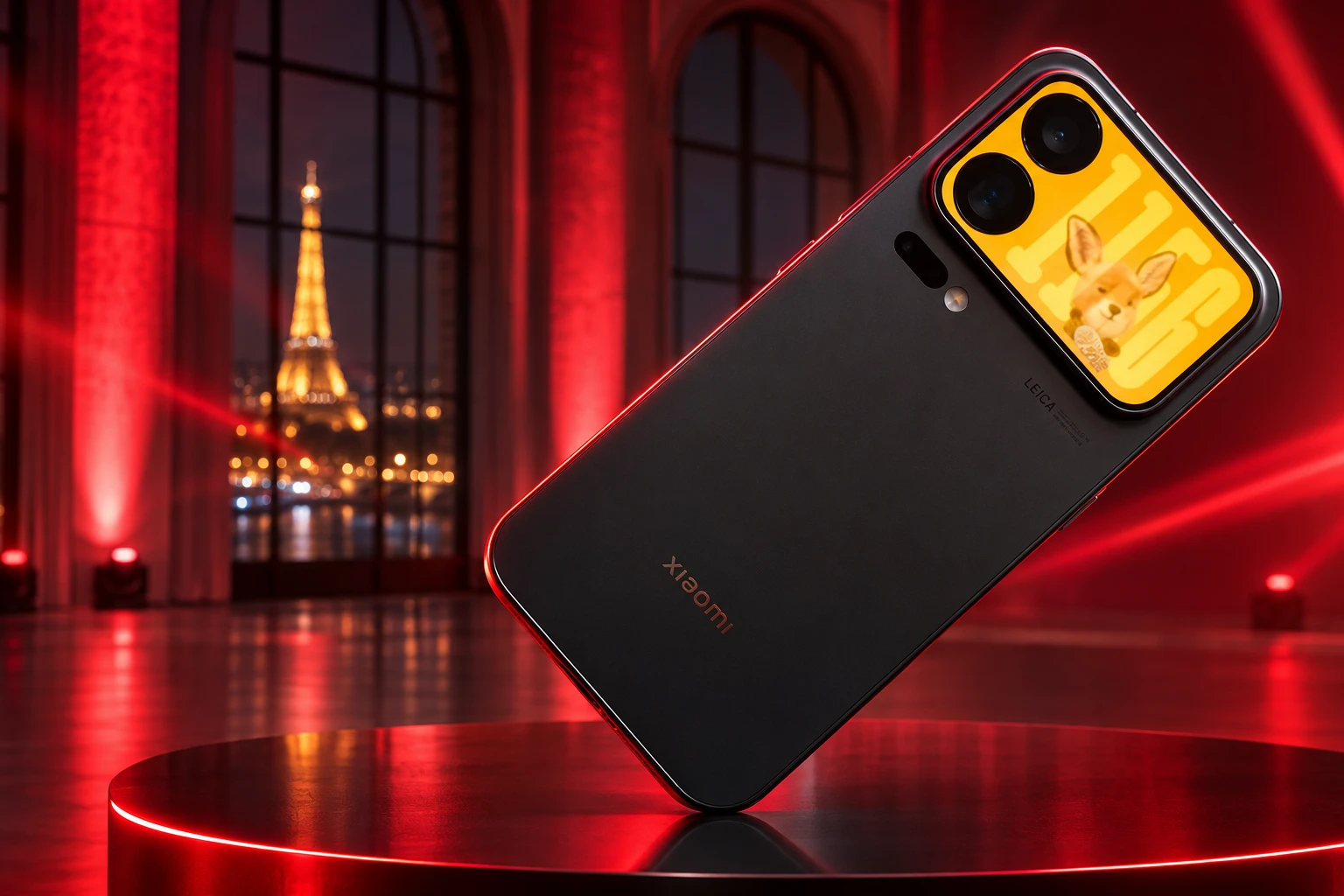
The pitch in Paris was not a faster chip. It was a second screen. Xiaomi’s global product page leads with an all-new Back Display, then the 6.4-inch privacy panel, then the cameras. The 18 Pro’s rear panel is 2.7 inches. The 18 Pro Max’s is 2.9 inches. Both are AMOLED, 1 to 120Hz, and rated at 4,000 nits peak, with Corning Gorilla Glass Victus 2 on the small pane.
Last year’s 17 Pro and 17 Pro Max used the same idea and never left China. This time Xiaomi is selling the twins as its international flagships, with HyperOS 4 on Android 17, an AI button on the frame, and a hardware privacy mode on the front glass. Jonathan Morrison, who spent the launch day with the company in Paris, said “the back display is pretty innovative,” while calling the cameras impressive.
WHAT THE BACK PANEL IS FOR
- Notifications: Incoming alerts, live activities, and pinned text or images sit on the rear glass without waking the front panel.
- Rear cameras: The small screen previews selfies, group shots, vlogs, and a photo-booth mode, including an open-palm countdown.
- Mini apps: A text prompt can build a lightweight tool or game for that panel, from a coin flip to a reaction test.
- Wallpapers: AI wallpapers and AI group photos are due by OTA from December 2026, with monthly generation limits.
The front panels are flat 120Hz LTPO OLEDs with 0.99mm bezels. The Pro is 6.4 inches at 2436 x 1120. The Pro Max is 6.9 inches at 2624 x 1208. Peak brightness is 4,000 nits on both. Colors for global units are White, Black, Velvet Red, and Cosmic Blue. China also sold Ice Peach Pink, Galaxy Blue, and a red transparent special edition that is not on the European sheet.
What the Xiaomi 18 Pro Costs in Europe
The 12GB and 256GB Xiaomi 18 Pro is €1,399. The 12GB and 512GB Pro is €1,599. The 18 Pro Max is €1,599 in 12GB and 256GB and €1,799 in 12GB and 512GB. The Pro stops at 12GB of RAM outside China. The Pro Max still offers a 16GB and 1TB configuration globally; Xiaomi did not read out a euro price for that SKU in the coverage of the Paris event.
In China on September 23, the same 12GB and 256GB Pro opened at 5,999 yuan. The 18 Pro Max opened at 6,999 yuan. Those yuan figures already sat 1,000 yuan, or 20 percent, above the 17 Pro’s 4,999 yuan launch price from September 2025. Xiaomi president Lu Weibing told the China audience that memory had been climbing for more than a year and a half and that forecasts ran into 2027. He told undecided buyers to move sooner.
CHINA LIST VS EUROPE LIST
| Configuration | China (yuan) | Europe (euros) |
|---|---|---|
| 18 Pro, 12GB + 256GB | 5,999 | 1,399 |
| 18 Pro, 12GB + 512GB | 6,999 | 1,599 |
| 18 Pro Max, 12GB + 256GB | 6,999 | 1,599 |
| 18 Pro Max, 12GB + 512GB | 7,999 | 1,799 |
China still sells 16GB and 512GB and 16GB and 1TB steps, at 7,999 and 8,999 yuan on the Pro and 8,999 and 9,999 yuan on the Max, plus transparent 16GB and 1TB editions at 9,999 and 10,999 yuan. Those extra rungs are the ones Europe mostly does not get. Import listings in late September already had a 12GB and 256GB China Pro from €857, which is the number official European buyers will keep measuring against the €1,399 tag.
The euro sheet does sit under some of the phones Xiaomi now has to beat. Samsung’s European store has the 256GB Galaxy S26 Ultra at €1,550 and the 512GB Ultra at €1,750 after an October rise tied to memory costs. The 12GB and 256GB 18 Pro undercuts that Ultra. The 12GB and 512GB 18 Pro Max, at €1,799, does not. Launch bundles include three months of Google AI Pro and YouTube Premium and four months of Spotify Premium, plus a short iQIYI pass. They do not close a 4,000-yuan-to-euro gap.
Global Units Lose About 1,450mAh
The international 18 Pro carries a 6,000mAh typical silicon-carbon cell. The international 18 Pro Max carries 7,050mAh. China sells a 7,000mAh silicon-carbon pack in China on the Pro and 8,500mAh on the Pro Max. That is 1,000mAh less on the smaller phone, about 14 percent, and 1,450mAh less on the larger one, about 17 percent. Wired charging on the global Pro falls from 100W to 90W. The Pro Max keeps 100W. Both still claim 50W wireless charging, plus reverse wired and reverse wireless.
THE CELL XIAOMI SHIPPED WEST
- 18 Pro: 6,000mAh typical globally, 7,000mAh in China, 90W wired on the export unit.
- 18 Pro Max: 7,050mAh globally, 8,500mAh in China, 100W wired in both markets.
- Silicon share: Xiaomi’s global account put the export cell at 28 percent silicon; the China product page puts the domestic cell at 32 percent.
- In the box: The global spec notes say no power adapter is included and recommend a 100W Xiaomi brick.
Xiaomi has not published a reason for the cut. The same split showed up on last year’s line, when the global Xiaomi 17 landed at 6,330mAh against 7,000mAh in China. Shipping rules for large lithium cells are the usual industry explanation, and Xiaomi has not confirmed it for these two phones. Under Lei Jun’s Paris photo dump, the first detailed objection was the 7,050mAh figure against the China pack. The rear screen is the feature Xiaomi flew to Paris to sell. The cell is what buyers checked second.
Two 200-Megapixel Cameras and an Extreme Chip
Both phones share a Leica triple. The main camera is a 200-megapixel Light Fusion 960 sensor, 1/1.28-inch, f/1.67, 23mm, with optical stabilisation. The telephoto is a second 200-megapixel sensor, 1/1.56-inch, f/2.4, 75mm, with 3.2x optical zoom, 12cm macro, and OIS. In-sensor steps are listed at 6.4x and 12.8x. The ultrawide is 50 megapixels, f/2.4, 102 degrees. The front camera is 50 megapixels. Xiaomi is selling Summilux glass, MgF₂ coating, and on-device looks that mimic CCD, monochrome film, and optical blur at 35mm and 75mm.
Qualcomm’s Snapdragon 8 Elite Gen 6 sits in the 18 Pro. The 18 Pro Max gets Snapdragon 8 Elite Extreme Gen 6. Both are 2nm parts with Oryon cores up to 5GHz. Qualcomm says the Extreme chip is 13 percent faster on CPU, 37 percent more efficient, and 44 percent faster on GPU than Snapdragon 8 Elite Gen 5. William Zeng, Xiaomi’s international president, said at the Snapdragon Summit on September 22 that the 18 Pro series would be first to those chips. Storage is UFS 4.1. Global RAM on the Pro is 12GB LPDDR5X only.
Other hardware is the usual flagship stack, with a few extras Xiaomi still treats as differentiators: an ultrasonic in-display fingerprint reader, an IR blaster, Bluetooth 6.0, dual nano-SIM, and IP66, IP68, and IP69 ratings. The Pro Max adds a third speaker. A customisable AI button can launch translation or a voice note. Offline Xiaomi-to-Xiaomi voice is listed as a limited-range extra, not an emergency radio.
Last Year’s Pro Twins Never Left China
The two-month talking point only works if last year’s Pro twins actually went abroad. They did not. Xiaomi put a rear screen on the 17 Pro and 17 Pro Max in Beijing, then built its international 17-series event around other models.
FROM BEIJING TO PARIS
- September 25, 2025: Xiaomi unveils the Xiaomi 17, 17 Pro, and 17 Pro Max in Beijing. The Pro starts at 4,999 yuan. The Pro Max starts at 5,999 yuan. Both have rear OLEDs.
- September 27, 2025: China sales open on mi.com and in Xiaomi stores.
- February 28, 2026: The international 17-series event in Barcelona puts the Xiaomi 17 and Xiaomi 17 Ultra on the global list. The 17 Pro and 17 Pro Max stay China-market phones.
- September 23, 2026: The 18 Pro and 18 Pro Max go on sale in China the night they are announced, from 5,999 and 6,999 yuan. Lu Weibing says the first batch sold out. The standard Xiaomi 18 is held for a later, separate launch.
- November 17, 2026: Xiaomi stages the international 18 Pro series at the Carrousel du Louvre in Paris and reads out euro prices. Sale dates are not attached.
The 17 Pro’s rear panel was treated as a China experiment. The 18 Pro’s rear panel is treated as the reason to fly journalists to Paris. That is the wager. It is also why the euro tags sting in a way a delayed vanilla flagship would not: Xiaomi is asking a Western list price for the exact form factor it previously declined to warranty, localise, or stock outside China.
A Paris Launch Without a Sale Date
Malaysia has already posted promotional pre-order prices, from RM3,999 for the 12GB and 256GB Pro, with that window running through November 26, 2026. Xiaomi has confirmed the 18 Pro for India without naming a day, and has not confirmed the Pro Max there. It has not announced a United States listing. European sale dates were still blank after the Louvre event.
WHAT WE KNOW
- The prices: Europe starts at €1,399 and €1,599 for the 12GB and 256GB Pro and Pro Max.
- The split: Global batteries are 6,000mAh and 7,050mAh; China keeps 7,000mAh and 8,500mAh.
- The SKUs: Global Pro is 12GB only, in 256GB and 512GB. The Pro Max adds a 16GB and 1TB option.
WHAT IS UNCONFIRMED
- Europe on sale: No country-by-country day was attached to the Paris event.
- India: The 18 Pro is confirmed, the Pro Max is not, and no rupee list exists yet.
- The United States: No listing, no FCC-style consumer page, no date.
Lei Jun posted a nine-photo recap from Paris on November 18 and thanked the team. He still did not add a sale day.
Xiaomi 18 Pro Series global launch. Here’s everything from Paris.
Proud of the team! pic.twitter.com/z9Covk9UrA— Lei Jun (@leijun) November 18, 2026
Xiaomi 18 Pro Series global launch. Here’s everything from Paris. Proud of the team!
Lei Jun, founder and CEO of Xiaomi, on X
The photos show the rear island, the small second panel, and the Velvet Red and Cosmic Blue glass Xiaomi flew in to prove the twins are no longer a China-only curiosity. Until a store puts a date on the drawer, that is all the global 18 Pro series is: a price list, a smaller cell, and a screen on the back that finally has an English product page.

One UI 9.5 Beta Puts the Galaxy S26 on Last Year’s Clock

DBS Puts a 24/7 USDC Window Inside the Bank

European Startups Head for $81 Billion as First Checks Shrink

US Stocks Lost $1.3 Trillion Before Nvidia’s Beat

Home Depot Bets on Finance Chief Richard McPhail as CEO

Aramco Crash Kills 14 Two Days After Oil Restart

Salah Captained Egypt to Their First World Cup Win

Zelda’s 40th Switch 2 Ships Without a Zelda Game

Apple Labor Day Deals Hide June’s Memory Price Hike

El Niño Puts Israel’s Needed Winter Rain on a Flood Clock
-
 BUSINESS5 months ago
Aramco Crash Kills 14 Two Days After Oil Restart
-
 NEWS6 months ago
Salah Captained Egypt to Their First World Cup Win
-
 GAMING2 months ago
Zelda’s 40th Switch 2 Ships Without a Zelda Game
-
 NEWS3 months ago
Apple Labor Day Deals Hide June’s Memory Price Hike
-
 NEWS4 months ago
El Niño Puts Israel’s Needed Winter Rain on a Flood Clock
-

 GAMING2 months ago
Palworld 1.0.4 Adds Palpedia Search After the 1.0 Launch
-

 NEWS4 months ago
Saudi Visa Routes Split Nigerian Travelers Into Two Speeds
-

 BUSINESS9 months ago
BAE’s 60-Year Saudi Franchise Now Runs Through Taif