
NEWS
European Startups Head for $81 Billion as First Checks Shrink
Atomico’s 2026 report puts European startup funding at $81 billion, but 13 giant rounds took 37 percent of the cash while first checks keep falling.

European startups are on track to raise $81 billion in 2026, 62 percent more than the $50 billion recorded in 2025 and the second-highest total Atomico has logged since 2015. The 12th full 2026 State of European Tech report, built with Dealroom data cut off on 30 September 2026, also counts about 40,000 new tech founders, a record. Thirteen rounds of $1 billion or more took 37 percent of the cash invested in those nine months, more than the prior four years combined.
Tom Wehmeier, partner and head of intelligence at Atomico, the London firm Skype co-founder Niklas Zennström built, said the ingredients are present and poorly aimed. “Nothing is missing, the capital, talent and demand are all here, but they’re locked or misallocated,” he said. “Our founders are flying into the wind.”
Thirteen Billion-Dollar Rounds Took 37 Percent
After three years stuck between $40 billion and $50 billion, the headline jumped. It still sits below 2021, when $94 billion went in during cheap-money years Atomico now treats as an outlier. The 2026 rebound is real, and it is narrow.
THE YEAR THE TOTAL MOVED
- The cheque: $81 billion is the full-year estimate, 62 percent above 2025 and second only to 2021.
- The split: Thirteen companies that raised $1 billion or more took 37 percent of money invested through 30 September 2026.
- The base: About 40,000 people founded a tech company in Europe in 2026, 36 percent more than about 29,000 in 2025.
- The mood: 46 percent of people Atomico surveyed feel more positive than they did 12 months earlier, with investors ahead of founders.
Wehmeier, presenting the figures in Helsinki, told interviewers the data “stopped being ambiguous some time ago” and that Europe has already built a world-class tech sector it refuses to trust. He also said concentration in financing has reached a level he has not seen before, and that the early stage is the part at risk of being neglected.
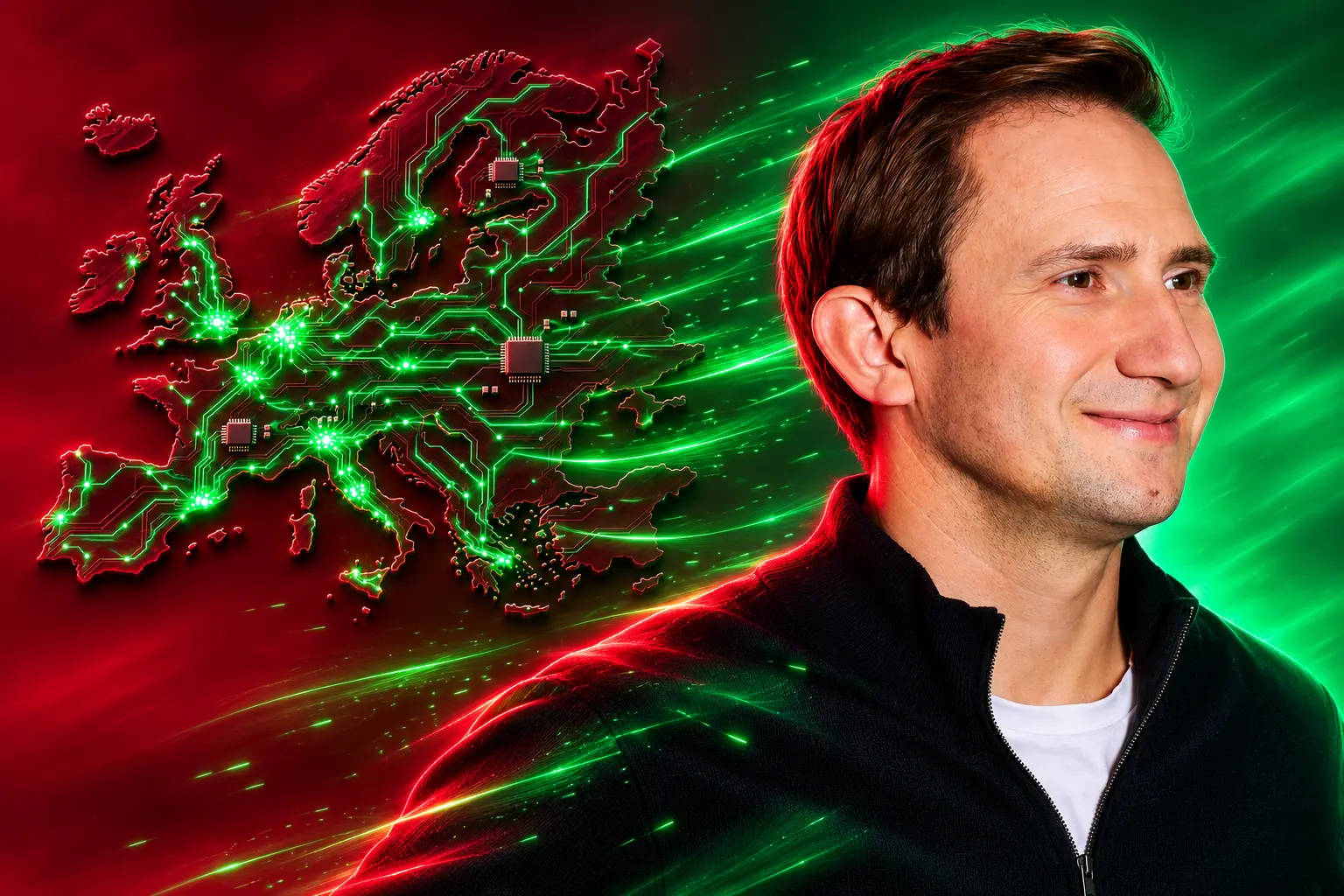
A Record 40,000 Founders Chase Fewer First Checks
Europe’s share of new tech founders worldwide is 29 percent in 2026, just ahead of the United States at 28 percent and Asia-Pacific at 24 percent. About 22,000 people started companies in 2024, so the two-year rise is 80 percent on Atomico’s count. Germany accounts for about 4,500 of the 2026 class, up 52 percent. The United Kingdom supplies almost 26 percent of Europe’s new founders, and London alone holds 27 percent of a $2.1 trillion private tech pool.
Atomico ties the founder surge to cheaper product tools. More than 60 percent of the new cohort are building alone. That is the opposite of what the funding market is doing. First-money-in rounds, pre-seed and seed, fell 28 percent between 2021 and 2025, and the 2026 run-rate points down again. Series A and Series B deal counts fell 19 percent over the same span.
The squeeze is not even. 68 percent of female founders say fundraising has got harder, against 44 percent of male founders. Founders and operators are the least upbeat group in Atomico’s survey, even as limited partners talk up the cycle. A record class is arriving in a market that has been withdrawing the first cheque for four years.
The Names Behind Europe’s $81 Billion Year
Compute, frontier models and defence did the heavy lifting. Among rounds of $100 million or more, compute and AI took 46 percent, led by Nscale, a UK infrastructure firm, at $5.4 billion, and by Paris-based Mistral AI. Defence raised a record $7.2 billion, and 48 percent of that went to three German companies: Helsing, STARK and Quantum Systems.
THE CHEQUES THAT BENT THE TOTAL
| Company | Base | Round | Amount |
|---|---|---|---|
| Nscale | United Kingdom | Compute financings | $5.4 billion |
| Mistral AI | France | Series D | €3 billion |
| Helsing | Germany | Series E | $1.8 billion |
| Neura Robotics | Germany | Growth round | $1.4 billion |
| Quantum Systems | Germany | Growth round | $1.1 billion |
| Ineffable Intelligence | Europe | Seed | $1.1 billion |
Mistral called the Series D the largest equity raise ever completed by a European technology company. Germany is on course for $13.4 billion in 2026, up 89 percent, second behind the United Kingdom at $31 billion and ahead of France at $12 billion. Helsing, Neura Robotics and Quantum Systems each cleared $1 billion in recent months, which is why a national total can jump on three names.
That is also how a rebound can look fat in the aggregate and still feel scarce on the ground, the same pattern as a rebound that has stayed thin even for companies that do get priced. Seed is no longer a broad on-ramp. Five companies took 43 percent of seed capital, including Ineffable Intelligence at $1.1 billion and AMI Labs at $1 billion.
Why First-Money-In Has Fallen 28 Percent
Median round sizes are up at every stage. The median European seed is $1.9 million and the median Series A is $14 million. The funds writing those checks have not grown with them. The median European venture firm is a $70 million vehicle, 29 percent below a $98 million peak in 2024, and the number of new funds has hovered around 100 a year for a decade.
WHERE THE MONEY STOPPED SPREADING
- Early stage: First-money-in rounds fell 28 percent between 2021 and 2025, with a further drop projected for 2026.
- A and B: Combined Series A and Series B counts fell 19 percent over the same years, so the middle of the ladder shrank too.
- Seed pile-up: Five rounds took 43 percent of seed capital, a US pattern Atomico says has now arrived in Europe.
- Series A pile-up: 55 percent of Series A capital sat in a handful of deals.
- Fund size: A $70 million median fund cannot lead the rounds the AI cycle now prices as standard.
Sara Rywe, a partner at ByFounders, warned in the report, “It feels like we are heading straight into a bubble,” pointing at rising round sizes and valuations. 47 percent of industry respondents called valuations inflated and expected a gradual reset; 21 percent expected a sharp one. Pete Sugden, a partner at the law firm Orrick, said the fall in early-stage financing points to a more selective market for new companies.
European managers still write local checks. a $400 million European AI fund is the kind of specialist pool that can stay with regional names when larger US vehicles skim the top. It is not a substitute for a wide seed market. Atomico’s own arithmetic is blunt: a record founder class is competing for a smaller set of first checks.
China Now Outinvests Europe in Venture Capital
In the first nine months of 2026, more venture money went into China than into Europe, reversing 2025. Compute and AI companies in China drew $35 billion; Europe more than doubled the same line to $20 billion from $9.5 billion and still trailed. US compute and AI startups raised $284 billion, 14 times the European figure. OpenAI and Anthropic took 61 percent of global AI funding.
THE GAP BEHIND THE $81 BILLION
| Measure | Europe | United States | China |
|---|---|---|---|
| 2026 startup funding | $81 billion (full-year estimate) | $450 billion (expected) | Ahead of Europe in first nine months |
| AI and compute funding | $20 billion | $284 billion | $35 billion |
| Share of world compute | 7 percent | 72 percent | Not stated |
| Pension share sent to VC | 0.006 percent a year | 0.028 percent a year | Not stated |
Europe’s slice of global venture has dropped from a 20 percent peak in 2022 to about 9.4 percent. US startups are expected to attract $450 billion in 2026, more than five times Europe’s $81 billion. Atomico’s line on the compute shortfall is practical rather than romantic: build more of the stack at home, and partner with trusted allies for the rest. Mistral, ElevenLabs and Black Forest Labs are the proof that model talent exists; 7 percent of world computing capacity is the constraint those labs still rent around.
On a like-for-like basis the companies do scale. Dealroom’s comparison, posted as Wehmeier spoke, shows that at the top end of capital raised, 89 percent reach a billion in Europe, against 92 percent in the United States, and that the curves track at every funding level. The report’s claim is not that European teams cannot build. It is that they are under-fired, then under-owned.
$13 Trillion in Pensions, $780 Million for Funds
European households hold $50 trillion in financial assets, including $17 trillion in cash and deposits. Wehmeier said only 0.01 percent of that savings stock flows into European venture to back homegrown companies. Shift 1 percent of the $50 trillion toward venture and Atomico’s sum is about $500 billion of extra fuel. That is a stock figure, not a budget Europe has passed.
The data on the European tech ecosystem stopped being ambiguous some time ago. We have built a world-class tech ecosystem; we just don’t let ourselves believe it. The value still to come from European tech is bigger than everything it has created so far. Nothing is missing, the capital, talent and demand are all here, but they’re locked or misallocated. Our founders are flying into the wind. It still works, but it doesn’t let you reach top speed.
Tom Wehmeier, partner and head of intelligence, Atomico
Pension math is tighter still. European pension funds hold $13 trillion and send $780 million a year into European venture funds, which is 0.006 percent of assets, against 0.028 percent in the United States. European insurers put 0.005 percent into venture; US insurers put 0.017 percent. UK Private Capital, the British industry body, noted European venture’s 18.5 percent ten-year net return while repeating Atomico’s 1 percent of assets thought experiment.
The private sector is already worth $4.4 trillion. More than 450 companies sit above $1 billion, 53 have crossed $10 billion, and Wehmeier said seven are worth more than $100 billion. In the first nine months, 58 European companies reached $1 billion for the first time, against 42 in all of 2025. Tech output is up 63 percent against 13 percent for the rest of the economy. The ownership problem is that European beneficiaries are not the main shareholders in that rise. Wehmeier’s test for the coming weeks is EU Inc, a planned single European company form meant to sit closer to a Delaware corporation, alongside a deeper capital-markets union.
The Case Against Flooding Venture Funds
The report’s invitation is to move the deepest capital pools off the sidelines. The better objection is that the same pools, poured into today’s fund shape, would buy more of the concentration the $81 billion already shows. Large institutions want size, fees they can explain, and an exit they can mark. They do not naturally seed a 40,000-founder class, and they do not fix a public market that still cannot absorb a young European listing.
The expensive gap is at both ends. Running a small European fund is heavy with admin and compliance, which thins the angel and microfund layer that, in the United States, does the discovery work. At the other end, the buyers who can take a company public with depth still sit in New York, which is why the breakout names keep looking there. Products that pull pension money into new tech listings would match how those institutions already invest, and would give founders a local finish line that a larger Series C fund cannot provide.
Atomico estimates that matching Europe’s share of global venture to its share of the world economy would take about $5 trillion over ten years. Black Forest Labs and Microagi, the report notes, have already reached $100 million in revenue in months rather than years. Agnès Seuret, head of startup investor managers for EMEA at AWS, said Europe is building at the frontier and that capital is following. The $780 million a year that pensions already commit, set against $13 trillion they hold, is the distance between those two sentences.
Disclaimer: This article is news reporting and analysis of Atomico’s State of European Tech 2026 figures and related public comments. It is informational only and is not investment advice, a solicitation, or a recommendation to commit capital to venture funds, startups, pensions, or listed technology shares. Readers who are considering an allocation should consult a licensed financial adviser or investment professional who can judge their own objectives, time horizon, and risk limits. The dollar totals, percentages, and full-year estimates reflect the sources as of 18 November 2026 and may be revised as 2026 closes and as later fundraising, listings, and currency moves come in.

One UI 9.5 Beta Puts the Galaxy S26 on Last Year’s Clock

DBS Puts a 24/7 USDC Window Inside the Bank

European Startups Head for $81 Billion as First Checks Shrink

US Stocks Lost $1.3 Trillion Before Nvidia’s Beat

Home Depot Bets on Finance Chief Richard McPhail as CEO

Aramco Crash Kills 14 Two Days After Oil Restart

Salah Captained Egypt to Their First World Cup Win

Zelda’s 40th Switch 2 Ships Without a Zelda Game

Apple Labor Day Deals Hide June’s Memory Price Hike

El Niño Puts Israel’s Needed Winter Rain on a Flood Clock
-
 BUSINESS5 months ago
Aramco Crash Kills 14 Two Days After Oil Restart
-
 NEWS6 months ago
Salah Captained Egypt to Their First World Cup Win
-
 GAMING2 months ago
Zelda’s 40th Switch 2 Ships Without a Zelda Game
-
 NEWS3 months ago
Apple Labor Day Deals Hide June’s Memory Price Hike
-
 NEWS4 months ago
El Niño Puts Israel’s Needed Winter Rain on a Flood Clock
-

 GAMING2 months ago
Palworld 1.0.4 Adds Palpedia Search After the 1.0 Launch
-

 NEWS4 months ago
Saudi Visa Routes Split Nigerian Travelers Into Two Speeds
-

 BUSINESS9 months ago
BAE’s 60-Year Saudi Franchise Now Runs Through Taif