
BUSINESS
US Stocks Lost $1.3 Trillion Before Nvidia’s Beat
US stocks wiped $1.3 trillion at Tuesday’s low as the Cboe VIX hit 25.46, then Nvidia reported $115.8 billion after the bell.

US stocks erased about $1.3 trillion at Tuesday’s low as the Cboe Volatility Index jumped to 25.46. The S&P 500 then closed at 7,340.53, down 1.03%, its weakest finish since July 29, hours before Nvidia reported.
The fear was supposed to be a chip event. It read more like a broad risk-off into a print that later beat, and into an NSA outage that officials tied to a software patch.
The Dow Dropped 1.64% Before Nvidia Spoke
The Dow Jones Industrial Average fell 848.75 points, or 1.64%, to 50,759.42 on Tuesday, November 17, 2026. At the worst of the session it was down more than 1,000 points, and it still finished as the heaviest of the three major averages.
The S&P 500 lost 76.06 points to 7,340.53. The Nasdaq Composite slipped 181.37 points, or 0.74%, to 24,328.38 after an intraday drop of about 2.1% that took it to its lowest level since April. The Russell 2000 fell 1.50% to 2,701.87. All 11 S&P 500 sectors closed lower. It was the S&P 500’s fourth straight decline and the first four-day losing streak for that index and the Nasdaq since September.
Those closes understate the hole at the lows, which is where the about $1.3 trillion paper-value figure comes from. The S&P 500 was down as much as 1.73% before buyers showed up into the bell. Oliver Pursche, senior vice president at Wealthspire Advisors, said every sector in the S&P was down.
TUESDAY’S INDEX CLOSES
| Index | Close | Point change | Percent |
|---|---|---|---|
| Dow Jones Industrial Average | 50,759.42 | -848.75 | -1.64% |
| S&P 500 | 7,340.53 | -76.06 | -1.03% |
| Nasdaq Composite | 24,328.38 | -181.37 | -0.74% |
| Russell 2000 | 2,701.87 | -41.07 | -1.50% |
| Cboe Volatility Index | 25.46 | +2.55 | +11.13% |
The 10-year Treasury yield eased to 5.102% as money moved toward assets treated as safer. Decliners led advancers by about three to one on the New York Stock Exchange, where 1,924 stocks fell and 700 rose.
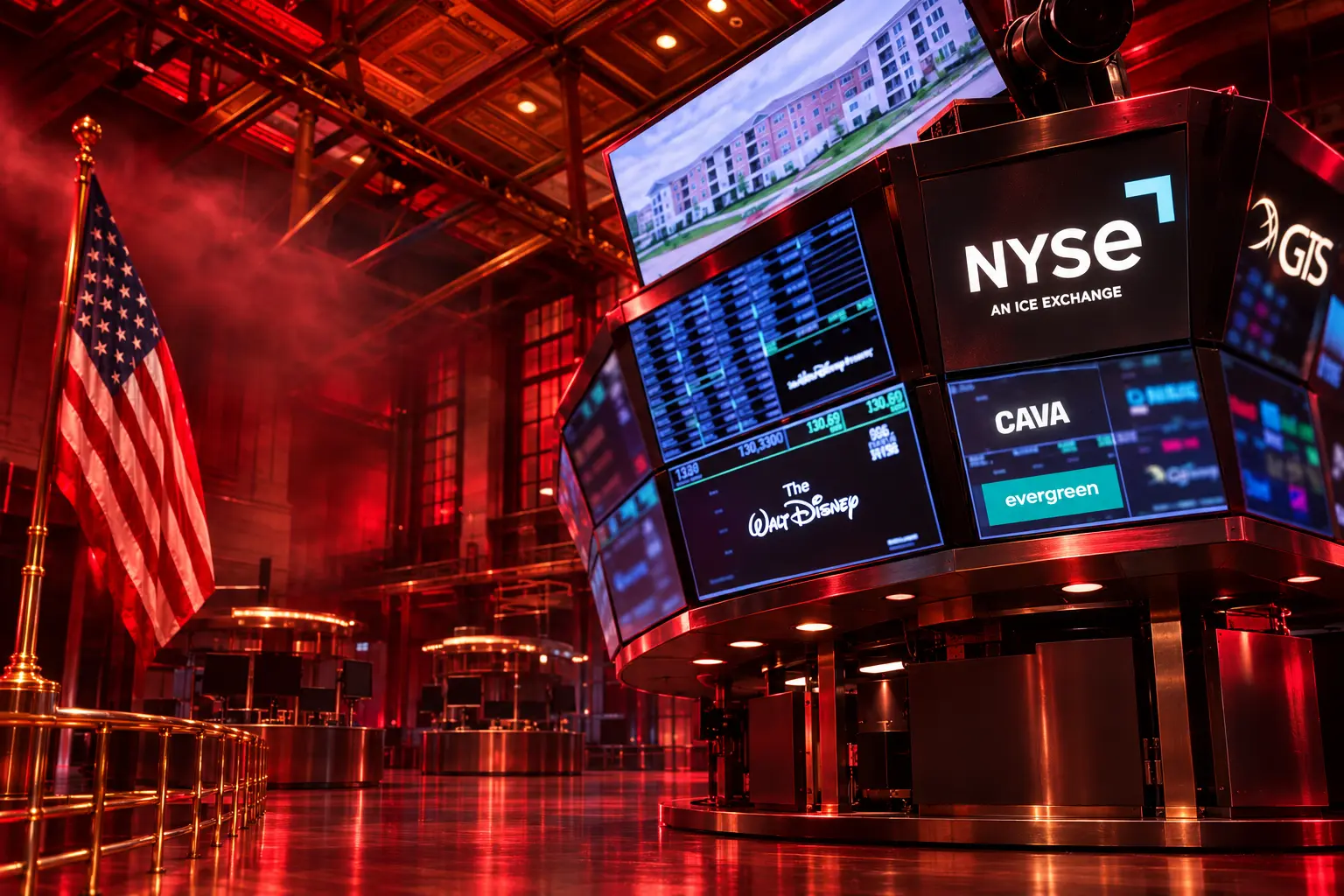
Software Sold Off Harder Than the Chip Stocks
The tape that produced that $1.3 trillion low was not a semiconductor collapse. The Dow’s 1.64% drop was more than twice the Nasdaq’s 0.74% decline, and Broadcom rose 2.46%. Nvidia itself closed at $155.46, down 0.44% from $156.14, after trading as low as $150.33.
Salesforce led the S&P 500 losers, closing down 9.45% at $194.52. Microsoft fell 2.27% and shed $87.26 billion of market value, the largest single-name loss of the session among large companies. Financials were the weakest sector, down 1.89%. Energy held up best and still fell 0.52%.
That mix matters because the week’s story had been written as an AI unwind into Nvidia’s first report since Jensen Huang resigned on November 12. Software and banks did more of Tuesday’s damage than the chip complex did. Alphabet’s two share classes lost a combined $87.81 billion. JPMorgan Chase dropped 2.44%.
Put buying in the SPDR S&P 500 ETF pushed the put-to-call volume ratio to 1.5, the highest since the first week of April. Dealer gamma on the S&P 500, modeled at about -$98.5 billion per 1% move, sat 248 points below its flip level near 7,589, a setup that tends to amplify swings in both directions until those options expire.
The VIX Peaked at 27.73, Then Closed 25.46
The Cboe Volatility Index closed at 25.46, up 2.55 points, or 11.13%, from Monday’s 22.91. During the session it ran as high as 27.73, about a 21% surge from the prior close, before fading into the bell. It was the fourth straight higher close for the index.
Cboe calculates the VIX from S&P 500 option prices as a 30-day forecast of expected swings, and a higher reading means traders are paying more for protection. At 25.46, that still sat well below the 52-week high of 35.30 and well above the 52-week low of 13.38. By 11:04 a.m. on Wednesday, November 18, the spot VIX had eased to 23.74, down 6.76% from Tuesday’s close, as Nvidia’s report filtered into the open.
THE VIX TAPE ON TUESDAY
- Spot close: 25.46, with an intraday high of 27.73 and a prior close of 22.91.
- One-day VIX: VIX1D jumped 7.06 points to 26.84, sitting above the 30-day index into the Nvidia reaction session.
- Curve: November VIX futures settled at 24.74, 8.30% above December’s 22.69, a front-month premium that expires on Wednesday morning.
- Skew: The Nov. 18 S&P 500 expiry priced 28.6% at-the-money volatility before the print, about 132 points of expected range for one session.
That front-end premium is the tell. Traders paid for a large Nvidia-day move, then got a beat that lifted the stock a few percent after hours. Some of Tuesday’s fear was event insurance, and some of it was a market already four days into a decline, sitting on its lowest S&P 500 close since late July.
What Nvidia Put on the Tape After Hours
Nvidia reported after the close for the quarter ended October 25, 2026, its first results under interim chief executive Colette Kress, who remains chief financial officer. The company posted revenue of $115.8 billion, up 103% from $57.0 billion a year earlier and up 20% from $96.2 billion in the prior quarter. LSEG’s consensus had been about $109.1 billion, a beat of roughly $6.7 billion.
NVIDIA’S THIRD-QUARTER SCORECARD
- Data center: $107.6 billion, up 110% from a year earlier and 21% from the prior quarter, or about 93% of sales.
- Edge computing: $8.2 billion, up 42% year over year and 14% from the prior quarter.
- Profit: GAAP net income of $65.3 billion, up 105% from $31.9 billion, with GAAP earnings of $2.70 a share and adjusted earnings of $2.68 against about $2.48 expected.
- Margins: GAAP gross margin 74.8% and non-GAAP 74.9%, with fourth-quarter margins guided to 71.0% to 72.0%.
The company said it expects fourth-quarter revenue of $130.0 billion, plus or minus 3%, a range of $126.1 billion to $133.9 billion, and it is not assuming any data center compute sales from China. That quarter includes an extra week. Kress also lifted the fiscal 2028 sales-growth outlook to about 75% from 70%. Vera Rubin NVL72 racks have shipped to CoreWeave, Google Cloud, Microsoft Azure, Oracle Cloud Infrastructure and Nebius, which Nvidia called the fastest product ramp in its history.
Our momentum is real. NVIDIA is an exceptional technology leader, powered by the relentless innovation of our people. Vera Rubin is off to an explosive start, our roadmap is on track and our ambition has never been greater.
Colette Kress, interim CEO and CFO, Nvidia third-quarter release
Shares rose as much as 4.81% in after-hours trading by 7:59 p.m. Eastern, then changed hands near $159.71 in Wednesday premarket, up 2.73% from the regular close. In September the board added $150 billion to the buyback limit, with no expiration. Nvidia returned $28.1 billion to shareholders in the quarter and had about $227.3 billion left on the authorization. The next cash dividend is $0.25 a share on December 23, to holders of record on December 2.
The leftover worry on the call was the margin guide, which steps down as memory costs rise, and the China assumption, which is now zero for data center compute. Demand, on Nvidia’s telling, did not blink during the leadership mess. The stock had already been through a violent reset from its October peak, and options into the report had priced an 8.5% move either way, a swing worth hundreds of billions of dollars in market value.
The NSA Outage Traced to a PHP Patch
Reports that NSA Net, the agency’s classified internal network, had gone down helped push stocks toward the session lows. The National Security Agency said the network had a “temporary degradation” during routine maintenance and that mission-critical systems stayed up. It said there was no evidence of a cyberattack.
Director of National Intelligence Jay Clayton, speaking on Fox Business, said officials did not see the signs of a coordinated or state-sponsored attack. He tied the NSA incident to patches for a PHP flaw that had been found with AI tools last month, a bug that could let someone take over servers remotely. “Everybody recognizes it’s time to upgrade their systems, and as they upgrade them, they’re not coming back as expected in all cases,” Clayton said.
The same stretch of days had already seen corporate email failures, grounded flights and a banking-system hitch. President Donald Trump’s administration called the picture fine. The market still treated a dark NSA network as a reason to sell, then learned the story was a patch window. That is a ugly way to price national-security risk, and it is also how a $1.3 trillion air pocket can open on a Tuesday that still had Nvidia’s numbers ahead of it.
Jensen Huang’s Offer Met a Closed Door
Huang resigned as president, chief executive and director on November 12, five days before the report, after disclosures about extramarital relationships, including one involving a woman U.S. officials have linked to Chinese intelligence. Beijing has denied those allegations. Nvidia has said it has no reason to believe company secrets were compromised. Kress took over as interim chief executive. Harvey Jones, the new board chair, opened the earnings call.
Earlier on Tuesday, Huang posted a statement saying he had failed to meet Nvidia’s standards, that he regretted the problems he created for the board, and that he would come back if asked.
If the Board of Directors decides that my return is in the best interest of our shareholders, our employees, the company, and America, I would be honored to answer these calls and return as CEO.
Jensen Huang, former Nvidia CEO, November 17 statement
Jones told analysts the board unanimously accepted the resignation and does not intend to bring Huang back. He said Huang’s personal conduct did not match the company’s code and that the search for a permanent chief executive would treat national security as a central test. The numbers on the release were a blowout. The governance answer was a locked door. Both things were on the tape the same night, which is why a 4% after-hours pop is not the same as a cleared risk.
Anthropic Still Must Price 825 Million Shares
The next test of whether Tuesday’s fear was only event premium sits one session later. Anthropic, the Claude maker, is due to set a final price on Wednesday, November 18, and to begin trading on the Nasdaq on Thursday, November 19, under the ticker ANT, subject to regulatory clearance. Its amended registration statement offers 825 million Class A shares at $70 to $78, a sale that would raise about $57.75 billion to $64.35 billion before a $26 billion private placement to AMD, Broadcom, Google, Micron, Microsoft, Nvidia and TSMC.
At $78, fully diluted value has been put near $1.4 trillion. Up to 20% of the offering is aimed at retail buyers, a much larger slice than the usual 5% to 10%. Goldman Sachs and Morgan Stanley are leading the books. People familiar with the process have said the company is guiding toward the top of the range or above, with some tickets of $10 billion or more in the book. Nvidia’s own release said it had expanded Anthropic’s access to Grace Blackwell and Vera Rubin capacity through cloud providers, so the chipmaker is both a supplier and a listed buyer of the stock.
That listing is the first large public AI name to price into a VIX that has just printed 25.46 and into an S&P 500 that has just closed at a four-month low. Anthropic’s planned Nasdaq debut as ANT was already a test of whether safety-branded AI can clear a trillion-dollar valuation. It is now also a test of whether Tuesday’s insurance buying was enough, or whether a 25-handle VIX still eats an IPO.
THE WEEK AROUND THE PRINT
- November 12, 2026: Jensen Huang resigns as Nvidia chief executive, and Colette Kress becomes interim CEO.
- November 16, 2026: The Nasdaq closes more than 10% below its October 6 high, a correction, with Nvidia at $156.14.
- November 17, 2026: Major indexes fall, the VIX closes at 25.46, and Nvidia reports $115.8 billion after the bell.
- November 18, 2026: Anthropic is due to price; FOMC minutes from the Oct. 27-28 meeting, when rates were held at 3.75% to 4.00%, are due at 2:00 p.m. Eastern.
- November 19, 2026: Anthropic Class A shares are due to start trading on Nasdaq as ANT.
Wednesday morning already showed the split. S&P 500 futures pointed a few tenths of a percent higher, Nasdaq futures did more of the work, and the VIX slipped toward 23.74. The Dow and the Russell were flatter. A beat repaired the chip tape faster than it repaired the rest of the market that actually led Tuesday’s drop.
The $1.3 trillion is not still missing from the close. It was the low. What remains is a VIX that has only partly given back a 27.73 spike, a software cohort that was hit much harder than Nvidia, and an IPO that still has to print a number into that tape.
Disclaimer: This article is news reporting and market analysis for information only. It is not investment advice, a recommendation to buy or sell any stock, option, IPO allocation or volatility product, and it is not a forecast of Nvidia, Anthropic or index returns. Readers should consult a licensed financial adviser, broker or other qualified investment professional who can consider their own objectives and risk limits before acting. Index levels, VIX readings, earnings figures and offering terms reflect the cited company releases, Cboe data and session reports as of the dates named above and will change as markets and filings update.

One UI 9.5 Beta Puts the Galaxy S26 on Last Year’s Clock

DBS Puts a 24/7 USDC Window Inside the Bank

European Startups Head for $81 Billion as First Checks Shrink

US Stocks Lost $1.3 Trillion Before Nvidia’s Beat

Home Depot Bets on Finance Chief Richard McPhail as CEO

Aramco Crash Kills 14 Two Days After Oil Restart

Salah Captained Egypt to Their First World Cup Win

Zelda’s 40th Switch 2 Ships Without a Zelda Game

Apple Labor Day Deals Hide June’s Memory Price Hike

El Niño Puts Israel’s Needed Winter Rain on a Flood Clock
-
 BUSINESS5 months ago
Aramco Crash Kills 14 Two Days After Oil Restart
-
 NEWS6 months ago
Salah Captained Egypt to Their First World Cup Win
-
 GAMING2 months ago
Zelda’s 40th Switch 2 Ships Without a Zelda Game
-
 NEWS3 months ago
Apple Labor Day Deals Hide June’s Memory Price Hike
-
 NEWS4 months ago
El Niño Puts Israel’s Needed Winter Rain on a Flood Clock
-

 GAMING2 months ago
Palworld 1.0.4 Adds Palpedia Search After the 1.0 Launch
-

 NEWS4 months ago
Saudi Visa Routes Split Nigerian Travelers Into Two Speeds
-

 BUSINESS9 months ago
BAE’s 60-Year Saudi Franchise Now Runs Through Taif