
BUSINESS
DBS Puts a 24/7 USDC Window Inside the Bank
DBS will let eligible firms mint and redeem USDC around the clock, wrapping Circle’s dollar token inside the bank hub treasurers said they wanted.

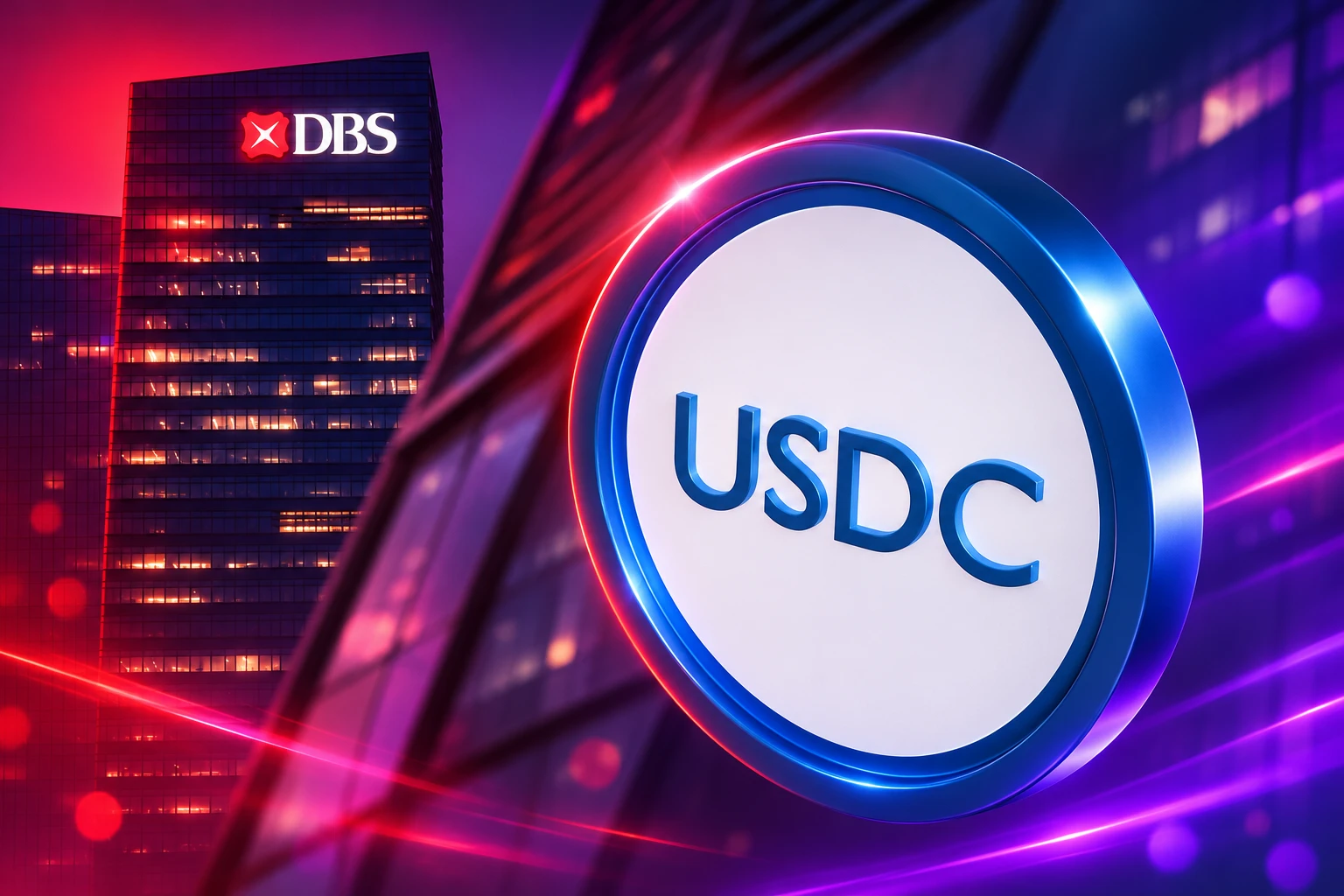
DBS will let eligible institutions mint and redeem USDC around the clock, with near-instant dollar settlement, under a deal with Circle dated 18 November 2026. The Singapore bank, which calls itself Southeast Asia’s largest by assets, is wrapping Circle’s dollar token inside its own books so those clients can move between US dollars and USDC without waiting on banking hours.
On 15 November 2026, DBS had dated a separate pipe for tokenised dollar deposits with JPMorgan’s Kinexys unit. The Circle window sits beside that rail, which is the product 64% of large-company finance chiefs in a DBS survey said they wanted: one bank as the way into tokenised money.
Eligible Clients Can Mint USDC Through DBS
Circle and DBS said eligible institutional clients can mint and redeem USDC through DBS, with 24/7 USD-USDC settlement when they do. The stated aim is to diversify reliance on secondary-market liquidity, the exchanges and brokers where USDC otherwise changes hands, and to support treasury, settlement and liquidity work outside cut-off times.
USDC stays an issue of Circle’s regulated affiliates. DBS supplies the banking relationship, the dollar liquidity and the mint and redeem channel. Neither party published a start date, a fee card, a chain list or a definition of eligible.
Circle, listed as CRCL, put the same terms on its account on 18 November 2026.
Circle 🤝 @dbsbank
We're expanding institutional USDC infrastructure in Asia Pacific, with direct issuance and redemption access, and 24/7 USD-USDC settlement for eligible clients.
Another milestone for institutional stablecoin adoption.https://t.co/oXe1EK9Ti1 pic.twitter.com/Nmin7jYEaM
— Circle (@circle) November 18, 2026
We believe the future of financial services will be multi-modal and multi-instrumental, with different forms of tokenized money serving different needs. By supporting USDC, alongside other trusted tokenized money instruments, we are providing institutions greater choice in how they move and manage value, based on what best serves their needs.
Evy Theunis, Head of Digital Assets, Institutional Banking Group, DBS
Kash Razzaghi, Circle’s chief commercial officer, said financial institutions want trusted ways to reach stablecoins and to plug blockchain rails into the operations they already run. He framed the DBS link as a step for USDC access across Asia and for the banking layer behind that access.
The practical shift is narrower than a new listing. A treasurer who can mint at par through the bank does not have to buy USDC in size on an exchange, where inventory, spreads and hours still bind. The bank keeps that flow next to cash, credit and the rest of the account.
What 64% of Finance Chiefs Want From a Bank
DBS released The Great Rewiring: Money in a new order on 28 October 2026. The study polled 422 business leaders across 11 markets, at firms with annual revenue above USD 500 million, in Australia, China, Germany, Hong Kong, India, Indonesia, Singapore, South Korea, Taiwan, the United Kingdom and the United States.
88% of those businesses were already deploying or piloting tokenised money. Stablecoins led the instrument mix. The same survey found that finance teams still trip on rules, data security, thin in-house skill and messy integrations, and that they want a bank to absorb that mess.
64% wanted banks to serve as a single point of integration into the tokenised-money stack. A separate 63% wanted help with pilots, proofs of concept and hook-ups. Lim Soon Chong, group head of global transaction services at DBS, said many new settlement networks are growing in parallel and that companies will need trusted anchors who can move value across them.
TOKENISED INSTRUMENTS IN THE DBS SURVEY
| Instrument | Share of respondents |
|---|---|
| Stablecoins | 63% |
| Tokenised deposits | 53% |
| Tokenised money market funds | 52% |
Those shares overlap; a firm can run more than one form. Expected gains within two years were led by auditability and traceability at 72%, then real-time cross-border payments at 71%, stronger internal controls at 66% and treasury liquidity at 65%. Some 78% said they had already spread settlement across more than one currency.
Han Kwee Juan, group head of institutional banking at DBS, said leaders have to rethink how they use tokenised tools, manage liquidity and build operating models that can take a shock. The Circle window is one answer to that brief: USDC arrives as a bank service, not as a separate fintech login a treasury team has to justify to risk and operations.
JPMorgan’s Tokenised Dollars Started on 15 November
The USDC channel is the second always-on dollar product DBS dated in four days. On 15 November 2026, DBS and Kinexys by J.P. Morgan said institutional clients could make instant USD transfers between blockchain accounts in the United States and Singapore, including weekends. That service links DBS Token Services with Kinexys’ Blockchain Deposit Account network. Partior handles settlement orchestration. DBS and Kinexys are founding shareholders of Partior.
Tokenised deposits are still bank money. They are deposits recorded on a permissioned chain, not a publicly issued stablecoin. Ant International is the first named client, using the link for treasury and liquidity across its entities in both markets. Ant had already worked with DBS on Treasury Tokens in 2024 and was an early Kinexys Blockchain Deposit Account user in Asia.
The 24/7 claim on that rail has a door that still closes. Transfers on the Kinexys Blockchain Deposit Account network run every day. Moving funds between traditional JPMorgan demand-deposit accounts and those blockchain accounts pauses from 3 p.m. to 6 p.m. Eastern Time every Saturday, a three-hour gap the banks said they are working to close.
THE 2026 DOLLAR RAILS AT DBS
- 5 September 2026: Completes a weekend USD payment with Citi’s New York office using tokenised deposits on the Swift Digital Ledger.
- 15 November 2026: Opens the Kinexys interoperability service for USD tokenised deposits between Singapore and the United States, with Ant International as the first client.
- 18 November 2026: Announces the Circle partnership for direct USDC minting and redemption with 24/7 USD-USDC settlement for eligible institutional clients.
DBS cited Asia outbound cross-border payments reaching USD 24 trillion by 2033, nearly double 2025 volumes of USD 13.5 trillion, from a Money20/20 and FXC Intelligence study dated April 2026. Rachel Chew, chief operating officer and co-head of digital assets in global transaction services at DBS, said tokenised money is moving from tests into live value and that clients will want optionality across instruments.
That optionality is the point of stacking USDC beside deposit tokens. One is Circle’s dollar, usable across public chains and the wider USDC network. The other is a DBS or JPMorgan liability that never leaves a permissioned bank network. A treasurer who holds both can match the instrument to the counterparty instead of running a second banking relationship to get a second form of money.
Singapore Already Had a Circle Mint Window
Direct USDC access in Singapore did not start with DBS. Circle Internet Singapore received a Major Payment Institution licence from the Monetary Authority of Singapore on 7 June 2023, covering digital payment token services and money transfers. In November 2023 Circle introduced Circle Mint in Singapore under that licence, aimed at customers with Singapore-registered entities.
Circle said then that fiat in a user’s bank account could convert to USDC instantly, depending on participating banks’ instant settlement networks, and that the product was meant to cut out brokers and resellers. The DBS deal does not say whether eligible clients still need a Circle Mint account, or whether the bank now sits in front of that mint as the only face the treasurer sees.
WHAT THE BANK WINDOW ADDS BESIDE MINT
- The 2023 channel: Circle Mint in Singapore gave licensed, entity-level issuance and redemption after the 7 June 2023 MPI licence, with conversion speed tied to the banks in that loop.
- The 2026 channel: DBS offers mint and redeem as a banking service, with the bank stating 24/7 USD-USDC settlement and a treasury, payments and liquidity wrapper around it.
- The open gap: The joint text never says who qualifies, what it costs, which chains are live, or whether Mint remains a separate login.
If the bank window works as written, the exchange is the venue a large client uses when it wants a price in the secondary market, not the venue it needs to get or cash USDC at par. Brokers who lived on that primary-adjacent flow lose the easy institutional ticket. Circle still issues the token. DBS owns the client file.
That is also why the deal can sit beside a rival product. DBS is not retiring tokenised deposits because it now mints USDC. It is selling both, which is the mix Theunis called multi-instrumental. Corporate desks that asked for one integration point get two dollar tokens through the same relationship, and they will have to decide which one to book when a supplier, a marketplace or an affiliate can take either.
MAS Lined Up Banks, Card Networks and Issuers
Circle’s statement ties the partnership to both firms’ seats in BLOOM, the MAS public-private project whose name stands for Borderless, Liquid, Open, Online, Multi-currency. MAS launched BLOOM on 16 October 2025 as a follow-on to Project Orchid, which had tested a digital Singapore dollar. The BLOOM page, updated 23 October 2026, says the work is to advance settlement using tokenised bank money and regulated stablecoins that meet regulatory expectations.
The design problem MAS names is bilateral sprawl. Each new token, chain and corridor now tends to need its own legal terms, technical hook-up and compliance pack. BLOOM’s bet is that shared operating arrangements cut that cost. On 23 October 2026, Bank Negara Malaysia and the Bank of Thailand joined as policymaker members, with the World Bank Group on the multilateral side.
Industry names on the MAS list include DBS, Circle, J.P. Morgan, OCBC, UOB, Standard Chartered, Visa, Mastercard, Stripe, Coinbase, Partior, StraitsX, Temasek and Ant International, among others. Workstreams cover acceptance and settlement across borders, how different digital-money arrangements connect, programmable controls such as identity checks and sanctions screening, and agentic payments that run inside pre-set limits.
DBS and Kinexys co-lead BLOOM’s token interoperability workgroup, the bank said in the 15 November 2026 deposit-token release. The Circle window is a commercial product, not a BLOOM trial write-up, but it uses the same pairing MAS has been convening: a large domestic bank and a regulated stablecoin issuer, sitting on one settlement map with card networks and other Singapore lenders.
Wholesale uses MAS lists for BLOOM include corporate treasury, trade finance and agentic payments, in G10 and Asian currencies, onshore and across borders. That is the same job DBS wrote onto the USDC term sheet. The central bank is not issuing USDC. It is the venue where the bank, the issuer and the other rails are supposed to agree how value hands off without a new contract every time.
Fees, Chains and Start Dates Stay Unsaid
The joint text is thin where operations live. It never names a go-live, a phased rollout, the countries inside “Asia,” account-opening rules, fees, size limits, the dollar settlement path or the blockchains on which minted USDC will land. It never says whether a client must already hold USDC somewhere else, or whether DBS will open wallets, custody and on-chain payment tools as part of the same package.
WHAT WE KNOW
- The service: Eligible institutional clients can mint and redeem USDC through DBS, with 24/7 USD-USDC settlement on those mint and redeem legs, per the 18 November 2026 statement.
- The issuer: Circle’s regulated affiliates remain the issuers of USDC; DBS is the banking and liquidity channel.
- The audience: The offer is limited to eligible institutional clients, not a retail USDC account at DBS.
- The stack: The same bank dated a Kinexys tokenised-deposit link on 15 November 2026 and a Circle mint window on 18 November 2026.
WHAT IS UNCONFIRMED
- Timing: No start date, sandbox or volume cap has been published.
- Access rules: Eligibility, onboarding, whether a Circle Mint account is still required, and which Asia markets are in scope remain unpublished.
- Pipes: Fees, limits, supported chains and how the dollar leg actually settles are not in the release.
Until those items land, the 24/7 claim is a product description, not a timetable. The Kinexys rail is already commercially live with a named client and a documented Saturday pause on the legacy-to-chain door. The USDC window is a press statement with the operational guts still inside the bank.
Ant International is already moving tokenised deposits on the JPMorgan link. The Circle window gives the same class of DBS client a second dollar instrument, still inside the bank, still gated to whoever DBS calls eligible. Which book those treasurers actually use, when both can settle outside ordinary hours, is the test the 18 November release does not run.
Disclaimer: This article is news reporting and analysis of a bank and stablecoin-issuer product announcement, and it is for information only. It is not investment, trading, legal or banking advice, and it is not a recommendation to buy, sell, mint, redeem or hold USDC, DBS shares, Circle shares or any other instrument. Readers who may use stablecoins, tokenised deposits or related banking services should consult a licensed financial adviser, treasury specialist or qualified legal counsel in their jurisdiction before acting. Figures, product terms, eligibility rules and live status reflect the company and regulator materials cited as of 18 November 2026 and can change without notice.

One UI 9.5 Beta Puts the Galaxy S26 on Last Year’s Clock

DBS Puts a 24/7 USDC Window Inside the Bank

European Startups Head for $81 Billion as First Checks Shrink

US Stocks Lost $1.3 Trillion Before Nvidia’s Beat

Home Depot Bets on Finance Chief Richard McPhail as CEO

Aramco Crash Kills 14 Two Days After Oil Restart

Salah Captained Egypt to Their First World Cup Win

Zelda’s 40th Switch 2 Ships Without a Zelda Game

Apple Labor Day Deals Hide June’s Memory Price Hike

El Niño Puts Israel’s Needed Winter Rain on a Flood Clock
-
 BUSINESS5 months ago
Aramco Crash Kills 14 Two Days After Oil Restart
-
 NEWS6 months ago
Salah Captained Egypt to Their First World Cup Win
-
 GAMING2 months ago
Zelda’s 40th Switch 2 Ships Without a Zelda Game
-
 NEWS3 months ago
Apple Labor Day Deals Hide June’s Memory Price Hike
-
 NEWS4 months ago
El Niño Puts Israel’s Needed Winter Rain on a Flood Clock
-

 GAMING2 months ago
Palworld 1.0.4 Adds Palpedia Search After the 1.0 Launch
-

 NEWS4 months ago
Saudi Visa Routes Split Nigerian Travelers Into Two Speeds
-

 BUSINESS9 months ago
BAE’s 60-Year Saudi Franchise Now Runs Through Taif