
BUSINESS
KPC and Aramco Put Steel Into the Disputed Durra Field
KPC and Aramco are awarding Durra gas packages on a field Iran still claims, locking contractors in before any maritime deal.

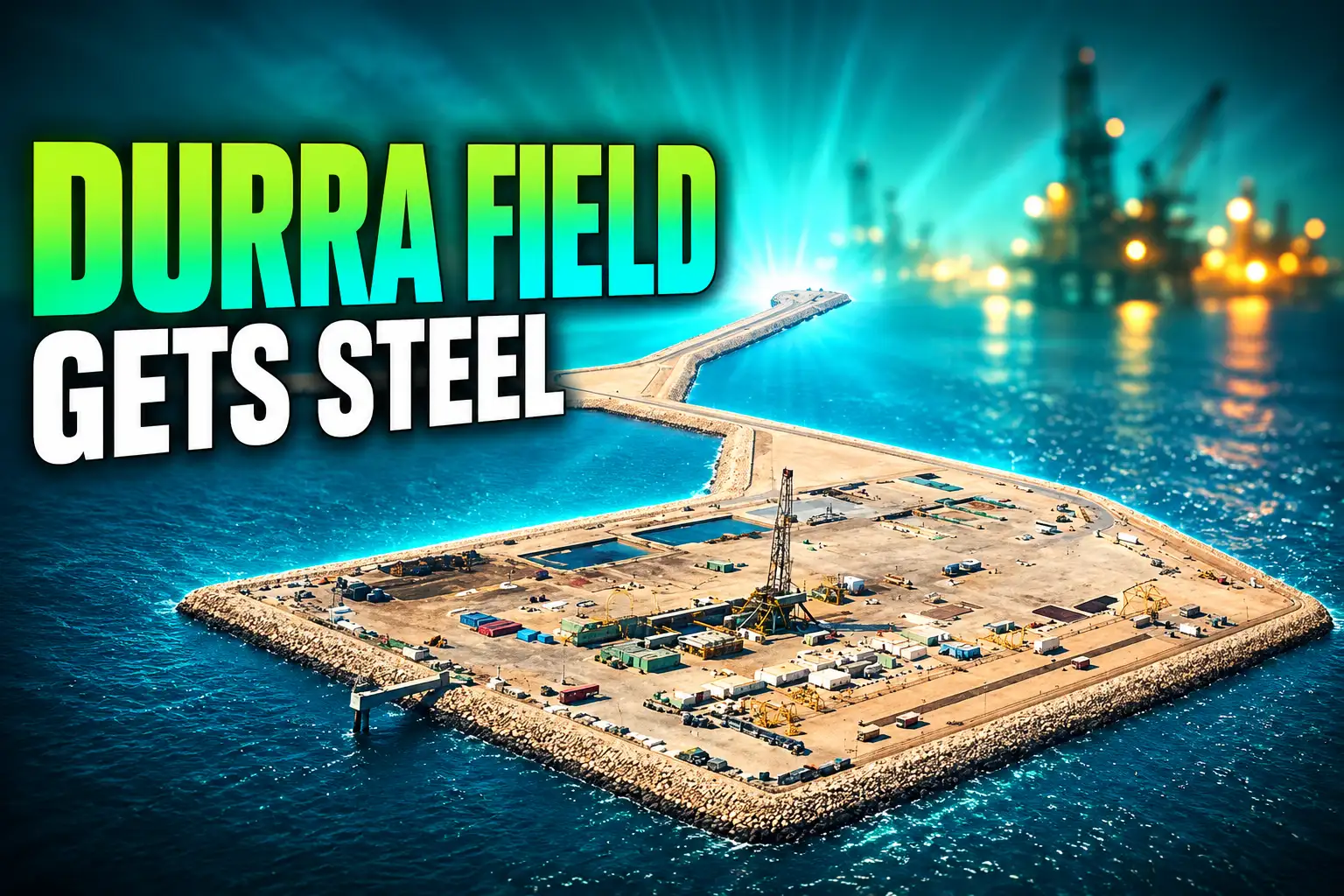
Khafji Joint Operations has already awarded the main steel packages on the Durra gas field, a reservoir Iran still claims. The job is no longer a study. Jackets, topsides, export lines and a plant at Khafji are under contract, while Kuwait’s larger onshore plant is still out to bid.
Kuwait Petroleum Corporation and Saudi Aramco, through their Divided Zone venture, are treating the field as theirs to build. Tehran still treats it as Arash, a shared pool. The wager is that contractors, once paid to cut steel, will finish the work before any maritime deal exists.
McDermott, Saipem and L&T Are Already on the Job
Al-Khafji Joint Operations, owned by Aramco Gulf Operations Company and Kuwait Gulf Oil Company, split Durra’s facilities into four engineering, procurement and construction packages. Three sit offshore. One sits onshore on the Saudi side at Khafji. Project records used by contractors put the four awards at about $6.7 billion.
India’s Larsen & Toubro Energy Hydrocarbon took the first offshore package in November 2025, seven jackets and the intra-field lines, at $140 million to $150 million. McDermott International took package 2A, wellhead topsides, flowlines and umbilicals, at about $1.5 billion. A Larsen & Toubro Energy Hydrocarbon and Saipem group took package 2B, the central gathering complex plus export pipelines and cables, at about $3.4 billion. Spain’s Técnicas Reunidas took onshore package 3, the Khafji gas plant, at about $1.65 billion.
THE FOUR KJO PACKAGES
| Package | Contractor | Scope | Value |
|---|---|---|---|
| Offshore 1 | Larsen & Toubro Energy Hydrocarbon | Seven jackets and intra-field pipelines | $140 million to $150 million |
| Offshore 2A | McDermott International | Wellhead topsides, flowlines, umbilicals | About $1.5 billion |
| Offshore 2B | L&T Energy Hydrocarbon and Saipem | Central gathering complex, export lines | About $3.4 billion |
| Onshore 3 | Técnicas Reunidas | Khafji gas plant and related kit | About $1.65 billion |
Those four jobs are the Saudi-Kuwait share of hardware at sea and at Khafji. They are not the Kuwait landfall. KGOC is running a separate plant next to the Al-Zour refinery for its own stream, and that contract has not been let.
The 2022 Pact Split Durra Down the Middle
On March 21, 2022, Saudi Energy Minister Prince Abdulaziz bin Salman and his Kuwaiti counterpart signed a plan to develop Durra and to house the work in Al-Khafji Joint Operations. A December 2022 memorandum between Aramco Gulf Operations and Kuwait Gulf Oil Company put that plan on a clock.
The design target is 1 billion cubic feet a day of gas and 84,000 barrels a day of condensate. Output is to be split 50/50. Separation is meant to happen at sea, so each side takes its own stream. Aramco Gulf Operations sends its gas, liquids and condensate to Khafji. KGOC sends its share to Al-Zour.
That landfall map is why there are two plants, not one. The Khafji award is the Saudi half of the bet. The Al-Zour tender is the Kuwaiti half. Neither document invited Iran to the table. Riyadh and Kuwait have instead kept a public call for Iran to negotiate the eastern boundary of the submerged divided area, as one side, and have refused to treat the reservoir as a three-way asset.
The entire Al-Durra offshore gas field lies within Kuwait’s territorial waters, and that all its natural resources fall solely within the Kuwaiti-Saudi Divided Submerged Zone.
Gulf Cooperation Council Supreme Council, 46th summit communique, Manama
The 46th GCC summit in Manama on December 3, 2025, repeated that line and said only Kuwait and Saudi Arabia have the right to exploit the field. Saudi state media had already put the same claim on the record in 2022 and 2023.
Foreign Ministry: Saudi Arabia, Kuwait Reaffirm Their Exclusive Joint Ownership of Natural Resources of Al-Durra Offshore Gas Fieldhttps://t.co/qdLpIpeRl8#SPAGOV pic.twitter.com/Y7XjhBgTHn
— SPAENG (@Spa_Eng) August 3, 2023
Tehran Still Calls the Field Arash
Iran’s name for the pool is Arash. Overlapping concessions in the 1960s, one granted by Iran and one by Kuwait, left the eastern edge of the Divided Zone without an agreed line. Kuwait and Saudi Arabia say the whole field sits inside Kuwait’s waters and inside their joint submerged zone. Iranian officials put Tehran’s share at about 40 percent and say GCC statements do not create title.
Esmaeil Baghaei, the Iranian foreign ministry spokesman, dismissed Kuwait’s unilateral claim in December 2025 and said only trilateral talks, with a formal maritime line, can fix each side’s share. The ministry’s line in 2025 was that a lasting deal needs bilateral talks and joint work, and that repeated GCC language does not grant Kuwait legal rights. IRGC-linked officials have used the same 40 percent figure.
WHERE THE CLAIMS SPLIT
- Kuwait and Saudi Arabia: The field lies entirely in Kuwait’s maritime area; resources in the partitioned submerged zone belong only to the two of them, 50/50.
- The GCC: No other party has a legitimate basis on Al-Durra or the Divided Zone, a position restated at Manama in December 2025.
- Iran: Arash is a shared reservoir, about 40 percent of it in Iranian waters, and work without Tehran is invalid.
The talks that exist are not about a three-way split of molecules. Riyadh and Kuwait will discuss an eastern line on a chart. They will not put Durra itself up for division. That is the trap for any contractor: the client is a joint venture with a signed 50/50 deal, and the neighbour still says the deal is illegal.
Why Kuwait Keeps Buying LNG
Kuwait needs Durra because it already buys gas. The Al-Zour import terminal, with eight tanks of 225,000 cubic metres each and 1.8 million cubic metres of storage, is built to take 22 million tons of LNG a year and to feed power and water plants when summer load spikes. The oil ministry has said the tanks can cover about 12 days of supply if ships stop arriving.
Most of Kuwait’s own gas still comes up with crude. When oil output is cut, the gas goes with it. The Washington-based Energy Research Unit put July 2026 LNG receipts at 803,000 tons, the highest month since fighting in the Gulf disrupted shipping after February 28, 2026. Durra is non-associated gas. If it flows, Kuwait gets a stream that does not rise and fall with an oil cut.
AL-ZOUR AND THE GAS MATH
- Field target: 1 billion cubic feet a day of gas, split equally, plus 84,000 barrels a day of condensate.
- Kuwait plant: 632 million cubic feet a day of treating capacity at Al-Zour, sized above a strict half share.
- Import buffer: 22 million tons a year of LNG receiving capacity at the same industrial strip.
- First gas: 2029, on the timeline Global Energy Monitor still carries for the field.
The 632 million cubic feet a day figure is plant capacity, not Kuwait’s 50 percent slice of the 1 billion cubic feet. The extra room is how operators size a new works for swell, liquids and a later tie-in. It is also a reminder that Kuwait is building as if Durra will actually land.
Four New Jack-Ups for the Divided Zone
The steel bet now includes rigs. Arabian Drilling told the Saudi Exchange on September 29, 2026, that it had signed a four-year deal with Khafji Joint Operations the day before for four jack-up rigs worth about SAR 2 billion (about $533 million). The company said it is the largest single offshore drilling award it has had from KJO and that it lifts the number of its rigs serving the venture by 200 percent. Revenue is due from the end of the fourth quarter of 2026. The backlog after the award is about SAR 18 billion.
KJO’s offshore patch is not Durra alone. It already runs Khafji, Hout and Lulu. The four jack-ups are written as support for that whole offshore program. They still change the picture at Durra, because a field that needs wells needs rigs in the same water, and KJO has now booked them through 2030.
The Al-Zour Plant Is Still Out to Bid
The piece of Durra that still matches the old “tender about to float” line is Kuwait’s onshore plant. KGOC issued that tender on August 23, 2026, at an estimated $3.3 billion, with bids due December 29 and a contractor meeting on September 14. The works sit on a 700,000-square-metre plot beside the Al-Zour refinery, owned by KPC’s Kuwait Integrated Petroleum Industries Company, and are designed to take 632 million cubic feet a day from the offshore line. Technip Energies completed the front-end engineering; project records say that work paused during the Gulf fighting and then resumed.
Industry notes also say KGOC has already let site preparation to Ahmadiah Contracting & Trading, so the plot is not sitting idle while the main bid runs. If the plant is awarded on the posted calendar, it would be Kuwait’s largest tender by value since 2015.
FIRMS THAT RAISED THEIR HANDS
- Samsung E&A: South Korean engineer on the February interest list.
- Larsen & Toubro: Already on the offshore packages through its hydrocarbon unit.
- Técnicas Reunidas: Already holding the Khafji onshore package for KJO.
- Saipem: Already paired with L&T on offshore package 2B.
- Hyundai Engineering & Construction and Hyundai Engineering: Two Korean bids, same group, separate units.
- JGC: Japanese engineer on the same February list.
Several of those names are already inside the KJO awards. That overlap is the point of the wager. A group that is welding jackets for Khafji Joint Operations has a reason to stay friendly with KGOC on the Kuwait plant, and a reason not to walk if Iranian statements get louder.
First Gas Is Aimed at 2029
Global Energy Monitor still carries Durra as in development, discovered in 1967, owned 50/50 by Kuwait Gulf Oil Company and Aramco’s Gulf unit, with first production aimed at 2029. Its 1P gas figure is 566 billion cubic metres, about 20 trillion cubic feet of gas, plus 300 million barrels of oil. Those barrels are a side stream. The prize the two states keep citing is the gas, because both have domestic burn they would rather not cover with imported LNG or with crude in power plants.
HOW DURRA GOT THIS FAR
- 1967: Field discovered on the unsettled eastern edge of the Kuwait-Saudi Divided Zone, with older overlapping concessions already on the books.
- March 21, 2022: Saudi and Kuwaiti energy ministers sign the Durra development plan and confirm Al-Khafji Joint Operations as the vehicle.
- December 2022: Aramco Gulf Operations and Kuwait Gulf Oil Company sign the memorandum to build, 50/50, with separate landfalls at Khafji and Al-Zour.
- September 2023: Technip Energies is selected for pre-feed and feed on the offshore development, updating a design more than a decade old.
- November 2025: Larsen & Toubro Energy Hydrocarbon is awarded the seven jackets.
- August 2026: McDermott, the L&T-Saipem group and Técnicas Reunidas are named on the remaining KJO packages; KGOC tenders the $3.3 billion Al-Zour plant on August 23.
- September 28, 2026: Arabian Drilling signs the four-year jack-up contract with KJO.
The original feed for Durra was done more than a decade ago and then went cold, in part because Riyadh and Kuwait spent years arguing about the Divided Zone itself. The 2022 papers closed that argument between the two of them. They did not close it with Iran. Awarding jackets and booking jack-ups is how they are trying to close it in practice.
Bids on the Al-Zour plant are due December 29, 2026. If those bids hold and the jackets move on the KJO clock, first gas is still the 2029 date in the field record. Iran has not signed a paper that says it agrees.

Christa Pike Survived the Execution Tennessee Would Not Pause

Musk’s Oligarch Charge Hits a Queue of Three

Circle Puts USDC and EURC Into SAP Pay Workflows

Ring’s First Smart Lock Skips Home Wi-Fi for Sidewalk

GTA 6 Puts Cash Back on the Story Path

Salah Captained Egypt to Their First World Cup Win

Aramco Crash Kills 14 Two Days After Oil Restart

Apple Labor Day Deals Hide June’s Memory Price Hike

Zelda’s 40th Switch 2 Ships Without a Zelda Game

Palworld 1.0.4 Adds Palpedia Search After the 1.0 Launch
-
 NEWS5 months ago
Salah Captained Egypt to Their First World Cup Win
-
 BUSINESS4 months ago
Aramco Crash Kills 14 Two Days After Oil Restart
-
 NEWS2 months ago
Apple Labor Day Deals Hide June’s Memory Price Hike
-
 GAMING1 month ago
Zelda’s 40th Switch 2 Ships Without a Zelda Game
-
 GAMING1 month ago
Palworld 1.0.4 Adds Palpedia Search After the 1.0 Launch
-

 NEWS3 months ago
El Niño Puts Israel’s Needed Winter Rain on a Flood Clock
-

 ENTERTAINMENT1 month ago
King Charles Letter Keeps Harry and Meghan as Private Citizens
-

 ENTERTAINMENT4 months ago
A Thousand and One Drops Off Riyadh’s October Calendar