
NEWS
Embalmers at Oxyrhynchus Sealed Homer Onto a Roman Mummy
A Book II Iliad scrap on a Roman mummy at Al Bahnasa sits in a line of 20 sealed packets, evidence Homer was workshop paper in Egypt.

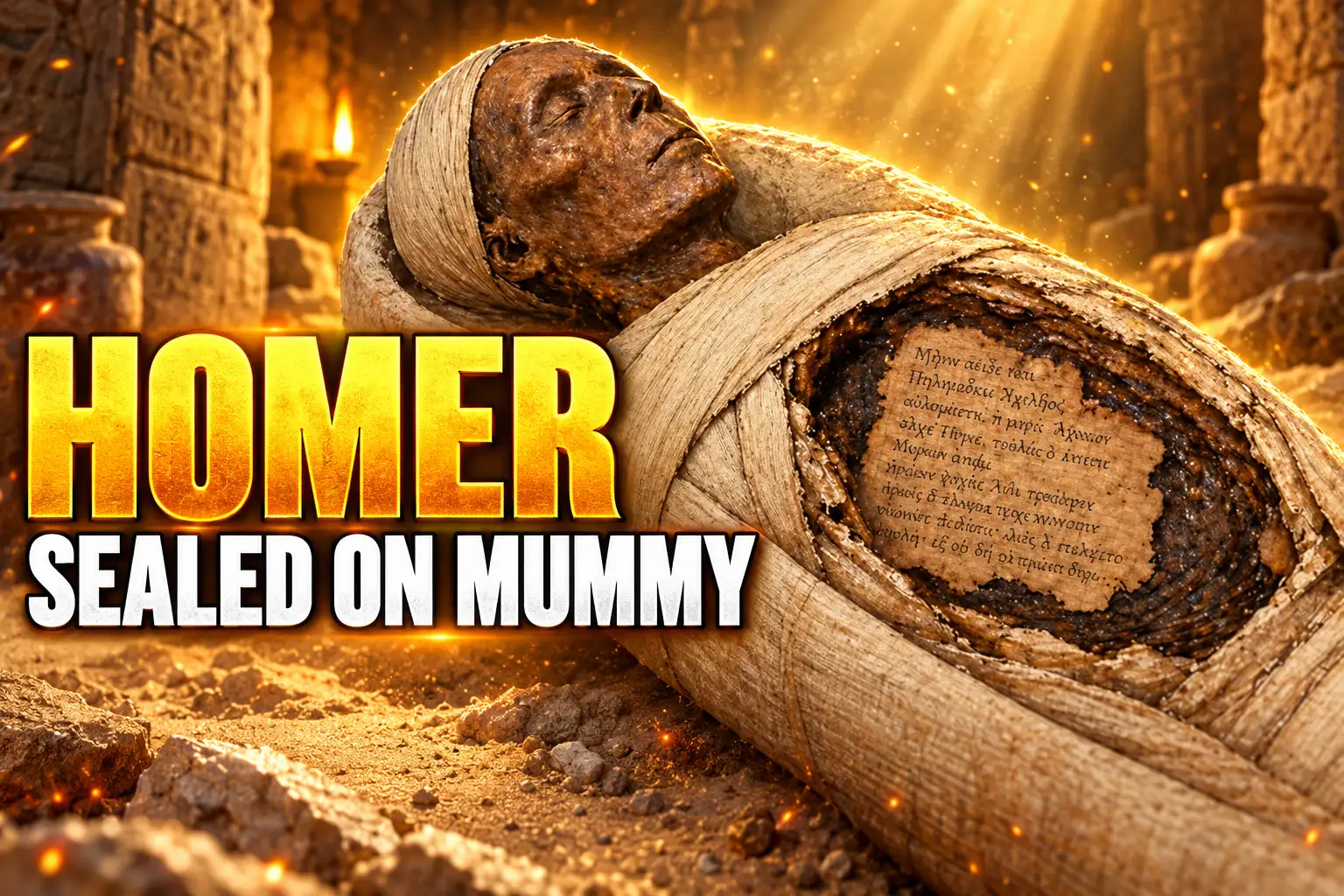
A papyrus from Homer’s Iliad lay on a Roman mummy’s abdomen in Tomb 65 at Al Bahnasa, Egypt. The University of Barcelona’s Oxyrhynchus team dated the burial to about 1,600 years and read the broken Greek as Book II’s Catalogue of Ships.
The excavators called the scrap the first Greek literary text built into embalming. Homer already filled classrooms in that city, and a local workshop had been sealing Greek paperwork onto bodies in clay.
A Papyrus on the Abdomen in Tomb 65
Núria Castellano’s crew opened the grave in the High Necropolis during the November and December 2025 season. The mummy was Roman. Other bodies in the same complex wore gold leaf or geometric wraps. This one had a papyrus packet on the belly, under the outer linen, as part of the last stage of wrapping.
That placement is easy to oversell. The sheet was not stuffed into the body. It sat where Egyptian amulets often sat, on the torso, then the bandages went over it. Conservator Margalida Munar, papyrologist Leah Mascia, and Ignasi-Xavier Adiego, a classical philologist at the University of Barcelona who directs the Oxyrhynchus project, took the pieces into the lab in January and February 2026. Mascia picked words out under a microscope. Adiego matched them to Homer. The university described the result as the first Greek literary text in a mummy used on purpose in embalming.
FROM DIG TO READING
- November and December 2025: Castellano’s team finds the mummy and papyrus in Tomb 65 of Sector 22.
- January and February 2026: Munar, Mascia, and Adiego clean and read the broken sheet.
- April 20, 2026: The University of Barcelona names the text as the Catalogue of Ships from Book II of the Iliad.
Al Bahnasa sits about 190 kilometers south of Cairo on the site of ancient Oxyrhynchus, a major Greek and Roman city. The mission, run by the Institute of Ancient Near East Studies, is led in the field by Maite Mascort and Esther Pons. Hassan Amer of Cairo University has directed excavation on the Egyptian side. Hisham El-Leithy, then acting secretary-general of the Supreme Council of Antiquities, said the cemetery adds to what is known of burial custom there in the Greek and Roman periods.
Embalmers Already Ran a Line of Sealed Packets
The Homer sheet did not arrive alone. Mascia’s group has been lifting the same kind of object from Roman mummies at the site for years: folded packets, tied, then closed with clay stamps that she reads as embalmers’ seals, some with hieroglyphs. They sit on chest and pelvis as well as abdomen, and they were made with matching technique, which points to a workshop, not a family heirloom packed at home.
Mascort and Pons have said they treat those packets as protection for the dead. Until this reading, the readable ones were magic or ritual Greek. Adiego put the shift in one line.
This is not the first time we have found Greek papyri, bundled, sealed, and incorporated into the mummification process, but until now, their content was mainly magical.
Ignasi-Xavier Adiego, classical philologist, University of Barcelona statement
Mascia’s write-up at the Centre for the Study of Manuscript Cultures lists a corpus of 20 sealed papyri, most of them in pieces. She has not assigned a function to the whole set. She has said only a full reading of every packet will do that. The mix already on the table is wide.
WHAT THE PACKETS HOLD
- Magic sheets: Greco-Egyptian spells, the type the mission had already logged on other bodies.
- Office paper: Greek and Demotic documents, the everyday files of a Greek-speaking town.
- Literary scraps: in at least this case, broken lines from the Iliad.
For an early Roman burial in Egypt, the expected books are still the Book of the Dead or the Book of Breathing. These packets do not follow that script. They look like a local substitute assembled in the wrapping room from whatever Greek paper was on the bench.
Homer Was Schoolwork in Roman Egypt
A new Homer fragment at Oxyrhynchus is not, by itself, news. Mascia told interviewers the Iliad moved through all of Egypt in the Greek and Roman centuries, in schools and in private hands. Finding a copy in this city is ordinary. Finding one sealed onto a corpse is what the team is still turning over.
Refuse mounds at the site have been famous since Bernard Grenfell and Arthur Hunt started digging them in 1896. Most of what they pulled was tax lists, leases, letters, and receipts. The literary share is smaller, and Homer dominates that share. Graeme D. Bird, working through papyri with a known find-spot, counted 200 Iliad papyri from Oxyrhynchus, the highest site total in his table. Across Egypt he put the Iliad corpus at more than 1,500 ancient copies, a pile no other Greek author matches.
Book II was already a teaching text. School copies and word lists for that book turn up in the Oxyrhynchus lots beside library-grade rolls. A ship catalogue is exactly the kind of passage a student copied, then left behind. In a town that treated Homer as homework, a damaged roll could migrate from a classroom to an embalmer’s tray without anyone thinking they had buried a masterpiece.
Greek had been the language of government since Alexander took Egypt in 332 BCE. Rome annexed the province in 30 BCE. By the date the Barcelona team gives this tomb, Greek verse had had centuries to become cheap, copied, and disposable. The dump already proved that. The sealed packets show the same paper stream reaching the dead.
What Does the Catalogue of Ships List?
The passage the lab named is the long roll call of Greek contingents sailing for Troy, the Catalogue of Ships in Book II. In the poem the narrator asks the Muses for the names, then recites leaders, places, and ship counts. Guneus, in that list, comes “with two and twenty ships from Cyphus.” Tlepolemus, “son of Hercules,” brings nine ships from Rhodes. Those lines illustrate the passage. The Barcelona team has not issued the exact verses that survive on this scrap.
Adiego said the usable bits sit in one tight stretch of that catalogue. Mascia described the copy as highly incomplete, with only parts of words recoverable. That is a poor page, not a display roll. It is also the sort of fragment a workshop could spare.
Mascort and Pons have said they are still testing hypotheses and do not treat the dead person as a Homer fan by default. One reading is amulet-like protection, the same job the magic packets already did. Another is reuse: a discarded Iliad sheet pressed into the same clay-sealed format as the rest of the line. The team has not chosen.
FUNERARY TEXT, EXPECTED AND FOUND
| What a Roman burial in Egypt usually carries | What these Oxyrhynchus packets carry |
|---|---|
| Book of the Dead spells | Greco-Egyptian magical papyri |
| Book of Breathing | Greek and Demotic office documents |
| Named funerary formulas in Egyptian | In this case, broken Iliad lines from Book II |
The table is Mascia’s contrast, not a claim that Homer replaced Osiris. The packets still sit in an Egyptian grave, with Egyptian seals, on a wrapped body. The Greek is the surprise inside a rite that otherwise looks local.
Gold Tongues in the Same Limestone Rooms
The Iliad mummy came out of a funerary complex of three limestone chambers and wooden sarcophagi, many of them smashed by older looting. Mohamed Abdel Badie of the Supreme Council of Antiquities described a trench of three rooms east of Ptolemaic tomb 67, a structure first recorded in 2024. Tomb 65 is in that group. Amer said gold and copper tongues found with the Roman mummies match written accounts of the custom.
Those tongues are thin metal foils placed in the mouth so the dead could speak to Osiris. The same necropolis had already produced them. In the 2024 season the mission recorded 13 golden tongues among 52 mummies, a separate haul that should not be folded into Tomb 65. This later cemetery added more gold and copper tongues, plus painted wood coffins and geometric linen, beside the papyrus packets.
The two kits do different jobs. A gold tongue is a voice for the next world. A sealed packet is a written object strapped to the torso. Putting Homer in the second kit does not make the dead person a reciter of epic. It puts Greek school-paper into a wrapping sequence that already used writing as hardware.
Support for the 2025-2026 season came from Spain’s Ministry of Culture, the university, the Palarq Foundation, the Catalan Egyptology Society, and AIXA Serveis Arqueològics, with the Supreme Council of Antiquities and Cairo University as Egyptian partners. The mission has worked at Al Bahnasa since 1992.
Papyrologists Already Knew Homer Could Ride With the Dead
The “first ever” line travelled farther than the lab notes. Ian Moyer, a historian of Egypt at the University of Michigan, answered a campus Q&A in May 2026 with a correction. Some papyrologists, he said, had already pointed out that, despite the excavators’ announcement, this is not really the first time a text of the Iliad was found intentionally buried with a mummy. He also cut the “inside the tummy” versions. The sheet sat on the body, under outer wraps, which is how protective amulets were placed.
Moyer’s caution fits the older cartonnage record. In Ptolemaic Egypt, discarded papyri, including literary rolls, were glued into mummy cases. That industry fades in the Roman period. What Oxyrhynchus shows instead is a later, neater product: small sealed packets laid on the corpse, not a whole cartonage shell boiled down from books. The Barcelona find sits in that second practice. Calling it the first literary text in embalming is the team’s claim. Other readers of mummy paper already had Iliad in graves, just in a different format.
WHERE EXPERTS DISAGREE
- The excavators: Mascort, Pons, and Adiego present this as the first Greek literary work deliberately placed in the wrapping process; earlier packets at the site were magic.
- Leah Mascia: An Iliad copy in Oxyrhynchus is not unusual; the oddity is a literary sheet in a funerary packet, and even that reading is preliminary.
- Ian Moyer: Specialists already knew Iliad texts could be buried with mummies on purpose; the Barcelona “first” overstates the case, and the papyrus was on the body, not in it.
None of those positions needs a devoted reader of Homer in the grave. The stronger picture is a wrapping room that already ran a standard packet, filled it with mixed Greek paper, and at least once used a Book II roll that nobody had to treasure to throw in. Mascort has said many other papyri from the cemetery are still being cleaned, and she would not rule out another literary text turning up in the same format.
Frequently Asked Questions
Where Does Al Bahnasa Sit on the Nile System?
The modern town lies beside the Bahr Yussef, a western branch of the Nile, about 190 kilometers south of Cairo in Minya Governorate. The pharaonic town was Per-Medjed. Almost nothing of that city still stands, but the necropolis was used for more than a thousand years and the Greek and Roman town left the dumps and tombs that later crews mined for papyrus.
Who Started the Spanish Mission at Oxyrhynchus?
Josep Padró, a University of Barcelona professor, opened the Oxyrhynchus Archaeological Mission in 1992. It is one of the longest-running Spanish excavations in Egypt. Field direction later passed to Maite Mascort and Esther Pons, with Ignasi-Xavier Adiego directing the broader project from the Institute of Ancient Near East Studies.
Which Egyptian Offices Work With the Barcelona Team?
The Supreme Council of Antiquities and Cairo University cooperate on the concession. Hassan Amer of Cairo University’s Faculty of Archaeology has directed excavation. Campaign results have been presented with Hisham El-Leithy for the Council. Spanish backers named on the 2026 release include the Ministry of Culture, the Palarq Foundation, the Catalan Egyptology Society, and AIXA Serveis Arqueològics.
What Other Homer Material Has Oxyrhynchus Produced?
Besides Iliad rolls from the rubbish mounds, the published Oxyrhynchus papyri include a Greek-Coptic paraphrase of the Iliad and a cento of Homeric verses on the myth of Daphne in volume LXXXIV, plus many Book II teaching texts and scholia. Apollonius Rhodius is the next most copied epic after Homer and Hesiod in that Roman-Egyptian market. The mummy packet is a new context for a poet the town already copied in bulk.
Mascort’s restorers still have unopened packets from the same ground. If another literary sheet appears in that clay, the Iliad scrap will look even less like a one-off tribute and more like stock from a wrapping bench that did not sort poetry from spells.

Christa Pike Survived the Execution Tennessee Would Not Pause

Musk’s Oligarch Charge Hits a Queue of Three

Circle Puts USDC and EURC Into SAP Pay Workflows

Ring’s First Smart Lock Skips Home Wi-Fi for Sidewalk

GTA 6 Puts Cash Back on the Story Path

Aramco Crash Kills 14 Two Days After Oil Restart

Salah Captained Egypt to Their First World Cup Win

Apple Labor Day Deals Hide June’s Memory Price Hike

Zelda’s 40th Switch 2 Ships Without a Zelda Game

Palworld 1.0.4 Adds Palpedia Search After the 1.0 Launch
-
 BUSINESS3 months ago
Aramco Crash Kills 14 Two Days After Oil Restart
-
 NEWS4 months ago
Salah Captained Egypt to Their First World Cup Win
-
 NEWS1 month ago
Apple Labor Day Deals Hide June’s Memory Price Hike
-
 GAMING4 weeks ago
Zelda’s 40th Switch 2 Ships Without a Zelda Game
-
 GAMING4 weeks ago
Palworld 1.0.4 Adds Palpedia Search After the 1.0 Launch
-

 NEWS3 months ago
El Niño Puts Israel’s Needed Winter Rain on a Flood Clock
-

 ENTERTAINMENT4 months ago
A 1909 Arizona Gazette Hoax Built the Grand Canyon Egyptian Cave Myth
-

 ENTERTAINMENT1 month ago
King Charles Letter Keeps Harry and Meghan as Private Citizens