
NEWS
Redis Cuts Tel Aviv Staff and Keeps a 10-Year Lease
Redis is cutting about 200 jobs worldwide, with the heaviest blow on Tel Aviv R&D, even as AI revenue hits $300 million and a 10-year Israeli lease stays in place.

Redis is cutting about 200 jobs worldwide, and CEO Rowan Trollope said the blow will land hardest on Israel, where the company keeps its largest lab. People familiar with the matter put the Tel Aviv share at about 75 jobs, about a quarter of a 300-person Israel staff, at a firm of about 1,300.
The database company had already signed a 10-year lease on new Israeli offices, and in January it said AI demand had pushed annual recurring revenue to $300 million. The founding floor is getting smaller. The Israeli flag on the door is not coming down.
Trollope Confirms 200 Jobs Will Go
On July 13, 2026, local reports said dismissal notices would go out that week in Tel Aviv. Redis, asked about those reports, said it does not comment on rumors or speculation. Two days later Trollope published a staff letter that made the cut official, and wider.
The letter announced a reduction of approximately 200 roles globally plus a realignment of teams and priorities. He wrote that the people leaving had helped build the company, serve customers, and support developers, and that he was grateful for that work. He also wrote that generative AI and software agents had changed both what customers buy and how Redis itself writes, tests, and ships code.
Product and engineering, he said, will run in smaller teams with thinner process. The three jobs he wants in that system are individual contributors who build, player-coaches, and directly responsible people who own delivery. Other workstreams that are not producing what customers need will be wound down. R&D takes the largest hit, and Israel houses much of that R&D.
With R&D having the most significant impacts and Israel housing much of this team, the changes may feel heavy in this region. Importantly, Israel is and remains our largest site, home to critical talent and technology, and we will continue to invest and hire here.
Rowan Trollope, Chief Executive Officer, July 15 letter to Redis staff
That is the split at the center of the cut. Trollope would not describe a retreat from Israel. He described a smaller Israeli lab inside a company that still wants the site, the talent, and the lease.
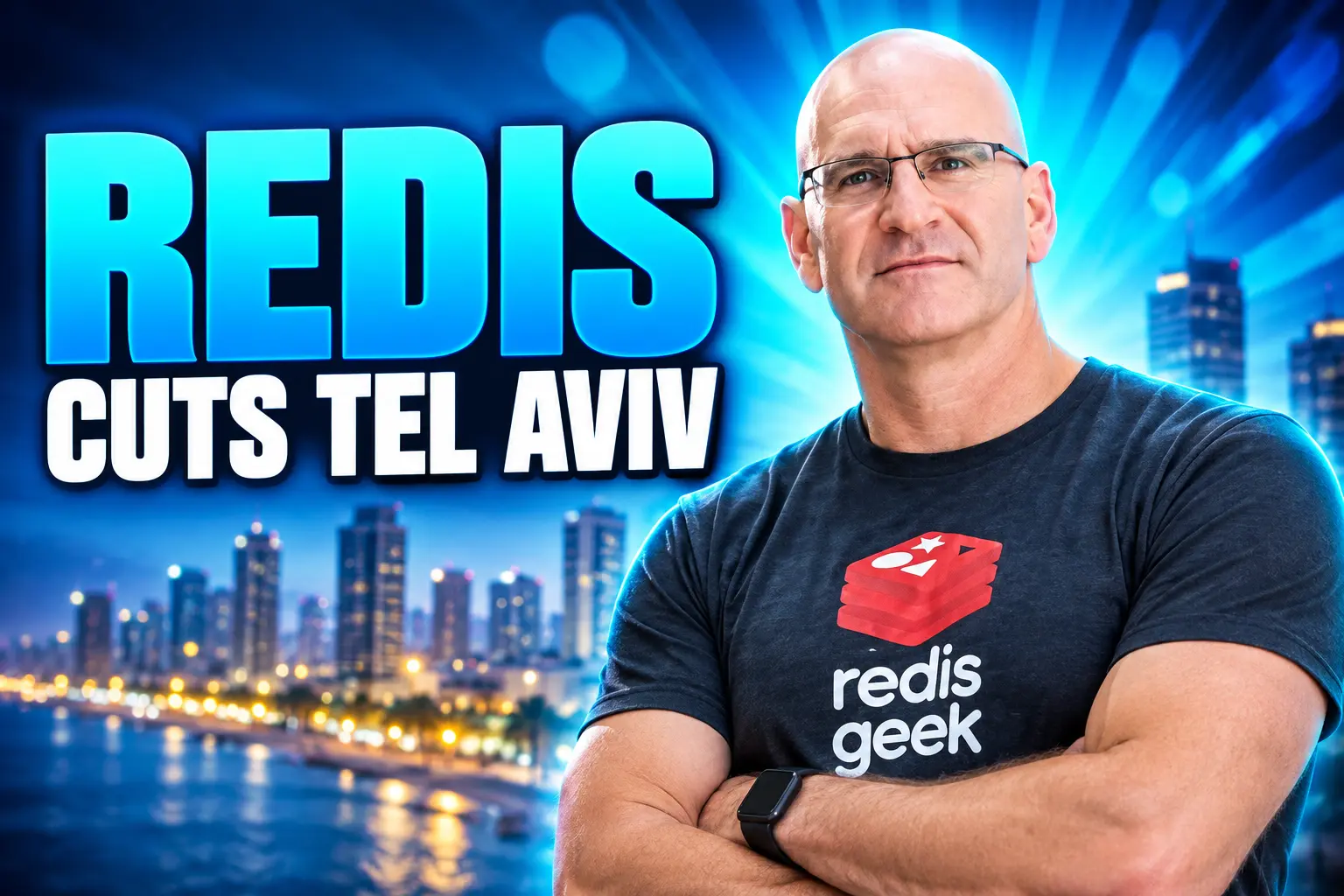
Israel’s Largest Redis Floor, Cut by a Quarter
Tel Aviv is not a satellite office. Redis was founded there in 2011 by Ofer Bengal and Yiftach Shoolman, and the Israel center is still the company’s biggest research and development hub, with more labs in the United States and Bulgaria and offices in London and Singapore. About 300 of the firm’s roughly 1,300 people sat in Israel when the notices were prepared.
REDIS AT THE JULY CUT
- Tel Aviv jobs: People familiar with the matter put the local cut at about 75 roles.
- Israel staff: About 300 people were on the Israeli books before the round.
- Worldwide staff: Redis employed about 1,300 people in total.
- The lease: The company had recently signed a 10-year rental deal on new Israeli offices.
A 10-year lease on a smaller headcount is a choice, not a contradiction Redis tried to hide. The company told Israeli reporters there were no plans to close the development center and that it meant to keep investing there. Trollope’s letter said the same thing in public, with the added detail that hiring in Israel would continue even as this round landed.
What changes is the mix. A lab that once planned to hire hundreds more, a large share of them in Israel, is being told to do the next chapter of the product with fewer people and more AI in the toolchain. The remaining engineers inherit the code, the on-call, and the lease.
How a $300 Million AI Shop Got Smaller
Redis is not cutting because the product stopped selling. On January 27, 2026, the San Francisco-based company said it had passed $300 million in annual recurring revenue, driven by infrastructure for AI and agent systems. It listed 12,000 paying customers, including a third of the Fortune 100, and more than 50 accounts that spend over $1 million a year, a rise of more than 20 percent from a year earlier. Annual recurring revenue sat near $200 million when Trollope took the job, so the climb under his watch is $100 million.
The same release said developers in the 2025 Stack Overflow survey named Redis the top choice for agent memory storage, at 42 percent. Downloads of RedisVL, the company’s free vector library, were nearly 1 million in December, triple the September figure and ten times December 2024. Trollope’s pitch is that agents fail on stale or scattered context, and that Redis already sits in the hot path where those systems read and write state.
We just crossed $300M in ARR. It's a big moment for us that comes as we're seeing high demand for infrastructure for AI and agentic systems.
From agent memory to RAG apps to real-time AI infrastructure, teams are building systems that need fast context, not just more compute. pic.twitter.com/5RB69AyHGW
— Redis (@Redisinc) January 27, 2026
That is the irony the July cut makes concrete. The company is selling speed and memory for other people’s AI, and it is using AI inside its own engineering shop to justify a smaller bench. Research shop Sacra put 2025 growth at 14.7 percent, a cooler pace than the boom years, which is the kind of curve that makes a chief executive reach for fewer teams and sharper bets rather than another hiring wave in Tel Aviv.
In May, Redis rolled out Iris, a context and memory layer meant to feed agents live business data. The commercial story is that this is the firm’s next market. The staffing story is that the people who would have been hired to build it, or kept to maintain the old stack, are exactly the R&D layer Trollope said would feel the cut.
The 2021 Unicorn That Never Reached Wall Street
The Tel Aviv lab is living with a leadership change that started years before the notices. Bengal ran Redis from the founding until he said in December 2022 that he would become chairman. Trollope became Redis CEO in February 2023, arriving from Five9. Shoolman left day-to-day work in 2025, stayed on the board, and started another company. Neither founder runs the shop that still carries their city on the org chart.
FROM GARANTIA DATA TO THE JULY LETTER
- 2011: Bengal and Shoolman found the company in Tel Aviv, first as Garantia Data, later Redis Labs, then Redis.
- April 2021: A $110 million Series G led by Tiger Global, with SoftBank Vision Fund 2 and TCV, values the firm at more than $2 billion. Total capital raised is about $350 million.
- February 2023: Trollope takes over as chief executive. Bengal becomes chairman.
- 2024 to 2025: Redis tightens its software license, watches the Valkey fork draw big-cloud backing, then returns the core to an open-source license after Trollope said the earlier move had hurt the developer community.
- January 27, 2026: Redis says annual recurring revenue has passed $300 million on AI infrastructure demand.
- July 15, 2026: Trollope tells staff the company will cut about 200 roles worldwide, with R&D, and therefore Israel, taking the heavy share.
During the 2021 run the company talked about hiring hundreds more people, many of them in Israel, and it was treated as a live Wall Street candidate. It is still private. The last headline valuation is the 2021 round. The people who raised that round are not the people who signed the July letter.
Trollope’s public argument is focus, not distress. He wrote that the foundation is strong and that the cut is a way to chase the agent market with more urgency. For the Tel Aviv floor, focus looks like fewer desks and the same long lease.
Wix, Rapyd and Amdocs Already Cut Thousands
Redis did not invent this round. Through late May and June, dollar-earning Israeli tech firms had already started shrinking payrolls that are paid in shekels. Wix chief executive Avishai Abrahami confirmed a cut of about 1,000 jobs, about 20 percent of staff, and pointed to a shekel that had climbed more than 20 percent against the dollar over 12 months by late May, a 33-year high, plus a shift toward AI-native work. Rapyd chief executive Arik Shtilman told staff the fintech would run as a company operated by AI; Rapyd has about 700 people worldwide. Amdocs, under new chief executive Shimie Hortig, moved to cut as many as 3,000 jobs globally, about 10 percent of staff, including hundreds in Israel.
THE 2026 CUTS AROUND REDIS
| Company | The cut | Israel angle |
|---|---|---|
| Redis | About 200 roles worldwide | About 75 of 300 in Tel Aviv, still the largest site |
| Wix | About 1,000 jobs, 20% of staff | Most costs in shekels, most sales in dollars |
| Rapyd | Overhaul under an AI operating model | About 700 staff worldwide |
| Amdocs | As many as 3,000 jobs, 10% of global staff | Hundreds of those jobs in Israel |
By June 22, tallies circulating in the Israeli business press put the year’s tech job losses, counting Israel and the United States, at about 8,500, with nearly 6,000 of those in May alone when Amdocs and Wix hit at once. The pattern underneath those figures is the same one Trollope put in writing: the junior and mid-level engineering layer is easier to delete than the C-suite that hired into the last boom, and AI tools give a board a clean sentence for the deletion.
A separate look at payrolls found that Israeli tech workers now cost more than U.S. counterparts once salaries are counted in dollars. That is the arithmetic a San Francisco chief executive sees when the shekel is strong and the product roadmap can be rewritten around agents. In an October interview as he left the Israel Innovation Authority, chief executive Dror Bin called the wider layoff wave a form of creative destruction driven by the shekel and by AI, painful for each worker and, in his view, required if firms are going to keep growing.
Who Stays After the Tel Aviv Notices
After the cut, Redis still wants a map that has Tel Aviv on it. Trollope said Israel remains the largest site and that the company will keep investing and hiring there. The 10-year lease is the physical version of that sentence. The other sites did not disappear with the 200 roles, and they are the backup if the next efficiency round looks at cost per engineer again.
WHERE REDIS STILL KEEPS PEOPLE
- Tel Aviv: Still the main R&D floor, now smaller, sitting on a newly signed 10-year office lease.
- United States: San Francisco headquarters plus a U.S. development hub, which is where Trollope writes the letters.
- Bulgaria: A second overseas development center, already on the company’s own site list beside Israel and the U.S.
- London and Singapore: Commercial offices, not the core lab, but part of the footprint the letter said was not under review.
The people who remain in Tel Aviv are being asked to ship the AI context stack with smaller teams and with the three-role model Trollope sketched. The people who left in July are the cost of that model. Redis still sells a database that other companies use to make their own agents faster. It now runs the company that built that database on a tighter Israeli bench, a decade of rented floor, and a promise to hire again when the chart says so.

Ninja Theory Staff Face Redundancy After Two Xbox Sales Collapse

Amazon Sells the MacBook Air at Its Pre-Hike Price

U.S. Slows Jet Parts to Squeeze China’s Flying Fleets

PEGI Pulled the GTA 6 Age Rating After Cocaine Details

Northwestern’s Smaller Ryan Field Gave Penn State Nowhere to Hide

Aramco Crash Kills 14 Two Days After Oil Restart

Salah Captained Egypt to Their First World Cup Win

Apple Labor Day Deals Hide June’s Memory Price Hike

Palworld 1.0.4 Adds Palpedia Search After the 1.0 Launch

Zelda’s 40th Switch 2 Ships Without a Zelda Game
-
 BUSINESS3 months ago
Aramco Crash Kills 14 Two Days After Oil Restart
-
 NEWS4 months ago
Salah Captained Egypt to Their First World Cup Win
-
 NEWS1 month ago
Apple Labor Day Deals Hide June’s Memory Price Hike
-
 GAMING4 weeks ago
Palworld 1.0.4 Adds Palpedia Search After the 1.0 Launch
-
 GAMING4 weeks ago
Zelda’s 40th Switch 2 Ships Without a Zelda Game
-

 NEWS3 months ago
El Niño Puts Israel’s Needed Winter Rain on a Flood Clock
-

 BUSINESS8 months ago
Egypt Bets EGP 638 Billion Can Open Sinai to Investors
-

 BUSINESS2 months ago
Egypt Seeks Two Extra El-Dabaa Reactors Before First Power