
BUSINESS
Hyperliquid Pushes a Control Test Into UK Crypto Rules
Hyperliquid Policy Center asked the FCA to keep public blockchains outside the 2027 crypto perimeter so safety tools on those chains do not trigger arranging.

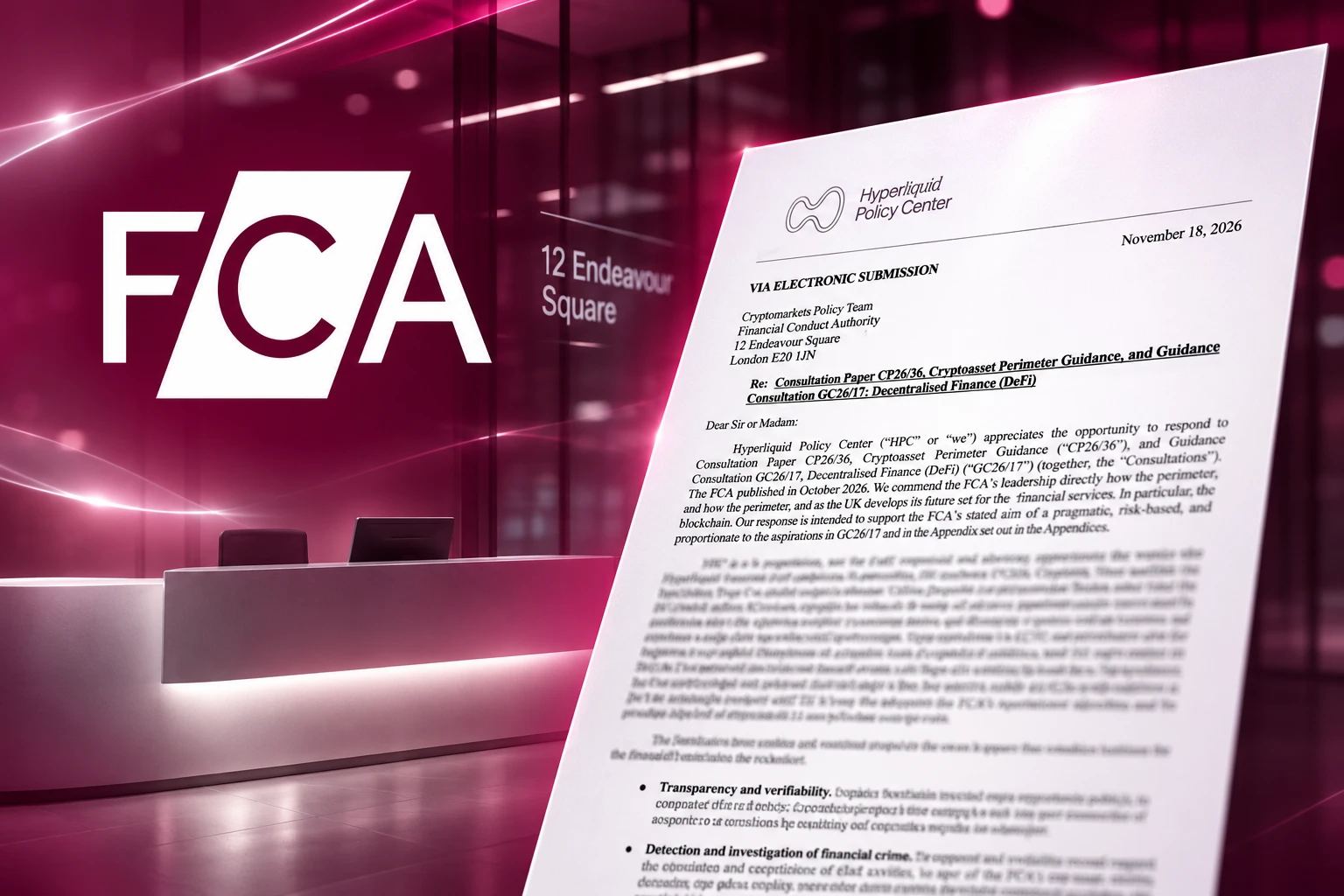
The Hyperliquid Policy Center asked the UK Financial Conduct Authority on 18 November 2026 to treat public blockchains as neutral infrastructure. It filed on the last day of two papers that will decide who needs a crypto licence in 2027.
The ask looks simple. Validators and software developers should not pick up financial duties just because a regulated firm uses their network. The effect is sharper. If safety tools count as control, UK firms will struggle to use public chains without turning the pipes into a venue.
HPC Files on the Last Day of Two Consultations
Jake Chervinsky, chief executive of the Washington not-for-profit, signed a November 18 consultation letter to the Cryptoasset Policy Team at 12 Endeavour Square. HPC describes itself as an independent research group that works on rules for onchain markets, including those on Hyperliquid.
The same day closed CP26/36 on perimeter guidance and GC26/7 on DeFi. Both papers opened on 21 October 2026. The FCA says it aims to publish final guidance in January 2027. Covered cryptoasset activities need permission from 25 October 2027 unless an exclusion applies.
HPC’s public note put the test in one line. Only a person with unilateral control over a regulated part of an onchain product should carry tailored duties. Validators and developers who maintain public chains without that control should not be treated as the firms that sell products to customers.
Today, HPC filed responses to @TheFCA’s consultations on how UK financial regulation applies to activity on public blockchains.
On a public blockchain, the functions that a single firm performs in traditional markets, such as operating a venue, matching orders, and settling… https://t.co/tiZoQmJjBJ
— Hyperliquid Policy Center (@HyperliquidPC) November 18, 2026
That hierarchy is the product Hyperliquid’s own crowd already assumes. The letter tries to write it into the Perimeter Guidance Manual before authorised firms have to name their venues.
A Safety Feature That Looks Like Control
The two papers do not ask the same question. CP26/36 explains new exclusions from cryptoasset regulation after the government added carve-outs for technical access, some proprietary trading, and certain stablecoin payment holds. GC26/7 is non-Handbook guidance on how authorised firms should handle operational resilience and financial crime when they use DeFi.
GC26/7 does not write a new DeFi rulebook. It tells firms already under SYSC 15A, SYSC 6 and the Money Laundering Regulations to meet the same outcomes they meet on older rails. It also pushes them toward protocols that are maintained, monitored and screened.
Aave Labs filed the same day and named the collision. CP26/36, as drafted, treats ongoing maintenance, risk management and screening as signs of centralisation or discretion that can pull a protocol or an interface inside the perimeter.
The features that make DeFi safer should not be the features that bring it within the perimeter.
Aave Labs, 18 November 2026 policy response
Aave’s page on two consultations pulling in opposite directions warns that the clash would penalise the safer stack and push British users toward offshore services. The DeFi Education Fund, also filing on the close, used a similar control test: obligations should follow a continuing ability to move user assets or transactions, not the act of writing, maintaining or governing non-custodial software.
Left as drafted, a firm that follows GC26/7 and picks a protocol with pause tools, audits and sanctions screens can look more “in control” under CP26/36 than a neglected contract with no one at home. That is the second-order trap HPC is trying to close.
What Unilateral Control Would Mean for Validators
HPC agrees with the FCA that the perimeter is technology-neutral and that the analysis runs person by person. It wants unilateral control weighted much more heavily than the draft now allows.
The letter defines that control as the ability of an identifiable person, acting alone, to direct a material function, for example by suspending it, changing its terms or reversing its outcome. On a proof-of-stake chain, HPC says, no single validator holds that power. Votes are combined by stake weight or median, and node software applies published rules to every user the same way.
The draft already says developing software is not, as such, a regulated activity, a line HPC cites at PERG 18.1.20. HPC wants the same reading for the “by way of business” test, so a validator that earns rewards under uniform rules is not treated as carrying on someone else’s regulated activity just because the work pays.
HPC’S SEVEN ASKS
| Ask | What HPC wants in final guidance |
|---|---|
| Firm responsibility | A regulated firm that uses a public chain to deliver a product keeps the duties; the network is not pulled in by that use alone. |
| Person-by-person review | Each participant is judged on the functions it actually performs, wherever it sits in the stack. |
| Business test | Earning validator rewards or shipping software does not, by itself, amount to a regulated crypto activity. |
| Retail counterparties | The expectation that dealing with a retail investor is a service should stay on bilateral books, not on multilateral matching. |
| Technical access | User-chosen interfaces that merely connect to a protocol should fit the technical services exclusion, including a single-protocol screen. |
| Resilience | Firms may use public networks and manage the dependency under SYSC 15A, without needing to control the chain. |
| Records and tools | On-chain records can support transparency duties; developers should not be forced to bake firm-level controls into public protocols. |
HPC is not asking the FCA to invent a new statute. The perimeter sits in the Cryptoassets Regulations 2026, passed on 4 February 2026, and in the later amending instrument that added the exclusions. PERG explains that line. It does not draw it.
The draft already refuses a bright-line test. Absence of unilateral or complete control, the FCA says, does not necessarily decide the outcome, and decentralisation sits on a spectrum. HPC quotes that language and still asks for control to be treated as among the most significant facts, because a person who cannot halt or reverse a function cannot discharge the duties authorisation would impose.
Where no one holds that power, HPC’s fallback is blunt. Keep the product out of the UK market unless a regulated firm can offer it in a form that meets the rules. Do not hang licences on people who could not comply.
The Technical Services Exclusion Is the Real Gate
Article 9Z2A is the carve-out HPC, Aave and DEF are all fighting to keep usable. It takes a person who is not already authorised, and who is not a payment-service provider, outside the arranging activity in article 9Y if that person is merely providing a technical service that lets someone else access an authorised firm or a decentralised protocol.
The exclusion is not a general pass for anything labelled DeFi. It does not cover dealing or safeguarding. Authorised firms cannot use it, which is why GC26/7 has to show those firms another path if UK customers are going to reach protocols through a regulated shopfront.
HPC’s fight is over the word “merely” and over what counts as a decentralised protocol. The draft looks for customer-initiated, non-discretionary access, with the user picking the provider or protocol, and with no ranking or best-execution promise. HPC says a screen that connects to only one protocol can still be user-selected, because the user chose that interface and can use another, or none.
It also says the statute’s “one or more” language should not punish a single listing. And it asks the FCA not to treat a foundation, a lab, or the people who maintain the software as if they were the protocol itself. A protocol is software. A person who develops it still has to be judged on whether that person controls it.
POWERS HPC TREATS AS CONTROL
- Halt or pause: The ability to stop user activity in a market or function without a network-wide vote.
- Reverse or reprice: The ability to unwind a transaction or settle it at a chosen price.
- Change the terms: The ability to alter economic parameters of a live product without dispersed agreement.
- Direct the function: Any other solo power to decide how a regulated activity is carried on once the system is live.
On proprietary trading, HPC backs the idea that a person dealing only for its own account, with no service to a counterparty, should not need permission. It objects to stretching the retail-counterparty expectation onto a central limit order book. On a bilateral app, the retail client relies on the firm for price and terms. On a public book, matching follows published price-time rules. Onchain, HPC says, the network’s state transition logic applies those rules the same way it applies any other transaction.
That is the Hyperliquid-shaped hole in the paper. If multilateral matching on a public book is treated as a service to every retail counterparty, the arranging net closes on the rails rather than on the broker.
Hyperliquid Puts Itself on the Settlement Layer
The letter places general-purpose public blockchains such as Ethereum and Hyperliquid at the settlement layer of the stack GC26/7 borrows from FATF and IOSCO. On some chains, order books, margin and settlement live in the base logic. On others they sit in contracts deployed later. HPC calls that a distinction without a difference, because validators still apply published rules uniformly.
The firm depends on the public internet, telecommunications networks and cloud computing networks to deliver its services, and it could not offer those services without that infrastructure. The providers of that infrastructure, in turn, are not subject to regulation in the same way as the firm. In our view, a public blockchain occupies the same position in relation to the persons who build on it and the regulated firms that use it.
Jake Chervinsky, Hyperliquid Policy Center, letter to the FCA, 18 November 2026
The internet line is doing work. HPC notes that identifiable people maintain TCP/IP and DNS, and that regulators still treat those protocols as pipes. It wants the same reading for a chain that identifiable developers upgrade and that validators are paid to secure.
This is also HPC’s second overseas filing. On 30 September 2026 it answered the European Commission’s MiCA review and argued that the ledger should not decide how an instrument is classed. The UK letter repeats that substance-over-technology line and cites HM Treasury’s own note that authorisation should not arise where no person undertakes the activity by way of business, with the FCA looking for a “sufficiently controlling party.”
The group is young. It launched in February 2026 and is based in Washington. The same policy centre has already asked U.S. futures regulators to keep event contracts on the federal side of a gambling line. In London, the prize is different. If Hyperliquid is settlement infrastructure, a UK-authorised firm can build a product on it, keep the customer relationship, and leave validators outside FSMA. If it is a venue, the 2027 perimeter lands on the chain.
January Guidance Lands Inside the Application Window
Firms that already run UK cryptoasset business and want the savings provision had to start filing on 30 September 2026. That window closes on 28 February 2027. The FCA has already said it will show some forbearance where uncertainty over the technical services exclusion delayed a complete arranging application, if the rest of the file arrives on time.
THE PERIMETER CALENDAR
- 4 February 2026: Parliament passes the Cryptoassets Regulations 2026, expanding the FCA’s crypto perimeter beyond promotions and money-laundering registration.
- 16 September 2026: The FCA publishes PS26/18, its first full perimeter guidance under the new regime.
- 30 September 2026: The authorisation window opens for firms that want a decision before the start date.
- 21 October 2026: CP26/36 and GC26/7 open, after a second statutory instrument added exclusions the September guidance could not cover.
- 18 November 2026: Both consultations close. HPC, Aave Labs and the DeFi Education Fund file.
- January 2027: The FCA aims to issue final guidance on both papers, while applications are still being taken.
- 28 February 2027: The application window closes.
- 25 October 2027: Covered cryptoasset activities need FCA permission unless an exclusion applies.
January guidance inside an open window is the practical fight. Firms are writing applications against draft PERG on draft amending regulations. Aave asked for forbearance to be written into the final text so late guidance does not punish an early file. HPC asked for worked examples of the technical services exclusion, which the draft still lacks.
On GC26/7, HPC largely accepts the risk list and argues the risks differ in degree, not in kind. It wants firms to map where each dependency sits, in an application, in the chain itself, or in the firm’s own connection, because a bug in a third-party market is not the same as a validator outage. Distributed validators, it says, cut single-provider failure. Public ledgers, it says, help reconstruct a crime without waiting on the affected firm’s books. Those benefits only count if using them does not become evidence of control under CP26/36.
The FCA has already shown where it will spend enforcement energy on the shopfront. On 29 October 2026 it announced High Court undertakings that stop HTX, formerly Huobi, from knowingly promoting crypto services to UK consumers, with the pledges running until 21 October 2031. Overseas venues that market into Britain are already in reach. HPC is arguing that the people who keep the shared ledger running are not that venue.
Final guidance in January 2027 will not rewrite the regulations. It will decide whether a UK firm can keep routing through a public chain as if it were a telecoms pipe, or whether maintenance, screens and pause keys turn that pipe into an unlicensed arranging business eleven months before the regime starts.
Disclaimer: This article is news reporting and analysis of consultation papers and industry filings. It is for information only and is not legal, regulatory, investment or trading advice. It does not tell any person whether to apply for FCA permission, to use a public blockchain, or to buy or sell any cryptoasset or token, including HYPE. Readers who may be affected by the UK cryptoasset regime should take advice from a qualified UK financial-services lawyer or compliance professional before acting. Dates, guidance drafts and application windows are those stated by the cited primary documents as of 18 November 2026 and can change when the FCA issues final text.

Jennifer Lopez and Mahershala Ali Describe a Pipeline They Cannot Buy

Lightsail Scatter Turns to Drag Far Above Starshot

Tallulah Willis Deletes a Bruce Willis Photo She Called Intimate

S&P 500 Futures Rebound Into a Holiday-Shortened Week

GTA VI’s Record Launch Still Needs the Same Fragile Grid

Aramco Crash Kills 14 Two Days After Oil Restart

Salah Captained Egypt to Their First World Cup Win

Zelda’s 40th Switch 2 Ships Without a Zelda Game

Apple Labor Day Deals Hide June’s Memory Price Hike

El Niño Puts Israel’s Needed Winter Rain on a Flood Clock
-
 BUSINESS5 months ago
Aramco Crash Kills 14 Two Days After Oil Restart
-
 NEWS6 months ago
Salah Captained Egypt to Their First World Cup Win
-
 GAMING3 months ago
Zelda’s 40th Switch 2 Ships Without a Zelda Game
-
 NEWS3 months ago
Apple Labor Day Deals Hide June’s Memory Price Hike
-
 NEWS5 months ago
El Niño Puts Israel’s Needed Winter Rain on a Flood Clock
-

 GAMING3 months ago
Palworld 1.0.4 Adds Palpedia Search After the 1.0 Launch
-

 NEWS4 months ago
Saudi Visa Routes Split Nigerian Travelers Into Two Speeds
-

 BUSINESS9 months ago
BAE’s 60-Year Saudi Franchise Now Runs Through Taif