
NEWS
Google’s Temporary Threads Hide AI Mode Chats, Not the Server Copy
Google’s AI Mode temporary threads keep queries out of your history, but the Search post never says how long the chats stay on Google’s servers.

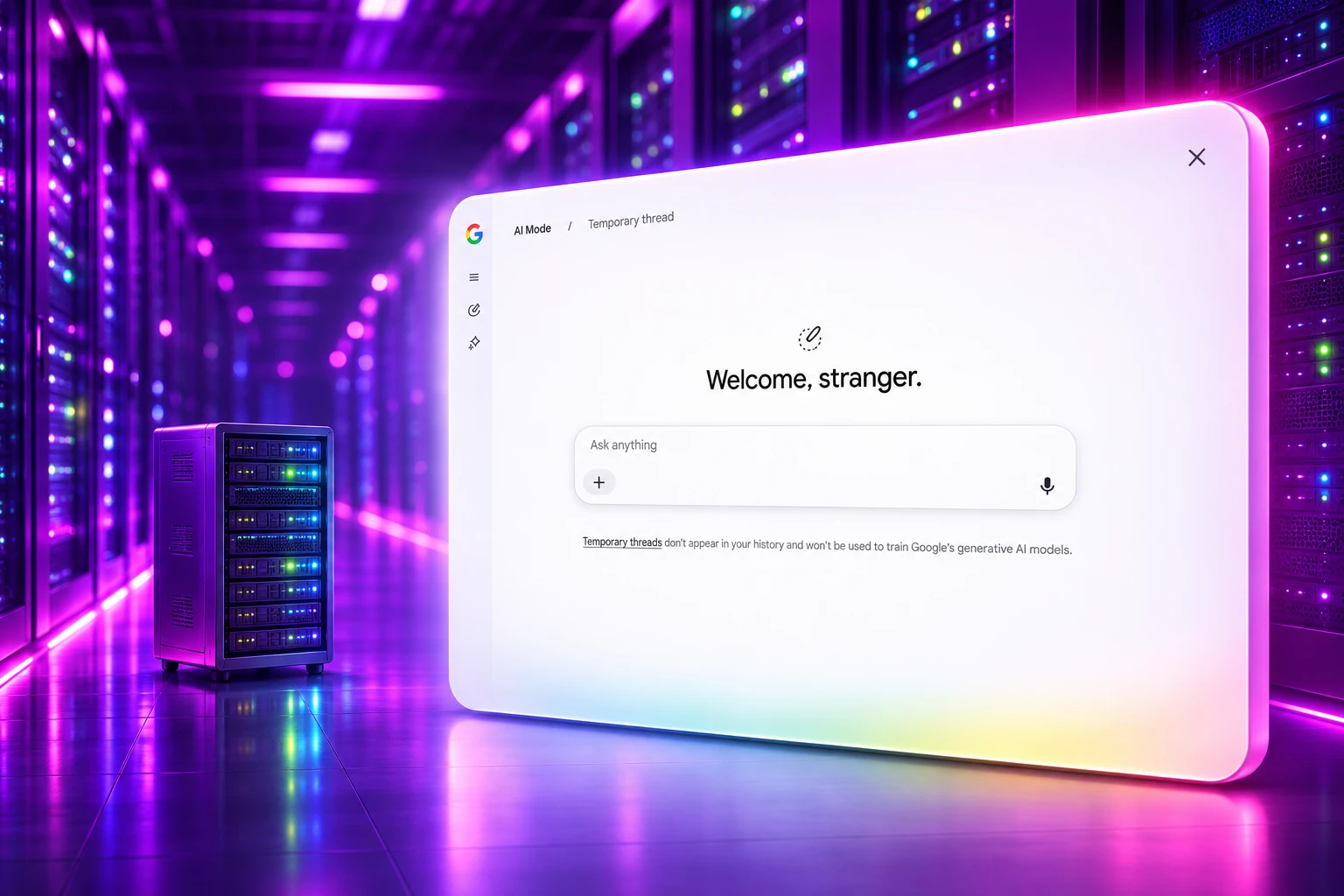
Google added temporary threads in AI Mode on November 17, a one-click way to keep a query out of your history. The Search post says the thread is gone when you close it. It does not say how long Google keeps a copy.
A day earlier, the Gemini app moved the same kind of hidden chat. History-off conversations are now saved for around two months, up from 72 hours on the Gemini help pages earlier in November. Search borrowed the button. It did not borrow a published clock.
Click the Icon in the Upper Right
You do not hunt through account settings. In AI Mode, the temporary threads icon sits in the upper right. Click it and type. Google says the session is completely detached from your account, so past preferences do not shape the replies, the chat does not change later personalization, and it is not saved to your history.
The company pitched the usual examples: a surprise gift, or a lookup you do not want resurfaced in recommendations. Close the thread and Search goes back to normal. The rollout is global on desktop and mobile browsers, in every language AI Mode already supports.
News from Google posted the same lines with a short demo the evening of November 17.
Rolling out globally across all languages: Temporary threads in AI Mode, which let you explore and ask questions about topics you don’t want resurfaced later in your history or recommendations — like browsing for a surprise gift.
To get started, click the temporary threads icon… pic.twitter.com/rf69aiIuId
— News from Google (@NewsFromGoogle) November 17, 2026
WHAT GOOGLE SAYS THE BUTTON DOES
- No settings trip: You start from the icon and switch back when you are done, with no privacy toggle to flip first.
- Detached session: Replies in that thread are not informed by past preferences on the account.
- No future personalization: The conversation is not supposed to train the recommendations you see later.
- No history entry: Google says the thread is not saved to your history and is gone once you close it.
- Same surfaces as AI Mode: Desktop and mobile browsers, worldwide, in the languages AI Mode already speaks.
That is a real fix for a real nuisance. AI Mode now remembers you on purpose. A one-off medical question or a gift for a partner can follow you around the product if it lands in the regular thread list. Temporary threads cut that loop. They do not, on the words Google published, promise that the transcript left Google’s machines.
Gemini Just Stretched Temporary to Two Months
On November 16, Google split one Gemini switch into two. You can keep chat history on and still opt out of generative AI training. History is on by default if you are 18 or over. Saved Gemini history auto-deletes after 18 months unless you pick 3 months, 36 months, or no auto-delete.
The other change sat in the same post. If you turn off Gemini chat history, future chats are still stored with your account for around two months. Google says it uses them to respond to you, process feedback, and protect Google, its users, and the public. That history does not appear in the Gemini History list you can browse.
The Gemini Apps Privacy Hub, last updated November 17, asks the retention question in those terms: temporary chats and chats with History off. Earlier in November those pages listed 72 hours. The live help page now matches the blog: around two months. Temporary chats in Gemini are still described as unused for model training. The Search announcement never repeats that sentence for AI Mode.
THE WEEK THE CLOCK MOVED
- Early November 2026: Gemini help pages still describe temporary chats and History-off chats as held with the account for 72 hours.
- November 16, 2026: Google posts new Gemini controls, splits history from training, and sets History-off storage at around two months, with a global app rollout in the coming weeks.
- November 17, 2026: Google launches temporary threads in AI Mode, says the closed thread is gone, and does not publish a Search retention window.
The two products share a family resemblance and a calendar. They do not share a public number. Treating the Gemini window as the AI Mode window would be a guess. Google left the guess on the table.
Why One-Off Questions Needed an Exit
AI Mode spent 2026 learning the account attached to it. Personal Intelligence, rolled out earlier in the year to paying subscribers, can pull context from Gmail and Google Photos so a search about a booking or a face in a camera roll comes back with that context already in the answer. The more the product knows, the more a stray query can look like a standing interest.
That is the job temporary threads actually do well. They stop a single health question from teaching Search to keep serving related suggestions. They stop a gift hunt from showing up in the thread rail the next time someone else glances at the screen. Saving was the default. The extra icon is the exception Google had to ship once the default got more personal.
Chrome already had Incognito for ordinary searches. AI Mode is a conversation, with follow-ups, and it sits on the signed-in Search surface. Closing a tab does not unwind a thread the way it unwinds a one-shot query. A dedicated control was the obvious patch. The patch is for the profile you see. It is not a statement about logs, reviewers, or legal holds.
People testing the button also keep running into a smaller leak Google did not bother to mention in the launch post: sites you open from the thread can still land in the browser’s own history. Pairing the thread with a private window is the only way to close that gap, and even then the destination site keeps its own records.
ChatGPT and Claude Already Publish 30 Days
OpenAI and Anthropic already sell the same idea under different names, and both put a number on the hidden copy. ChatGPT’s Temporary Chat FAQ says chats stay out of history and are not used to improve models while they remain temporary, and that OpenAI may still keep a copy for up to 30 days for safety. Claude’s incognito chats are not saved to history or memory and are not used for training; Anthropic says they are still retained for 30 days for safety, or longer if a chat is flagged.
Gemini now sits behind both of those published windows for History-off and temporary chats. AI Mode sits nowhere on the chart, because Google did not fill in the cell.
STATED SERVER WINDOWS FOR HIDDEN CHATS
| Product | Visible history | Stated server window | Training while hidden |
|---|---|---|---|
| Gemini History off or temporary chat | No | Around two months | Temporary chats not used to train |
| ChatGPT Temporary Chat | No | Up to 30 days for safety | No while the chat stays temporary |
| Claude incognito chat | No | 30 days for safety | No |
| Google AI Mode temporary threads | No | Not stated in the November 17 post | Not stated in the November 17 post |
Thirty days is not deletion on close either. It is a number a user can plan around. Around two months is a longer number, and it arrived as Gemini’s models got more capable, which is the reason Google gave for needing more time to investigate abuse. Search’s silence is the odd one out in that set, not a sign that Search deletes faster.
Reviewed Chats Can Last Three Years
Even the Gemini pages that now say around two months leave a longer path open. Chats pulled for human review are handled on a separate clock. The Gemini Apps Privacy Hub says reviewed chats can be kept for up to three years, disconnected from the account, and that deleting your visible history does not delete them. Human review can still happen for safety whether you wanted the chat saved or not.
Now, if you turn your new History setting off, future chats will be saved for around two months; they’re used to respond to you, process your feedback, and protect Google, its users, and the public.
Google, Gemini app blog, November 16, 2026
Work and school accounts sit on another track. Gemini’s history help page says Workspace administrators control those retention settings, and you may not be able to see how long chats are kept. The Search announcement does not spell out a parallel rule for AI Mode on managed accounts. If you search from a company or school login, assume the admin policy wins until Google says otherwise.
None of that makes the new button useless. It makes the label honest only if you read it as a history switch. Temporary, in this product family, has meant “hidden from you” for a while. On Gemini it now also means “held about two months unless a reviewer keeps it longer.” On Search, Google has not finished the sentence.
What Google Has Not Put in Writing
The Keyword post is 150 words of product copy and a video. It never says “deleted from our servers.” It never says “24 hours” or “two months.” It never says whether AI Mode temporary threads are used to train models, whether contractors can read them, or whether a Workspace admin can export them. Those answers exist for Gemini. They do not exist, in the launch text, for Search.
WHAT WE KNOW
- The visible effect: A temporary thread is detached from the account, stays out of Search history, and is not supposed to change later recommendations.
- The Gemini figure: History-off and temporary Gemini chats are stored with the account for around two months, up from 72 hours on the same help pages earlier in November.
- The rivals: ChatGPT and Claude both publish a 30-day safety copy for their hidden chats.
WHAT IS UNCONFIRMED
- Search’s server window: Google has not said how long an AI Mode temporary thread stays on its systems after you close it.
- Training and review: The November 17 post does not say whether those threads are excluded from training or from human review.
- Managed accounts: There is no public AI Mode rule for work and school logins in the launch post.
Until Search publishes its own window, the safe working assumption is the one Gemini already wrote down for the sibling product: gone from your screen is not gone from the account Google still holds. The icon is still worth pressing when you do not want a gift or a health question sitting in the thread list. It is a history tool. It is not a deletion receipt.

Jennifer Lopez and Mahershala Ali Describe a Pipeline They Cannot Buy

Lightsail Scatter Turns to Drag Far Above Starshot

Tallulah Willis Deletes a Bruce Willis Photo She Called Intimate

S&P 500 Futures Rebound Into a Holiday-Shortened Week

GTA VI’s Record Launch Still Needs the Same Fragile Grid

Aramco Crash Kills 14 Two Days After Oil Restart

Salah Captained Egypt to Their First World Cup Win

Zelda’s 40th Switch 2 Ships Without a Zelda Game

Apple Labor Day Deals Hide June’s Memory Price Hike

El Niño Puts Israel’s Needed Winter Rain on a Flood Clock
-
 BUSINESS5 months ago
Aramco Crash Kills 14 Two Days After Oil Restart
-
 NEWS6 months ago
Salah Captained Egypt to Their First World Cup Win
-
 GAMING3 months ago
Zelda’s 40th Switch 2 Ships Without a Zelda Game
-
 NEWS3 months ago
Apple Labor Day Deals Hide June’s Memory Price Hike
-
 NEWS5 months ago
El Niño Puts Israel’s Needed Winter Rain on a Flood Clock
-

 GAMING3 months ago
Palworld 1.0.4 Adds Palpedia Search After the 1.0 Launch
-

 NEWS4 months ago
Saudi Visa Routes Split Nigerian Travelers Into Two Speeds
-

 BUSINESS9 months ago
BAE’s 60-Year Saudi Franchise Now Runs Through Taif