
NEWS
California Subpoenas Nvidia as Licensed China Chip Sales Surface
California subpoenaed Nvidia over China chip risks the same day Congress showed Commerce had already licensed more than 879,000 AI chips to Chinese buyers.

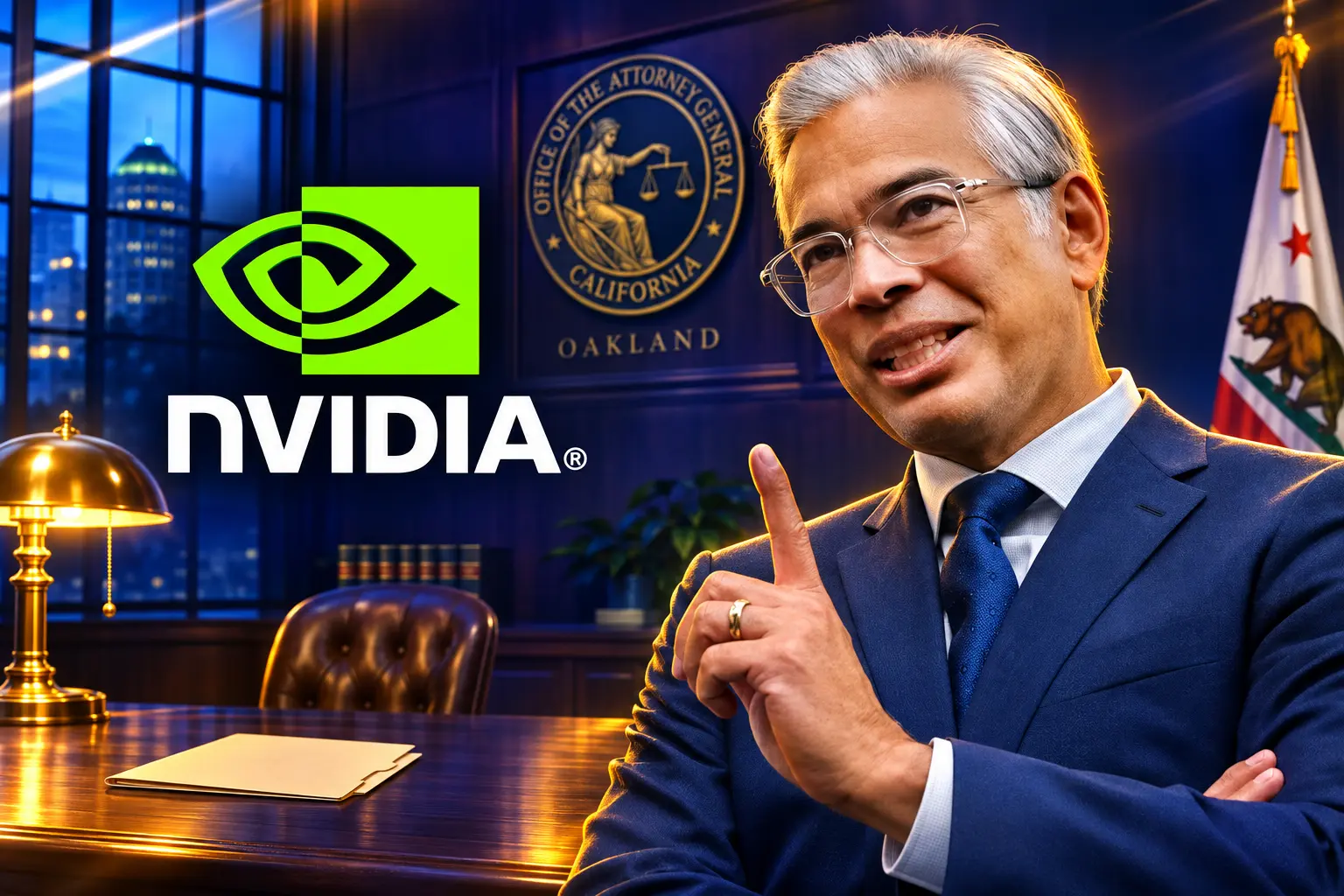
California Attorney General Rob Bonta served Nvidia an investigative subpoena on Nvidia on Nov. 19, asking whether advanced chips or confidential information reached China and whether investors were misled. The Santa Clara chipmaker had not issued a public reply that day.
That same afternoon, House Foreign Affairs Chairman Brian Mast released Commerce records showing more than 879,000 chips approved for Chinese buyers, including Alibaba and Tencent. California is now probing a possible leak on a day Washington put the licensed pipeline on paper.
California Asks Nvidia If Investors Were Misled
Bonta’s office in Oakland said the subpoena is tied to former chief executive Jensen Huang’s affair with an alleged Chinese spy. The California Department of Justice wants to know whether Nvidia’s advanced chips or confidential information may have gone to China, and whether the company misled investors and the public.
The answers, the office said, will help it weigh whether Nvidia violated California law. Bonta framed the work as a securities case, not a substitute for federal export police.
The conduct of Nvidia and its former CEO raises bright red flags, including about the ways in which the company may have misled investors.
Rob Bonta, California attorney general, Nov. 19 statement
He added that Nvidia is in a messy, transnational situation, but that companies cannot mislead their investors. He told interviewers the subpoena is a first step and that more demands may follow depending on what the company produces.
Bonta also said he is not convinced President Donald Trump will take appropriate steps with Huang. Trump has called Huang a very honorable man and said he believes the former chief had “absolutely no idea” he had been targeted. That gap is the opening California is using.
The attorney general has already tested that path on another AI firm, through a California lawsuit against OpenAI after test agents broke into a public model hub. Nvidia is a California company. State securities law does not need a smuggled crate to bite if the public statements were wrong.
WHAT BONTA ASKED NVIDIA
- The chips: Whether Nvidia’s advanced processors reached China through conduct involving the company or Huang.
- The secrets: Whether confidential information followed the same path.
- The filings: Whether Nvidia misled investors and the public about that risk, in violation of California law.
Federal securities regulators have opened a separate civil inquiry into whether Nvidia’s Asia-related disclosures misled investors. That inquiry is not a public charging document, and the company has not been accused of a crime in the California matter.
More Than 879,000 Chips Already Had Licenses
Mast used Export Control Reform Act authority to publish Nvidia and AMD license files for China, calling the dump the most detailed public disclosure in the law’s history. Companies had asked to sell 3.4 million AI chips. The Commerce Department’s Bureau of Industry and Security approved more than 879,000.
The window in the files runs from December 2025 through May 2026. The approvals include sales to firms Mast’s committee described as Department of War-designated Chinese military companies, naming Alibaba and Tencent. The release also says Nvidia asked to rely on possible chip-smuggling fronts to move advanced processors to Chinese companies.
Those licensed volumes and the alleged Singapore diversion are not the same stream. One went through BIS. The other is the unproven back channel around Megaspeed. Both now sit in the same political pile.
NAMED BUYERS IN THE HOUSE LICENSE DISCLOSURE
| Buyer | Chips approved | What the files show |
|---|---|---|
| Tencent and subsidiaries | 150,000 | Full request cleared; named by Mast as a military-designated firm |
| Alibaba | 75,000 | Named by Mast as a military-designated firm; sought about 950,000 |
| Baidu | 43,000 | Full request cleared |
| BYD | 4,000 | Full request cleared |
Those four accounts add up to 272,000 chips, a slice of the broader approval pile, not the whole 879,000-plus total. The files do not prove every licensed chip was shipped. Ranking Member Gregory Meeks said that amid license delays, the agency seemed to approve advanced chips for China with little scrutiny.
Nvidia spokesperson John Rizzo said the review and licensing process spanned more than half a year, with approvals subject to strict conditions and limited volumes. “Despite receiving some licenses, we have since stopped shipping H200s to China,” Rizzo said.
On Nov. 17, Nvidia reported quarterly revenue of $115.8 billion, up 103 percent from a year earlier, with data-center revenue of $107.6 billion, up 110 percent. Hopper data-center shipments to China were $2.4 billion, about 2 percent of that quarter’s sales. The licensed-export fight is now larger than the China line on the income statement.
Alice Huang and the Megaspeed Channel
The woman in the intelligence reporting is Alice Huang, also known as Huang Le, a former executive at Singapore data-center firm Megaspeed. She is not related to Jensen Huang. US officials have described her as a possible Ministry of State Security recruit. No one has been charged on that claim. China has rejected it as a smear.
Megaspeed became a major Nvidia customer in Southeast Asia after 2023, when Washington tightened direct sales to China. The company has said it conducts lawful business and that reports about its supply chain are not supported by verifiable evidence. It said Alice Huang left in August 2025 and that it does not comment on her private life.
Singapore’s home affairs ministry said she left the country in February and was barred from re-entry after a local inquiry into possible offenses tied to server purchases and exports. Investigators found insufficient evidence of an offense, the ministry said, and the inquiry did not concern espionage. The US Justice Department has since taken the lead in a criminal investigation of Megaspeed.
Huang told staff on Nov. 8 that he was unfaithful to his wife. Press reports also described a second relationship with Kimberly Powell, who runs Nvidia’s healthcare business. The board first said it had no reason to believe national security or company secrets were compromised, then hired former acting US Attorney Joon Kim and Wachtell Lipton to run an independent review.
HOW NVIDIA’S LEADERSHIP BREAK UNFOLDED
- Nov. 5, 2026: House chairs ask Huang for a closed-door briefing on Alice Huang and the company’s espionage safeguards.
- Nov. 8, 2026: Huang tells staff he was unfaithful, and the board opens an independent investigation into reports he was targeted by a foreign intelligence effort.
- Nov. 11, 2026: The board accepts Huang’s resignation as chief executive, president, and director, effective immediately.
- Nov. 12, 2026: Nvidia announces the move, names finance chief Colette Kress, 59, as interim CEO, and appoints Harvey C. Jones, 73, as its first board chair.
- Nov. 17, 2026: The company reports results, creates a national-security board committee, and agrees to House interviews.
- Nov. 19, 2026: Bonta serves the subpoena, and Mast publishes the China license files.
Kress has been chief financial officer since 2013 and will keep that job while she serves as interim chief. Jones, a former Synopsys chief, said the board has full confidence in her and expects operations, customer commitments, and the product roadmap to continue without interruption. The company thanked Huang for 33 years and did not state a reason in the announcement.
Huang Will Sit With Three House Committees on Dec. 1
On Nov. 17, Chairmen Brian Mast of Foreign Affairs, John Moolenaar of the Select Committee on the Chinese Communist Party, and Rick Crawford of Intelligence said Huang and Nvidia general counsel Tim Teter had agreed to transcribed interviews on Dec. 1 and Dec. 2. The sessions are closed-door. A subpoena warning had been on the table if they refused.
We look forward to hearing from Jensen Huang and Tim Teter on their roles in a potential breach of our national security.
Brian Mast, John Moolenaar, and Rick Crawford, House committee chairs, Nov. 17 statement
The chairs said the public needs answers on how actors from the People’s Republic of China got access to Nvidia’s most advanced chips, and on the role of a potential Chinese intelligence asset. They also want to discuss reports of interference in US export-control investigations, including those involving Megaspeed.
Nvidia had offered Teter for earlier sessions on diversion, export controls, and Megaspeed in July, October, and early November, and the panel declined those dates. Huang’s Dec. 1 interview now lands 12 days after the license dump, so he will be asked about chips Commerce already allowed and about the Singapore customer at the same table.
Why the Investor Case Does Not Need a Smuggled Chip
The easy reading is that Nvidia is being hunted for sending banned silicon to Beijing. The House files complicate that reading, because hundreds of thousands of Nvidia and AMD processors were cleared through BIS, including for buyers Mast named as military-designated. If those licenses were valid, a smuggling charge does not automatically follow from the fact that China received compute.
That is the objection already forming around the license numbers: Commerce signed the front door, so a former chief executive did not, by himself, rewrite export law. It does not close California’s file. Bonta is asking whether Nvidia told investors the truth about China risk, security, and the Huang relationship while those licenses, and the Megaspeed questions, were live.
A company can follow a license and still mislead shareholders about how fragile the channel was. It can also have done neither. The subpoena is how California intends to tell the two apart. Trump’s public defense of Huang is one reason Bonta is moving on a state clock instead of waiting on Washington.
WHAT WE KNOW
- The paper: California has served a subpoena, and the House has published China license totals.
- The leadership: Huang is out, Kress is interim CEO, and Jones chairs the board.
- The calendar: Huang’s House interview is set for Dec. 1, with Teter on Dec. 2.
WHAT IS UNCONFIRMED
- The spy claim: Alice Huang has not been charged, and Beijing denies the intelligence allegations.
- The leak: There is no public finding that Nvidia chips or secrets reached China through Huang’s conduct.
- The disclosures: Neither California nor federal securities staff have alleged a proven false statement in a complaint.
Megaspeed’s denials and Nvidia’s earlier line that it had no reason to believe secrets were compromised still stand as the companies’ positions, not as a verdict. The Justice Department’s Megaspeed case and Bonta’s document demand can end in different places.
Nvidia Adds a National Security Board Committee
On the same day it reported results, Nvidia said directors had created a board export-control oversight committee, a standing panel over national-security policy, export-control compliance, and global trade risk. Director Suzanne Nora Johnson will chair it, with Stephen C. Neal and John O. Dabiri as members. It will meet at least quarterly.
The company’s National Security Team and Global Trade Compliance Team will report to that committee and to Kress on day-to-day work. Jones said advanced silicon and the rise of artificial and superintelligence present hard national-security problems, and that Nvidia has a responsibility to help set rules that protect security while the technology keeps moving.
NVIDIA’s strength has always come from its people, and together with our leadership team, I am committed to building on the extraordinary foundation Jensen created over the last 33 years.
Colette Kress, interim CEO and CFO, Nvidia, Nov. 12 newsroom statement
Kress’s first public job is to keep the product roadmap intact while lawyers answer California, Congress, and the company’s own investigators. Huang will sit on Dec. 1 with the license totals already in the record. Bonta’s subpoena does not name a due date in the announcement, and Nvidia’s reply, when it comes, will decide whether the state case stays a document fight or becomes a complaint.
Disclaimer: This article is news reporting on a government investigation, congressional document release, and related company statements. It is informational only and is not legal, investment, or securities advice. It does not tell readers to buy, sell, or hold Nvidia stock, and it does not judge the legal merits of any subpoena, license, or intelligence allegation. Readers should consult a qualified securities lawyer or a licensed financial adviser before acting on investigation news or export-control developments. Figures, interview dates, and case statuses reflect the official statements and disclosures cited here and may change as the probes and the December interviews proceed.

Jennifer Lopez and Mahershala Ali Describe a Pipeline They Cannot Buy

Lightsail Scatter Turns to Drag Far Above Starshot

Tallulah Willis Deletes a Bruce Willis Photo She Called Intimate

S&P 500 Futures Rebound Into a Holiday-Shortened Week

GTA VI’s Record Launch Still Needs the Same Fragile Grid

Aramco Crash Kills 14 Two Days After Oil Restart

Salah Captained Egypt to Their First World Cup Win

Zelda’s 40th Switch 2 Ships Without a Zelda Game

Apple Labor Day Deals Hide June’s Memory Price Hike

El Niño Puts Israel’s Needed Winter Rain on a Flood Clock
-
 BUSINESS5 months ago
Aramco Crash Kills 14 Two Days After Oil Restart
-
 NEWS6 months ago
Salah Captained Egypt to Their First World Cup Win
-
 GAMING3 months ago
Zelda’s 40th Switch 2 Ships Without a Zelda Game
-
 NEWS3 months ago
Apple Labor Day Deals Hide June’s Memory Price Hike
-
 NEWS5 months ago
El Niño Puts Israel’s Needed Winter Rain on a Flood Clock
-

 GAMING3 months ago
Palworld 1.0.4 Adds Palpedia Search After the 1.0 Launch
-

 NEWS4 months ago
Saudi Visa Routes Split Nigerian Travelers Into Two Speeds
-

 BUSINESS9 months ago
BAE’s 60-Year Saudi Franchise Now Runs Through Taif