
ENTERTAINMENT
Fincher Turns Cliff Booth Into a $200 Million Episode
Fincher cut 60 pages from Tarantino’s 230-page Cliff Booth script, then Netflix got a two-week IMAX exclusive that Regal and Cinemark refused.

The Further Mis-Adventures of Cliff Booth opens in IMAX on November 25. Netflix lists the R-rated film at 2 hours 23 minutes, with streaming on December 23.
David Fincher directed Brad Pitt from a Quentin Tarantino script, eight years after Once Upon a Time in Hollywood. The first draft ran 230 pages. Two big chains still will not give it an IMAX screen.
THE LOCKED DETAILS
- The runtime: Netflix lists the cut at 2 hours 23 minutes, or 143 minutes.
- The money: Tarantino called it a $200 million movie, his biggest by $100 million.
- The window: IMAX on November 25 for two weeks, then Netflix on December 23.
- The rating: R in the United States for violence, bloody images, language, sex, nudity, and drug use.
That package is the whole bet. Three famous names, a period Los Angeles rebuild, and a streamer trying IMAX for the first time, with most of the audience still a month away from the sofa.
The Fairytale Is Over in 1977 Hollywood
Netflix’s own logline is blunt. Murder, blackmail, theft, and extortion are just another summer in Hollywood. It is 1977, and the fairytale is over. Los Angeles no longer needs a hippie-slaying stuntman the way it did in 1969.
Cliff Booth still has the grin and the bracelets. He also has rent to make. He bartends, he runs a projector, and he takes fixer jobs for people who cannot call the police. He lives in Marina del Rey with his aging father, Gus, played by Peter Weller. Admirers still want the Bruce Lee story. The town has moved on.
Talent agent Karen Crosby, played by Elizabeth Debicki, pulls him into the mess around TV star Charlie Peters, played by Scott Caan. Carla Gugino is Toni, Peters’ wife and an old flame of Cliff’s. Yahya Abdul-Mateen II is Roderick “Hot Rod” Harrison, a football champion turned screen star. Matt Groove and JB Tadena play the Verdusco brothers, gangsters from Manila who make the errand deadly.
The official trailer puts that 1977 hang in IMAX terms, sodium light and all.
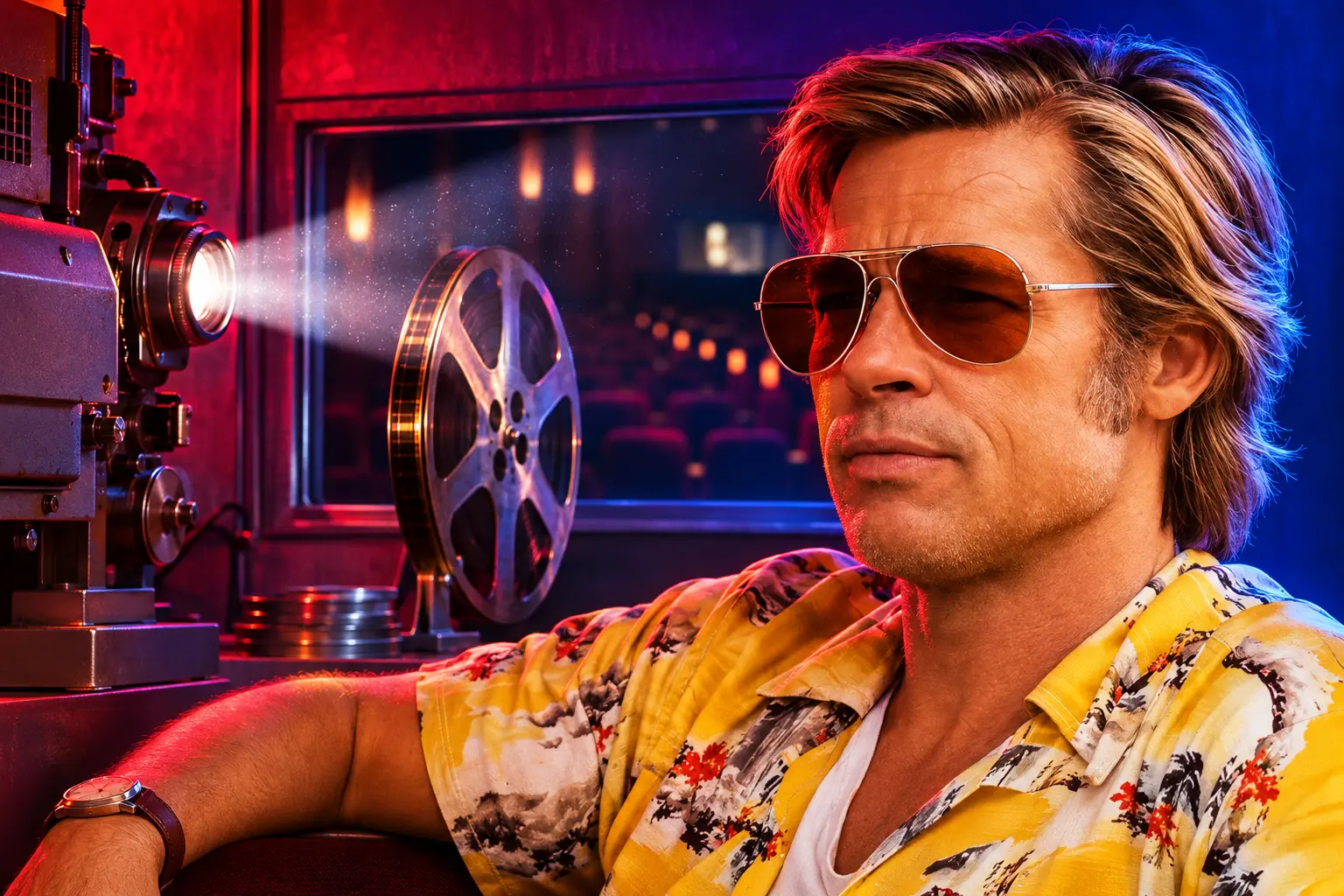
Fincher shot the opening in a real single-screen house, the Gardena Cinema, after the crew recast fake-wood handrails and pulled off plastic cup holders. On set he told Pitt, in the projection booth, that his name was Cliff and he was a projectionist. Pitt, fiddling with a bracelet, asked what his motivation was. It is their fourth film together. The joke only works if you already know the guy.
Fincher Inherited a 230-Page Novel in Script Form
Tarantino wrote the script as a possible tenth film, then walked away. He said he loved the pages and still felt he was on ground he had already walked. His last movie, he said, had to be uncharted. Pitt would not let Cliff go. He took the script to Fincher, his director on Seven, Fight Club, and The Curious Case of Benjamin Button, and Fincher said he was smitten.
Netflix bought the script in April 2025. The CinemaCon reveal landed on April 1, which is why the trades had to say it was not a prank. Principal photography ran in Los Angeles from late July 2025 to January 15, 2026, with extra days in August 2026. California’s film tax credit program put $20 million against a shoot listed at 110 days, 128 cast, and 428 crew, with $105.9 million in qualified in-state spend.
HOW THE SCRIPT BECAME A MOVIE
- April 2025: Netflix acquires Tarantino’s Cliff Booth screenplay and Pitt brings in Fincher.
- July 2025: Cameras roll around Los Angeles, Long Beach, Huntington Beach, and the Ventura County Fairgrounds.
- January 15, 2026: Principal photography wraps.
- August 2026: Additional photography with Pitt, including rebuilt sets.
- November 16, 2026: World premiere in Los Angeles, after a Directors Guild screening.
- December 8, 2026: HarperCollins publishes Tarantino’s novelization, titled The Adventures of Cliff Booth.
Fincher told Tarantino the first draft was not a movie. It was two.
The first draft I read was 230 pages. It was essentially two movies.
David Fincher, joint interview with Quentin Tarantino, Empire, November 3, 2026
He cut 60 pages, which leaves 170. Some of those lost pages were radio essays, the sound of punching an ACDelco in-dash, the fringe life around Cliff. Fincher still wanted the audience to feel the 230-page read. There was a live choice, he said, between a movie and a series. They made a long movie. When Tarantino left for Tel Aviv, he warned Fincher the assembly might run four and a half hours. Fincher called back with 2 hours 18 minutes. Tarantino’s reply, as Fincher tells it, was “WHAT?! What did you do?”
Tarantino still says there is not a scene he wrote that is missing. Fincher calls it compression. He also says the first person he wants happy is the writer.
Twenty-Eight Takes, on Purpose
Fincher walked in wanting to keep it lean, five or six takes a setup, because he wanted to know the pages cold. Tarantino was not having a diet Fincher. He wanted the full effect. He wanted 28 takes for every setup. Fincher said okay.
That bargain is the joke at the center of the movie. The precision director got hired to tame an unwieldy novel in screenplay form, and the novelist demanded more of the precision, not less. They spent six to eight weeks before cameras in an office at Red Studios that Tarantino stuffed with George B. Seitz posters, talking two hours a day, sometimes just bullshitting. Tarantino called that the romantic part.
He has said Fincher is his favorite director aside from himself. He also took a swing at the lighting on their Zoom, claiming his was drastically better, and Fincher agreed. On the page, Tarantino does not think this is a hangout movie at all. Once Upon a Time in Hollywood was a hangout, he said, because you already knew you were going to Cielo Drive. This one, he said, had the flavour of an Elmore Leonard paperback.
Kirk Baxter, who cut the film, gave Fincher the line that stuck. It is like Shampoo, but with a body count. Fincher heard Hal Ashby in it, an L.A. story with compassion for people who have failed themselves. He also said Cliff could be his Travis McGee, a paperback hero on the margins, living with his dad instead of on a red carpet.
Industry figures put the above-the-line checks near $80 million before a frame was shot, with Pitt around $40 million to star and produce and Fincher and Tarantino around $20 million apiece. Tarantino kept ownership of the underlying work and licensed the picture. Leonardo DiCaprio was in early talks to return as Rick Dalton and declined. “I’m not in it,” he said. “I think David Fincher’s the perfect man for the job.”
Why Two Chains Left IMAX Screens Empty
Netflix is selling an exclusive two-week IMAX run from November 25, its first IMAX exclusive, then a global debut on the service on December 23. That is a 28-day gap, and it is why the booking fight started.
Regal and Cinemark declined to give the film their IMAX screens. AMC is the major chain that said yes, with a handful of independents around the edges, including Tarantino’s New Beverly, which planned 35mm. Regal has about 100 IMAX screens. Cinemark has about 20. Brooks LeBoeuf, Regal’s senior vice president of U.S. content, said short theatrical windows limit the chance for people to see films on a big screen, and the chain would keep its premium auditoriums on titles that treat exclusivity as a real commitment, including The Hunger Games: Sunrise on the Reaping.
Cinemark chief executive Sean Gamble put it in earnings-call language. The company books film by film, he said, and looks at precedent. “We don’t believe the proposed release model is constructive for the broader theatrical ecosystem, and it’s not aligned with what’s of the greatest interest in our theaters.” IMAX chief executive Rich Gelfond, on his own call, sounded less impressed by the stance. Some exhibitors, he said, were standing on ceremony about the Netflix window, and a lot of them had already played KPop Demon Hunters after it was on the app.
THE RELEASE MAP
| Date | Window | Who is showing it |
|---|---|---|
| November 16, 2026 | Los Angeles premiere | Already screened for guilds and press |
| November 25, 2026 | Two-week IMAX exclusive | AMC IMAX and select independents; not Regal or Cinemark |
| December 8, 2026 | Novelization | HarperCollins, The Adventures of Cliff Booth |
| December 23, 2026 | Worldwide stream | Netflix |
The British board has the film rated 15 for British screens. In the United States it is R. Either way, it is an adult crime picture asking for IMAX money on a Thanksgiving corridor, then disappearing into the app before New Year’s.
Netflix marked the Los Angeles premiere the same way it marked the trailer, as a 1977 Hollywood night that now has a calendar date.
Hollywood, CA 1977. THE FURTHER MIS-ADVENTURES OF CLIFF BOOTH premiere in Los Angeles. See it first only in IMAX November 25. pic.twitter.com/ql0XzxdAEp
— Netflix (@netflix) November 18, 2026
Tarantino already explained, on the Church of Tarantino podcast in August 2025, why a theatrical-only version of this script never made sense to him. “This movie that I’m doing with Netflix is the biggest budget movie I’ve ever done by $100 million. It’s like a $200 million movie,” he said. “And the box office doesn’t matter. I mean, it doesn’t matter fuck all, not fuck all. Netflix don’t care. They don’t care. So, it’s a little like gambling with the casinos money.” The chains that sat out IMAX are, in that light, refusing to be the casino floor.
Fresh at 84 Percent, Stuck at 69
Rotten Tomatoes has the film at 84 percent from 63 reviews, with an average of 7.2 out of 10. Metacritic has it at 69 from 32 reviews, 24 of them positive, 6 mixed, and 2 negative. Those are not the same weather report. One tracker reads like a good time. The other reads like a shrug with nice lighting.
The notices that like it keep returning to Pitt. Mick LaSalle called it pure entertainment and maybe the best showcase yet for Pitt’s charm, the joke being a man who sounds like reason while doing the craziest things. Other raves go further and call it Fincher’s most alive work in years. The pans, which are fewer, call it a compromise, a QT television episode, or, in Brian Tallerico’s line, his least favorite Fincher and Tarantino movie. He said it made him sad to file that.
WHERE THE ARGUMENT SPLITS
- Hangout or crime paperback: Tarantino says it is not a hangout movie. Several early notices treat the ambling middle as the point, a leisurely L.A. crawl that explodes late.
- Fincher’s hand: Some critics say the frames finally feel like Fincher having fun. Others say you can sit through most of it and forget he directed it, apart from a couple of still-photo bursts.
- The ending: The original’s Cielo Drive rewrite had a sick historical joke under the blood. This climax, for the cooler notices, is another slaughter that assumes the slaughter is still cool.
The uglier complaint sits under the scores. Early scenes reportedly drag Cliff through a stolen Oscar, a predatory criminal, and a teenager, with the R list doing a lot of work. The Verdusco rampage, in the harsher write-ups, adds a home invasion and the shooting of young innocents that does not make the brothers more vicious so much as the night more sour. Trent Reznor and Atticus Ross, on their sixth Fincher score, stay in the pocket with funk and jazz cues that could pass for forgotten 1970s needle drops. They do not rinse the dank out of Erik Messerschmidt’s lighting. Where Tarantino’s 1969 Los Angeles was sun and nostalgia, this 1977 is underlit on purpose.
A separate fight started the day reviews landed, over faces, traffic, fire, and signs that some viewers swear look generated. Netflix has not answered that claim. The pushback writes itself: this is the director who will shoot a setup 28 times, and he does not tend to leave accidents in the frame. The accusation still matters because the movie is about to be studied on laptops. IMAX will not be the last word. Pause and zoom will.
Pitt Says the Movie Is an Episode
Pitt has been plain about what he thinks he signed. “This is something Quentin Tarantino wrote,” he said. “It’s an episode, not really a sequel, of the character from Once Upon a Time. He didn’t want to direct it at this point, so our friend David Fincher stepped in.” That word, episode, keeps landing in the reviews that cannot find a larger reason for 2 hours 23 minutes. It also fits the man on screen. Cliff is still the unlikable jackass who believes his private code lets him hit whoever has it coming, and Pitt still makes that arrogance feel like charm.
Fincher said the weirdest part of the job was directing an actor who already knew more about the character than anyone else ever would. Brad could weather the hurricane of what-about-this, Fincher said, because Brad had the guy. Scott Caan did not even realize he was not auditioning. Fincher told him he had the part and to read the script. Tarantino had been watching Hawaii Five-O, nine episodes of it, while writing Charlie Peters, a short, combustible TV king with a seven-foot personality. Caan kept insisting he was not the villain. Fincher kept teasing that he causes every problem in the movie.
WHO CLIFF RUNS INTO
- Karen Crosby: Elizabeth Debicki as the long-suffering agent who wants nothing to do with this peculiar loser, then does.
- Charlie Peters: Scott Caan as the client who takes forever to say what he actually did.
- Toni Peters: Carla Gugino as the wife, and Cliff’s old flame, whom Fincher called both lurid and real.
- Hot Rod Harrison: Yahya Abdul-Mateen II as the football star turned actor, the man whose fake Blaxploitation climax plays in Cliff’s booth.
- Gus Booth: Peter Weller as the father in Marina del Rey, the detail Fincher liked because it kills the red-carpet myth of L.A.
Debicki, Fincher said, had to be able to play Sheena, Queen of the Jungle, and still be funny. The courtship with Cliff is the stretch even cool notices keep. He is smug and faintly romantic in a creepy way. She is all withering skepticism. The movie spends a long time letting him win her over, which is also how it treats the audience.
Ceán Chaffin produced with Pitt. Kirk Baxter edited. Donald Graham Burt designed the 1977 storefronts, including a Highland Park block dressed around the Highland Theatre. Laray Mayfield cast it. Trish Summerville did costumes. Ren Klyce did sound. Dave Macomber ran stunts. Reznor and Ross scored. It is a Fincher crew wrapped around Tarantino pages, which is the experiment.
Fincher is not renewing his exclusive Netflix deal when it expires in 2027. Mank and The Killer were the first two films under that pact. This is the third. Whether it is also the last depends on a two-week IMAX booking that two chains treated as a precedent fight, and on a Christmas stream Tarantino already said does not have to recoup a ticket.
Most People Will See It on a Sofa in December
The Further Mis-Adventures of Cliff Booth had its Los Angeles premiere on November 16. IMAX tickets are for November 25. The novelization arrives December 8, in the middle of that theatrical window, under a slightly different title, as if even the book wants to be an episode. On December 23 the same cut lands on Netflix, which is where Tarantino said the box office can go to hell.
A $200 million period film built for IMAX glass will, for most people, play like the thing Fincher almost made it: a long night of back-alley collisions, paused, rewound, and argued over on a television. That is not a twist the marketing invented. It is the distribution plan that Regal and Cinemark refused to join, and it is the shape Tarantino handed over when he would not spend his tenth film on a character he already knew.

Jennifer Lopez and Mahershala Ali Describe a Pipeline They Cannot Buy

Lightsail Scatter Turns to Drag Far Above Starshot

Tallulah Willis Deletes a Bruce Willis Photo She Called Intimate

S&P 500 Futures Rebound Into a Holiday-Shortened Week

GTA VI’s Record Launch Still Needs the Same Fragile Grid

Aramco Crash Kills 14 Two Days After Oil Restart

Salah Captained Egypt to Their First World Cup Win

Zelda’s 40th Switch 2 Ships Without a Zelda Game

Apple Labor Day Deals Hide June’s Memory Price Hike

El Niño Puts Israel’s Needed Winter Rain on a Flood Clock
-
 BUSINESS5 months ago
Aramco Crash Kills 14 Two Days After Oil Restart
-
 NEWS6 months ago
Salah Captained Egypt to Their First World Cup Win
-
 GAMING3 months ago
Zelda’s 40th Switch 2 Ships Without a Zelda Game
-
 NEWS3 months ago
Apple Labor Day Deals Hide June’s Memory Price Hike
-
 NEWS5 months ago
El Niño Puts Israel’s Needed Winter Rain on a Flood Clock
-

 GAMING3 months ago
Palworld 1.0.4 Adds Palpedia Search After the 1.0 Launch
-

 NEWS4 months ago
Saudi Visa Routes Split Nigerian Travelers Into Two Speeds
-

 BUSINESS9 months ago
BAE’s 60-Year Saudi Franchise Now Runs Through Taif