
NEWS
Google’s Oregon Superhot Deal Leaves the Beams for Later
Google’s 50 MW Quaise offtake for Oregon data centers uses conventional drilling; the granite-melting beams are slated for a later phase.

Google signed a 50-megawatt power purchase agreement on November 17, 2026, for Project Obsidian in central Oregon. Deliveries to its existing data centers in The Dalles are due as early as 2030. Quaise Energy, the Houston developer behind the plant, confirmed the contract is worth more than $500 million over its life and put the build cost at about $350 million.
The announcement sold granite-melting beams. Quaise’s own release says the first phase will use conventional drilling to reach superhot rock at commercial scale.
Google Locked In 50 Megawatts From Project Obsidian
The offtake covers 50 megawatts of superhot geothermal power from the flagship site near Newberry Volcano, on federal geothermal leases in the Deschutes National Forest. Once the plant runs, the electricity is meant to support Google’s campuses in The Dalles and nearby towns, not a new server hall on the volcano.
Quaise expects the project to support 200 to 400 jobs during construction and more than 50 permanent roles in engineering and operations. It also promises grid upgrades and royalties from power sales. Carlos Araque, Quaise’s chief executive and president, treated the signature as a sector event, not a boutique science grant.
Together with Google, we are building the commercial foundation for superhot geothermal and cementing the United States as the global leader in geothermal power.
Carlos Araque, CEO and President, Quaise Energy
Lucia Tian, Google’s head of advanced energy technologies, tied the deal to Oregon rather than to a single lab. “Google data centers are long-term investments in the communities we call home,” she said. “This collaboration with Quaise on superhot geothermal will help fuel local economic growth while helping to build a more robust and affordable energy future for Oregon.”
Google opened its first owned-and-operated U.S. data center in The Dalles in 2006 and now runs three campuses there, plus a Cloud region and a Portland office. In the last 20 years it has invested more than $7 billion in the state. The company says those Oregon campuses have already reached 83% carbon-free energy, and that in 2025 it helped generate $9.3 billion of economic activity for Oregon firms, nonprofits, publishers, creators, and developers.
From 2010 to 2025, Google signed more than 240 agreements to buy nearly 35 gigawatts of new clean power, including more than 29 gigawatts in North America across 148 projects. This contract is a small slice of that book. It is also a first customer stamp for a plant that has not sent a kilowatt to the grid.
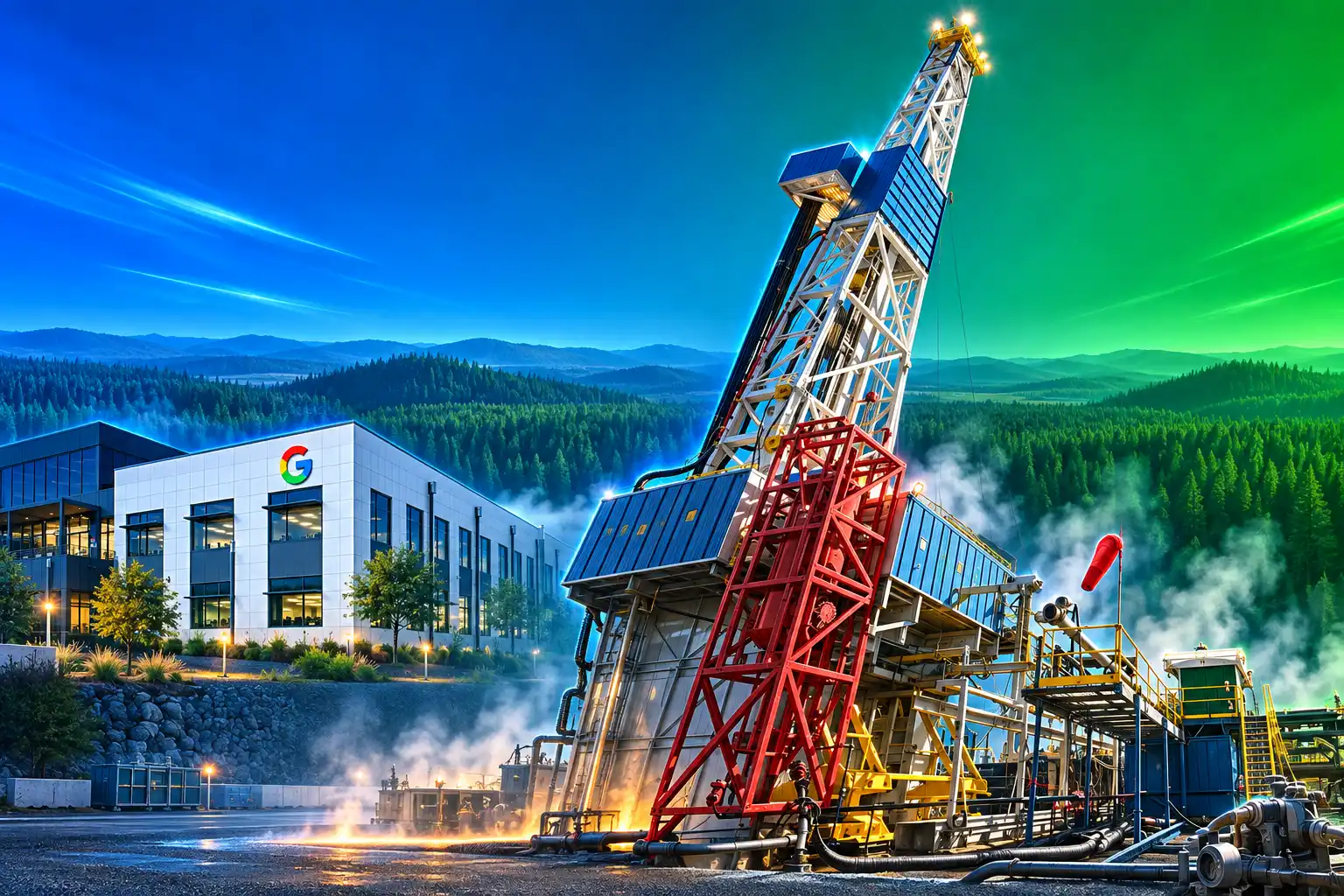
The Rock-Melting Beams Come in Phase II
Quaise is famous for a drill that does not chew rock. A gyrotron, a vacuum tube borrowed from fusion research after more than a decade of work at MIT, fires millimeter-wave energy down a waveguide. The beam heats the stone until it spalls, melts, and turns to ash, which a purge gas carries out of the hole. There is no bit at the cutting face, which is the point: steel and diamond fail in rock hotter than about 572°F, or 300°C, the threshold the company calls superhot.
That machine is not what Google is buying first. The initial Obsidian phase, the 50 megawatts in the contract, “will use conventional drilling technology to access superhot geothermal conditions at commercial scale,” Quaise said. The second phase “is expected to be the first in the world to use millimeter wave drilling.” Later phases are drawn at 250 megawatts, then up to 1 gigawatt. Google’s paper covers the first block. Quaise is still hunting offtakers for an extra 200 megawatts on the same ground.
Newberry is the reason a normal rig can even try. Magma sits closer to the surface here than in most of the country, so an oil-field well can, in theory, reach rock hot enough to flash injected water into steam without a sci-fi bit. The method for that first plant is an engineered geothermal system: fracture the rock, pump in water, let the heat make steam, spin a turbine. Traditional hydrothermal plants hunt rare pockets of natural hot water that, Quaise says, rarely exceed 600°F. The company says superhot wells can make up to 10 times more electricity each than those older systems. That multiplier is a design target, not a meter reading.
Quaise has described a later hybrid in which a conventional string goes down about 2.5 miles, then the beam takes over. That sequence is the worldwide pitch, the one that would let superhot plants sit far from volcanoes. It is also the sequence that has not yet produced power. The Clean Air Task Force’s heat map still frames the prize as enormous: just 1% of U.S. superhot rock potential could yield 4.3 terawatts of clean firm power, in a preliminary model, not a drilled inventory.
The public story never made that split. Even the company’s own channel led with Google as first customer and superhot geothermal stepping toward the market, which is true as far as a signed offtake goes and silent on which drill will open the first well.
With @Google as our first customer, superhot geothermal has taken the next major step toward commercialization.
This is just the beginning. See how the story is unfolding:
📰@WSJ: https://t.co/e9PHDyEhYa
📻@OPB: https://t.co/0CU5pzd2Kj
🎧@EnergySPG: https://t.co/5pk6e0pMSu… pic.twitter.com/bqJruPKn4W— Quaise Energy (@QuaiseEnergy) November 19, 2026
118 Meters of Granite, Then a Hard Stop
The beam works in a quarry. It has not yet drilled a geothermal production well. Quaise’s completed field record is a hole about 118 meters deep in granite at a central Texas quarry, finished in July 2025 on the first try, with a camera showing a clean wall from soil into stone. In July 2026 the company said the same Texas system was approaching 1 kilometer. That deeper mark was in progress, not logged as done.
THE MILLIMETER-WAVE DEPTH LADDER
- Fall 2024: Drills 4 feet into a granite core inside the Houston lab, then 10 feet into another core just outside it.
- May 2025: Drills 40 feet into a granite core on a full-scale Nabors oil rig outside Houston.
- July 2025: Completes about 118 meters at a granite quarry in central Texas, soil into granite, the deepest hole the company reports with the beam.
- July 2026: Says the Texas field system is approaching 1 kilometer; the figure is a company status, not a finished, independently logged depth.
- July 2026: Starts conventional drilling at Project Obsidian in Oregon on a Nabors PACE-B rig.
A lab core, a quarry hole, and a miles-deep production well are three different jobs. No source reports the Texas granite at superhot temperature. No deep geothermal well completed with millimeter waves has been published. The climb from 4 feet to 118 meters in under a year is the demonstrated fact. Everything past that, including the 1-kilometer target, is still a target.
Nabors Holds 14% and Runs the Oregon Rig
The party with steel in the ground is not a search company. On August 27, 2026, Nabors Industries, the listed land driller, completed a $35 million strategic equity investment in Quaise, paid with about 392,000 Nabors shares. That stake made Nabors the largest shareholder at 14% fully diluted and sat inside Quaise’s $180 million Series B, which brought total funding, the startup said, to $280 million.
A Nabors PACE-B rig is already drilling at Obsidian. The companies also set an exclusivity arrangement for Nabors to provide drilling on Quaise geothermal projects, plus a wider framework on rig engineering, automation, and field work. Anthony G. Petrello, Nabors’ chairman, president, and chief executive, called the holding a way to pair Quaise’s design with Nabors’ global platform. For a land driller watching oil-field utilization, a superhot well is another hole that still needs a mast, a crew, and a contract.
That is the quiet transfer inside the headline. If the beam ever replaces the bit at depth, Nabors still wants the rig it bolts onto. If Phase I stays conventional, Nabors is already turning to the right on federal leases. Either path, the offtake Google signed is what lenders and equity desks use to argue the plant is more than a slide deck. Araque has said as much in plainer words: the signature is a commercial foundation. It is also a construction-finance instrument for a well that was still being drilled in the fall.
Utah Already Has a Larger Google Geothermal Contract
Google is not waiting on Newberry for its first next-generation geothermal electrons. Fervo Energy, which uses engineered reservoirs and ordinary oil-field tools, declared commercial operation at Cape Station’s first 33-megawatt GeoBlock in Utah on September 30, 2026. That unit is a different plant and a different method class, already selling power under a PPA.
GOOGLE’S TWO GEOTHERMAL OFFTAKES
| Project | Contracted power | Earliest power | What is in the ground now |
|---|---|---|---|
| Project Obsidian (Quaise, Oregon) | 50 MW | as early as 2030 | Conventional Phase I well; beams slated for Phase II |
| Cape Station (Fervo, Utah) | 396 MW | mid-2028 | 33 MW GeoBlock 1 in commercial operation since Sept. 30, 2026 |
On September 1, 2026, Fervo signed what it called the largest enhanced-geothermal power purchase agreement to date, a 15-year take-or-pay deal that supplies 396 megawatts, with first power expected mid-2028. That block, Cape Google 400, is an expansion beyond the 33-megawatt unit already running. Fervo also committed to an option of about 600 megawatts more, which would take Google’s Utah offtake toward 1 gigawatt. The Oregon paper is 50 megawatts against that 396-megawatt Utah contract, nearly eight times larger and due two years earlier.
The mismatch is the tell. Goldman Sachs Research projects global data-center power demand will jump 170% between 2025 and 2030, with more than 60% of that growth in the United States. Google is spreading bets across geothermal shops, including Fervo, while Meta has signed with Sage Geosystems and XGS Energy. Tian has said the scale of power Google wants, and the scale of impact it wants on the grid, requires it to back more than one new technology at once. A 50-megawatt, 2030 start does not rewire The Dalles. It keeps a superhot developer alive long enough to try the well.
Two Superhot Projects Share One Oregon Volcano
Quaise does not have Newberry to itself. Mazama Energy, another superhot developer on the same volcano, raised $135 million in September 2026, with Centaurus Capital, Doerr Capital, ConocoPhillips, Shell Ventures, Khosla Ventures, and Gates Frontier in the round. Mazama has reported rock at 629°F and a 15-megawatt project, Ceres, aimed at 2027, three years before Obsidian’s earliest Google deliveries. It has also advertised cooling gear that, it says, lets crews drill 20% faster in 645°F rock.
That race is local and unsentimental. Newberry is one of the most studied geothermal sites in the country because the heat is shallow enough that today’s tools can touch it. A commercial superhot plant that actually runs here would prove the reservoir and the turbine, not the fusion-grade bit. Mazama is trying to get electrons out with faster conventional wells. Quaise is trying to get a first 50 megawatts out with a conventional Phase I, then sell the beam as the thing that takes the design anywhere. Both can be true. Only one will be first to a meter.
Water sits under the romance. Engineered systems inject fluid to make steam. A reply to Google’s own energy staff on X went straight at that point, and at Google’s record with novel power plants that did not age as advertised. The contract does not disclose how much water Obsidian will use, or how Oregon’s allocation fights will treat a new industrial wellfield. Those questions will be answered in permits, not in a launch post.
What Still Has to Work Before 2030
Four years is a short construction calendar for a first-of-kind geothermal plant and a long time in the AI power scramble. The offtake is signed. The plant is not. Quaise has a PACE-B turning, a $350 million budget, and a customer for the first 50 megawatts. It still has to finish the subsurface work that turns a volcanic lease into a turbine that runs.
WHAT PHASE I STILL HAS TO PROVE
- The temperature: Quaise’s own drilling has not yet logged superhot rock; Newberry is the bet that a conventional well can.
- The reservoir: An engineered system has to keep water moving through fractured rock hot enough to make steam, for years, not for a test.
- The date: “As early as 2030” is a target in a release that also carries a page of forward-looking caveats.
- The next buyers: Phase II is drawn at 250 megawatts, and Quaise still needs offtakers for 200 megawatts beyond Google if that block is to be sized as planned.
- The beam: A 118-meter quarry hole is not a production well; Phase II is where the gyrotron has to earn the headline it already got.
On the southern flank of Newberry, the Nabors mast is the part of the story you can photograph. Google’s 50 megawatts are sold. The beams that vaporize granite remain a later phase, still measured in quarry meters, not in megawatts on the Oregon grid.

Jennifer Lopez and Mahershala Ali Describe a Pipeline They Cannot Buy

Lightsail Scatter Turns to Drag Far Above Starshot

Tallulah Willis Deletes a Bruce Willis Photo She Called Intimate

S&P 500 Futures Rebound Into a Holiday-Shortened Week

GTA VI’s Record Launch Still Needs the Same Fragile Grid

Aramco Crash Kills 14 Two Days After Oil Restart

Salah Captained Egypt to Their First World Cup Win

Zelda’s 40th Switch 2 Ships Without a Zelda Game

Apple Labor Day Deals Hide June’s Memory Price Hike

El Niño Puts Israel’s Needed Winter Rain on a Flood Clock
-
 BUSINESS5 months ago
Aramco Crash Kills 14 Two Days After Oil Restart
-
 NEWS6 months ago
Salah Captained Egypt to Their First World Cup Win
-
 GAMING3 months ago
Zelda’s 40th Switch 2 Ships Without a Zelda Game
-
 NEWS3 months ago
Apple Labor Day Deals Hide June’s Memory Price Hike
-
 NEWS5 months ago
El Niño Puts Israel’s Needed Winter Rain on a Flood Clock
-

 GAMING3 months ago
Palworld 1.0.4 Adds Palpedia Search After the 1.0 Launch
-

 NEWS4 months ago
Saudi Visa Routes Split Nigerian Travelers Into Two Speeds
-

 BUSINESS9 months ago
BAE’s 60-Year Saudi Franchise Now Runs Through Taif