
NEWS
Googlebook OLED Blacks Go Gray After the OS Loads
Googlebook OLED blacks turn gray after Googlebook OS loads. Google says a software patch will restore them without a panel swap.

Google has traced washed-out Googlebook OLED blacks to software and says a patch can restore them without a panel swap. The panels already show true black at boot, and the gray arrives after Googlebook OS loads.
That is a sour pitch on machines that start at $899 and run to $1,299, four of them sold on OLED. Google’s Mishaal Rahman told owners the team found the root cause and believes an update will be enough.
The Panels Go Black Before the OS Loads
The giveaway is timing. Affected laptops show inky black on the boot logo and during setup, then the same pixels lift into a cloudy dark gray once Googlebook OS reaches the desktop. A dead panel does not heal itself for the firmware splash and fail after login.
Owners of Acer and Lenovo OLED Googlebooks began posting in mid-October that Netflix letterbox bars and full-screen YouTube looked closer to an edge-lit LCD than to pixels that had switched off. Acer owners added that the gray floor moved when they dragged brightness, which is a software path, not a cracked sheet of glass.
WHAT OWNERS ARE SEEING
- Boot and setup: Blacks look correct until Googlebook OS finishes loading.
- Dark video: Letterbox bars and night scenes read as dark gray on Netflix and YouTube.
- Acer brightness: The gray floor shifts as the brightness slider moves.
- Side-by-side: A Lenovo Googlebook 15 sat next to a Galaxy Tab S9 Ultra in a dark room still glowed while the tablet’s pixels went off.
A Lenovo owner who opened chrome://gpu said the OS was already sending full-range RGB and a 0,0,0 black. The panel still would not drop to zero nits. That points at the driver or the controller after Googlebook OS takes over, which is why Google’s own HDR brightness enhancement toggle and brightness slider cannot be treated as the fix.
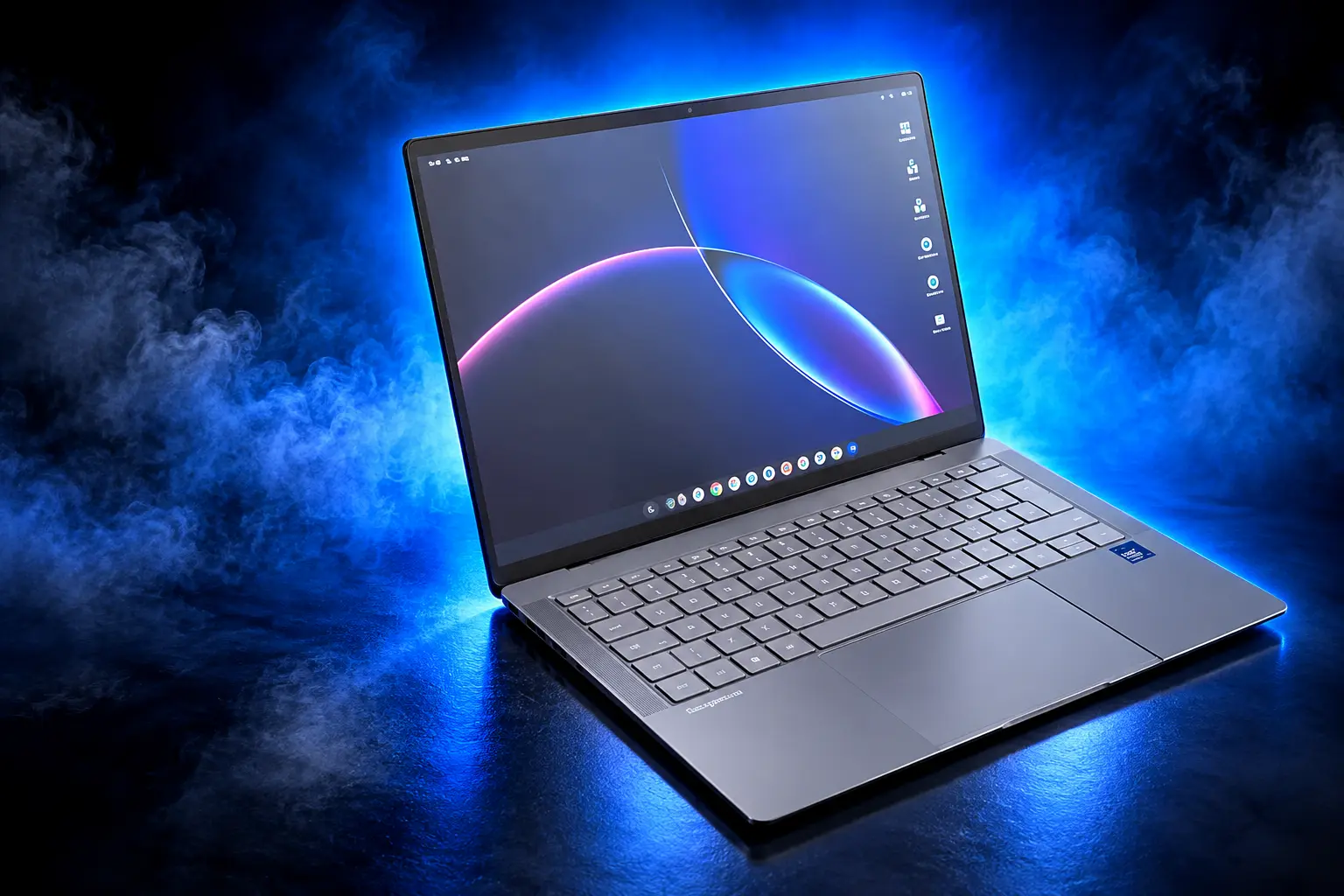
An ASUS OLED Hit 1250:1 Contrast in Lab Tests
Lab tests on an ASUS Googlebook 14, taken with CalMAN and an X-Rite i1Pro 3, put black at 0.42 cd/m² and contrast at 1250:1. Those are IPS-class numbers on a 14-inch 2880 x 1800 OLED rated for 120Hz. Peak SDR brightness still cleared 540 cd/m², with a 527.4 cd/m² average, and HDR peaked at 1266 nits, so the panel can go bright. It is not going dark.
On the same comparison chart, an HP Googlebook 14c with a Snapdragon X Elite recorded a 0.02 cd/m² black level and 25,750:1 contrast. Both machines are Googlebooks. Both use OLED. Only one of them is lighting the black floor.
TWO OLED GOOGLEBOOKS UNDER THE SAME METER
| Machine | Chip | Black | Contrast |
|---|---|---|---|
| ASUS Googlebook 14 | Intel Core Ultra 7 355 | 0.42 cd/m² | 1250:1 |
| HP Googlebook 14c | Snapdragon X Elite | 0.02 cd/m² | 25,750:1 |
The ASUS unit was also stuck in sRGB, with CalMAN ColorChecker at 3.5 ΔE and greyscale at 5.6 ΔE. The HP unit was sRGB-locked too, so that color-space clamp is a separate Googlebook OS limit. It does not explain why one OLED behaves like IPS and the other turns pixels off.
Four Googlebooks Shipped With OLED, One Did Not
Google opened preorders on September 21, 2026, with five partner laptops from Acer, ASUS, Dell, HP, and Lenovo. US shelves opened on October 4, then Canada, the UK, Ireland, France, Germany, and Australia on October 5. Every machine ships with 16GB of RAM as the floor. Google has promised up to 10 years of software updates.
The company’s store still sells the pitch on panel type. Its OLED and IPS LCD specs put a 15.3-inch Lenovo OLED, 100% DCI-P3, 500 nits, and 120Hz next to the 13.4-inch XPS Googlebook, which is the only launch model with an IPS LCD.
THE FIVE LAUNCH GOOGLEBOOKS
| Model | Display | Starting price | Chip |
|---|---|---|---|
| Acer Googlebook 14 | 14-inch OLED, 2880 x 1800, 500 nits | $899 | Intel Core Ultra 5 |
| XPS Googlebook | 13.4-inch IPS LCD, 2560 x 1600, 500 nits | $999 | Snapdragon X Elite |
| Lenovo Googlebook 15 | 15.3-inch OLED, 2880 x 1800, 500 nits | $1,099 | Intel Core Ultra 5 |
| ASUS Googlebook 14 | 14-inch OLED, 2880 x 1800, 120Hz | $1,299 | Intel Core Ultra |
| HP Googlebook 14 | 14-inch OLED, 2880 x 1800 | $1,299 | Snapdragon X Elite |
Owner reports of gray blacks cluster on the Intel Acer and Lenovo machines. The measured ASUS unit is Intel as well. The XPS never promised OLED, so its buyers are not in this fight. HP’s Snapdragon OLED is the control sample that still looks like an OLED.
Acer Certified True Black on the Convertible
Acer priced the only convertible at $899 and hung the display on OLED. The September 21 press release lists a 14-inch 2880 x 1800 touch panel, 500 nits, 100% DCI-P3, Gorilla Glass, and VESA DisplayHDR True Black 500 certification. True Black is a VESA grade written for OLED and similar emissive panels, where black is supposed to mean the pixel is off.
Google’s Lenovo listing uses the same 500-nit, 100% DCI-P3 OLED language. The ASUS 14 is the $1,299 Intel machine whose lab contrast landed at 1250:1. Buyers were not shopping a “good enough” IPS. They were shopping the spec that OLED exists to deliver.
Ten days after US launch, that spec was the complaint. Rahman answered on the r/Googlebook thread rather than through a staged product note, which is how a three-week-old platform is being supported in public.
No Date on the Software Fix
Rahman posted as Google’s community specialist after the gray-black thread piled up. He did not name the code path. He did say the engineers had it, and that the company does not plan to pull panels.
Hi there, thanks for flagging this issue to us. Our engineering team has identified the root cause and is working on getting out a fix ASAP. We’ll keep you posted!
Mishaal Rahman, Google community specialist, r/Googlebook
When owners asked whether this could be done over the air, he said, “Yes, the team believes we can fix this issue with an update. I don’t have an exact ETA to share, but we’re working to push this fix out as soon as we can!” On October 21 he added that the fix “should be available soon,” still with no calendar day, and that he expected a more detailed progress note shortly.
THE ROAD TO A PATCH
- September 21, 2026: Google opens Googlebook preorders. Acer publishes DisplayHDR True Black 500 on the 14-inch convertible.
- October 4, 2026: US sale starts, with six more countries on October 5.
- October 14, 2026: Rahman says the root cause is identified and a fix is coming ASAP.
- October 15, 2026: Lab tests on the ASUS Googlebook 14 publish a 0.42 cd/m² black level and 1250:1 contrast.
- October 21, 2026: Rahman says the fix should be available soon and still has no date.
Some buyers were already lining up Best Buy returns before that first reply. The software answer is also a commercial one. A panel swap on four OLED SKUs would have been a launch-week recall in all but name. A patch keeps the glass in the lid.
Why the HP OLED Still Turns Pixels Off
The HP Googlebook 14c result is the cleanest evidence that this is not “OLED laptops, as a class.” That Snapdragon machine, on the same test bench as the ASUS, still delivered 0.02 cd/m² and 25,750:1. Googlebook OS can drive an OLED to true black. It is failing the Intel path that Acer, Lenovo, and ASUS share, which is also where the public complaints sit.
Google has not said the bug is Intel-only. Rahman’s notes never named a chip. The pattern in the owner thread and in the lab chart still runs that way, and it fits a new Android desktop stack that has to talk to two GPU drivers in the same product family. The cheaper reading, that every OLED Googlebook is broken, does not match the HP meter.
By October 22 Google had not posted a public drop note for the patch. Rahman’s October 21 line was still “soon.” Those laptops already carry a promise of up to 10 years of software updates, and the first display fight is whether Googlebook OS will let the pixels go dark.

Cook Hands Democrats the House as Crypto’s Bill Stays Dead

Wicker’s Broken Bed Was the Short Story’s Punch Line

Nvidia’s $500 Billion Financing Plan Draws a $180 Sell

Maserati Bets the Grecale V6 Can Fill Porsche’s Gap

EV Cable Theft Follows the Old Railway Copper Playbook

Aramco Crash Kills 14 Two Days After Oil Restart

Salah Captained Egypt to Their First World Cup Win

Zelda’s 40th Switch 2 Ships Without a Zelda Game

Apple Labor Day Deals Hide June’s Memory Price Hike

Palworld 1.0.4 Adds Palpedia Search After the 1.0 Launch
-
 BUSINESS4 months ago
Aramco Crash Kills 14 Two Days After Oil Restart
-
 NEWS5 months ago
Salah Captained Egypt to Their First World Cup Win
-
 GAMING2 months ago
Zelda’s 40th Switch 2 Ships Without a Zelda Game
-
 NEWS2 months ago
Apple Labor Day Deals Hide June’s Memory Price Hike
-
 GAMING2 months ago
Palworld 1.0.4 Adds Palpedia Search After the 1.0 Launch
-

 NEWS4 months ago
El Niño Puts Israel’s Needed Winter Rain on a Flood Clock
-

 BUSINESS8 months ago
BAE’s 60-Year Saudi Franchise Now Runs Through Taif
-

 BUSINESS8 months ago
Egypt Bets EGP 638 Billion Can Open Sinai to Investors