
NEWS
Europe’s €1.8 Billion Tech Week Rested on Three Packages
European tech funding topped €1.8 billion in a week of 65-plus deals, but ID Finance, Stryker’s CMR option and EZO debt built the league tables.

Deal tallies for European tech funding in the seven days through 18 October 2026 ran past 65 rounds and €1.8 billion. Fintech’s €621 million, Spain’s €586.3 million and Ireland’s €194.6 million all lean on a handful of packages, not a wide bid from venture funds.
The United Kingdom still led on €694.4 million. Healthtech took €478 million and energy €236.6 million. Peel the three heaviest cheques off those columns and the week looks like a mid-market industrial list, plus US buyers walking out with the exits.
One Barcelona App Accounts for Spain’s Week
Barcelona consumer lender ID Finance said on 13 October it had secured €545 million of debt and equity to grow Plazo, its payments, rewards and short-term credit app. That single package is 93 percent of Spain’s €586.3 million and 88 percent of the week’s fintech total. It is also about 30 percent of the €1.8 billion floor for the whole continent.
The company did not split equity from debt and did not give a valuation. Repeat backer i80 Group supplied asset-based financing against receivables, after a $150 million debt line in early 2024. Spice Expeditions, WashU and Kingsway Capital were named as leads. German asset manager nordIX had already added a €21 million credit line in September.
Founders Boris Batine and Alexander Dunaev, former Deutsche Bank bankers, built ID Finance in 2012. The group booked €243 million of revenue in 2025 and said profit nearly doubled. Plazo reached net profitability, grew revenue 300 percent, and passed 400,000 users. Dunaev said the money would expand the product suite, including Turrón, a buy-now-pay-later tool launched in July, and that Plazo’s book should grow another 300 percent in 2026 on AI underwriting.
“This investment is a strong vote of confidence in Plazo and in the model we’ve built to modernise consumer credit in Spain,” Dunaev said.
Spain’s leftover €41.3 million is a different country. Qilimanjaro Quantum Tech closed €19.6 million as a first close of Series A. Causa Prima took $20 million in seed three months after its pre-seed. Cofrai closed €2.6 million, Ruit €880,000, and Constrik €350,000. Quantum hardware and construction software did not put Spain on the podium. The loan book did.
Stryker Paid for a Call on Cambridge Robotics
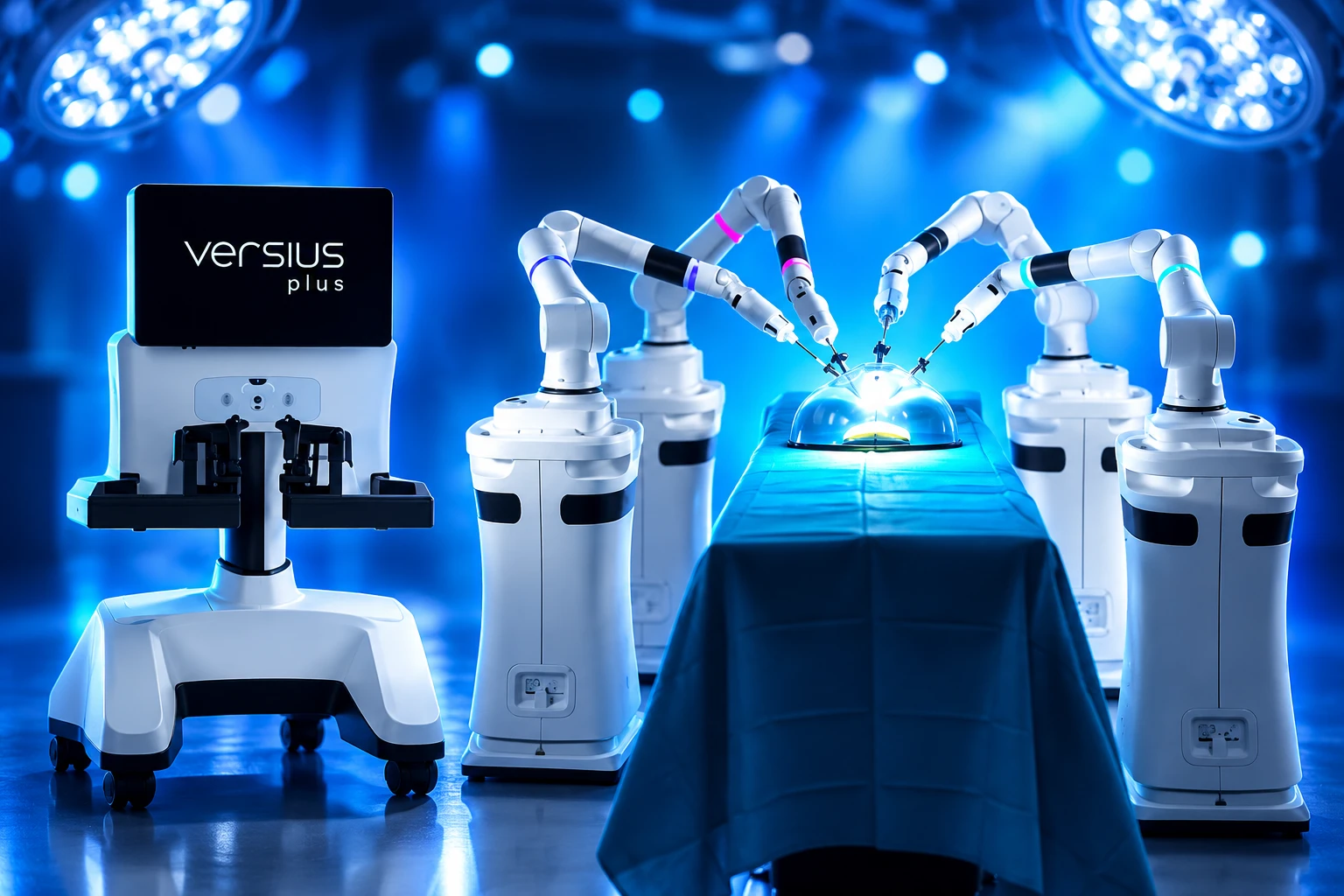
Cambridge-based CMR Surgical announced on 12 October a $400 million preferred equity investment from Stryker, the US medtech group, with a sterling figure of £300 million. Stryker also takes an exclusive option to buy 100 percent of CMR later, and becomes the exclusive US sales agent for the Versius soft-tissue robot. Andy Pierce, Stryker’s group president for MedSurg and Neurotechnology, is due to join the board. The investment still needs regulatory approvals and ordinary closing conditions. No takeover has completed.
Cambridge Innovation Capital, CMR’s first institutional backer, said Versius is the second most widely used soft-tissue surgical robot in the world, with more than 50,000 operations in more than 35 countries. In Britain it works with more than 20 NHS trusts, including Addenbrooke’s, Guy’s and St Thomas’, and Manchester Royal Infirmary. Product work stays in Cambridge. Manufacturing stays in Ely.
This strategic alliance is a significant milestone for CMR and a strong endorsement of the technology, clinical experience and global business we have built. Stryker’s investment will give us additional strength to accelerate innovation and the continued global expansion of the Versius portfolio, while its scale and deep customer relationships create a significant growth opportunity in the United States.
Massimiliano Colella, Chief Executive Officer, CMR Surgical
Stryker, whose market value CIC put at more than $100 billion, called the move a careful entry into soft-tissue robotics after years of watching the segment. For the UK column, it is the largest line in a €694.4 million week, and it is structured as a path into American ownership rather than a classic growth round from European funds.
October’s new robotics money was already top-heavy before this alliance landed. The Stryker cheque is the sort of package that fills a weekly total without telling you whether Britain still holds the company in five years.
Ireland’s Rank Rests on a Charger Facility
Ireland’s €194.6 million is 77 percent EZO. The Irish EV charging firm reached financial close on a €150 million investment-grade, non-recourse senior debt facility with a consortium that includes Aberdeen Investments and Standard Life, a close the company posted in mid-September and that still sat in the mid-October count.
The money is meant to fund design, installation, operation and maintenance of more than 3,000 charge points, more than 100,000 kW of capacity, across Ireland and the UK, mostly under long public-sector concessions. Revenues from those chargers are ring-fenced to repay the debt over seven years. Chief executive Ollie Chatten’s firm already runs thousands of sockets and has said the UK should become its main market by 2027.
That is project finance for sockets, not a venture bet on software. The leftover €44.6 million is essentially LearnUpon’s $50 million growth facility. Third place in the country table is a pension-style charger line plus a learning-software loan, not a burst of Irish seed activity.
What the €1.8 Billion Looks Like Without ID Finance
Strip the Spanish package out of the published slices and the league table changes shape. Healthtech’s €478 million still has Stryker’s CMR line at the top. Energy’s €236.6 million is a cluster of hardware and software firms, not one lender. The UK list is long. Spain, fintech and Ireland are not.
WHERE THE WEEKLY TOTALS ACTUALLY SAT
| Slice | Tracked total | Largest package | Remainder |
|---|---|---|---|
| Spain | €586.3 million | ID Finance €545 million | €41.3 million |
| Fintech | €621 million | ID Finance €545 million | €76 million |
| Ireland | €194.6 million | EZO €150 million debt | €44.6 million |
The prior seven-day tally in the same series had been a little over €818 million across more than 70 deals. This week’s jump is the Spanish book and the Cambridge robot option, not a doubling of cheque counts. Crunchbase had already put European startup funding at $25 billion in the third quarter, up 77 percent from $14 billion a year earlier, with AI taking $18.8 billion, or 75 percent. Against that run-rate, €1.8 billion in seven days is a normal autumn week wearing unusual labels.
THE HEAVY DATES
- October 12, 2026: Stryker agrees $400 million of preferred equity in CMR Surgical, with an option to buy the rest. 1KOMMA5° prices a new round at a $1.35 billion pre-money valuation.
- October 13, 2026: ID Finance announces the €545 million mixed package. Jensen Huang, in Paris, names Nvidia stakes in four French firms.
- October 14, 2026: Salience Labs closes a $125 million Series B for photonic switches.
- October 15, 2026: Intuit says it will buy Sequence. Terms stay blank.
More than five exits and related deals sat beside those dates, including Accenture’s purchase of UK customer-intelligence firm Sagacity and Mistral’s buy of British company New Material, its fourth acquisition in eight months. The funding table still did the talking.
Oxford Photonics Drew Intel and AMD Into the Round
The cleanest large equity cheque in the UK column was not a loan and not a call option. Oxford-based Salience Labs, which builds all-optical circuit switches for AI data centres, said on 14 October it had closed an oversubscribed $125 million Series B led by Bullhound Capital.
AMD Ventures, Intel Capital, SBI Group, Hudson River Trading and the British Business Bank joined, as did existing holders Applied Ventures, Oxford Science Enterprises, Cambridge Innovation Capital and Silicon Catalyst Ventures. Callum Stewart of Bullhound takes a board seat. Chief executive and co-founder Vaysh Kewada said the money would push volume manufacturing and a larger Silicon Valley presence after a live 64-port switch demo at ECOC in September. The company wants 128-port and 256-port units next. Nvidia is not in the cap table.
That Oxford round is actual growth equity into a hardware bottleneck. It also sits in a European AI capital pool that still has dedicated vehicles; one of those recently raised $400 million for European AI firms. Chip-adjacent photonics is where the week’s AI story lives when you stop counting consumer-credit debt as “fintech momentum.”
Around that cheque, the list that actually looks like a funding week is a string of product companies in the €5 million to €50 million band.
THE MID-MARKET CHEQUES
- Dougs: The French accounting firm, bootstrapped for 8 years, took €50 million from Expedition to automate bookkeeping with AI agents.
- Microbiotica: The UK IBD company raised £36 million to push treatments further into the clinic.
- Scarlet: A $50 million Series B is meant to speed AI certification for medical devices.
- Harmonic Security: Another $50 million Series B backs tools that police how staff use AI at work.
- Rabot Energy: $50 million to turn homes into a virtual power plant.
- Duvo: Tomáš Čupr’s Czech enterprise AI firm, from the Rohlik founder, raised $32 million in Series A.
- Turn2X: €20 million Series A in Germany.
Those rounds will not move a country ranking. They are, with Salience, what a diversified week looks like when a lender and a US option are not filling the chart.
Intuit Signed for Sequence as Nvidia Shopped in Paris
Intuit signed an agreement to acquire Sequence on 15 October. Sequence, founded in 2021 and run from London and New York, automates quote-to-revenue work: pricing, billing, invoicing, collections and revenue recognition for usage-based and milestone contracts. Intuit wants it inside Intuit Enterprise Suite and QuickBooks Online Advanced. Financial terms were not disclosed. Figures circulating around the sale have put it near $200 million, a number neither company has confirmed.
Co-founder and chief executive Riya Grover will join Intuit’s mid-market product group. Co-founder Eamon Jubbawy previously built Onfido. Backers have included Andreessen Horowitz, Passion Capital, firstminute capital and 645 Ventures. Intuit called Sequence a Series A company. Ashley Still, who runs Intuit’s small-business and mid-market group, said complex usage-based billing is one of the reasons growing firms pick an ERP, and that Sequence lets Intuit take that job into software and professional services.
Revenue management has long been the most fragmented workflow in the back office. As businesses adopt usage-based and hybrid pricing, that complexity is only growing. We built Sequence to automate the entire process, from contract to revenue recognition, with AI agents automating daily tasks and working securely alongside finance teams. With Intuit’s platform and reach, and our shared alignment on serving mid-market businesses and creating AI-driven financial workflows, this is a natural fit for both companies.
Riya Grover, Co-Founder and CEO, Sequence
The missing price is the hole in the exit. A signed US purchase of a London billing platform can be read as a win for UK AI software, or as another European product disappearing into a Nasdaq buyer before it ever files its own numbers.
Jensen Huang used 13 October in Paris to name four French names rather than one cheque. Nvidia is taking minority stakes in Doctolib, the medical booking platform; Pigment, which makes planning software; Genesis AI, which works on general-purpose robots; and Entalpic, which uses AI to hunt materials at atomic scale. None of the four disclosed a figure. Doctolib said the chipmaker would help it train models in Europe, including a patient assistant already used by 400,000 people in France. Those stakes sit beside the weekly total, not inside a disclosed sum, which is why France does not appear among the three country leaders even as Nvidia shops there.
Smaller Cheques Filled Out Energy, Health and Accounting
Hamburg home-electrification company 1KOMMA5° is the energy column’s valuation event, not its largest cash raise. A new round of more than €70 million, led by b2venture with Japan’s Marunouchi Innovation Partners joining, set a pre-money valuation of $1.35 billion, about €1.2 billion, 35 percent above its July 2025 round. Existing holders including CalSTRS, eCapital, G2 Venture Partners and Eurazeo came in again.
The company said it will put more than €100 million into Heartbeat AI in 2027, the software that trades, bills and meters household solar, batteries, heat pumps and chargers, with about €35 million of that from its own cash flow. Chief executive Philipp Schröder said the firm is weighing a US push next year. Core hardware, the company said, is profitable at EBITDA and still debt-free, even after it lined up bank facilities of up to €1.5 billion for public and private customers. That is a different use of leverage from ID Finance’s receivables line: a hardware operator funding software with cash and a modest equity top-up.
Elsewhere in the energy and climate list, Epyr raised €15 million after an industrial heat-storage deployment, HyLight €13 million for hydrogen airships, CarbonFarm €7 million against methane from rice, and Tivano €537,000 for carbon removal in Namibia. Health beside CMR included Scarlet and Microbiotica. France’s Dougs, after eight years without outside equity, finally took Expedition’s €50 million. The UK government’s £500 million sovereign VC fund put money into security firm Augur. Skeleton Technologies, the Estonian storage company, was listed as having passed a $1 billion valuation with Siemens backing for a US expansion, another European industrial name pointing west.
Stryker still needs its approvals. Intuit still has not named a price. Deal trackers have already booked both into the week through 18 October, which is how a loan book, a call option and a charger facility become a boom on the page.
Disclaimer: This article is news reporting and analysis of announced funding rounds, valuations and acquisitions, and it is for information only. It is not investment advice, a solicitation to buy or sell any security, or a recommendation of any private round, option, debt facility or public share. Readers who are considering an investment, a secondary sale or a lending position should consult a licensed financial adviser or fund counsel who can review the actual documents, because several of the largest packages named here remain subject to closing conditions and undisclosed terms. Figures, rankings and deal statuses reflect the company statements and deal tallies cited in this piece as of 18 October 2026 and may change as closes, options and undisclosed splits are updated.

Cook Hands Democrats the House as Crypto’s Bill Stays Dead

Wicker’s Broken Bed Was the Short Story’s Punch Line

Nvidia’s $500 Billion Financing Plan Draws a $180 Sell

Maserati Bets the Grecale V6 Can Fill Porsche’s Gap

EV Cable Theft Follows the Old Railway Copper Playbook

Aramco Crash Kills 14 Two Days After Oil Restart

Salah Captained Egypt to Their First World Cup Win

Zelda’s 40th Switch 2 Ships Without a Zelda Game

Apple Labor Day Deals Hide June’s Memory Price Hike

Palworld 1.0.4 Adds Palpedia Search After the 1.0 Launch
-
 BUSINESS4 months ago
Aramco Crash Kills 14 Two Days After Oil Restart
-
 NEWS5 months ago
Salah Captained Egypt to Their First World Cup Win
-
 GAMING2 months ago
Zelda’s 40th Switch 2 Ships Without a Zelda Game
-
 NEWS2 months ago
Apple Labor Day Deals Hide June’s Memory Price Hike
-
 GAMING2 months ago
Palworld 1.0.4 Adds Palpedia Search After the 1.0 Launch
-

 NEWS4 months ago
El Niño Puts Israel’s Needed Winter Rain on a Flood Clock
-

 BUSINESS8 months ago
BAE’s 60-Year Saudi Franchise Now Runs Through Taif
-

 BUSINESS8 months ago
Egypt Bets EGP 638 Billion Can Open Sinai to Investors