
AUTO
Tesla’s Flying Roadster Still Cannot Use Public Roads
Tesla’s new Roadster kickflipped a Semi at McGregor, yet the flying Rocket trim is not approved for public roads and production is slated for 2028.

Tesla showed a new Roadster at SpaceX’s McGregor test site on October 15, 2026, sending it upside down, over a Semi, and to 60 mph in 0.81 seconds. Elon Musk called the night a Tesla and SpaceX collaboration, and said success was not guaranteed. The tricks that made the clip were real. The car Tesla will sell as road-ready is a narrower machine.
Tesla Sent the Roadster Over Its Own Lineup
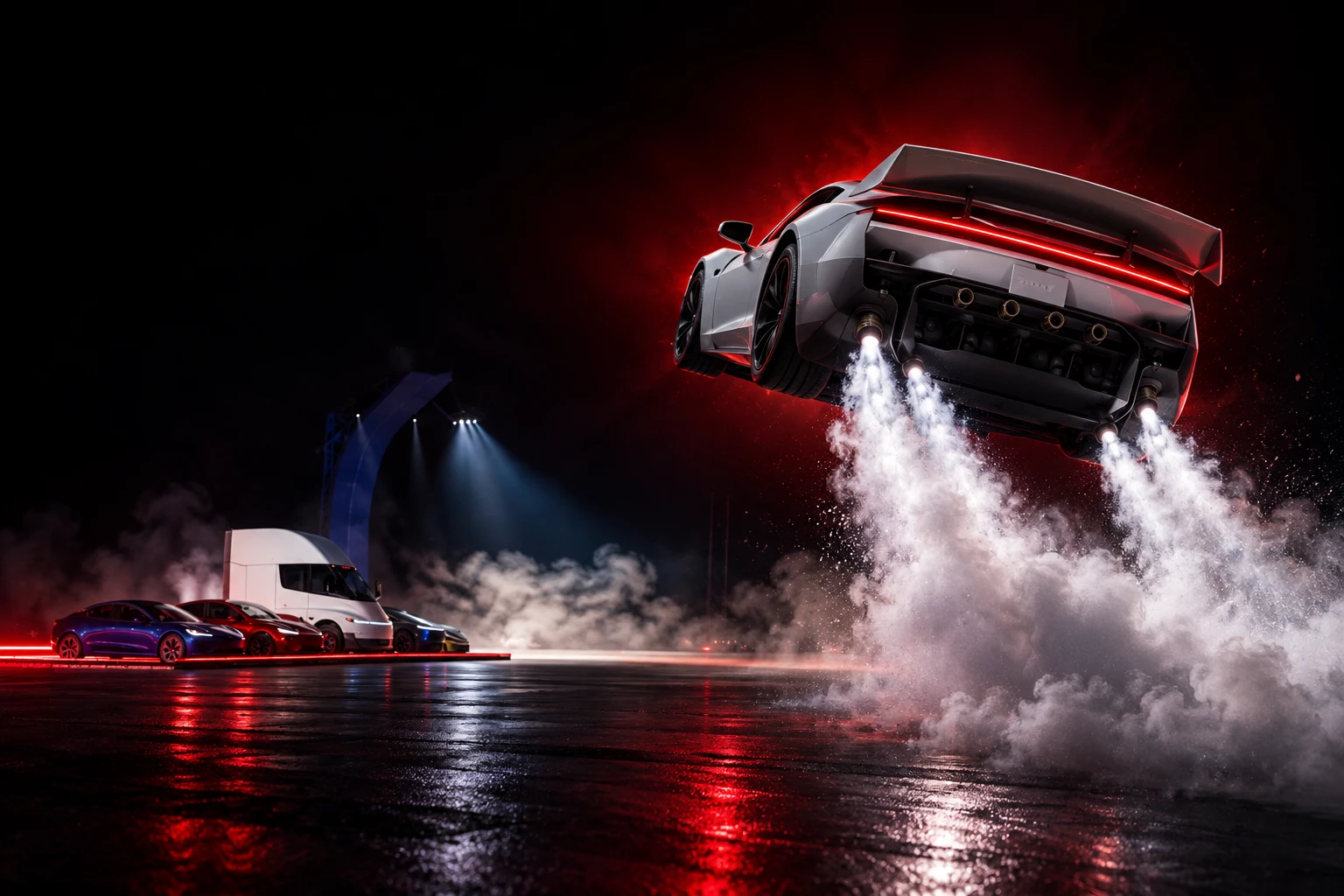
The livestream opened on a CRT-style stage at the SpaceX proving ground outside Waco, Texas, after weather had already killed an October 1 date. Musk told the crowd they would see crazy stuff, then a white two-seater climbed a giant inverted ramp on fan suction, hung upside down, and left the structure on its roof. Cold-gas thrusters rolled it upright and set it down in a cloud of white exhaust.
“Well, it worked,” Musk said. A dummy in a Starman suit sat in the seat. He stressed that it was not a real human, and that the demo run was automated so they would not kill anyone. Later he said the Roadster would be Tesla’s only manually driven car.
This is the culmination of incredible work by Tesla and SpaceX Engineers working closely together to make something you haven’t seen in any movie, better than any James Bond car.
Elon Musk, Tesla CEO, Roadster reveal in McGregor
The second pass was the one built for the internet. The car jumped a parked row of Tesla products, a Model 3, Model Y, Cybertruck, Cybercab, and a Semi, then twisted in the air and landed. Lars Moravy, Tesla’s vice president of vehicle engineering, said Tony Hawk would be proud and that they call that the kickflip. Tesla streamed the whole thing live.
A timed run on the same hardware posted 0.81 seconds to 60 mph, after an earlier pass Tesla clocked at about one second. Musk said a production car could go quicker, then joked about detaching a retina. He also said the car is not a safety-optimized machine, and that it would crush every track record that has existed.
Three Trims, and Only One Is Road Ready
After the stream, Tesla split the myth into three cars. The page now lists active aero, cold-gas thrusters, and suction as separate pieces, and it treats the loudest hardware as extras on top of a base car. All three versions are claimed to top 230 mph and to travel a little over 300 miles on a charge, which is less than half the 620-mile figure Tesla attached to the 2017 prototype.
THE THREE ROADSTERS TESLA LISTED
| Trim | Seats | Tesla’s label | 0-60 claim | Money to hold | Public roads |
|---|---|---|---|---|---|
| Performance | 2 | Road ready | under 1.6 seconds | $50,000 | Road-ready wording |
| Thrust | 2 | Race ready | under 0.9 seconds | $250,000 | Limited; thruster augment |
| Rocket | 1 | Air ready, invite only | under 0.59 seconds | Invitation | Not approved for public road use |
Performance is the street story: two seats, active aerodynamics, and a multi-mode suction system Tesla says can add more than 2 Gs of downforce, against about 1.26 Gs from tires alone. It does not get the rear thrusters that produced the 0.81-second clip. Thrust adds those rear cold-gas jets and is listed as limited. Rocket seats one person, wraps 10 thrusters around the body, and is the configuration that matches the kickflip. Tesla’s own product copy says Rocket is not approved for public road use.
That split is the night in miniature. The footage that will sell posters is the trim Tesla will not register. The trim you can talk about as a car is a very fast EV with fans, and even that 0-60 claim of under 1.6 seconds now sits next to cars that already exist. Rimac’s Nevera R has a claimed 1.66-second run to 60 mph as a production hypercar. In 2017, Tesla’s 1.9-second promise was the shock. In 2026, Tesla needed SpaceX hardware to get the internet to watch, then fenced that hardware off the public road.
What a $50,000 Deposit Buys You
Tesla still has not named a sticker price for any version. It did reopen the reservation pipe at the same cash gate it used in 2017, with a steeper gate for the race car.
HOW THE HOLDS WORK
- Performance hold: $5,000 due at reservation, which Tesla calls fully refundable, then $45,000 within 10 days, for a $50,000 total.
- Thrust hold: $5,000 now and $245,000 within 10 days, for a $250,000 total, or the reservation cancels.
- Rocket access: invite only, with no public deposit path on the page.
- The missing figure: Tesla published no full price for Performance, Thrust, or Rocket.
- The 2017 echo: Tesla once asked $250,000 as the full Founders Series price for 1,000 cars; that sum is now the Thrust deposit alone.
Performance and Thrust reservation holds are live, and Tesla notes the car will not be offered in every region. The product page also says the specs shown there reflect the Thrust augment as an optional upgrade. Buyers putting down six figures are still buying a place in line for a 2028 build, not a vehicle identification number.
YouTuber Marques Brownlee, who has waited through earlier Roadster delays, wrote that Tesla had just told a crowd a newly designed 4,000-plus-pound car can do flips, go half the speed of sound, and ship in 2028, then asked if the night was a prank. The demo was not CGI. The purchase contract is still a calendar.
Nine Years After the 2020 Promise
Tesla first pulled a second-generation Roadster out of a Semi trailer on November 16, 2017, and said production would start in 2020. The original Roadster, built on a Lotus Elise chassis from 2008 to 2012, had already been Tesla’s first production car and the first EV with a lithium-ion pack good for about 200 miles. The 2017 follow-up was sold as a 2+2 with a 200 kWh pack, a 1.9-second 0-60, 4.2 seconds to 100 mph, an 8.9-second quarter mile, and a top speed above 250 mph, from $200,000, or $250,000 for one of 1,000 Founders cars.
THE ROADSTER CLOCK FROM 2017 TO MCGREGOR
- November 16, 2017: Tesla unveils the second-generation Roadster at the Semi event and points to 2020 production.
- June 2018: Musk describes about 10 small SpaceX rocket thrusters around the car for acceleration, top speed, braking, and cornering, and says they might even let a Tesla fly.
- 2020 through 2024: Tesla delays the car while Model 3, Model Y, and Cybertruck soak up the factory.
- April 1, 2026: A promised reveal slips again, after Musk had already missed a late-2025 window.
- October 1, 2026: Severe weather forces another postponement.
- October 15, 2026: The McGregor show lands, and Musk says production starts in 2028, then adds “actually” and “for real.”
Almost nine years sit between the first surprise and this one. The four-seat layout is gone. The range claim fell from 620 miles to a little over 300. The 2020 start date is now 2028. What survived, and then grew, is the 2018 joke about flying. Franz von Holzhausen, Tesla’s chief designer, said the new body draws on the SR-71 and on cars that transform. The company also pointed at the F-35 and at James Bond’s Lotus, a car Musk owns and had on the grounds. Butterfly doors and a coupe roof mean the thing still named Roadster is not, from what Tesla showed, a roadster.
SpaceX Packed Thrusters Into Every Empty Space
Moravy said 10 thrusters feed from about 600 liters of compressed air, held in two carbon-overwrapped pressure vessels with roughly 250 kg of air on board. The tanks can be refilled from ambient air, so the car does not need a separate propellant stop. Tesla said on X that every usable void packed with pressure vessels is the packaging trick, using the same COPV family SpaceX flies on rockets. The liveblog and later recaps put peak thrust above 80,000 N, enough, on paper, to shove a light car to 60 mph in less than a second.
THE HARDWARE TESLA PUT ON STAGE
- Air store: Two COPVs hold about 600 liters and roughly 250 kg of compressed air, then recharge from the atmosphere.
- Nozzles: Ten cold-gas thrusters handle pitch, roll, and the rear shove.
- Suction: Underfloor fans are claimed at up to 2 Gs, which is how the car stuck to the inverted ramp.
- Drive unit: Tesla says a new battery and motor package makes 1 MW, a third more power than Model S Plaid at half the mass.
The cockpit Tesla showed is a two-seat cell with buckets molded into the chassis, a steer-by-wire yoke, and by-wire brakes and throttle. The tablet remains. The car is finished in Ano White. Musk’s top-speed tease is Mach 0.5, about 380 mph if you split the 763 mph speed of sound he was using, which sits well above Tesla’s written claim of more than 230 mph. Those are different targets. One is on the site. The other is a hope from the stage.
None of that hardware is subtle in a crash lab. High-pressure air tanks in every unused cavity, plus a fan system that can glue the car to a ceiling, are why the Rocket line on the configurator reads like a disclaimer. The same kit is why the demo looked like a Hot Wheels ad shot with a real chassis.
Street Legal Depends on Your Street
An audience member yelled the obvious question. Musk said it depends on your street, but that it would be a viable car. Earlier he had said this would be an actual car on the roads, then walked it back.
I’m not necessarily sure it’s legal in all jurisdictions. But there will be such a car that someone can own.
Elon Musk, Tesla CEO, answering the road-use question in McGregor
WHAT WE KNOW
- Performance language: Tesla calls that trim road ready, with two seats and no flight package.
- Rocket language: Tesla says it is not approved for public road use.
- Thrust language: Tesla calls it race ready and limited, with rear thrusters as an augment.
WHAT IS UNCONFIRMED
- NHTSA path: Tesla did not say how a suction car, let alone a thruster car, meets bumper, lighting, and occupant rules, and the prototype appeared to skip conventional side mirrors.
- FAA overlap: A vehicle that can leave the ground sits in a gap between highway rules and aircraft rules that no production car has had to clear.
- Insurance: A policy written for four wheels on pavement has no clean box for a car that can hover and roll.
That last gap showed up immediately in the replies under Musk’s own clip. People did not argue about the 0.81-second clock so much as about who would write a policy on a car that can leave the ground. A machine that needs a special street, a private track, or an invitation is still a product. It is a different product from the 2017 promise of a four-seat, 620-mile, $200,000 road car.
Turns out the future does have flying cars pic.twitter.com/6fexPp6SXI
— Elon Musk (@elonmusk) October 16, 2026
A Halo Car That Will Not Move the Needle
Musk has said he is not sure the Roadster moves the needle massively from a revenue standpoint. Morningstar analyst Seth Goldstein still called it Tesla’s missing halo car, a high-performance luxury piece meant to show off engineering, and put a rough yearly volume around 2,000 units. Tesla is a volume EV maker that has spent the past two years defending share in a slower U.S. market. A two-seat, 2028 sports car does not change that math even if every Rocket invite clears.
Musk also said Tesla may try to jump the Snake River Canyon, the gorge Evel Knievel failed to clear in a steam rocket. “Where we’re going, you don’t need tires,” he told the crowd. The next demo can be wilder. The production date is still 2028. The flying trim is still invite-only. The road-ready car is still the one without the kickflip.

Cook Hands Democrats the House as Crypto’s Bill Stays Dead

Wicker’s Broken Bed Was the Short Story’s Punch Line

Nvidia’s $500 Billion Financing Plan Draws a $180 Sell

Maserati Bets the Grecale V6 Can Fill Porsche’s Gap

EV Cable Theft Follows the Old Railway Copper Playbook

Aramco Crash Kills 14 Two Days After Oil Restart

Salah Captained Egypt to Their First World Cup Win

Zelda’s 40th Switch 2 Ships Without a Zelda Game

Apple Labor Day Deals Hide June’s Memory Price Hike

Palworld 1.0.4 Adds Palpedia Search After the 1.0 Launch
-
 BUSINESS4 months ago
Aramco Crash Kills 14 Two Days After Oil Restart
-
 NEWS5 months ago
Salah Captained Egypt to Their First World Cup Win
-
 GAMING2 months ago
Zelda’s 40th Switch 2 Ships Without a Zelda Game
-
 NEWS2 months ago
Apple Labor Day Deals Hide June’s Memory Price Hike
-

 NEWS4 months ago
El Niño Puts Israel’s Needed Winter Rain on a Flood Clock
-
 GAMING2 months ago
Palworld 1.0.4 Adds Palpedia Search After the 1.0 Launch
-

 BUSINESS8 months ago
BAE’s 60-Year Saudi Franchise Now Runs Through Taif
-

 BUSINESS8 months ago
Egypt Bets EGP 638 Billion Can Open Sinai to Investors