
NEWS
Ubitium Bets $14 Million on One Chip for Physical AI
Ubitium raised $14 million to turn a 256-element test chip into one processor for sensing, inference and control on robots and drones.

Ubitium raised $14 million in seed funding on October 13, 2026, to turn a working test chip into a commercial processor for robots, drones and other machines that sense, decide and move. Ibex Investors led the round. OpenOcean joined, as did existing backers KBC Focus Fund, Runa Capital and Inflection, plus a personal check from Florian Seibel, co-founder and co-CEO of Quantum Systems. The Düsseldorf company now puts total seed funding at $18 million since it was founded in 2024.
The wager is not another inference accelerator. Chief executive Hyun Shin Cho says sensing and control are as hard as the model, and those jobs still run on separate chips. Ubitium wants one reconfigurable RISC-V array to do all three, and this money is meant to turn that array into a product.
A Drone CEO Wrote a Personal Check
Seibel did not come in as a tourist. Quantum Systems builds autonomous aircraft that have to keep working when the radio link drops, inside tight budgets for watts and grams. He framed the check as an operations problem, not a portfolio bet.
An autonomous machine operating in the real world must keep working when communications are unavailable. It has to process its surroundings, make decisions and control itself on board, within strict limits on power and weight. Today that means integrating a stack of chips that were not designed to work together, and every one of them costs weight, power and integration time we don’t have. Ubitium is building the one processor that does that whole job. That’s why I invested.
Florian Seibel, co-founder and co-CEO of Quantum Systems, Ubitium funding announcement
That is the customer voice the round needed. Drones, radar sets and factory machines pay for board space, power rails and the weeks it takes to make three toolchains talk. A defence-tech chief putting his own money on a single part is a different signal from a fund chasing TOPS charts.
Jeffrey Peters, a partner at Ibex Investors, said hardware has not kept up with the pace of AI models, and that Ubitium’s pitch is one silicon die with one set of tools that can be retargeted as the models change. Tom Henriksson, general partner at OpenOcean, called the present stack a patchwork of chips built for other jobs. Both are buying the same claim Seibel is living with: the bottleneck is the glue, not the neural net.
Sensing and Control Still Run Off-Chip
Cho put the technical argument in one line. Physical AI machines bring a new set of computing problems, and inference is not the hardest of them. Sensing the real world and controlling the machine in it are just as hard, and those still run on separate chips. Ubitium built one processor that does all three, proved it in silicon, and is using the new round to turn that proof into a part customers can design in.
The design is a coarse-grained array of programmable processing elements that can be reassigned in software as the workload shifts. Unified memory sits next to that array so samples, weights and control loops do not bounce across chip-to-chip links. The company says the same transistors can be set for CPU-style out-of-order work, DSP-style loops, or GPU-style parallel threads, without a vendor language or a second compiler.
THREE JOBS ON ONE DIE
- Signal processing: Radar and audio chains run as real-time DSP work on the array, which is the first commercial target.
- On-device inference: Neural nets execute locally on the same elements, without a separate accelerator die.
- Machine control: Linux and a real-time operating system run together, so perception code and motion loops share one part.
Makers would keep a standard RISC-V toolchain instead of qualifying a CPU, a DSP and an NPU as three suppliers. The company puts the broader embedded computing market at $115 billion and says a modern vehicle can hold more than 200 processors, each with its own stack. That sprawl is the cost it is selling against.
256 Elements Now, 4,096 on the Product Chip
The round follows first silicon, not a slide deck. The proof chip is the UB108. It has 256 processing elements and was made on Samsung’s 8nm process. Ubitium says it has already run signal processing, AI inference and real-time control on that same array.
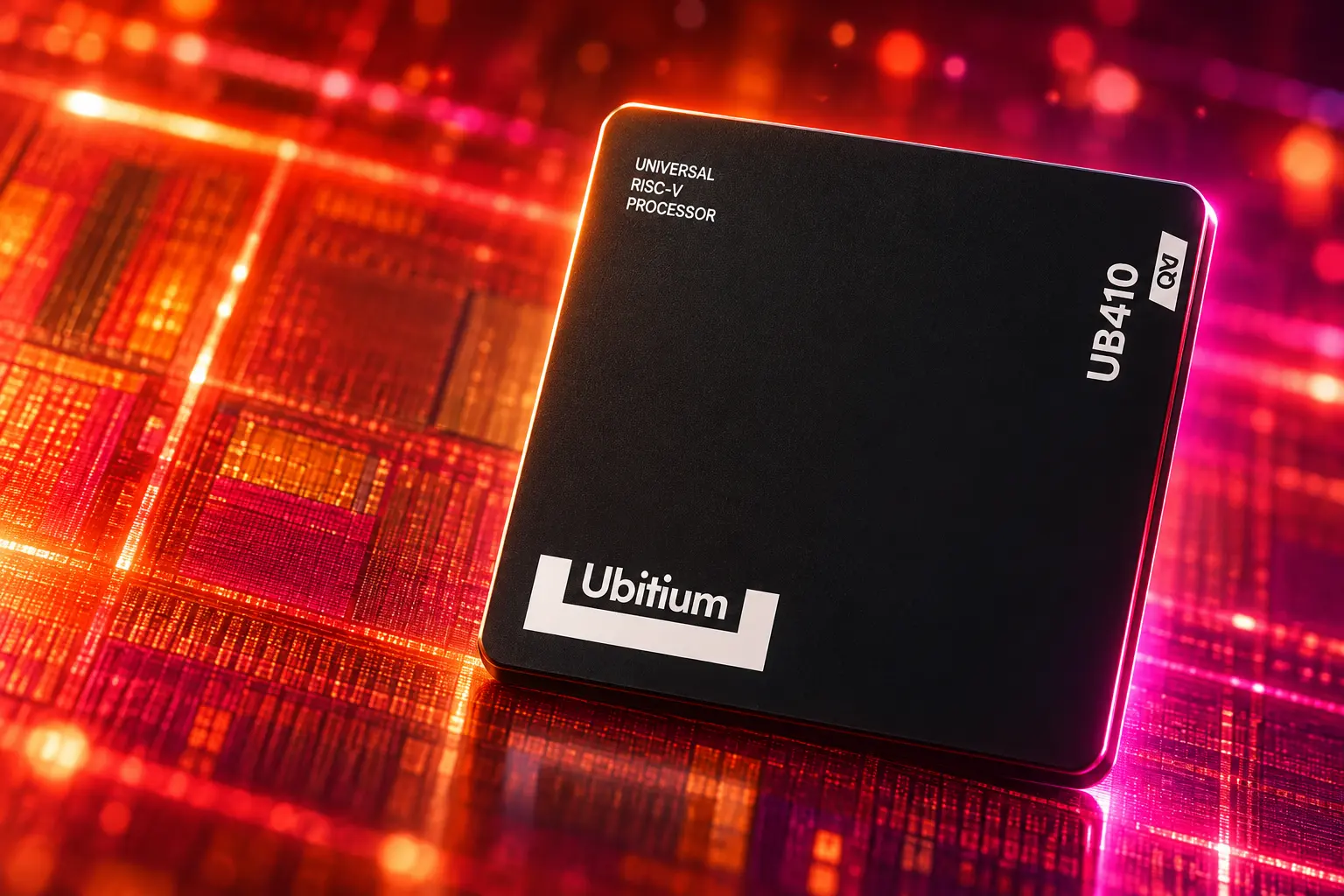
The product chip is the UB410. It is planned with 4,096 processing elements, 16 times as many as the UB108. Tape-out of that part, and delivery of evaluation units, is planned for 2027. Early boards are aimed at high-resolution radar and audio. Drones and other autonomous machines are listed for the full architecture, not as the first sockets.
THE TWO CHIPS IN THE PLAN
| Chip | Processing elements | Role | Status |
|---|---|---|---|
| UB108 | 256 | First silicon, proof of the array | Demonstrated sensing, inference and control on Samsung 8nm |
| UB410 | 4,096 | First commercial processor | Tape-out and evaluation units planned for 2027 |
Rudi Severijns, investment director at KBC Focus Fund, said the universal processor was a bold bet when his firm first wrote a check, and that first silicon in a single year turned that bet into proof. He is staying in alongside Ibex and OpenOcean. Jonatan Luther-Bergquist, general partner at Inflection, said his firm wrote the first check in early 2024 and is coming back because the physical-AI market the founders described has shown up, from drones to humanoids.
The calendar still has a gap. A 256-element part that ran three workloads is not a 4,096-element product in a drone. The new money is for that gap, not for a victory lap.
Martin Vorbach Already Tried This Once
The technical bet is older than the company. Martin Vorbach, co-founder and chief technology officer, founded a microprocessor firm while he was still at university and later built PACT XPP Technologies, a reconfigurable-processor company whose work was licensed to large U.S. chip firms. The company’s about page credits him with more than 200 processor patents. Round materials put Ubitium’s own granted set at 17, with more pending.
In the 2000s his group published the PACT XPP reconfigurable architecture, a coarse-grain array with a packet network aimed at signal processing, graphics and similar streams. That generation still sat next to a host CPU. Ubitium’s claim is that the new array can boot a normal Linux image with no host, which the company said it demonstrated on an FPGA prototype on April 27, 2026, while it waited for Samsung samples.
Cho met Vorbach at the Karlsruhe Institute of Technology in the early 2000s, then spent two decades in automotive, industrial and defence work at a German conglomerate. Peter W. Weber, a former Intel and Texas Instruments executive, is the third co-founder. The wider team lists silicon tours at Intel, Nvidia, Apple and Texas Instruments, plus Markus Weinhardt on the compiler and Martin Burtscher on algorithms. Headquarters is at TechHub.K67 on Kasernenstrasse in Düsseldorf, with a research site in Rülzheim and an engineering centre in Karlsruhe.
Vorbach’s line at tape-out was that embedded workloads have outgrown the parts the industry still uses, and that consolidation is inevitable. He has been making a version of that argument for three decades. The difference this time is RISC-V tools, a foundry partner and a drone buyer in the cap table.
The Stack the Rest of the Industry Still Ships
The rest of the physical-AI market is consolidating too, just not the way Ubitium wants. AMD’s Ryzen AI Embedded X100 series, which began sampling in June 2026, puts up to 16 Zen 5 cores, an RDNA graphics engine and an XDNA neural block on one SoC with shared memory. That is three engines in one package, still specialised, sold as a way to run perception, planning and control without extra cards.
Robot makers already buy that style of module, or they bolt a discrete GPU next to an x86 board, or they hang an NPU off a mid-range Arm SoC. The incumbent answer to Cho’s complaint is to shrink the stack onto one piece of silicon and keep the jobs in separate blocks. Ubitium’s answer is to make the blocks themselves the same, and to retarget them in software.
That is a harder sell on day one. A homogeneous array has to match a DSP on radar, an NPU on a net, and a microcontroller on a control loop, then beat the power and latency of chips that only do one of those jobs. If it misses any one of those, the three-chip board stays. If it hits all three, the BOM, the board and the software team all shrink. The round is a bet that the second path is worth funding through 2027 boards.
Evaluation Boards Are Due in 2027
Ubitium completed the tape-out of its first silicon on Samsung Foundry’s 8nm process in December 2025 and announced it on March 9, 2026. Taejoong Song, vice president and head of foundry technology planning at Samsung Electronics, said the one-processor pitch lines up with where Samsung sees embedded systems heading, and that the foundry was proud to make the first silicon. Siemens Digital Industries Software supplied hardware-assisted verification. ADTechnology ran the back-end on the 8nm node. The tape-out also confirmed an LPDDR5 memory interface next to the array.
Foundry chatter in February 2026 had Ubitium moving toward a larger Samsung 8nm order. The company’s own plan, restated with the new money, still puts evaluation units in 2027. The proof chip is in hand. The product chip is not.
FROM FIRST CHECK TO EVALUATION BOARDS
- November 21, 2024: Raises $3.7 million in a seed round co-led by Runa Capital, Inflection and KBC Focus Fund, with first chips then aimed at 2026.
- December 2025: Completes tape-out of first silicon on Samsung Foundry’s 8nm process.
- March 9, 2026: Announces that tape-out and names Samsung, Siemens and ADTechnology as production partners.
- April 27, 2026: Says an FPGA prototype of the array booted off-the-shelf Linux with no host CPU.
- July 16, 2026: Takes delivery of first engineering samples, the first chip built on the new architecture.
- October 13, 2026: Raises $14 million led by Ibex Investors, bringing stated seed funding to $18 million.
- 2027: Plans UB410 tape-out and delivery of evaluation units, with radar and audio as the first sockets.
Cho’s own summary is the cleanest. The company built one physical-AI processor that does sensing, inference and control, proved it in silicon, and this funding turns it into a product. The proof is the UB108. The product is the UB410. Between those two chips sit a 16-times jump in processing elements, a year of bring-up, and the first customers who have to trust one array with the jobs they now split across a board.

Cook Hands Democrats the House as Crypto’s Bill Stays Dead

Wicker’s Broken Bed Was the Short Story’s Punch Line

Nvidia’s $500 Billion Financing Plan Draws a $180 Sell

Maserati Bets the Grecale V6 Can Fill Porsche’s Gap

EV Cable Theft Follows the Old Railway Copper Playbook

Aramco Crash Kills 14 Two Days After Oil Restart

Salah Captained Egypt to Their First World Cup Win

Zelda’s 40th Switch 2 Ships Without a Zelda Game

Apple Labor Day Deals Hide June’s Memory Price Hike

Palworld 1.0.4 Adds Palpedia Search After the 1.0 Launch
-
 BUSINESS4 months ago
Aramco Crash Kills 14 Two Days After Oil Restart
-
 NEWS5 months ago
Salah Captained Egypt to Their First World Cup Win
-
 GAMING2 months ago
Zelda’s 40th Switch 2 Ships Without a Zelda Game
-
 NEWS2 months ago
Apple Labor Day Deals Hide June’s Memory Price Hike
-

 NEWS4 months ago
El Niño Puts Israel’s Needed Winter Rain on a Flood Clock
-
 GAMING2 months ago
Palworld 1.0.4 Adds Palpedia Search After the 1.0 Launch
-

 BUSINESS8 months ago
BAE’s 60-Year Saudi Franchise Now Runs Through Taif
-

 BUSINESS8 months ago
Egypt Bets EGP 638 Billion Can Open Sinai to Investors