
BUSINESS
TSMC Hits the Limit as the AI Trade Breaks
Asian chip factories hit circuit breakers after the Nasdaq fell 5.52%, as a U.S. data-center vote reached hardware before any federal AI bill.

TSMC opened at its 10% daily limit in Taipei on November 6, the Asian leg of an AI market rout that knocked 5.52% off the Nasdaq Composite. Seoul halted trading for 20 minutes.
No federal AI bill has passed. The selling is already hitting the plants that supply American data centers.
The Nasdaq Just Confirmed a Technical Correction
U.S. stocks gave back Wednesday’s post-election bounce in a single session. The Dow had surged nearly 1,600 points on November 4. On November 5 it closed down 1,833.16 points, or 3.44%, at 51,528.16, and every one of its 30 members finished lower.
The S&P 500 dropped 4.35% to 7,353.85 and shed about $3 trillion in value. The Nasdaq Composite fell 1,421.52 points to 24,315.00. That was its worst day in 19 months, since the Liberation Day tariff shock in April 2025, and it left the index more than 10% below its October 6 record close.
The Nasdaq 100 did worse, sliding 6.36% to 26,629.81, its weakest session since 2020. The Russell 2000 lost 4.45%. Breadth was ugly: 411 S&P 500 stocks fell and 75 rose; 2,822 Nasdaq names declined against 463 advancers. Volume on U.S. exchanges hit 26.9 billion shares, against a 20-session average of 17.7 billion.
U.S. CLOSES ON NOVEMBER 5
| Index | Close | Move |
|---|---|---|
| Dow Jones Industrial Average | 51,528.16 | down 3.44% |
| S&P 500 | 7,353.85 | down 4.35% |
| Nasdaq Composite | 24,315.00 | down 5.52% |
| Nasdaq 100 | 26,629.81 | down 6.36% |
| Russell 2000 | 2,729.84 | down 4.45% |
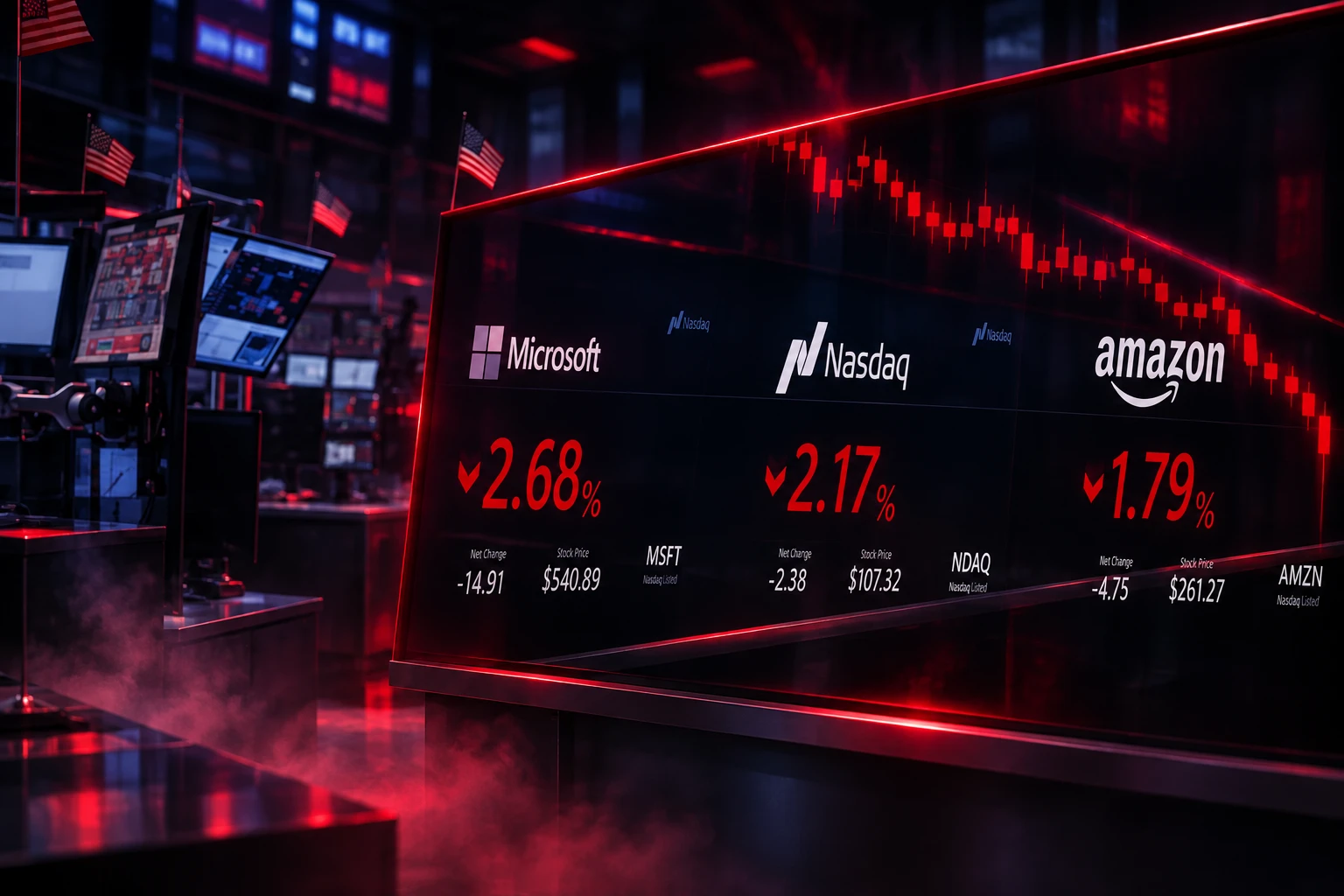
All seven Magnificent Seven stocks fell, but they did not fall together. Tesla dropped 10.77% to $343.69. Nvidia lost 9.26% to $181.60 and is now down about 3% for 2026. Apple held up best, off 1.53% to $344.17, with Amazon down 2.19% and Alphabet down 2.20%. Microsoft slid 3.58% and Meta 3.96%.
After the close the S&P 500 was still up 7.4% for the year and the Nasdaq Composite up 4.6%. Those cushions were 12.3% and 10.7% when the session began. The Russell 2000 remains up 10.1% in 2026, the Dow 7.2%, and the Nasdaq 100 6.7%.
Seoul Halted Trading After an 8.6% Plunge
Friday’s open in Asia was the second-order move the U.S. close implied. Chipmakers that cut wafers and memory for U.S. server halls do not sit in Congress. They sit on the other end of the order book, and they were first through the circuit breakers.
FOUR SESSIONS THAT REPRICED THE AI BUILD
- November 3, 2026: Democrats take the House and the Senate. Local ballots constrain data centers in 40 of 41 measures.
- November 4, 2026: U.S. indexes rally, with the Dow up nearly 1,600 points, as election risk seems to clear.
- November 5, 2026: The Nasdaq Composite falls 5.52% and the Philadelphia Semiconductor Index drops more than 12%, its worst day since March 2020.
- November 6, 2026: The KOSPI trips a 20-minute halt at 9:03 a.m. and TSMC opens at its daily limit in Taipei.
Allen Huang, vice president in the equities trading department at Mega Financial Holding, said the Taipei session had the shape of forced selling. “Today we are bound to see further liquidation of margin accounts, which suggests we are likely in the final stage of capitulation,” he said. “Even TSMC hit its daily limit-down circuit breaker at one point, which typically marks the tail end of a downturn. When TSMC gets sold off, that means all stocks have been thoroughly dumped.”
TSMC Took More Than 40% of the Taiex Down With It
Taiwan Semiconductor Manufacturing Co., which accounts for over 40% of the Taiex, opened at NT$2,020, the 10% daily limit, NT$220 below its November 5 close of NT$2,240. Central News Agency said that was TSMC’s largest drop in absolute price on record and cut about NT$5.7 trillion off its market value. MediaTek, Delta Electronics and ASE Technology also tagged their limits. Hon Hai, known as Foxconn, fell more than 9%.
The Taiex had already lost 3.2% on Thursday, closing at 41,574.72, with TSMC off only 0.88%. On Friday it traded as low as 37,837.05, a 3,737.67-point slide from that close, about 8.99%, and the largest intraday point drop in the index’s history. TSMC’s U.S.-listed shares had already fallen 10.78% on Thursday, so Taipei was catching up to New York, then overshooting it.
Korea’s Exchange Cut the Session for 20 Minutes
The Korea Exchange halted stock and derivatives trading for 20 minutes at 9:03 a.m. after the KOSPI fell 8.6% to 4,923.47, its first print under 5,000 in nine months. Samsung Electronics dropped 10%. SK Hynix, which supplies high-bandwidth memory for AI accelerators, lost 13%. Japan’s Nikkei Stock Average fell 5.5%, with Kioxia down 11% and Tokyo Electron down 7.5%.
Joe Maher, markets economist at Capital Economics, said growing fears about the AI buildout, set against the shift in U.S. politics, had produced another bruising day for tech. Charu Chanana, chief investment strategist at Saxo Markets, put it on the suppliers: opposition to data-center expansion has become a headwind for operators, power-equipment firms and chip companies whose growth math still assumes a fast build.
What a Data Center Vote Does to Chip Orders
Investors are not waiting for a statute. They are marking down the hardware that would fill halls in Texas, Georgia, Ohio and Michigan, states where Democrats who campaigned against new data centers just won.
Gina Hinojosa, the Texas governor-elect, ran on an immediate moratorium on new data centers, an end to industry tax breaks, and a requirement that developers cover their full electricity costs. James Talarico is the Democratic senator-elect there. In Ohio, Sherrod Brown won a Senate seat after tying his opponent to local data-center fights. Abdul El-Sayed takes a Michigan Senate seat after voicing the same skepticism. An NBC exit poll found 56% of voters called AI and data centers a crucial or major factor in their vote for Congress.
Local ballots did the work Congress has not. Voters backed constraints in 40 of 41 local measures across the country. That is the channel that hits a wafer order. A pause in Texas permitting does not need a White House signature. It needs a county board and a governor who campaigned on it.
The public numbers behind those votes have been moving all year. By August, Pew Research Center found that 54% of U.S. adults called data centers mostly bad for the environment, up from 39% in January, with 50% saying the same about home energy costs and 49% about quality of life nearby. In a summer survey, 60% said they would not be too comfortable, or at all comfortable, with a new data center in their area; only 7% were extremely or very comfortable. Earlier in the year, three-quarters of adults had heard of data centers.
Voters overwhelmingly rejected data center expansion in this year's midterms.
In our summer survey, 60% of U.S. adults said they would not be too or at all comfortable with a new data center in their area, while only 7% would be extremely or very comfortable with this.… pic.twitter.com/4OoC93IXIZ
— Pew Research Center (@pewresearch) November 4, 2026
Melissa Brown, global head of investment decision research at SimCorp, said investors appear to be recognising that some newly elected members of Congress and governors want to slow AI infrastructure. She added that a full stop looks unlikely, but any slowdown matters because the growth story has depended on a rapid build of the supporting kit.
Goldman Says 45% of Planned Capacity Faces State Pauses
Goldman Sachs economists put the physical risk in one ratio: states likely to tighten data-center rules hold about 45% of planned U.S. capacity, and Texas alone is about a quarter of that pipeline. The bank expects short pauses in Texas, Georgia and Michigan while lawmakers weigh electricity, water and tax breaks. It also treats those pauses as temporary, arguing that data centers are not a top voter priority once new rules exist.
UBS is harsher on the calendar. Its strategists wrote that data-center pauses will slow the build into 2028, with about 30% of expected 2028 additions now at risk, and that Texas alone is 18 GW of that slice. They see Congress as less likely than the states to go further, and they see a shift toward making data centers pay for grid upgrades, which raises costs. The 45% figure is planned capacity in states that may pause projects. The 30% figure is 2028 additions UBS now tags as at risk. They are not the same pile of megawatts.
HOW MUCH OF THE BUILD IS IN THE BLAST ZONE
- Goldman’s 45%: States likely to tighten rules hold about 45% of planned U.S. data-center capacity.
- Texas share: About a quarter of that planned capacity sits in Texas, the state Hinojosa will govern.
- UBS 2028 cut: About 30% of expected 2028 additions are now at risk, including 18 GW in Texas.
- Voter comfort: 60% of U.S. adults would not be comfortable with a new data center nearby, Pew found.
Steve Sosnick, chief strategist at Interactive Brokers in New York, said the political shock landed on a trade that had no slack. Investors had already begun to question whether the copious AI spending would reap enough returns to justify billions in debt and equity capital. “When a group of stocks is heavily owned, priced to perfection, and critical to the bull market’s thesis, there is not much room for error if their fundamentals appear threatened,” he said. After damage of this sort, he added, it is difficult to think the market can simply bounce, even if it is oversold in the short term, because the underlying questions cannot be wiped away.
A Presidential Veto Still Blocks a Federal AI Law
The new Congress does not convene until January 3, 2027. Democrats will hold the House after a net gain of at least 30 seats and the Senate by at least 54-44. President Donald Trump remains in office and can veto what they pass. That gap is why a Taipei limit-down is a cleaner fact than a federal AI statute that does not exist.
Yet at a federal level, congressional control alone would not be enough to curtail AI-related data center construction in the face of a presidential veto.
Elliot Hentov and Christine Norton, State Street Investment Management, client note
Hentov and Norton also wrote that AI remains a strategic priority for both parties, so more scrutiny should not be read as the end of the spending cycle. They expect AI investment to continue in 2027, tempered by supply-chain strain and tighter credit. Dallas Dolen, PwC’s technology, media and telecom lead, said Democratic control likely means more questions on safety, bias, labor, copyright and transparency, and that more oversight is not the same thing as more certainty.
The bill already sitting in the House is H.R. 9925, the FRONTIER Act, introduced on July 23, 2026 by Reps. Jay Obernolte and Lori Trahan. It would set federal oversight of frontier models, including independent evaluation of frontier AI models. Trahan’s office said the measure creates tiered audits and incident reporting for the largest developers. That is a model-safety bill. It is not a freeze on concrete in Texas. The market is selling the concrete anyway.
Elon Musk, who spent nearly half a billion dollars backing Republican candidates, wrote after the results that data centers in space were looking pretty appealing. Tesla fell 10.77% on November 5. The political spend did not hedge the equity.
The Cash-Flow Scare Started Months Before the Midterms
George Boubouras, head of research at K2 Asset Management in Melbourne, said the AI and tech selloff began a few months ago on valuation metrics and the hit to free cash flow, and has now accelerated on the prospect that the U.S. data-center rollout will be affected by the change in the Senate and House. Shane Oliver, chief economist and head of investment strategy at AMP in Sydney, said investors are still trying to grapple with what the Democrat win might mean and do not fully know yet. High multiples left the trade vulnerable, he said, and the midterms provided the trigger. “It’s too early to say the markets have bottomed, but providing the economic outlook is unaffected, it’s probably going to be more of a correction than a bear market,” Oliver said.
Thursday’s tape had a company-level shove as well. Qualcomm fell 9.5% after it missed estimates for fourth-quarter smartphone chip sales. That miss is not a Texas zoning vote. It is another reason a crowded, expensive cohort had no room for error, which is Sosnick’s point in plainer clothes.
Jed Ellerbroek, a portfolio manager at Argent Capital Management, said the session felt like the capitulation phase for data-center capital-spending beneficiaries, especially the chipmakers, and that the size of the moves looked outsized. Huang, speaking from Taipei, called TSMC’s limit-down a sign that dumping had gone all the way through the stack. Those two reads can both be true in one week: forced selling into a political headline, on a group that was already being marked down for cash-flow math.
The louder problem is the missing hedge. Chipmakers in Hsinchu and Gyeonggi-do do not vote in Travis County. Their order books still run through U.S. server halls. When those halls look slower, the limit-down hits the foundry first, then the argument about Washington catches up.
Memory Stocks Ate the Worst of Thursday’s Tape
The Philadelphia Semiconductor Index’s drop of more than 12% was the cleanest map of who got paid last in the boom and paid first in the rout. Memory and storage, which had been the hottest kit inside AI servers, led the list. The VanEck Semiconductor ETF fell 11.21%.
CHIP AND DATA-CENTER NAMES DOWN 10% OR MORE
- Sandisk: Down 22.26%, the worst of the large storage names.
- Micron Technology: Down 17.46% as high-bandwidth memory lost its bid.
- Western Digital: Down 17.35%, tracking the same memory wipeout.
- AMD: Down 17.26%, the steepest drop among major designers.
- Arm Holdings: Down 13.08% after a weak outlook the night before.
- Broadcom and Intel: Down 10.43% and 10.33%, with TSMC’s U.S. shares off 10.78%.
Data-center operators IREN and Applied Digital each fell more than 14%, and CoreWeave dropped almost 10%. Networking and optics names Astera Labs, Lumentum, Credo and Marvell all lost more than 16%. Lam Research fell 16.36% and Applied Materials 13.58%. The damage ran from the wafer to the warehouse.
Cleveland Fed President Beth Hammack and Richmond Fed President Thomas Barkin both hinted at possible rate increases in comments on November 5. Traders were already leaning toward a December hike after the September move, with the October jobs report due on November 6. Lower Treasury yields on the equity down-day did not rescue the chip complex. Buyers wanted less AI duration, not cheaper money to fund more of it.
Oliver’s correction case still has the YTD scoreboard on its side. Huang’s margin-liquidation case has the Taipei open on its side. Between them is a political fact that has not yet become a law: 40 of 41 local votes went against the buildings, Goldman’s 45% of planned capacity now sits in states that may pause, and TSMC still opened at NT$2,020.
Disclaimer: This article is news reporting and market analysis for information only. It is not investment advice, a recommendation to buy or sell any stock, index, fund or other security, or a forecast of future returns. Readers should consult a licensed financial adviser or other qualified investment professional before making decisions about portfolios, margin, or exposure to semiconductor and data-center shares. Figures, index levels, vote counts and policy statuses reflect the sources cited as of November 6, 2026 and can change in the next session.

One UI 9.5 Beta Puts the Galaxy S26 on Last Year’s Clock

DBS Puts a 24/7 USDC Window Inside the Bank

European Startups Head for $81 Billion as First Checks Shrink

US Stocks Lost $1.3 Trillion Before Nvidia’s Beat

Home Depot Bets on Finance Chief Richard McPhail as CEO

Aramco Crash Kills 14 Two Days After Oil Restart

Salah Captained Egypt to Their First World Cup Win

Zelda’s 40th Switch 2 Ships Without a Zelda Game

Apple Labor Day Deals Hide June’s Memory Price Hike

El Niño Puts Israel’s Needed Winter Rain on a Flood Clock
-
 BUSINESS5 months ago
Aramco Crash Kills 14 Two Days After Oil Restart
-
 NEWS6 months ago
Salah Captained Egypt to Their First World Cup Win
-
 GAMING2 months ago
Zelda’s 40th Switch 2 Ships Without a Zelda Game
-
 NEWS3 months ago
Apple Labor Day Deals Hide June’s Memory Price Hike
-
 NEWS4 months ago
El Niño Puts Israel’s Needed Winter Rain on a Flood Clock
-

 GAMING2 months ago
Palworld 1.0.4 Adds Palpedia Search After the 1.0 Launch
-

 NEWS4 months ago
Saudi Visa Routes Split Nigerian Travelers Into Two Speeds
-

 BUSINESS9 months ago
BAE’s 60-Year Saudi Franchise Now Runs Through Taif