
NEWS
Battle Truck Wraps Startup Kit in a Ukraine Ambulance
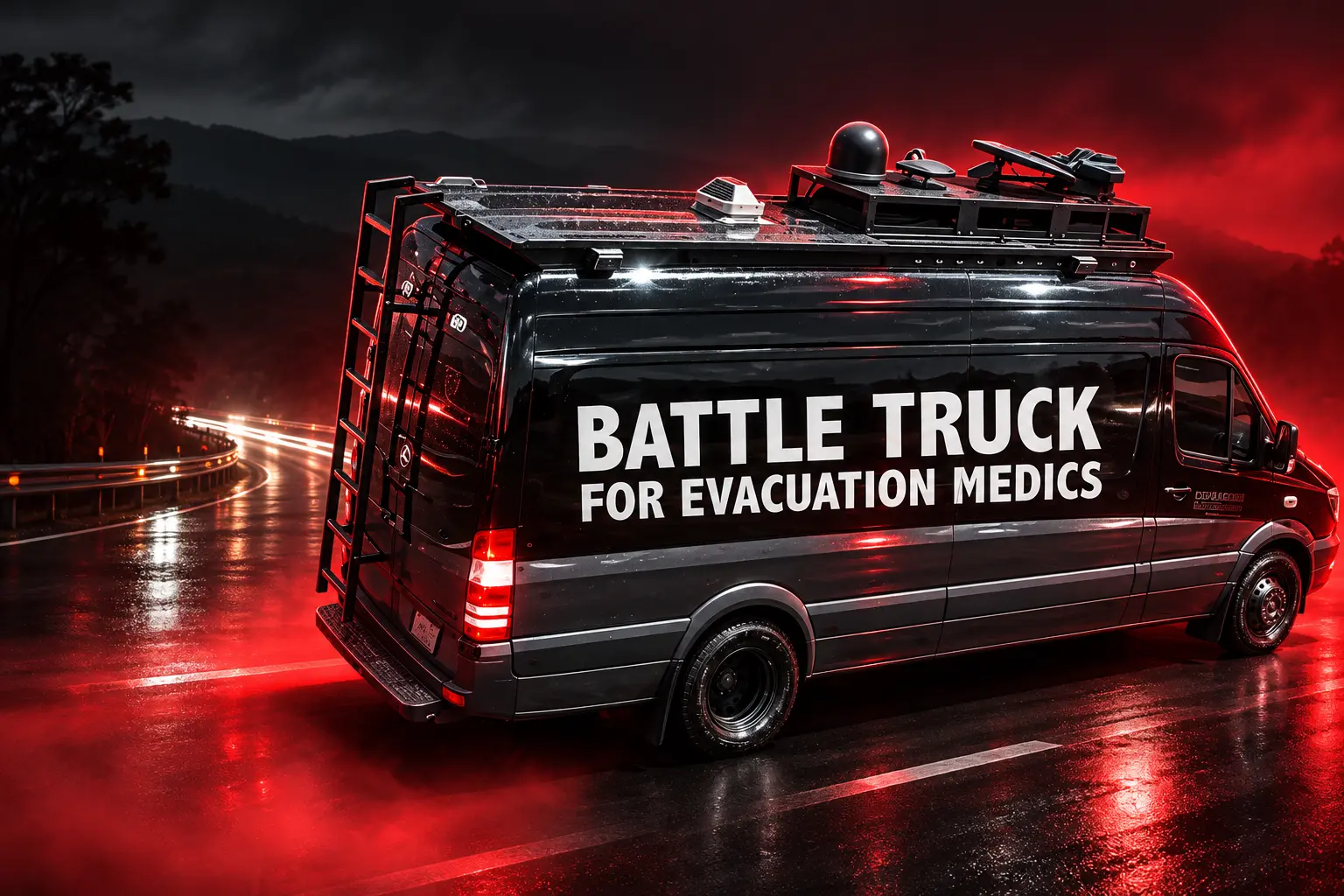
Howard Hunt’s Battle Truck is a planned Ukraine evac van that doubles as a rolling testbed for startups locked out of military procurement.

Howard Hunt’s Battle Truck project wants a donated Fiat Ducato, about €500,000, and a chance to prove five companies’ kit on Ukraine’s roads. The van is still missing. Hunt, a Berlin volunteer medic who works under the callsign Hunter, has spent four months trying to open a fast-track buy for the finished truck, and he has been blunt about what the vehicle is for.
It is an ambulance. It is also a demo. Ukrainian medics have already told the partners they want some of the gear. They still have no simple way to purchase it.
Hunt Calls the Van a Trojan Horse of Products
Battle Truck is a planned conversion, not a factory model. The group wants a heavy transit van, ideally a Fiat Ducato, with tougher suspension, tyres and a protective wrap, then fill the cabin with kit from firms in the Netherlands, the UK, the United States, Estonia and Denmark. Hunt is also co-founder of the volunteer evacuation team The AO and of AO-Med, which would put its own digital triage tools on board.
The vehicle is basically a trojan horse of products. We drive it into Ukraine and prove it works
Howard Hunt, volunteer medic and Battle Truck lead
The partners would pay for their own prototypes. The collaboration is non-exclusive. If a purchase order ever arrives, they would then argue over how to split the money. A memorandum of understanding is on the list of next steps, along with tests at Dark Star bootcamps, Brave Tech programmes, and military sites in Rivne and Lutsk, reached if they can through the Rivne Interregional Medical Cluster.
Hunt said the group has been working a fast-track procurement route for four months and thinks it might work “if we are able to prove viability in battlefield conditions.” A Ukrainian requirement from a brigade or from the defence ministry’s medical offices could, in that telling, support talks with German or Dutch authorities. None of that starts until someone hands over a van.
Three Ambulances Taught Him What Donations Get Wrong
Hunt did not come to this as a defence founder looking for a war. When Russia launched its full-scale invasion on 24 February 2022, he was in Berlin, putting up Ukrainian refugees in his apartment. Thirteen people stayed, among them a historian and a graphic designer from Ivano-Frankivsk and two music producers from Kyiv. He then travelled to Ukraine, walked into the Hospitallers Medical Battalion with bags of supplies, and completed three rotations on a rescue bus before asking to join an ambulance crew.
The battalion’s answer, as he later told it, was practical. He had too little experience to run as a lead medic. They did not have fuel for every ambulance. If he were killed they would have to get his body home. He did not speak Ukrainian. Then came the line that built his later companies: if he brought his own ambulance, he could have his own crew. He went back to Germany and raised money for three vans.
HOW HUNT GOT TO THE TRUCK
- March 2022: Hosts Ukrainian refugees in his Berlin apartment, 13 people in all, then leaves for Ukraine.
- 2022 to 2024: Completes four medical rotations with Hospitallers in Donetsk Oblast, three of them on a rescue bus, and is told a foreigner can run evac only with his own vehicle.
- 2024: Crowdfunds three ambulances, drives them east, and later says two were close to falling apart in Poland.
- 8 July 2026: Describes AO-Med as a Berlin battlefield-monitoring startup at TRL 7, already working with the 112th Brigade in Kyiv and the 92nd Brigade in Kharkiv.
- 5 November 2026: Names Battle Truck as the conversion that would carry several firms’ kit, with the 92nd Brigade in Lyman listed as the first intended user if the prototype survives testing.
He has already lived the failure mode the new project is trying to dodge. Western fundraisers keep sending city ambulances into a war of potholes, night driving and drone fire. Hunt’s own second and third vans, he said on a later recording, were “on the verge of falling to pieces and exploding in Poland.” Ukraine Focus, a U.S. volunteer group that has sent hundreds of medical vehicles, has said more than 70% of the ambulances it donated have since been destroyed. Vehicles that survive the drones still die on the roads.
Early in the invasion, Hunt said, crews could sometimes drive to the zero line in daylight. That window closed. Combat medics now stabilise people near the line, move them to collection points outside drone range, and only then hand them to evacuation crews. Hunt said he was rarely carrying one patient. Quite often he had five seriously wounded soldiers in a single ambulance, which is a different job from a civilian run.
What the Partners Want to Load Into the Cabin
NIXXEN in the Netherlands would rework the van’s suspension, chassis and layout so it can take broken roads. Molecular Products in the UK would put its Rugged Oxygen Generator on board. Velico in the United States would bring FrontlineODP, a spray-dried plasma. AO-Med would handle digital triage and Tactical Combat Casualty Care reporting. Phoenix Denmark is listed as a possible source for a covering meant to stop fragments and burning white phosphorus and to cut the van’s heat signature.
THE FIVE COMPANIES ON THE VAN
| Company | Country | What it brings | Where it stands |
|---|---|---|---|
| NIXXEN | Netherlands | Suspension, chassis, modular evac layout | Named engineering partner; already in talks with Hunt on a 112th Brigade pilot |
| Molecular Products | United Kingdom | Rugged Oxygen Generator, no cylinders, no power | FDA-cleared device; Ukrainian medics interested, no buy path |
| Velico | United States | FrontlineODP spray-dried plasma | Phase 1 safety study done; no FDA or EU approval yet |
| AO-Med | Estonia | Digital triage and TCCC reporting | Hunt’s firm, TRL 7; wants data from about 2,000 casualties |
| Phoenix Denmark | Denmark | Protective covering against fragments, phosphorus, heat | Identified as a potential supplier, not a signed kit |
The oxygen piece is the furthest along as a product. Molecular Products’ non-pressurised 15-minute oxygen generator is a chemical unit, not a tank. The company’s product page lists more than 96% purity, a 6 litre-per-minute flow, a 15-minute run, a 2.3 kg weight and a 115 by 284 mm body, with FDA 510(k) clearance dated 6 December 2024. It needs no electricity, mixing or filling. The chemistry sits in the same family as the firm’s submarine oxygen candles, which Hitesh Raval, the company’s defence business development manager, called 40-year-old technology moved to the point of injury. A smashed compressed cylinder is a blast hazard. This unit is built not to behave like one.
Plasma is the harder sell. Frozen plasma needs a cold chain and time to thaw, which a night run from a collection point does not offer. Velico turns donated plasma into a dry product that, the company says, can be mixed with sterile water in under three minutes. Its 24-volunteer spray-dried plasma trial, published in the journal Transfusion in 2026, put FrontlineODP against standard frozen plasma in three dose steps up to 800 mL. All 24 people finished the study. No clots were recorded. Side effects landed at similar rates to frozen plasma. The same company page warns that the system has not received FDA or EU approval for any use. France’s Armed Forces Blood Transfusion Centre is evaluating the manufacturing side. For Battle Truck, the pitch is plasma in the cabin without a freezer.
AO-Med is Hunt’s own bet on the paperwork. Inside a moving ambulance, medics still take blood pressure with a cuff, count breaths by hand and fill paper TCCC cards, then those cards travel with the patient until someone types them in. Hunt wants wearables and a digital record so the data follows the casualty. He has said the hardware is only how you collect the information, and that the value is a dataset large enough to warn a crew that a patient may crash in the next 15 or 20 minutes. He puts that threshold at about 2,000 casualties. “That isn’t something you can simulate in a laboratory,” he said. “You have to collect it during real medical evacuations in active conflict.” The first deployments, he said in July 2026, were meant to involve the 60 ambulances run by Hospitallers, with a longer aim of the Ukrainian fleet of about 4,000 military ambulances. Battle Truck is one more way to put those sensors on the road.
Kherson Showed Why Heat and Fragments Kill Crews
The covering is the piece aimed at the sky. Phoenix Denmark, if it joins, would supply a blanket meant to stop explosive fragments and burning white phosphorus and to damp the van’s infrared outline. Incendiary mix can light a vehicle, wreck the cabin kit and stick to skin. White phosphorus can reignite when it meets air. Human Rights Watch has recorded incendiary attacks in Ukraine, including a November 2024 drone strike that set fire to two ambulances at the Kherson Regional Oncology Centre, though the weapons in that strike were not identified.
The same city has been a laboratory for what happens when drones hunt the people who come to help. In its June 2025 report, Human Rights Watch documented drone strikes on Kherson ambulances and clinics, and ambulance staff said they had stopped answering some calls because the follow-up drone was waiting. Police in armoured vehicles had to move the wounded instead. The Geneva Conventions require parties to protect medical crews. The tally on the ground does not read like compliance.
ATTACKS ON UKRAINE HEALTH CARE IN 2025
- Incidents: Insecurity Insight’s count for the Safeguarding Health in Conflict Coalition recorded 613 attacks on health care in 2025.
- People: 87 health workers were killed and 140 were injured in those incidents.
- Buildings and crews: Facilities were damaged or destroyed on at least 382 occasions, and emergency medical services were attacked at least 110 times.
- Drones: Explosives-armed drones accounted for nearly half of incidents tied to Russian forces, rising from 127 in 2024 to 296 in 2025.
Over 95% of the 2025 attacks were linked to Russian forces. There is still no official Ukrainian figure for medics killed or wounded in the war. Hunt’s project cannot stop a drone. It can try to make the van harder to see on a thermal screen and harder to ignite, which is a smaller claim, and an honest one.
The Procurement Path Stops at the Brigade Clinic
Raval has already sat with the people who would use the oxygen kit. He described a meeting with medical staff tied to the Azov Brigade, a unit that began as a volunteer battalion in 2014 and later joined the National Guard: a staff sergeant, a medical trainer and a combat medic. They liked the product. Then they asked how they were supposed to get it.
They were very interested in the product, but the question was how they could obtain it. Even when frontline medics identify equipment that could help them, there isn’t necessarily a straightforward route to purchasing and deploying it.
Hitesh Raval, Defence Business Development Manager, Molecular Products
That gap is why a converted Ducato is being asked to do two jobs. Early-stage firms need operational proof to raise money and to enter tenders. Getting that proof in Ukraine is costly, and the procurement queue is built around drones and other strike gear. Raval said competing priorities matter, “especially when military resources are needed for drones and other equipment.” He also said a vehicle sent into a war zone may not come back, and that manufacturers have to hear that before they sign anything. “The priority is getting suitable equipment to the people who need it, rather than creating a marketing exercise.”
Hold both facts. The medical need is not a pitch deck. Hunt has worked the night runs; Raval has sat with brigade medics who cannot raise a purchase order. And the structure of Battle Truck is still a workaround for a buy path that does not exist. If the van works, Hunt thinks a Ukrainian requirement might unlock German or Dutch money. If it fails, the companies will have spent their prototype budgets on a vehicle that may already be wreckage.
Edwin Milotte of NIXXEN put the imbalance in one line: while everyone is focused on offensive kit, his firm is focused on keeping wounded soldiers alive. He said that if the first Battle Truck works, the ambition is another 500 vehicles, and not only at the front, because civilian casualties are rising in cities farther from the line.
Raval Puts the Price at €500,000
The near-term ask is small by defence-budget standards and large for a volunteer project. Raval estimates that about €500,000 could support three or four vehicles, depending on the final spec and on what partners throw in. The team is looking at NGOs, humanitarian groups, vehicle makers and the technology firms themselves. Raval has argued for assembling the first van in Germany so the European suppliers can meet in one place. Poland is the fallback.
WHAT STILL HAS TO ARRIVE
- The van: A donated Fiat Ducato or similar heavy transit vehicle, not another city ambulance on standard springs.
- The money: About €500,000, enough in Raval’s estimate for three or four conversions once partners cover their own kit.
- The shop: A build site, with Germany preferred and Poland still in play.
- The paper: A memorandum among the firms, then a Ukrainian requirement that can be walked into German or Dutch procurement.
- The users: Frontline medics to score the kit rather than a foreign demo team scoring it for them.
The timetable is the funding. After a prototype is built it would go to Ukraine for testing. The slide deck names the 92nd Brigade in Lyman as the intended first recipient if that test holds. That is a different role from AO-Med’s existing work with the 92nd in Kharkiv, which is about sensors, not about this van. Hunt has said potential partners need to understand from the start that the truck may not return intact. That is the opposite of a showroom tour.
The Last Mile Is Already Going Airborne
While Battle Truck looks for a chassis, Ukraine’s own defence cluster has been solving a different stretch of the same chain. Ground ambulances cannot always reach the position. On 28 October 2026 the defence ministry said Ukrainian forces had carried out the first heavy-drone medical evacuation, lifting an infantryman of the 30th Separate Mechanized Brigade from a blocked position. The aircraft was the Heavy Shot Ayudag-6, a 98 kg hexacopter with a 130 kg payload, and it flew more than 15 km one way. Brave1, the state defence-tech cluster, has been writing requirements for that class of machine since 2024: at least 130 kg over at least 15 km, and at least three kinds of radio so the link survives jamming.
A later design, StarGate, was built from the start as an evac drone at the request of assault troops. The ministry said it deploys in about 10 minutes, lifts up to 150 kg, and can fly at up to 105 km/h with a stretcher module. If navigation is jammed, the software is supposed to plot a route home without GPS. That does not make Battle Truck pointless. Hunt’s own account of the job is the middle of the chain: collection point to stabilisation point, often with five casualties in the back, on roads that wreck a donated sprinter. Drones are for the stretch a van cannot enter. The van is for everything after.
The irony sits in the paperwork, not in the physics. Brigade medics can want a 15-minute oxygen candle and still have no way to buy it. A Berlin volunteer can raise three ambulances and still watch two of them nearly die before they reach the Donbas. A U.S. plasma firm can finish a 24-person safety study and still be years from a licence. Hunt’s answer is to bolt those problems into one Ducato and drive it in. The 92nd Brigade in Lyman is on the deck as the first crew. They will not see the truck until someone donates the van and the half-million euros that turn it into more than a slide.

One UI 9.5 Beta Puts the Galaxy S26 on Last Year’s Clock

DBS Puts a 24/7 USDC Window Inside the Bank

European Startups Head for $81 Billion as First Checks Shrink

US Stocks Lost $1.3 Trillion Before Nvidia’s Beat

Home Depot Bets on Finance Chief Richard McPhail as CEO

Aramco Crash Kills 14 Two Days After Oil Restart

Salah Captained Egypt to Their First World Cup Win

Zelda’s 40th Switch 2 Ships Without a Zelda Game

Apple Labor Day Deals Hide June’s Memory Price Hike

El Niño Puts Israel’s Needed Winter Rain on a Flood Clock
-
 BUSINESS5 months ago
Aramco Crash Kills 14 Two Days After Oil Restart
-
 NEWS6 months ago
Salah Captained Egypt to Their First World Cup Win
-
 GAMING2 months ago
Zelda’s 40th Switch 2 Ships Without a Zelda Game
-
 NEWS3 months ago
Apple Labor Day Deals Hide June’s Memory Price Hike
-
 NEWS4 months ago
El Niño Puts Israel’s Needed Winter Rain on a Flood Clock
-

 GAMING2 months ago
Palworld 1.0.4 Adds Palpedia Search After the 1.0 Launch
-

 NEWS4 months ago
Saudi Visa Routes Split Nigerian Travelers Into Two Speeds
-

 BUSINESS9 months ago
BAE’s 60-Year Saudi Franchise Now Runs Through Taif