
AUTO
Tesla Clears the Cybertruck Line to Scale Cybercab
Tesla will wind down Cybertruck production at Gigafactory Texas around mid-2027, shifting a 125,000-unit truck line toward Cybercab after weak pickup sales.

Elon Musk said Tesla will wind down Cybertruck production at Gigafactory Texas around mid-2027 so the plant can build more Cybercabs. On November 7 he added that the factory is still building the stainless pickup for another eight or nine months, then Tesla has to scale the two-seat robotaxi.
The Texas plant already lists the truck and the cab at the same installed capacity. The pickup never filled that line, which is what makes the factory swap a cheap wager to place.
Musk Says the Texas Truck Line Has Months Left
On November 6, Musk wrote that Tesla “will be winding down production of the Cybertruck at Gigafactory Texas around the middle of next year to make room for increased Cybercab production.” He did not name a last-build date, a residual rate, or a second factory. Austin is the only plant tooled for the truck’s stainless body, so a Texas wind-down is, in practice, the production clock.
Tesla will be winding down production of the Cybertruck at Gigafactory Texas around the middle of next year to make room for increased Cybercab production
— Elon Musk (@elonmusk) November 6, 2026
Asked whether the news was the end of an era, Musk replied, “True, but the Cybertruck fleet will be around for a long time.” Cybertruck lead engineer Wes Morrill, who also handles reliability, test, and analysis for Tesla vehicles, told owners the same day that parts and service continue. He separately called the truck “an incredible technology development platform” that “lives on through Cybercab.”
WHAT TESLA HAS AND HAS NOT SAID
- The Texas clock: Production at Gigafactory Texas winds down around the middle of 2027, with eight or nine months of builds still on the line as of November 7.
- The stated reason: Floor space for increased Cybercab output, not a published sales target or a formal kill notice for the nameplate.
- Still open: Whether any Cybertruck assembly moves to another plant, how many unfinished orders get built, and what output the freed bays are meant to add.
Former Aston Martin chief executive Andy Palmer put the industrial case in one line: it does not make sense to keep a line going when it is not meeting its targets. Tesla did not publish a separate product note. The decision arrived as a post from the chief executive, then as a parts pledge from the engineer who led the truck.
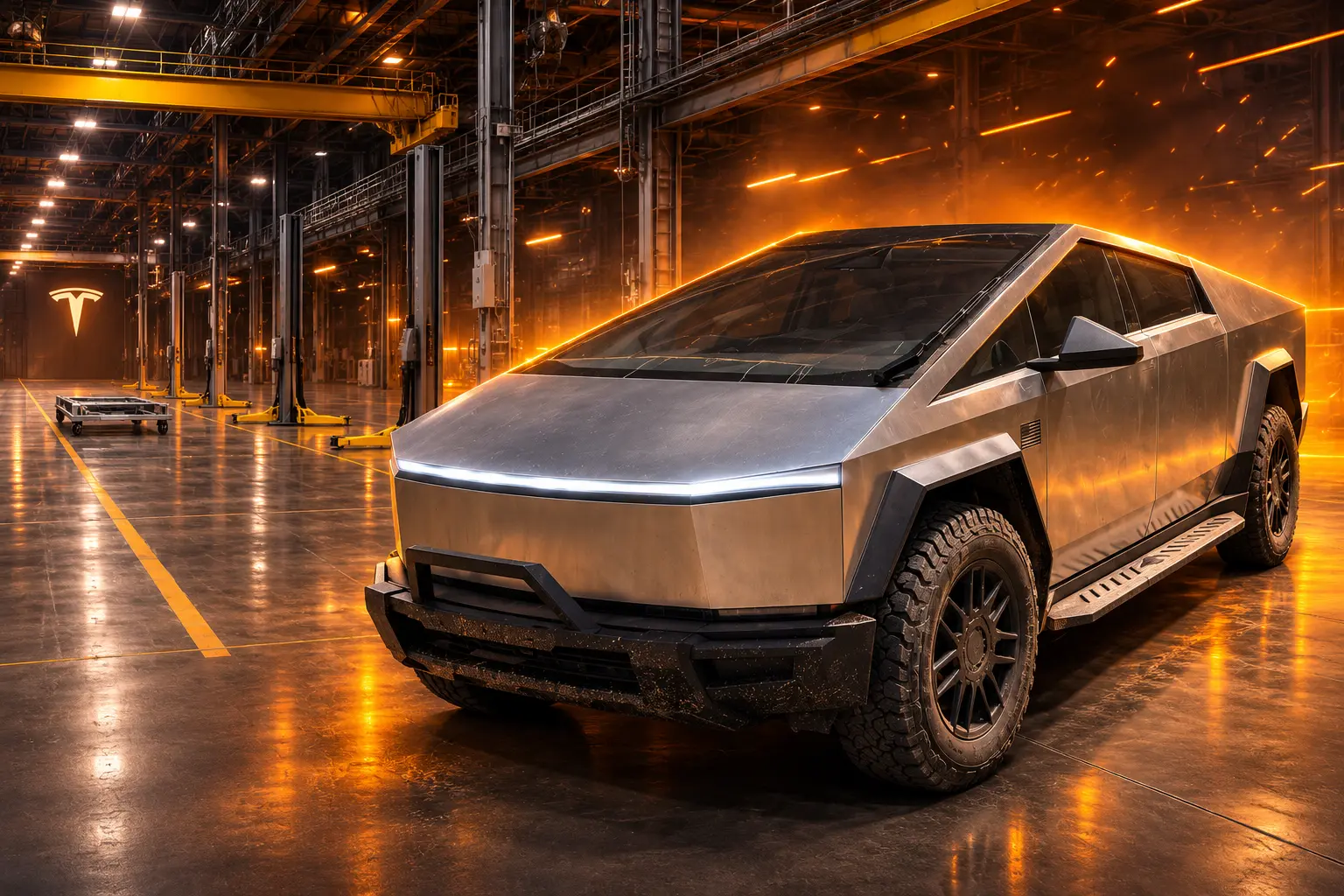
A Pair of 125,000-Unit Lines in Texas
Tesla’s Q3 2026 update, posted October 21, already rates both vehicles at more than 125,000 a year of installed capacity in Texas, each marked “Production.” The same table lists Texas Model Y capacity at more than 375,000. Installed capacity is not a run rate. Tesla says output depends on uptime, supply, upgrades, and regulation.
TEXAS LINES IN THE Q3 UPDATE
- Cybertruck: More than 125,000 vehicles a year, status production.
- Cybercab: More than 125,000 vehicles a year, status production.
- Other Models built: 7,004 in the third quarter, down 40% from 11,624 a year earlier.
- Other Models delivered: 8,295 in the quarter, against 478,237 Model 3 and Model Y deliveries.
Annualize those 7,004 builds and the Other Models bucket runs at about 22% of the truck line’s listed capacity. The bucket is not the truck alone. Tesla groups every vehicle that is not a Model 3 or Model Y there, and the Nevada Semi line is now in volume production at 25,000 units of listed capacity. Even as a ceiling, 22% is a half-idle body shop with its own stainless tooling, castings, and suppliers.
Gigafactory Texas has more than 10 million square feet of factory floor, by Tesla’s own count. The cab already has a listed line of its own. Taking the truck’s bays anyway is a choice about focus and unique metal, not a plant that has run out of empty concrete.
US Sales Sat at 20,237 Against a 250,000 Goal
Tesla does not publish Cybertruck deliveries on their own. The closest official figure is 8,295 Other Models delivered in the third quarter, against 15,933 a year earlier, with Model 3 and Model Y at 478,237. Total deliveries were 486,532. Total production was 464,391.
Around the start of production, Musk had predicted annual sales of 250,000. Kelley Blue Book’s US estimates never approached that figure, and they fell after the first full year.
US CYBERTRUCK SALES VERSUS THE LINE TESLA BUILT
| Period | Estimated US sales | Share of 250,000 target | Share of 125,000 capacity |
|---|---|---|---|
| 2024 (full year) | 38,965 | 15.6% | 31% |
| 2025 (full year) | 20,237 | 8.1% | 16% |
| January-September 2026 | 11,586 | Partial year | Partial year |
US sales in 2025 were 20,237, down 48% from 38,965 in 2024. The first nine months of 2026 came in at 11,586, down 28% from 16,097 in the same stretch of 2025. Those are US retail estimates, not Tesla’s global Other Models line, and they should not be added to 8,295.
The quarterly Other Models series still shows how fast the non-3/Y bucket shrank as Tesla simplified the mix. It delivered 23,640 in the fourth quarter of 2024, 16,130 in the first quarter of 2026, 12,364 in the second, and 8,295 in the third. Model S and Model X production ended in April 2026, which is why the last two quarters are a cleaner look at the truck plus the Semi.
A line equipped for more than 125,000 trucks a year, pointed at a 250,000 sales goal, and clearing about 20,237 US sales in its second full year is a factory waiting for another product. The Cybercab is the product Tesla is putting in that space.
Austin’s Robotaxi Fleet Already Includes the Cab
Cybercab is the two-seat robotaxi with no steering wheel or pedals. Tesla’s Q3 letter says it started providing robotaxi rides using Cybercabs on September 3 in Austin, and that cumulative unsupervised robotaxi miles grew eightfold quarter over quarter to nearly 2 million. Austin hours now run from 6 a.m. to midnight.
On the October earnings call, vehicle engineering chief Lars Moravy said Cybercab production had begun on the Texas line, with output going to Tesla’s own robotaxi fleet. Texas had 463 Cybercabs registered as of late October. That is not a volume fight for 10 million square feet. It is an early fleet that Tesla wants to grow faster than a polarizing pickup can fund.
The accounting is the wager in miniature. Tesla’s production tables count passenger vehicles sold to customers. A Cybertruck that leaves as a retail sale books automotive revenue. A Cybercab that enters Tesla’s own fleet has to earn the money back fare by fare. Musk is giving factory hours to the second model, after listing both at more than 125,000 units of capacity, because he wants the taxi’s build rate up. Battery supply, the letter says, was still the limiter on auto volumes in the quarter. 4680 cell output is being raised to support Cybercab, Semi, and Model Y, not a truck refresh.
What Happens to Cybertrucks Already on the Road?
Owners asked the practical question first: does Tesla keep supporting a truck it is about to stop building in Texas. Morrill answered before the company issued any owner bulletin.
Yes, of course! Tesla will maintain spare parts and service will continue support
Wes Morrill, Cybertruck lead engineer, on X, November 6, 2026
That pledge is the residual-value floor for a vehicle whose cheapest advertised pitch was $39,900 in 2019 and whose Premium All-Wheel Drive recently listed at $92,490 on Tesla’s design page. Steer-by-wire and rear-wheel steering are already in the trucks on the road. Those systems do not move to a two-seat cab in a form a ranch or a mountain cabin can use.
WHAT EXISTING OWNERS KEEP
- Parts and service: Morrill said Tesla will maintain spare parts and that service support continues.
- No second market: Tesla cancelled Cybertruck plans for Australia and New Zealand in October and is refunding reservation holders there.
- A short order window: Anyone still buying new has the first half of 2027 under Musk’s wording, unless Tesla fills in the blanks.
Daily drivers who use the truck as a truck are treating the remaining builds as last-chance metal. A two-seat cab with no wheel and no pedals does not tow, does not take a cabin road, and is not a vehicle those owners say they will buy. Tesla is leaving that customer on purpose. The people who still want the stainless pickup are being told the fleet will last, while the factory points at a product they cannot drive.
SpaceX Bought 1,279 Trucks in a Single Quarter
Even captive demand did not fill the line. S&P Global Mobility figures showed SpaceX bought 1,279 Cybertrucks in the fourth quarter of 2025. Musk’s companies took 1,339 in total that quarter. SpaceX’s IPO filing listed $131 million of Cybertruck purchases from Tesla in 2025 at list price.
A sister company buying at list is the last customer a low-volume halo truck can hope for. It still left the Texas body shop at a fraction of the capacity Tesla printed in the shareholder deck. Supporting a stainless-steel pickup, with its own dies and its own crash structure, at that rate is a bill Tesla no longer wants to carry while it funds robotaxi software, 4680 cells, and a cab line that already outruns how fast the company can put cars into paid service.
The pattern matches what Tesla already did with its old flagship cars. Model S and Model X production ended in April 2026. The Q3 update says Optimus production began in Fremont on high-volume lines. When Tesla needs floor for the next machine, it clears a current one and calls the move a hand-off. Morrill’s “lives on through Cybercab” line is that hand-off in engineering language.
There Will Never Be Another Vehicle Like It
The production run is short for a nameplate Tesla once talked about in six-figure annual volumes. Customer deliveries began in late 2023. If the Texas line winds down around the middle of 2027, the truck will have been in customer production for about three and a half years.
THE TEXAS CLOCK
- November 2019: Tesla unveils the Cybertruck and advertises a $39,900 starting pitch.
- Late 2023: Customer deliveries begin from Gigafactory Texas, the only plant tooled for the stainless body.
- 2024: US sales reach 38,965, the high year, still 15.6% of the 250,000 target.
- 2025: US sales fall to 20,237.
- April 2026: Model S and Model X production ends; Cybercab production is underway in Texas.
- September 3, 2026: Tesla starts Cybercab robotaxi rides in Austin.
- October 2026: Australia and New Zealand plans are cancelled with deposit refunds; the Q3 update lists both Texas lines at more than 125,000.
- November 6-7, 2026: Musk sets the mid-2027 Texas wind-down and the eight-or-nine-month build clock.
We are still building Cybertruck for another 8 or 9 months btw, but then Tesla needs to focus on scaling Cybercab.
There will never be another vehicle like it.
— Elon Musk (@elonmusk) November 7, 2026
On November 7 Musk wrote, “We are still building Cybertruck for another 8 or 9 months btw, but then Tesla needs to focus on scaling Cybercab.” He added, “There will never be another vehicle like it.” The factory bet is now dated. The trucks already sold keep parts, and the line in Texas has months of stainless left before the bays go to a cab that does not need a driver.

One UI 9.5 Beta Puts the Galaxy S26 on Last Year’s Clock

DBS Puts a 24/7 USDC Window Inside the Bank

European Startups Head for $81 Billion as First Checks Shrink

US Stocks Lost $1.3 Trillion Before Nvidia’s Beat

Home Depot Bets on Finance Chief Richard McPhail as CEO

Aramco Crash Kills 14 Two Days After Oil Restart

Salah Captained Egypt to Their First World Cup Win

Zelda’s 40th Switch 2 Ships Without a Zelda Game

Apple Labor Day Deals Hide June’s Memory Price Hike

El Niño Puts Israel’s Needed Winter Rain on a Flood Clock
-
 BUSINESS5 months ago
Aramco Crash Kills 14 Two Days After Oil Restart
-
 NEWS6 months ago
Salah Captained Egypt to Their First World Cup Win
-
 GAMING2 months ago
Zelda’s 40th Switch 2 Ships Without a Zelda Game
-
 NEWS3 months ago
Apple Labor Day Deals Hide June’s Memory Price Hike
-
 NEWS4 months ago
El Niño Puts Israel’s Needed Winter Rain on a Flood Clock
-

 GAMING2 months ago
Palworld 1.0.4 Adds Palpedia Search After the 1.0 Launch
-

 NEWS4 months ago
Saudi Visa Routes Split Nigerian Travelers Into Two Speeds
-

 BUSINESS9 months ago
BAE’s 60-Year Saudi Franchise Now Runs Through Taif