
NEWS
Gannet Lets Lithuanian Drones Strike and Fly Home
Vilnius startup PDKINEMATICS fits Gannet on existing bomber drones so they drop guided rounds from 700 metres and return, plugging NATO’s contact-line gap.

PDKINEMATICS’ Gannet kit lets bomber drones drop guided rounds from 700 metres and fly home. The Vilnius firm says the kit is already on Ukrainian aircraft and on fleets in several other European countries. It bolts onto drones those units already fly.
That height is the product. NATO jets and helicopters were built for precise strikes, then found they could not work near Ukraine’s contact line. Cheap drones filled the gap, most of them unguided.
Gannet Flies the Bomber Drone Home
Rapolas Markevičius, chief executive and co-founder, puts the design in one split. Costly electro-optics and the rest of the precision gear stay on the drone. After the drop, that aircraft comes back. The round itself is built to be made in volume.
On the company site, Gannet is sold as drone-agnostic and GNSS-independent. An aerodynamic section is rated for up to 200 metres of horizontal flight from 500 metres, which is how the carrier stays clear of cheap counter-drone guns. A modular bay takes up to 1,000 grams. The guidance block is specified for sub-meter hits without GNSS.
Those two heights are not the same number. Marketing for Gannet talks about flying the carrier at up to 700 metres, six times higher than with unguided loads and with no claimed loss of accuracy. The 500-metre / 200-metre pair is the glide the kit advertises so the bomber never has to finish the run.
GANNET IN FIGURES
| What the kit claims | Figure |
|---|---|
| Carrier operating height | Up to 700 metres |
| Glide from 500 metres | Up to 200 metres horizontal |
| Payload bay | Up to 1,000 grams |
| Accuracy without GNSS | Sub-meter |
| Fit on a new UAV type | Under four weeks to first flight |
Markevičius said the firm is taking established guidance methods and shrinking them for hardware that can be made at drone prices. He will not publish a full sensor list. He does say GPS-denied flight, including under heavy jamming, is “one of the core capabilities of our technology,” and that the kit is built to work in bad weather.
This means the drone is more likely to return home safely, which is particularly important in the kind of conventional warfare we’re seeing in Ukraine.
Rapolas Markevičius, CEO, PDKINEMATICS
In a video interview he described the same split in plainer workshop language: keep the expensive camera on the aircraft that returns, and make the munition cheap enough to throw away. The method is not a new law of physics. Cruise missiles have matched terrain for decades, and self-driving stacks have been shrinking for years. The change is the size, the price, and the fact that the bomber is supposed to land.
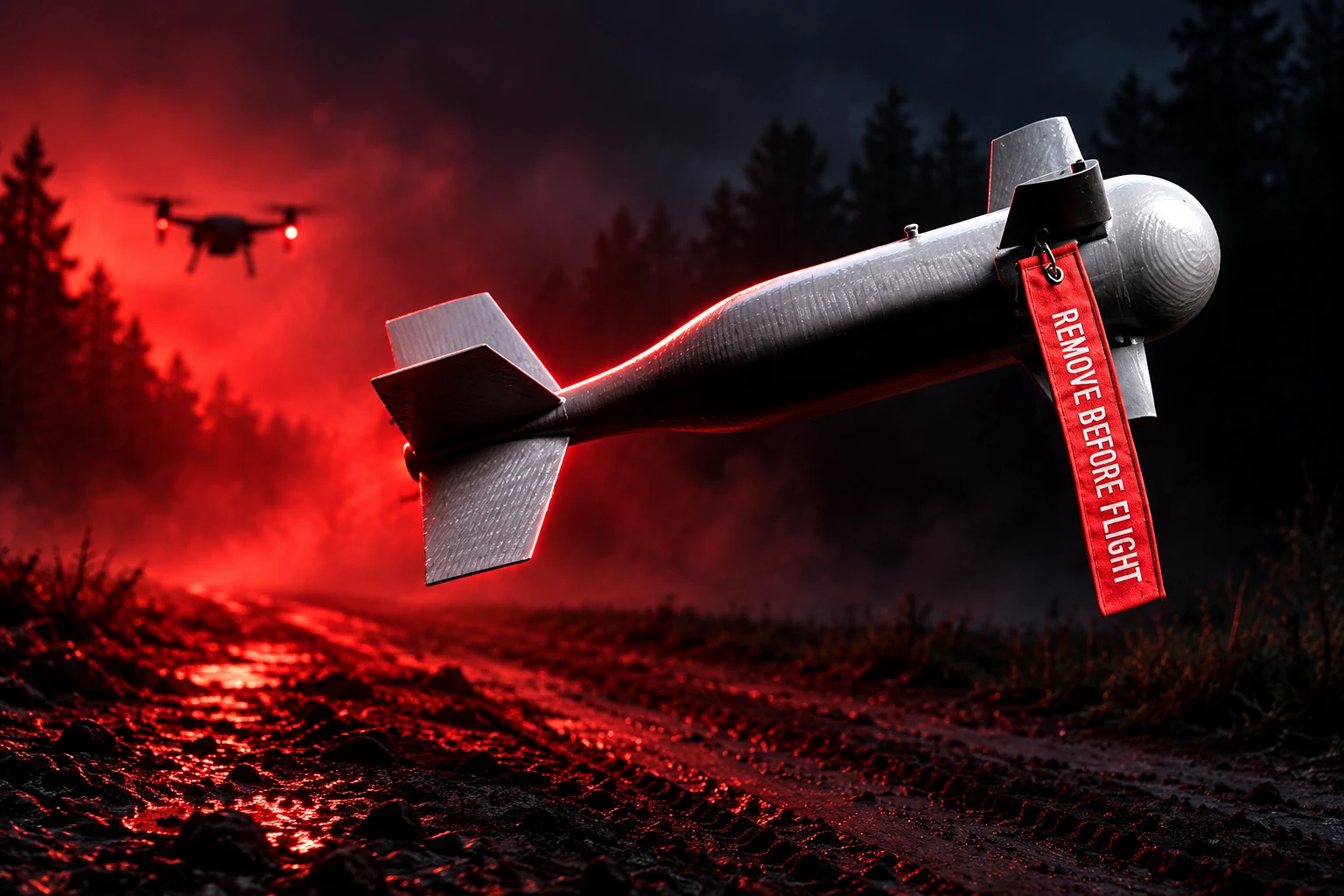
The 300,000 Unguided Drops Each Month
PDKINEMATICS cites a figure of about 300,000 drone-deployed munitions a month in Ukraine, almost all unguided. Independent tallies of that exact drop count are not on the public record, so it sits as the company’s working picture of the market it wants to convert.
First-person-view racing drones closed some of that gap. They still lean on a skilled pilot, a short link, and weather that cooperates. Dr Jack Watling, writing for the Royal United Services Institute on 23 October 2025, found that most FPV kills inside a 3 km belt of the forward line, that those aircraft fail in bad weather, and that their pilots have to sit still while they fly. Larger bomber drones can carry more, but without guidance they drop low, which puts them in range of ground fire.
Watling also described a Ukrainian “wall of drones” that imposes an attrition belt of about 30 kilometres. That is a different job from a 700-metre guided drop. Gannet is aimed at the bomber that has to live through the run, not at the one-way FPV that does not.
After 1945, large states poured money into precision for aircraft and helicopters because it cut collateral damage and fitted NATO doctrine. Markevičius’s point is that those platforms cannot operate near today’s contact line, so the doctrine still needs a cheap round that hits from height. He is not arguing that a Vilnius kit replaces a fighter. He is arguing that the fighter is not coming.
Where the €2 Million Seed Is Going
On 17 June 2026 the company closed a €2 million seed round ($2.2 million), co-led by Coinvest Capital, Lithuania’s sovereign investment fund, and Iron Wolf Capital. Defence-focused angels and technology founders joined. With earlier money counted, total funding stands at €3 million.
Žygimantas Sušnys, founding partner at Iron Wolf Capital, said the team “moves at the speed this moment demands” and had “earned credibility in Ukraine.” Viktorija Trimbel, managing director of Coinvest Capital, said her network first saw the kit when the Lithuanian Riflemen’s Union put it through a live stress test called The Flaming Shield, and that the term sheet started there.
The firm makes empty munition guidance kits, plus the software and firmware that run them. It does not sell the explosive. Beside Gannet it is building a proximity fuze for loitering munitions and interceptor drones, and a set of parts meant to hold up in jammed radio conditions, with both of those lines aimed at a first working product by the end of 2026.
FROM WORKSHOP TO SEED
- Late 2022: Markevičius and aerospace engineer Simonas Stasevičius start the work after Russia’s full-scale invasion.
- 2025: PDKINEMATICS is founded in Vilnius. Dominykas Rinkevičius joins as head of engineering. A GNSS-independent kit named Padūkėlis is shown in public in August.
- 17 June 2026: The €2 million seed closes. Total funding reaches €3 million.
- July 2026: The Lithuanian Innovation Agency says Gannet is already with Ukrainian units and has been flown at that year’s Iron Wolf army exercises.
- 28 October 2026: Markevičius talks through the doctrine gap; the company account posts that PDKINEMATICS exists because Russia invaded Ukraine.
The seed is earmarked for more factory output, more fielded kits in Ukraine and Europe, a thicker NATO sales effort, and those two extra products. It is a small cheque against a fighter programme. It is a large one for a shop that still measures staff in dozens.
How Gannet Fits Existing UAV Fleets
Gannet is a supplier part, not a new airframe. PDKINEMATICS says it can take a handshake to first flight in under four weeks on a UAV type it has not shipped on before. That is the commercial pitch to armies that already bought bomber drones and are tired of flying them down into rifle range.
WHAT THE KIT IS BUILT TO DO
- Ride along: It is meant to sit on bomber drones already in service rather than force a new fleet buy.
- Ignore GPS: Guidance is specified to work when satellite signals are jammed or gone.
- Split the bill: Sensors stay on the returning aircraft; the round is the cheap, repeatable piece.
- Ship empty: The company sells the kit, code and firmware, and leaves the warhead to the operator.
- Move in weeks: Integration is sold as a four-week job from agreement to first flight.
That supplier stance is how a 20-person shop tries to sit inside NATO supply chains without racing Europe’s better-funded platform startups. Ukrainian firm M-FLY is on laser guidance built to live through jamming. Deftak is on computer-vision rounds that also drop GPS. Auterion, a Swiss-US company, is on autonomous terminal guidance for smaller drones. Kyiv’s The Fourth Law is on AI terminal guidance with a human still in the loop. Gannet’s bet is the empty kit and the four-week fit, not a new airframe name on the fuselage.
Vilnius Iterates on Ukrainian Fire Cycles
Markevičius is a former private equity manager at 1 Asset Management. After the invasion he trained as a reserve officer at the Lithuanian Military Academy, then pulled in co-founders with space-industry engineering backgrounds. “The situation became very personal as soon as Russia invaded Ukraine. I think it was a call to action for me as well,” he said. “We decided that we could contribute to changing Europe’s geopolitical situation.”
The company’s own account put the same origin in one line on 28 October 2026.
We started PDKINEMATICS because Russia invaded Ukraine.
Our CEO @RapolasMark spoke with @tech_eu about why we entered defence tech, what Ukraine is teaching us, and where European defence is heading.#DefenceTech https://t.co/2U09bMr1ip
— PDKINEMATICS (@PDKINEMATICS) October 28, 2026
The shop grew from three engineers to a team of around 20 in Lithuania and Ukraine. Markevičius calls hiring a Baltic-wide problem: “You cannot scale a European technology business without expanding the geographical scope of your talent pool.” Because the work is old guidance methods on new hardware, he can also hire people from newer tech sectors, not only missile veterans.
Early cash came from Lithuania’s defence innovation vouchers, run by the Innovation Agency. The first voucher paid for live target identification and tracking, now inside Gannet. A larger second voucher, plus company money, went into a radio-link product the firm still hoped, as of July 2026, to test in Lithuania and Ukraine before year-end. Pranciškus Vaišvila, the agency’s defence-technology specialist, said the point of the cheques is speed, and that flying the kit in national exercises and with allied units is the proof that the spend landed.
Markevičius credits Lithuania’s political and social support for Ukraine with opening doors to the people who actually fly the aircraft. Feedback, he said, comes in weeks, not procurement years, and there is “no other way to create an effective product without having customers or future customers involved from a very early stage.” He also said Ukrainian defence buying has got less chaotic: “The Wild West of Ukrainian defence tech has been diminishing. It’s now a lot more standardised and accountable.” That raises the bar for a startup leaving pilots for contracts, which is the hard step he still has to clear.
Kits Bound for Bavovna, SiraLab and NATO Ships
The first industrial hook in Ukraine is a partnership with Bavovna.ai, which PDKINEMATICS calls one of the country’s large bomber-class UAV makers. Gannet is integrated on those platforms and, the firm says, already flying in combat. Bavovna lists a tactical bomber with a 2.5 to 3 kg bomber UAV payload, a drop mechanism, and a claimed ceiling of 2,000 metres, which is well above the height Gannet is sold to use.
In Europe the company has a deal with Italian UAV maker SiraLab. Gannet was selected for Iron Wolf 2026, Lithuania’s large international exercise, and the Innovation Agency said in July that the kit had already been used in that year’s Lithuanian army Iron Wolf drills. In June the firm also said its next step was a first fit with the navy of a NATO member it would not name.
WHERE GANNET IS CLAIMED TO SIT
| Partner or venue | What PDKINEMATICS says |
|---|---|
| Bavovna.ai bomber UAVs | Strategic partner; kit integrated and used in Ukraine |
| SiraLab, Italy | European platform deal |
| Iron Wolf 2026 | Selected, and flown in 2026 Lithuanian army drills |
| Unnamed NATO navy | First naval fit planned, country not disclosed |
| Other European operators | Deployed in several countries besides Ukraine |
None of those lines is a multi-year framework contract with a named ministry of defence. They are the proof points a seed-stage kit maker can put on a slide: a Ukrainian bomber line, an Italian airframe, a home-nation exercise, and a navy still off the record.
Autonomous Strikes Wait on European Rules
Markevičius’s next argument runs past Gannet. He says much of the wider defence-tech stack can already fly with less human steering, and that Ukrainian firms are already fielding pieces of that, including The Fourth Law’s terminal guidance, still with a person in the loop. European and NATO governments have held back because they have not settled who is accountable when a machine closes the last metres.
I would argue that autonomous warfare is no longer primarily a technical challenge. It’s a question of how and whether to deploy these capabilities.
Rapolas Markevičius, CEO, PDKINEMATICS
That is the mixed half of the story. The kit that sends a bomber home from 700 metres is a manufacturing and integration problem, and Vilnius is treating it as one. The decision to let software pick and chase a target is a political problem, and he says Europe is late to it. “European countries and NATO allies need to prepare for the possibility of defending themselves against highly autonomous military operations.”
Near-term plans stay close to the front that made the company. “I like to think about our expansion as an onion, where we gradually move outwards,” Markevičius said. There are global ambitions, he added, but they are not specific yet. “We established PDKINEMATICS to build technologies that matter and that can materially improve our region’s ability to defend itself. We have global ambitions, but our immediate focus remains Ukraine and Europe.”

One UI 9.5 Beta Puts the Galaxy S26 on Last Year’s Clock

DBS Puts a 24/7 USDC Window Inside the Bank

European Startups Head for $81 Billion as First Checks Shrink

US Stocks Lost $1.3 Trillion Before Nvidia’s Beat

Home Depot Bets on Finance Chief Richard McPhail as CEO

Aramco Crash Kills 14 Two Days After Oil Restart

Salah Captained Egypt to Their First World Cup Win

Zelda’s 40th Switch 2 Ships Without a Zelda Game

Apple Labor Day Deals Hide June’s Memory Price Hike

El Niño Puts Israel’s Needed Winter Rain on a Flood Clock
-
 BUSINESS5 months ago
Aramco Crash Kills 14 Two Days After Oil Restart
-
 NEWS6 months ago
Salah Captained Egypt to Their First World Cup Win
-
 GAMING2 months ago
Zelda’s 40th Switch 2 Ships Without a Zelda Game
-
 NEWS3 months ago
Apple Labor Day Deals Hide June’s Memory Price Hike
-
 NEWS4 months ago
El Niño Puts Israel’s Needed Winter Rain on a Flood Clock
-

 GAMING2 months ago
Palworld 1.0.4 Adds Palpedia Search After the 1.0 Launch
-

 NEWS4 months ago
Saudi Visa Routes Split Nigerian Travelers Into Two Speeds
-

 BUSINESS9 months ago
BAE’s 60-Year Saudi Franchise Now Runs Through Taif