
NEWS
Nvidia Repeats Intel’s 2018 Play After Huang Resigns
Nvidia put finance chief Colette Kress in as interim CEO after Jensen Huang resigned, repeating Intel’s 2018 CFO stopgap and leaving the permanent job open.

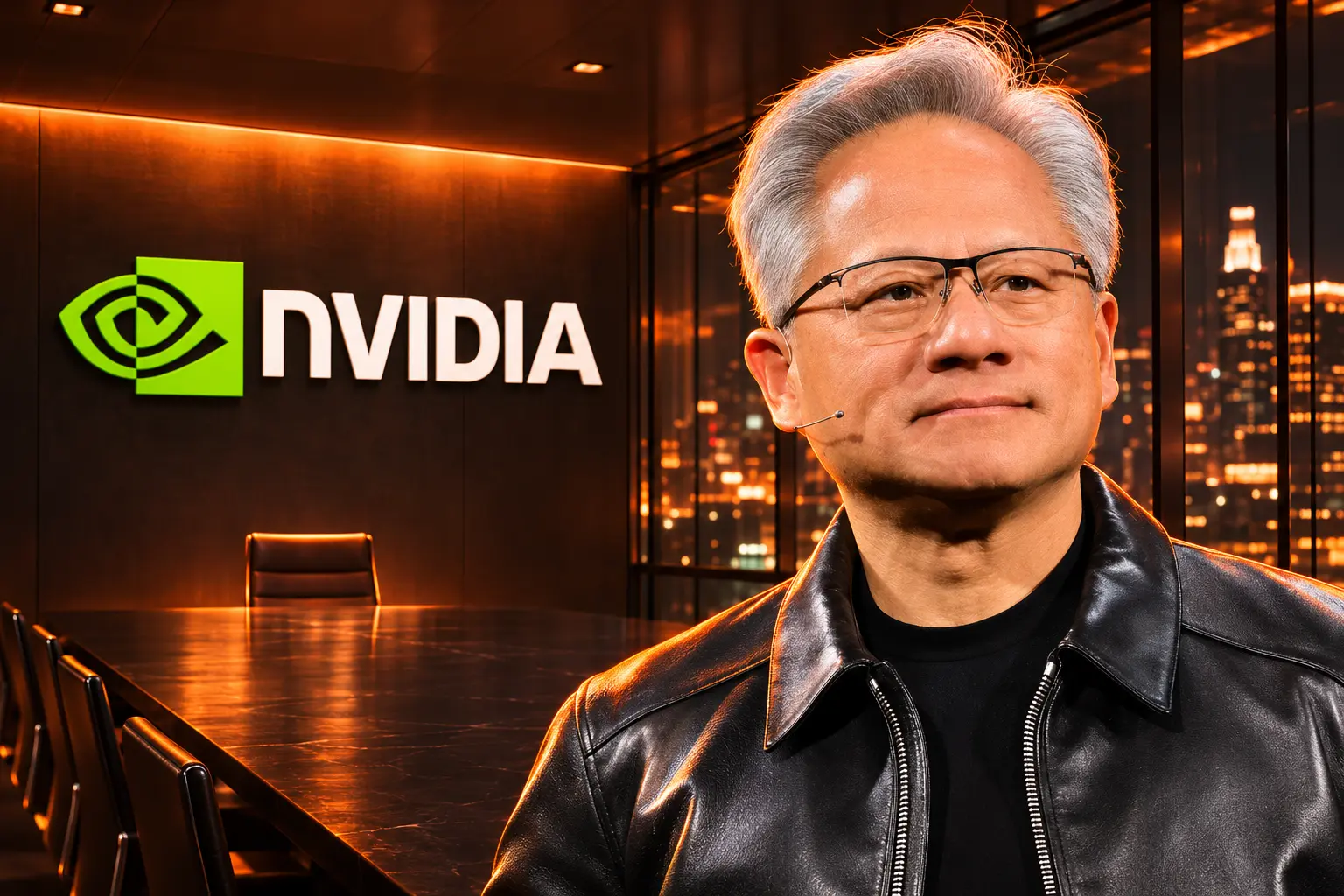
Nvidia’s board accepted Huang’s resignation effective immediately on November 11 and put finance chief Colette Kress, 59, in as interim CEO. Jensen Huang, 63, had been the only chief executive in the company’s 33 years.
The current report filed the next morning also named Harvey C. Jones, a director since 1993, as the first chair of the board. The permanent job is open. Internal and external names are both in play, and the closest analog in the chip business is Intel in 2018, when another board handed the same crisis to its CFO.
A Four-Day Plan After 33 Years
Huang co-founded Nvidia in 1993 and never split the top job. He resigned as president, chief executive, and director in one stroke, and Kress keeps her finance post while she runs the company. Jones, 73, is a former Synopsys chief who has sat on this board since the founding year.
The collapse was compressed. On October 14, weeks earlier, Huang told Emily Chang on Bloomberg’s The Circuit that the next chief would have to earn the seat. He said he hoped that person was already inside the company, and that he wanted to keep earning the job himself for another 20 years. By the next month’s second week, the board was writing his exit.
He admitted an extramarital relationship on November 8, a Sunday, and the directors said they would look into whether he had been a foreign intelligence target. Alice Huang, a data-center executive tied to Singapore-based Megaspeed, is the woman US officials have described as a suspected Chinese intelligence target. Megaspeed imported more than $4.6 billion of Nvidia products as Washington tightened advanced-chip sales to China. A further report on November 11 said Huang also had a relationship with Kimberly Powell, an Nvidia executive who reported to him. The board met that evening.
THE WEEK THE ONLY CEO LEFT
- October 14, 2026: Huang, on camera, says the next CEO has to be hired the same way he can be fired, and that his children Madison and Spencer would have to earn any future job.
- November 8, 2026: He tells staff he was unfaithful to his wife. The board opens a probe into a possible foreign intelligence effort and later brings in former acting US Attorney Joon Kim and the law firm Wachtell Lipton.
- November 11, 2026: A second reported relationship, with a direct report, lands. The board accepts his resignation that night.
- November 12, 2026: Nvidia files the 8-K, names Kress interim chief, and creates the chair role for Jones. Kress signs the filing.
- November 13, 2026: The shares close below $4 trillion in market value for the first time since July 2025.
- November 14, 2026: Edmund Lee writes that Huang misled Nvidia’s top lawyer about the Alice Huang relationship.
Kress told employees a company meeting is set for November 18 at 9 a.m. Pacific. The board’s public line is continuity. Jones said he expects the company’s operations, customer commitments, and product roadmap to continue without interruption.
Intel Ran This Play in 2018
On June 21, 2018, Intel said Brian Krzanich had resigned as CEO and director after an investigation confirmed a past consensual relationship with an employee that violated the company’s non-fraternization policy for managers. The Santa Clara board named Robert Swan interim chief executive the same morning. Swan was the CFO. He had been in that finance job since October 2016.
Intel’s chairman at the time, Andy Bryant, said the board believed in the strategy and was confident Swan could lead while a search ran for a permanent chief, including internal and external names, with a search firm. Nvidia’s November 12 release uses the same bones: a CFO stopgap, a search that looks inside and outside, and a promise that work goes on.
TWO CHIP BOARDS, SAME FIRST MOVE
| Step | Intel, June 2018 | Nvidia, November 2026 |
|---|---|---|
| Trigger | Past consensual relationship with an employee; policy breach confirmed | Reported relationships, including a direct report; board accepts resignation |
| Interim chief | CFO Bob Swan | CFO Colette Kress, 59, in the job since 2013 |
| Search | Internal and external, with a search firm | Internal and external; outside firm already in talks before the vote |
| What the board said | Strategy intact; Swan can run the shop | Roadmap intact; Kress knows the books and the customers |
| What followed | Swan made permanent on January 31, 2019; replaced by engineer Pat Gelsinger on February 15, 2021 | Permanent successor not named |
Swan had told staff he was not chasing the permanent seat. The board gave it to him anyway, about seven months later. He was a finance executive, not a process engineer, and Intel had mostly put technical people in the corner office since 1968. When the board later wanted an engineer back, it appointed Pat Gelsinger as chief executive and shares jumped on the news. Gelsinger himself was gone by the end of 2024. Lip-Bu Tan took over in 2025.
Nvidia is larger, faster, and far more concentrated in one software stack than Intel was in 2018. The governance rhyme is still the one investors can check: scandal, CFO, open search, then a long argument about whether a builder or a balancer should keep the job.
Bob Swan’s Path Is the Warning
Kress joined Nvidia in September 2013 from finance posts at Cisco and Microsoft and has sat next to Huang on every earnings call for 13 years. Gil Luria at DA Davidson called her the only other highly visible executive. Josh Gilbert at eToro called her the obvious choice to steady the ship. Those are arguments for a caretaker, which is what Swan was supposed to be.
Colette has helped lead NVIDIA through a period of extraordinary growth and has a deep understanding of our business, customers, operations and financial position. She is supported by an experienced leadership team that has been instrumental in executing NVIDIA’s strategy and advancing its technology roadmap. The Board has full confidence in Colette and the leadership team, and we expect the company’s operations, customer commitments and product roadmap to continue without interruption.
Harvey C. Jones, Chair, Nvidia board announcement, November 12, 2026
Kress said Nvidia’s strength has always come from its people and that she is committed to building on the foundation Huang created. She will host the November 18 staff meeting and then, the next afternoon after earnings, take questions the founder used to take. Bob O’Donnell, president of TECHnalysis Research, said it will be very challenging to find a single person to replace Huang and that the company may need several senior hires to cover pieces of what he did.
That is the Swan problem in a different decade. The interim tag can harden. A board that likes the calm of a known finance voice can delay the harder hire, then discover it still needs someone who can freeze a chip design, fight for wafer starts, and walk into a White House meeting without notes.
Who Can Do the Job Huang Never Split?
Huang did not run Nvidia as a chart with deputies who each owned a third of his diary. Founders who dealt with him said he personally backed startups with customer introductions and fundraising help. Prediction-market traders on Kalshi, by November 13, put Ian Buck at 33% for the permanent job, with Kress and Arm chief Rene Haas each at 13%. Odds that Huang himself returns as permanent chief by the end of 2028 fell from as high as 15% to around 7%.
Buck joined in 2004, holds a Stanford doctorate, and runs hardware and software products for hyperscale AI. Shay Boloor, chief market strategist at Futurum Equities, called him the strongest long-term internal candidate because of CUDA and the hyperscale business. Tae Kim, who wrote a book on Nvidia’s rise, called Buck one of the most important figures in the company’s history. Haas is a former Nvidia executive now running Arm. Other names in circulation include sales chief Jay Puri, 32-year veteran Jeff Fisher, AMD’s Lisa Su, Apple hardware chief Johny Srouji, and, from President Donald Trump, Tim Cook.
Madison Huang is a senior director of product marketing for physical AI. Spencer Huang is director of robotics product. Their father said on October 14 that he did not hope the job on them and that they would have to earn it. Family continuity is a rumor, not a plan the board has published.
THE JOB THAT WAS NEVER CUT IN TWO
- The roadmap: Multi-year bets on architectures that have to be taped out before customers can see them.
- The foundry fight: Wafer allocation at TSMC, where a missed cycle shows up in someone else’s rack.
- The software lock: CUDA, the layer that keeps models on Nvidia silicon and that Buck helped build.
- The government file: Export licenses, China rules, and a Washington calendar that now includes Democratic control of both houses after a midterm fought in part over data centers.
- The personal book: Hyperscalers, sovereign buyers, and young labs that treated Huang as the person who could make a deal move.
A reinstatement campaign is already circulating, and Elon Musk said it would be an honor to hire Huang if he became available. People who work at Nvidia still talk about him as the founder of a company that has no second chair. That loyalty is the cultural fact the board now has to manage, and it is also why no deputy was ready.
The Software Moat Outlasts Its Architect
CUDA is not a person. Developers who trained on it do not rewrite stacks because a leather jacket left the building. Taiwan suppliers told local reporters they expect little immediate disruption to GPU orders, even if ASIC work at Amazon, Google, AMD, and Broadcom gets a faster hearing. The substrate and packaging chain still runs on Nvidia’s volume.
What does not automatically transfer is the way Huang sat in the middle of capacity, credit, and introductions. He was the one who could call a cloud buyer, a foundry, and a model lab in the same afternoon. Kress can sign the forecasts. She cannot, on day two, be the person those rooms were built around.
Customers planning multi-year clusters want dates they can put in a budget. Governments want a name they can put on an export file. European buyers who already thread European health and compute contracts through Nvidia silicon are watching the same supply calendar. On the China side, the Alice Huang and Megaspeed file sits next to China’s chip-led export boom and a fight in Washington over who failed to police transshipped processors. Beijing has warned the United States not to use the spying allegations as a pretext for tighter curbs. That is not a product bug. It is a relationship the next CEO has to inherit in public.
Nvidia Lost $573 Billion in a Week
The shares were already in a slide before the board met. They then took the scandal in one burst.
THE WEEK’S MARKET TALLY
- Weekly drop: Nvidia shares fell 12.75% in the trading week through November 13, the most since April 2025, and logged a sixth straight weekly decline, the longest since 2012.
- Thursday tape: The stock fell as much as 14% at the open after the announcement, then closed about 4% lower.
- Friday close: Shares dropped another 2.01% and finished below $4 trillion in market value for the first time since July 2025.
- Cap destroyed: Dow Jones Market Data counted a weekly market-cap loss of $573 billion, the largest for any company on record. From the October 6 peak near $5.77 trillion to about $3.92 trillion, the longer slide is more than $1.8 trillion.
Rival chip stocks caught a bid as money looked for names without a management hole. That rotation can reverse if Kress holds the quarter. It can also stick if customers start dual-sourcing while the search drags. The board cannot talk the multiple back by itself. It can only produce a name the supply chain believes.
Tuesday’s Earnings Arrive Without Him
Nvidia will report third-quarter fiscal 2027 results on Tuesday, November 17, at about 1:20 p.m. Pacific, with the call at 2 p.m. The date was set before the resignation. Kress will now take both roles on that call, finance and chief executive, in the slot Huang occupied for a generation of investors.
Jones has the search. He has been in the room since 1993 and now holds a title the company never bothered to create while Huang was there. The outside firm was already identifying names before the vote, including the option of a temporary chief during a longer hunt. That is not a completed plan. It is a board catching up with a founder who never appointed a deputy.
Just as I can be fired, the next CEO has to be hired. And I like it that way.
Jensen Huang, then Nvidia CEO, on Bloomberg’s The Circuit, recorded October 14, 2026
He liked the idea of being replaceable. The filing on November 12 showed he had not built the replacement. Intel walked this corridor in 2018 and spent the next three years finding out that a CFO can keep the lights on while the engineering job stays vacant. Nvidia’s version starts on Tuesday, with Kress reading the numbers Huang used to sell.
Disclaimer: This article is news reporting and analysis of a leadership change at a public company and is for information only. It is not investment advice, a recommendation to buy or sell Nvidia or any other security, or a forecast of earnings, market cap, or succession odds. Readers who may act on company news should consult a licensed financial adviser or securities professional who can consider their own holdings, time horizon, and risk. Figures, titles, and investigation details reflect the company filings, official statements, and market data cited here as of the dates given in the piece and can change with later filings, court or regulatory action, and trading.

One UI 9.5 Beta Puts the Galaxy S26 on Last Year’s Clock

DBS Puts a 24/7 USDC Window Inside the Bank

European Startups Head for $81 Billion as First Checks Shrink

US Stocks Lost $1.3 Trillion Before Nvidia’s Beat

Home Depot Bets on Finance Chief Richard McPhail as CEO

Aramco Crash Kills 14 Two Days After Oil Restart

Salah Captained Egypt to Their First World Cup Win

Zelda’s 40th Switch 2 Ships Without a Zelda Game

Apple Labor Day Deals Hide June’s Memory Price Hike

El Niño Puts Israel’s Needed Winter Rain on a Flood Clock
-
 BUSINESS5 months ago
Aramco Crash Kills 14 Two Days After Oil Restart
-
 NEWS6 months ago
Salah Captained Egypt to Their First World Cup Win
-
 GAMING2 months ago
Zelda’s 40th Switch 2 Ships Without a Zelda Game
-
 NEWS3 months ago
Apple Labor Day Deals Hide June’s Memory Price Hike
-
 NEWS4 months ago
El Niño Puts Israel’s Needed Winter Rain on a Flood Clock
-

 GAMING2 months ago
Palworld 1.0.4 Adds Palpedia Search After the 1.0 Launch
-

 NEWS4 months ago
Saudi Visa Routes Split Nigerian Travelers Into Two Speeds
-

 BUSINESS9 months ago
BAE’s 60-Year Saudi Franchise Now Runs Through Taif