
NEWS
XMR1 Crashed 99.8% After a Deleted Server Kept Its Key
XMR1 fell 99.8% on Hyperliquid after its mint wallet sent 5.2 million tokens, while native Monero kept trading and refunds rest on a personal promise.

XMR1 fell 99.8% on November 20 after its mint wallet dumped 5.2 million tokens on Hyperliquid. A new account sold 369,623 of those tokens to 420 buyers for $13.51 million. The price went from about $500 to $1 in half an hour.
The crash wrecked Wagyu’s wrapped token on that order book. Native Monero kept trading, and Wagyu’s operator says a deleted server at an Icelandic web host had kept the mint key.
5.2 Million Tokens Left the Mint Wallet Before Breakfast
On-chain tracker Lookonchain flagged the flow first, asking if XMR1 had been hacked after address 0x1464 received 5.2 million tokens, sold them on Hyperliquid, and spent $13.22 million in USDC on 7,467 ETH.
Has $XMR1 been hacked?
Attacker 0x1464 received 5.2M $XMR1 and dumped on Hyperliquid, then used the proceeds to buy $ETH.
So far, the attacker has spent 13.22M $USDC to buy 7,467 $ETH.https://t.co/NXCMzh31oOhttps://t.co/iC0ZoPsuOP pic.twitter.com/d3ec15kqrr
— Lookonchain (@lookonchain) November 20, 2026
Bitquery, a blockchain data firm, then matched every Hyperliquid fill. The tokens came from 0x2077, the account that deployed XMR1, in three signed sends. On Hyperliquid a spot send is signed by the account’s main key, not by a trading bot. Whoever moved the pile most likely held that key.
THE MORNING OF NOVEMBER 20
- 03:30 UTC: Address 0x1464 receives 0.098 ETH from Tornado Cash.
- 03:38 UTC: The same address appears on Hyperliquid.
- 04:46 UTC: The deployer sends 100,000 XMR1.
- 04:49 UTC: The first large sale hits the book.
- 05:14 UTC: Another 100,000 XMR1 leaves the deployer.
- 05:16 UTC: A final 5,000,000 XMR1 follows.
- 10:28 UTC: The last recorded sale prints, most of it already done near $1.
A normal day in that market did about $6.9 million of volume. The seller matched that in less than three minutes, then kept offering size as the book went to $1. By 13:00 UTC it had sold only 7% of what it received. About 4,824,377 tokens still sat in the selling account, including 309,129 in open asks, most of them at $1.
XMR1 Was Always an IOU on Hyperliquid
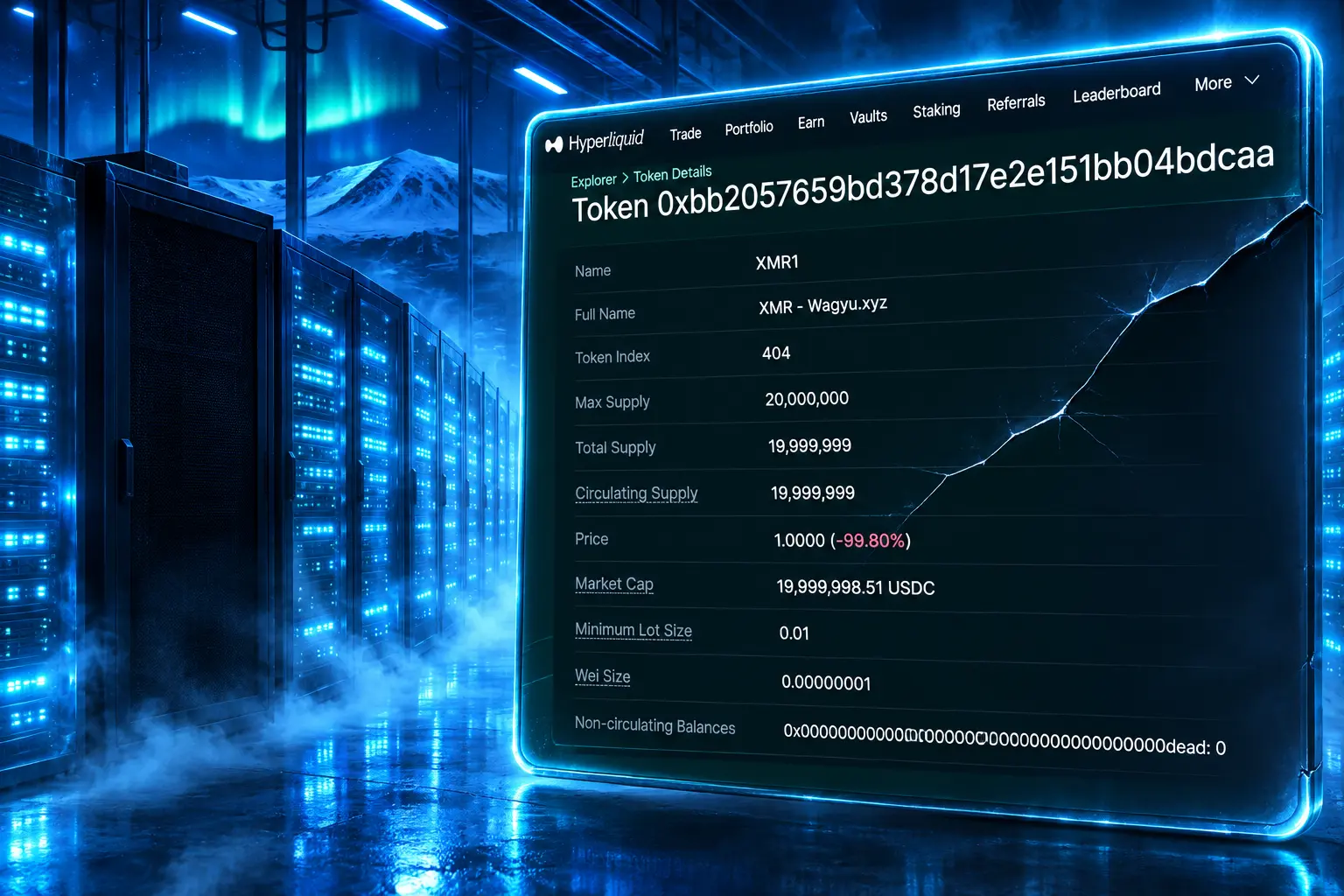
Monero hides senders, receivers and amounts on its own chain, so it cannot sit on Hyperliquid’s public book. Wagyu’s answer was a wrapper. You send XMR to the bridge and receive XMR1 at a Hyperliquid address. You send XMR1 back and the bridge is supposed to pay native XMR.
Wagyu’s own bridge page still says each token can be redeemed one for one for native XMR, minus the exit fee, with no account and no KYC. The token trades as XMR1/USDC, listed under the name XMR – Wagyu.xyz. It is not the XMR perpetual, which settles in USDC and never pays out coins.
XMR1’S TERMS ON THE BRIDGE
- Mint path: A deposit of native XMR mints XMR1 to a Hyperliquid address, with no deposit fee and a 0.01 XMR minimum.
- Exit path: Sending XMR1 back pays native XMR after a 2 percent withdrawal fee, usually in under a minute.
- Genesis supply: Hyperliquid credited all 20,000,000 tokens to one deployer account when the token went live on December 17, 2025.
- Reserve problem: Only Wagyu can see the Monero side, so public ledgers cannot show how much XMR still backs tokens in the wild.
That genesis setup is how Hyperliquid’s HIP-1 tokens are born. Tokens were meant to leave the mint wallet as real XMR arrived. Before Friday’s sends, the deployer still held 93% of supply. After the drain, Hyperliquid snapshots around 12:30 UTC showed 13,398,781 XMR1 still in the deployer, 4,824,377 in the seller, and about 1,777,000 with everyone else.
Who Paid the $13.51 Million?
Every dollar the seller raised came from the other side of a trade. Bitquery matched those fills and found that 420 buyers paid $13.51 million for 369,623 tokens between 04:49 and 10:28 UTC. Seventy-five percent of that cash came from buy orders already resting on the book. Twenty-seven large buyers paid 77% of the total. The largest single account paid $3.56 million filling bids near the old price.
That is a market-maker failure as much as a theft. Quotes that track the XMR perpetual will keep bidding a wrapper as if it still prints one Monero. When the peg breaks, those bids buy a token heading to $1, and the hedge on the perpetual barely moves. There was no kill switch on size that large. Seventy-six percent of the money arrived in the first 11 minutes, before most desks could pull the quotes.
WHERE THE $13.51 MILLION WENT
| Step on November 20 | Amount |
|---|---|
| Sold on Hyperliquid | 369,623 XMR1 for $13.51 million |
| USDC bridged to Arbitrum | $13.28 million in 11 transfers |
| Swapped on CoW Protocol | $13.22 million USDC for 7,467 ETH |
| Still held at last check | 7,348 ETH in three wallets |
The largest slice, 4,836 ETH, landed in an Ethereum wallet that had never sent a transaction. Bitquery marked that ether around $1,740. Bridges on the way out cost about 1.7%. Just before the big sales, the seller also forwarded 6,000 XMR1 to seven other accounts. Four of those passed the tokens within about 30 seconds to a busy address that looks like a swap sweeper, which may have been an attempt to cash some of the pile into native XMR while the price was still near $500. Any Monero that left would sit on Monero’s chain, where public tracers cannot follow it.
The Deployer Key Sat on a Deleted Server in Iceland
PerpetualCow, the account that speaks for Wagyu, first wrote at 09:36 UTC that he was not yet sure what had happened. He said market makers who kept buying the dump took the hit, that people using the swap suffered no loss, and that he was open to talks with whoever did it. At 11:31 UTC he said those market makers would be refunded in full and that nobody but him would lose money.
At 12:48 UTC he tied the key to 1984.hosting, an Icelandic web host that had just shut itself down.
Post-mortem of the $13m XMR hack:
It's WORSE than I thought.
Turns out that the entire hosting provider of https://t.co/skXiWey4Fb got hacked with everyone's data + internal server files today.
The XMR1 deployer key was held on an OLD server on there that I DELETED, but…
— PerpetualCow.hl (@PerpetualCow) November 20, 2026
He wrote that the XMR1 deployer key sat on an old server he had deleted, and that the host had still kept logs and files. “Everyone who lost money due to this will be refunded by me personally and Wagyu will re-launch at a later stage,” he said. “Give me some time please.”
1984 ehf. did confirm a serious attack on its own kit the same day. Managing director Mörður Áslaugarson said the company had stopped all services after a well organised, technically advanced breach, and that email and DNS would return first under extra watch. He told Icelandic radio the attackers looked professional and well funded, talking of tens of millions in artificial intelligence costs and a speed he had not seen before. Magni R. Sigurðsson, head of CERT-IS, the national cyber team, said artificial intelligence was clearly used to map the host’s systems. The company serves tens of thousands of customers. Its notice does not say the XMR1 key was among the files taken. That link is still PerpetualCow’s account. Bitquery was plain on the same point: the chain cannot show where a key came from.
Three weeks earlier the same operator had already confirmed a leak. On October 28 he wrote that three months of data had been leaked, not the full year Wagyu had been running, and that no funds were lost. Hudson Rock, a threat-intel firm, reviewed files tied to that claim and counted 38,628 order records and 10,139 distinct IP addresses, including 4,580 completed cross-chain swaps that put a deposit hash, a Monero receive address and a client IP in the same row. A group calling itself WhiteArmor had listed the service and asked for $5 million. No public evidence ties that leak to Friday’s deployer sends. It does show that Wagyu’s off-chain records, and now its mint key, were the weak points, not Monero’s chain.
Native Monero Barely Moved
Hyperliquid’s XMR perpetual traded between $456 and $489 while the wrapper went to $1, and sat near $462 around 12:30 UTC, down about 7% with the wider market. That is the cleanest public read that the underlying coin was not the thing being sold. Holders who thought a $1 print was cheap Monero were buying a separate token whose issuer had just lost control of the mint.
Quit phrasing this as an ‘XMR’ hack, Monero was not hacked, YOU were hacked and your XMR1 IOU was affected.
Seth for Privacy, COO of Cake Wallet, on X
The wrapper existed so traders could get Monero-like exposure on a transparent book. The book did what transparent books do. It showed the mint wallet moving size, showed the dump, and showed the cash leaving for ether. Native Monero’s privacy held because that chain was never in the path of the 369,623 tokens sold for cash.
A Personal Refund With No Claims Window Yet
Wagyu’s operator has promised to cover losses himself and to bring the service back later. He has not published a timetable, a claims form, or a reserve figure for the Monero still in the bridge. Bitquery checked at 13:16 UTC on November 20 and found that none of the 10 largest buyers had received a transfer from another Hyperliquid account since 06:00 UTC. A lookalike account began circulating a registration site on November 21. The last post from @PerpetualCow did not publish that form.
WHAT WE KNOW
- The send: 5.2 million XMR1 left the deployer in three signed transfers to a wallet funded that morning from Tornado Cash.
- The cash: 420 buyers paid $13.51 million; $13.22 million of USDC became 7,467 ETH, with 7,348 ETH still in three wallets at Bitquery’s last check.
- The host: 1984 ehf. and CERT-IS confirmed a serious attack and a full service stop on November 20.
WHAT IS UNCONFIRMED
- The key: No independent trace shows the deployer key was taken from 1984’s retained files, only that the main key signed the sends.
- The backing: Public data cannot show how much native XMR still covers the roughly 1,777,000 tokens outside the deployer and the seller.
- The refunds: No paid claims had posted on Hyperliquid for the largest buyers by early afternoon on November 20, and no official claims window exists from the operator’s own account.
Swap users who passed through XMR1 for a few seconds may have been fine, as PerpetualCow said. Anyone still holding the token is waiting on a bridge that only Wagyu can operate, and on a personal promise from a pseudonymous operator.
The Same Key Still Controls Almost All of ZEC1
XMR1 was not the only wrapper that mint wallet created. The same account deployed ZEC1, Wagyu’s Zcash token on Hyperliquid, plus other tickers. At 13:16 UTC it still held 99.97% of ZEC1, about 20,993,997 tokens. ZEC1 was still near its perpetual around 12:30 UTC, at $824.16 against a ZEC perp at $814.33, because almost none of it trades. The key that signed Friday’s XMR1 sends controls that supply too.
Bitquery also noted that stolen funds from four other cases this month, Across, Kava, Lighter and a Safe drain, had bought about $6.6 million of XMR1 on the way toward Monero. Nothing on-chain ties those thieves to this drain. It does show why a wrapper with a single mint key became a busy last hop, and why the hop failed in public.
The 4,836 ETH in the silent Ethereum wallet had not moved by 12:38 UTC on November 20. Native Monero is still the coin it was before breakfast. XMR1 is the IOU that a deleted server, a public order book and one key were enough to break.
Disclaimer: This article is news reporting and analysis of a wrapped-token dump and a related hosting breach, and it is for information only. It is not investment advice, trading advice, tax advice, or a recommendation to buy, sell, hold or redeem XMR, XMR1, ZEC1, ETH or any other asset, and it is not a claim-filing guide. Readers who hold these tokens or who may have a refund claim should consult a qualified financial adviser and, where needed, a lawyer who works on digital-asset custody and fraud, before sending funds, connecting a wallet or using any compensation site. Figures, wallet balances, service status and refund promises reflect the on-chain records, operator posts and host statements cited here as of November 20, 2026, and can change as wallets move and as investigations continue.

Jennifer Lopez and Mahershala Ali Describe a Pipeline They Cannot Buy

Lightsail Scatter Turns to Drag Far Above Starshot

Tallulah Willis Deletes a Bruce Willis Photo She Called Intimate

S&P 500 Futures Rebound Into a Holiday-Shortened Week

GTA VI’s Record Launch Still Needs the Same Fragile Grid

Aramco Crash Kills 14 Two Days After Oil Restart

Salah Captained Egypt to Their First World Cup Win

Zelda’s 40th Switch 2 Ships Without a Zelda Game

Apple Labor Day Deals Hide June’s Memory Price Hike

El Niño Puts Israel’s Needed Winter Rain on a Flood Clock
-
 BUSINESS5 months ago
Aramco Crash Kills 14 Two Days After Oil Restart
-
 NEWS6 months ago
Salah Captained Egypt to Their First World Cup Win
-
 GAMING3 months ago
Zelda’s 40th Switch 2 Ships Without a Zelda Game
-
 NEWS3 months ago
Apple Labor Day Deals Hide June’s Memory Price Hike
-
 NEWS5 months ago
El Niño Puts Israel’s Needed Winter Rain on a Flood Clock
-
 GAMING3 months ago
Palworld 1.0.4 Adds Palpedia Search After the 1.0 Launch
-

 NEWS4 months ago
Saudi Visa Routes Split Nigerian Travelers Into Two Speeds
-

 BUSINESS9 months ago
BAE’s 60-Year Saudi Franchise Now Runs Through Taif