
ENTERTAINMENT
Marie Antoinette Spent 20 Years Becoming the Template
Sofia Coppola’s Marie Antoinette is on Criterion and back at Versailles, 20 years after Cannes. The pop-court method now runs through prestige TV.

Sofia Coppola’s Marie Antoinette is on Criterion spine 1335 and back in 4K, 20 years after Cannes greeted it with boos. The film cost $40 million, took $15.96 million in North America, and finished at $60.9 million worldwide.
The anniversary machine is loud: a disc, a restoration, a mother’s last documentary, a palace show. The quieter fact is that Coppola’s mix of court ritual and pop records became how later hits dress a trapped young woman.
Cannes Booed a Film That Had Not Found Its Crowd
Marie Antoinette premiered at Cannes on May 24, 2006, in the Palme d’Or competition, then opened in the United States on October 20. Coppola, then coming off Lost in Translation, had written the script from Antonia Fraser’s biography Marie Antoinette: The Journey and shot inside the Palace of Versailles with a crew of more than 300.
Kirsten Dunst, who was 24 when the film opened, did not treat the jeers as a mystery. “How would we feel about the French doing a movie about George Washington with French actors?” she said. At the Cannes press conference Coppola called the reaction “disappointing to hear,” and Dunst cut in: “Well, I like the movie. I’m really proud.”
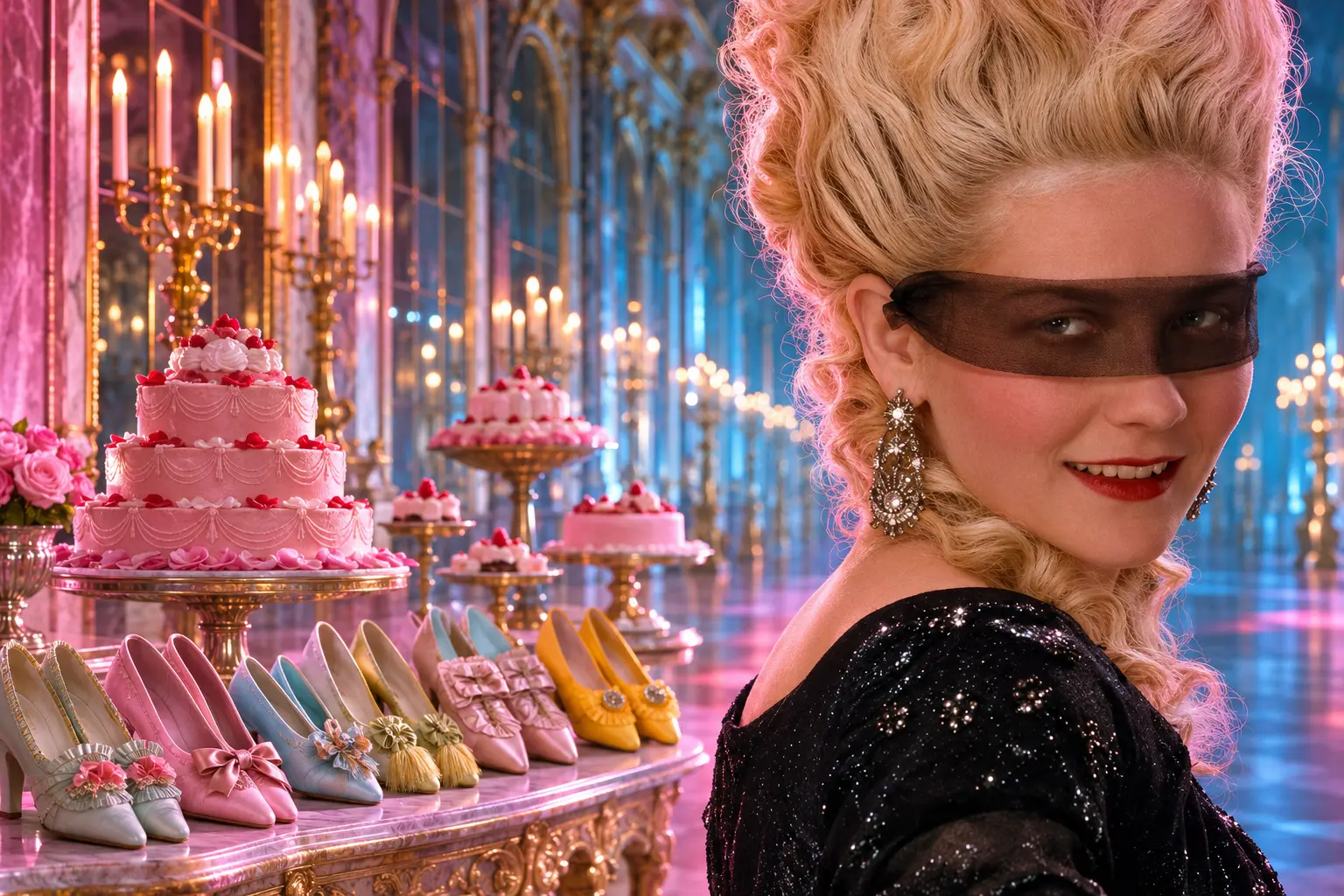
Almost all of the talk is in English, and it sounds like California. New Order’s Age of Consent had already sold the teaser. In the feature, Gang of Four’s Natural’s Not in It opens on Dunst lounging toward the camera, and Bow Wow Wow’s I Want Candy scores a shopping jag of cake, shoes, and silk. A pair of Converse high-tops sits in a dressing-room pile. Coppola later said she had even parked a white Rolls-Royce at the Petit Trianon and pulled it when the gag felt cheap.
She kept a box of clippings. “A Royal Mess.” “Lost in Sensation.” “I was told, you know, no one wants to see this,” she said at the Harvard Film Archive during a 4K screening this fall. She also said the court read to her like high school, and the Hall of Mirrors like the quad.
One Oscar and a Quiet American Run
Columbia opened the film wide on October 20, 2006, in 859 theaters. The first weekend took $5.36 million. Seven weeks later the North American total had stalled. Japan, not France, was the largest market abroad.
THE 2006 LEDGER
| Market | Gross |
|---|---|
| North America | $15.96 million |
| Japan | $15.74 million |
| France | $7.87 million |
| Worldwide | $60.9 million |
| Production budget | $40 million |
That worldwide figure is about 1.5 times the budget, which is recoupment, not a hit. The only Oscar was crafts. On February 25, 2007, at the 79th Academy Awards, Milena Canonero won Best Costume Design. Presenters called the clothes eye candy drawn from French-court desserts. Canonero, who had already won for Barry Lyndon and Chariots of Fire, thanked Francis Ford Coppola for introducing her to Sofia on The Cotton Club, then called the new film “a movie set like a poem.”
The crafts vote never settled the argument about tone. Coppola had put the money into new clothes rather than rental-house stock, because old gowns photographed sad, and the real rooms at Versailles were a bright turquoise she had not expected from faded paintings.
Converse, Bow Wow Wow and the Shows That Followed
Coppola has been plain about the wager. She wanted the queen fashionable to a 2006 eye and still inside the period. Mood boards mixed macarons with John Galliano’s Dior couture. Hair references came from Odile Gilbert. Manolo Blahnik made shoes because Coppola had been watching trophy wives at Barneys buy pairs to cheer themselves up. “If Marie Antoinette was alive at that time, she would ask Blahnik to do them,” she told the Harvard audience.
The out-of-time cues are few on purpose. Dunst winks before the credits. The sneakers flash and vanish. The rest of the rebellion sits on the soundtrack Brian Reitzell built from post-punk, new wave, and mid-2000s indie beside court music. Coppola has said she was having fun, and that taking on French history that way was a little rebellious. Cannes heard the fun as insult. A later audience heard a girl building a world because it was the only lever she had.
THE SHOWS THAT KEPT HER MIX
- Bridgerton: Ballrooms move to pop covers and a string-quartet gloss, with the now leaking into the then as a house style.
- The Great: An empress story plays as court satire, trading textbook reign for appetite, spite, and joke timing.
- Dickinson: A 19th-century poet is staged as a restless young woman, with modern songs doing the interior work the plot will not speechify.
A Knight’s Tale had already smashed rock into jousting. Coppola’s move was to apply that smash to a queen, to girlhood, and to boredom as politics. You can still see the same candy-and-cage pictures circulating as mood boards. She told Harper’s Bazaar the film “didn’t really have an audience at all” in 2006, then started hearing from viewers about 10 years later, once those images could travel.
What the 4K Restoration Shows
The new transfer is a director-approved 4K digital restoration, signed off by Coppola and director of photography Lance Acord. Criterion issued it on November 10, 2026, as spine #1335, on 4K UHD in Dolby Vision HDR plus a Blu-ray of extras, with 5.1 DTS-HD Master Audio. The film remains 123 minutes, 1.85:1, rated PG-13. Tori Huynh designed the new cover.
MUBI put the 4K into U.S. theaters and onto its service on October 23. Park Circus’s UK cinema return from 13 November is the British leg. Pathé takes the same restoration into French cinemas on November 25, 2026.
THE CRITERION 4K PACKAGE
- New talk: Coppola sits for a fresh interview, and Dunst records a selected-scene commentary.
- Craft program: Acord, production designer KK Barrett, and Canonero walk through how the look was built.
- Old jokes: A parody short with Jason Schwartzman as Louis XVI, deleted scenes, and Phoenix’s Run Run Run video.
- Essay: Claire Marie Healy writes on girlhood in the Hall of Mirrors.
The disc arrived in shops as an object people were already treating like delayed justice, the Cannes night rewritten as a bad early review of a film that had simply been waiting. Criterion announced the title as an anti-biopic with candy color, synth-pop, and those high-tops still in the copy.
💘 Our beautiful 4K edition of Sofia Coppola’s MARIE ANTOINETTE (2006) has entered the collection! 💘 https://t.co/KZeMiHn6j9
Coppola brings a candy-colored palette, a dreamy synth-pop soundtrack, and Converse high-tops to eighteenth-century Versailles for this exuberantly… pic.twitter.com/BZ9gCYgx1m
— Criterion (@Criterion) November 11, 2026
Dunst Still Carries the Lonely Part
The film is Dunst’s. She plays the Austrian archduchess as a 14-year-old sent to France in 1770, stripped of her dog and her name, then watched by a household that dresses and undresses her on a schedule. Coppola has said Fraser “set the record straight of making her human.” Dunst said the part was solitary. She could not lean on a crowd of other principals to pull the performance out of her, and she was grateful when Schwartzman, Coppola’s cousin, was on set as Louis XVI so she could “unload a little bit on him.”
Schwartzman’s shy dauphin is the other half of the joke and the ache. Rip Torn’s Louis XV, Judy Davis’s Comtesse de Noailles, Rose Byrne’s Polignac, Asia Argento’s Du Barry, Marianne Faithfull’s Maria Theresa, and Jamie Dornan’s Axel Fersen fill the court, but the camera stays with a girl who learns that buying things is the one plot she can author. Coppola said at Harvard that the queen’s only creative outlet was “her environment, her clothes, her flowers and gardens,” and that the private rooms behind the state bedroom were human-scaled, a backstage.
In 2005, all the reviews were written by men. I get it that the movie is maybe not their thing, but I just think it’s so cool that nowadays young women have a real voice in culture. Young women weren’t considered an audience in the way that they are today. It’s such a thrill to me that, 20 years later, people are still watching it.
Sofia Coppola, Harvard Film Archive Q&A
She has also said she wants to work with Dunst again “at this stage of her life.” The 20th-anniversary circuit already put them back in the same rooms, including a packed Academy Museum screening where the line ran longer than regulars there are used to seeing.
Eighty Hours of Versailles, Finished After Her Death
Eleanor Coppola, who made Hearts of Darkness: A Filmmaker’s Apocalypse about the Apocalypse Now shoot, was on this set too. In 2005 she filmed about 80 hours while her daughter, 34, ran a $40 million court picture and called herself rusty on day one. Eleanor died on April 12, 2024, at 87, at home in Rutherford, California. Sofia produced the finished documentary to honor a wish to cut the footage into a feature. Diane Lane reads from Eleanor’s journals. The running time is 86 minutes.
Theaters took Making Marie Antoinette on October 23, 2026, beside the 4K. The 86-minute making-of on MUBI followed on November 6. MUBI’s own notes call it tender, “flush with a mother’s love.” The on-set crises are not Hearts of Darkness crises. They are fittings that run long, a director who looks too slight for the call sheet, and the last-day feeling of missing a circus that had been exhausting. Sofia has said it is odd, and sometimes embarrassing, to watch herself as a “baby director,” and that she tried to keep her mother’s point of view anyway.
FROM CANNES TO SPINE 1335
- May 24, 2006: Premieres at Cannes in competition, to a split house of applause and boos.
- October 20, 2006: Opens in the United States with a $5.36 million weekend.
- February 25, 2007: Canonero wins the costume Oscar; the film takes no other Academy nominations.
- April 12, 2024: Eleanor Coppola dies at 87; the Versailles footage is still unshaped as a feature.
- September 22, 2026: The Palace of Versailles opens a Coppola-designed show at the Petit Trianon.
- October 23, 2026: The 4K restoration and the making-of documentary reach U.S. theaters.
- November 10, 2026: Criterion issues spine 1335; Park Circus follows in the UK on November 13.
A companion book, also titled Making Marie Antoinette, collects on-set stills by Coppola and Andrew Durham, including the now-familiar shots of powdered extras in wired headphones with laptops. Those pictures do the same joke the sneakers did, only off camera.
The Petit Trianon Now Treats the Movie as History
From September 22, 2026, through January 24, 2027, the Palace of Versailles is hosting an exhibition at the Petit Trianon conceived with Coppola and backed by Cartier. Curators Laurent Salomé and Hélène Delalex put Canonero’s original costumes, props, storyboards, annotated scripts, and set pieces in the estate where they were used. Visitors can watch sequences in the rooms where they were filmed. The show is open afternoons, closed Mondays, and bundled with a 25 euro Passport or a 15 euro Estate of Trianon ticket.
During the production of Marie Antoinette, Versailles was far more than just a filming location: it became an integral part of the film’s language and atmosphere, a true character in the story.
Sofia Coppola, Palace of Versailles exhibition note
Salomé, director of the National Museum of the Palace of Versailles and Trianon, said the film now sits in the palace’s own contemporary history, and that the show is partly about how Coppola’s images changed what people picture when they picture Marie Antoinette. In September, Dunst and Schwartzman went back for the commemorative opening. Dunst called the night “like a wedding and a funeral at the same time.”
France’s first public was the Cannes press hall. France’s current public is a ticketed walk through the queen’s private house, with pistachio Saint-Honoré on the café card in the film’s pastel green. Coppola told Harvard she tries to go with what she is excited about and not analyze it too much. “If you’re interested in something, there has to be someone else out there that’s interested in that, too.” It took 20 years for the someone else to include the palace, the Criterion Collection, and the streaming service running the making-of. The method had already left the building.

Jennifer Lopez and Mahershala Ali Describe a Pipeline They Cannot Buy

Lightsail Scatter Turns to Drag Far Above Starshot

Tallulah Willis Deletes a Bruce Willis Photo She Called Intimate

S&P 500 Futures Rebound Into a Holiday-Shortened Week

GTA VI’s Record Launch Still Needs the Same Fragile Grid

Aramco Crash Kills 14 Two Days After Oil Restart

Salah Captained Egypt to Their First World Cup Win

Zelda’s 40th Switch 2 Ships Without a Zelda Game

Apple Labor Day Deals Hide June’s Memory Price Hike

El Niño Puts Israel’s Needed Winter Rain on a Flood Clock
-
 BUSINESS5 months ago
Aramco Crash Kills 14 Two Days After Oil Restart
-
 NEWS6 months ago
Salah Captained Egypt to Their First World Cup Win
-
 GAMING3 months ago
Zelda’s 40th Switch 2 Ships Without a Zelda Game
-
 NEWS3 months ago
Apple Labor Day Deals Hide June’s Memory Price Hike
-
 NEWS5 months ago
El Niño Puts Israel’s Needed Winter Rain on a Flood Clock
-

 GAMING3 months ago
Palworld 1.0.4 Adds Palpedia Search After the 1.0 Launch
-

 NEWS4 months ago
Saudi Visa Routes Split Nigerian Travelers Into Two Speeds
-

 BUSINESS9 months ago
BAE’s 60-Year Saudi Franchise Now Runs Through Taif