
NEWS
Gemini Live Offline Mode Depends on Phones Running Nano
Google app strings point to Gemini Live offline after an online setup, on phones that already host Gemini Nano.

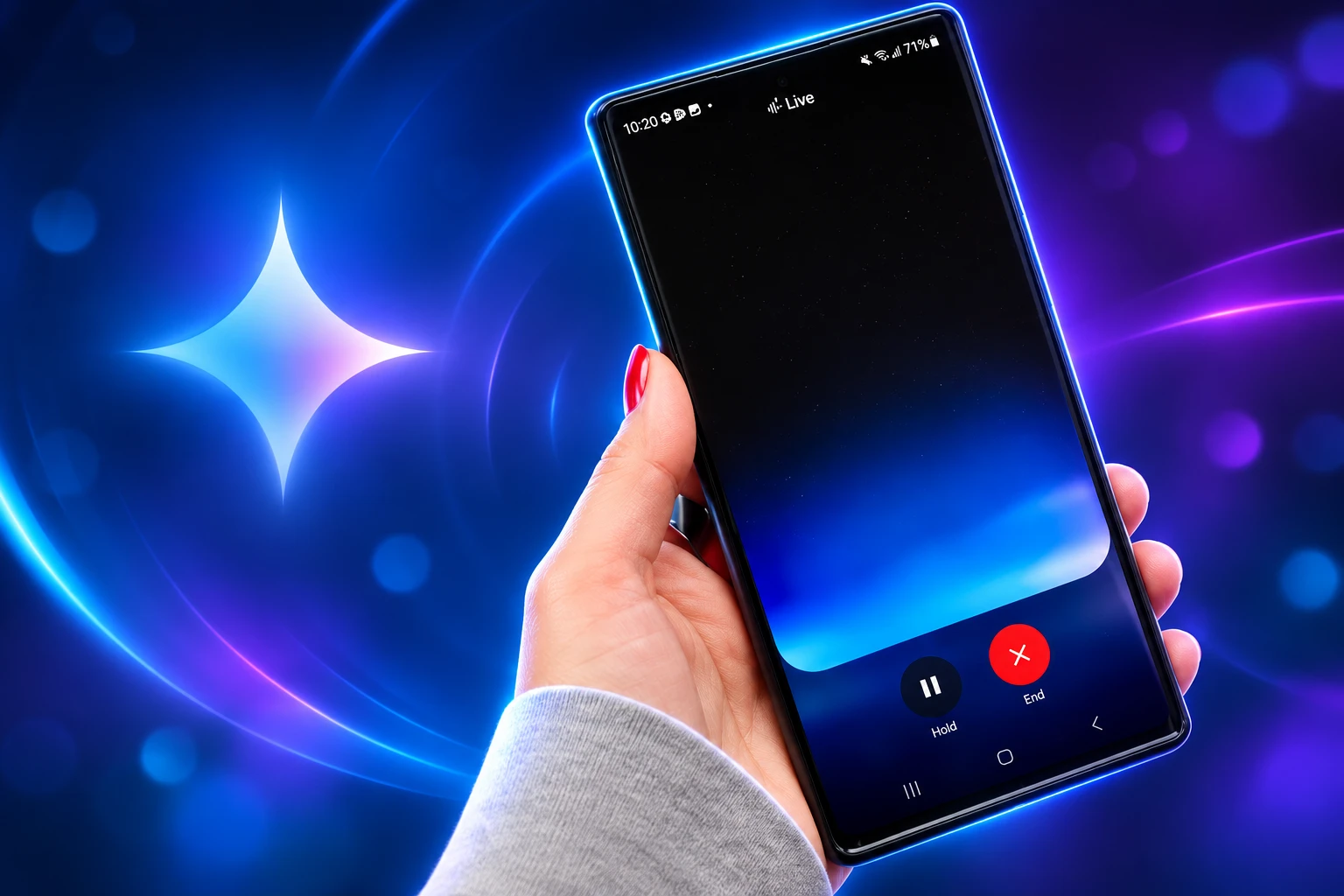
Google app v17.73.15 tells people to set up Gemini Live’s offline mode while they still have a signal. A second string warns that the disconnected session will run with limited features. That setup step is how Android already delivers an on-device Gemini to phones that can hold it.
Google has not announced the mode, a model name, a device list, or a ship date. The code still names the stakeholder: a local Live session only exists if a local Gemini exists, and on Android that local Gemini is Nano.
Two Google App Builds Spelled Out the Limits
A teardown of Google app v17.71.17 on October 30, 2026 found an “Offline mode” label whose subtitle reads “Use Gemini Live without an internet connection.” The resource name, assistant_ui_account_offline_mode, points at Gemini’s account switcher, not a buried debug flag.
Seven days later, v17.73.15 added the setup rule and the warning users will see once the radio drops. The wording copies the bargain Google Maps and Google Translate already teach: download first, then go dark, then live with less.
THE STRINGS AS THEY APPEARED
- October 28, 2026: Android Dev Summit opens Gemini Nano 4 and ML Kit agent APIs for on-device agents.
- October 30, 2026: Google app v17.71.17 carries “Offline mode” and “Use Gemini Live without an internet connection.”
- November 6, 2026: Google app v17.73.15 adds the setup-while-online prompt and the limited-features candybar.
The November 6 setup string is blunt. “To keep talking to Gemini, set up offline mode when you’re connected to the internet.” What gets installed during that step is not named. The teardown notes Google could fetch a fresh on-device model or wake one already on the phone.
The Phone Already Has a Local Gemini
Android’s on-device Gemini is not a rumor. Gemini Nano runs in Android’s AICore, a system service that keeps the model current, runs inference on the phone’s hardware, and is built so prompts never need a server. Google’s developer docs say that path is for cases where cost and privacy come first, and that it works without a network connection.
AICore does not talk to the internet itself. Model downloads go through the Private Compute Services companion app, which is the same “be online once” pattern the new Live strings describe. ML Kit’s GenAI APIs also share one Nano copy across apps, so a phone that already holds the model does not wait on a second download.
That shared copy is the quiet split inside the leak. On a Pixel or a flagship that already has Nano, “set up offline mode” can be a switch. On a phone that does not, it is a download, a storage bill, and a hardware check Google has not published for Live.
Speech is already on that local stack. ML Kit lists on-device speech recognition, speech translation, and text to speech, which are the three pieces a spoken Live session has to have if it is going to answer at all with the radio off. Camera understanding, live web results, and connected apps are a different class of work, and they are the first things a limited mode would shed.
Nano 4 Already Runs Offline Agents
Two days before the first Live strings showed up, Google told developers Nano 4 was ready for agents that never leave the phone. Mishaal Rahman, who handles community engagement for Android at Google, put the pitch in one line: Nano 4 lets you add an offline AI agent to an Android app.
✨ Gemini Nano 4, our latest on-device AI model, is available to developers through the ML Kit Agentic API.
With Nano 4, you can add an offline AI agent to your Android app.#AndroidDevSummit pic.twitter.com/UAzdCrpXmA
— Mishaal Rahman (@MishaalRahman) October 28, 2026
Jingyu Shi, a developer relations manager, followed on November 5, 2026 with the rest of the kit. Nano 4 adds function calling, and ML Kit now exposes agentic workflows entirely on-device, with a Prompt API plus an Agentic API that runs tools, keeps chat history, and holds the loop. Shi wrote that Nano 4, built on Gemma 4, delivered a 3x inference speedup and cut memory use by up to 4x against the previous Nano in Google’s internal tests.
The agent examples are the jobs people actually want in a tunnel. ML Kit’s own pattern list includes turning spoken requests into app commands, changing playback, and toggling preferences. That is flashlight, timer, downloaded music, and a short answer, which is exactly the stub a limited Live mode can sell without search.
None of that names Gemini Live. It does show Google wiring a spoken, tool-using agent to Nano 4 at the same moment Live’s offline labels landed in the Google app. Live’s cloud model is still Gemini 3.8 Live on Google’s servers. The local one, if Live offline ships, has to be this smaller stack or a close cousin, because Android does not ship another on-device Gemini.
Which Android Phones Can Host It
Google has not said which phones will get Live offline. It has said which phones already get Nano for custom generation and agents, and that list is the closest map we have. Google’s Gemini Nano device list, updated November 6, 2026, splits the field by model generation.
GEMINI NANO ON CURRENT FLAGSHIPS
| Nano version | Google phones | Other phones on the same tier |
|---|---|---|
| nano-v2 | None listed | OnePlus 13, Xiaomi 15, Galaxy Z Fold7, and other 2025 flagships |
| nano-v3 | Pixel 9 and Pixel 10 lines | Galaxy S26, S26+, S26 Ultra, OnePlus 15, OPPO Find X9 |
| nano-v4 | Pixel 11, 11 Pro, 11 Pro XL, 11 Pro Fold | Galaxy Z Flip8, Z Fold8, Z Fold8 Ultra |
nano-v4 is the thin edge: four Pixel 11 models and three Samsung foldables. Pixel 9 and Pixel 10 sit on nano-v3 with the Galaxy S26 line, which still gets direct model access and agent workflows, just not the newest weights. Mid-range Androids and last year’s cheap 8 GB sets are simply not on the custom-generation table.
Google Research already spent June 26, 2026 making Nano v3 faster on Pixel 9, retrofitting multi-token prediction onto frozen production weights and quoting speedups of 50% or more on that phone depending on the task. The hardware club is not theoretical. It is a shipping list, and Live offline will either join it or invent a second model pipeline Google has never described.
Camera, Inbox, and the Cloud Half of Live
Gemini Live as people use it now is a streaming product. Google’s August 11, 2026 note that the Gemini app had passed 1 billion monthly users also said 63% of users talk to Gemini out loud, and that one in five Gemini Live interactions go beyond voice into live camera feeds and screen sharing. Those turns need a fat uplink. They also need a model that can see.
HOW PEOPLE ALREADY USE GEMINI LIVE
- Voice share: 63% of Gemini users talk to it out loud, per Google’s August 11, 2026 figures.
- Camera and screen: One in five Live sessions use a live camera feed or screen sharing for real-time help.
- iPhone crowd: Google counted 100 million-plus active Gemini users on iOS, who sit outside this Android-app leak.
An August 26, 2026 Gemini Live update piled more cloud work on that voice path. Spark hands long jobs to Docs, Sheets, Drive, and the web. Daily Brief reads Gmail and Calendar out loud. Hands-free inbox sorting asks Live to treat your mail as a live feed. Personal Intelligence inside Android Auto is the same idea in the car: Live with your mail along for the ride.
WHAT A DEAD RADIO CUTS
- Live camera and screen share: Google says these already make up one in five Live sessions, and they need a pipe to a large visual model.
- Spark and Daily Brief: Both reach into Docs, Drive, Gmail, and Calendar, which do not exist as a local Nano tool.
- Web answers: The November 6 strings do not list cuts, but any reply that needs a fresh page dies without a connection.
- Connected apps: Live’s linked services, including the Gmail path, are cloud sessions with account tokens, not on-device weights.
The leftover is still useful. Device toggles, timers, a downloaded playlist, and a short question that does not need the open web are the jobs Google Assistant used to keep when the signal died. Live offline, in that form, is less a new chatbot than a spoken control layer that no longer goes mute in a tunnel.
Limited Mode Tells You to Come Back Online
The November 6 candybar does not pretend the local session is equal. It names the downgrade, then sells the upgrade.
Gemini Live is in offline mode with limited features. Connect to the internet for the full experience.
Google app v17.73.15
A sibling string offers the switch in advance: “Turn on offline mode to use Gemini Live with limited features.” The product is designed to remind you it is incomplete. That is the Maps move too. Offline areas get you to the next turn, then the app wants the live layer back for traffic, listings, and search.
For Google the split has a second use. Cloud Live is the expensive, logged, tool-using model. A local stub can absorb “set a timer” and “skip this track” without a round trip to a data center, which is wasted spend on a 1 billion-user voice surface. The nag to reconnect keeps Gmail, Spark, and camera Live on the metered path where Google can still see the session.
Privacy is the other side of that split. Nano’s own docs say on-device prompts skip server calls and keep the data on the phone. Cloud Live does not. A local mode is the first time a Gemini Live turn could stay on the device, and the strings still treat that turn as a lesser product.
Phones Without Nano Stay on the Server
If Live offline ships on the Nano map, the winners are already in the table: Pixel 11 and the 2026 Samsung foldables on nano-v4, then Pixel 9, Pixel 10, and Galaxy S26 on nano-v3. Those phones already paid for the NPU, the RAM, and the AICore download. Everyone else, including Google’s 100 million-plus Gemini users on iOS, keeps a Live that dies when the radio dies.
Older Androids and iPhones can still talk to Gemini in a dead zone the old way, which is not at all. The Google app strings are Android-only. Gemini Live is still listed as needing the latest Google app, a signed-in account, and an Android phone or tablet in Google’s own help pages, with no offline clause.
Teardown strings also vanish. Google’s own warning on this class of leak is that work-in-progress code may never reach a public release. The next hard clue is not a keynote. It is an Offline mode row in the Gemini account menu, on a phone that already holds Nano, after a Google app update that no longer hides the switch.

One UI 9.5 Beta Puts the Galaxy S26 on Last Year’s Clock

DBS Puts a 24/7 USDC Window Inside the Bank

European Startups Head for $81 Billion as First Checks Shrink

US Stocks Lost $1.3 Trillion Before Nvidia’s Beat

Home Depot Bets on Finance Chief Richard McPhail as CEO

Aramco Crash Kills 14 Two Days After Oil Restart

Salah Captained Egypt to Their First World Cup Win

Zelda’s 40th Switch 2 Ships Without a Zelda Game

Apple Labor Day Deals Hide June’s Memory Price Hike

El Niño Puts Israel’s Needed Winter Rain on a Flood Clock
-
 BUSINESS5 months ago
Aramco Crash Kills 14 Two Days After Oil Restart
-
 NEWS6 months ago
Salah Captained Egypt to Their First World Cup Win
-
 GAMING2 months ago
Zelda’s 40th Switch 2 Ships Without a Zelda Game
-
 NEWS3 months ago
Apple Labor Day Deals Hide June’s Memory Price Hike
-
 NEWS4 months ago
El Niño Puts Israel’s Needed Winter Rain on a Flood Clock
-

 GAMING2 months ago
Palworld 1.0.4 Adds Palpedia Search After the 1.0 Launch
-

 NEWS4 months ago
Saudi Visa Routes Split Nigerian Travelers Into Two Speeds
-

 BUSINESS9 months ago
BAE’s 60-Year Saudi Franchise Now Runs Through Taif