
NEWS
The iPhone Duo Foldable Puts a $999 Screen in Your Pocket
Apple’s iPhone Duo starts at $1,999 with a 7.6-inch inner display that costs $999 to replace, and some early units have already cracked along the hinge.

Apple’s iPhone Duo starts at $1,999, and replacing its inner display without coverage costs $999, half the phone. Closed it is meant to vanish in a pocket. Opened it is a 7.6-inch canvas Apple called the largest display ever on iPhone, with a hinge engineered from more than 100 parts.
John Ternus, Apple’s CEO, said iPhone Duo is “the most transformational change to iPhone since the original.” Three days after the October 23 launch, Apple was already telling owners with cracked inner screens to contact AppleCare for a replacement.
The $999 Screen Inside a $1,999 Phone
The folding panel is the reason to buy this iPhone, and it is the part that turns a drop into a bill. Apple’s U.S. service list, compiled by iFixit from the company’s repair pages, puts inner display damage listed at $999 if you skip AppleCare+. Other accidental damage tops out at $1,499, about three quarters of the base phone.
How Much Does iPhone Duo Screen Repair Cost?
Without AppleCare+, the inner folding OLED is $999, the 5.4-inch outer display is $379, and the thin nano-texture cover layer on the inner screen is $49. With AppleCare+, those copays fall to $99, $29, and $19, and a battery that has dropped below 80 percent of original capacity is replaced at no charge.
IPHONE DUO REPAIR PRICES
| Repair | Without AppleCare+ | With AppleCare+ |
|---|---|---|
| Inner cover layer | $49 | $19 |
| Back glass | $199 | $29 |
| Battery service | $229 | $0 if below 80% |
| Outer display | $379 | $29 |
| Inner display | $999 | $99 |
| Other accidental damage | $1,499 | $99 |
The outer screen matches the $379 fee Apple charges for an iPhone 18 Pro Max panel. The inner one does not. iFixit’s comparison puts Google’s Pixel 11 Pro Fold inner display at $568 and Samsung’s Fold 8 inner screen repair prices at $579 for a module swap, or $419 for a cheaper screen repair. Apple is the outlier, and that gap is the ownership tax on a first iPhone fold.
iFixit still gave the Duo a provisional 5 out of 10 for repairability, the highest score it has handed a foldable, ahead of 4 out of 10 for both the Galaxy Z Fold 8 and the Pixel 11 Pro Fold. Batteries release with an electrical charge, the outer display comes off intact, and the matte cover peels away without killing the OLED underneath. The deductions sit where owners will feel them: the inner panel and the hinge. “This is the most repairable foldable smartphone we’ve seen so far, and it’s still going to be a bear to repair,” iFixit said after the teardown.
Cracks Along the Hinge Showed Up in Days
Apple spent the launch window talking about durability. Grade 5 titanium, Ceramic Shield 2 with 3x better scratch resistance than the last generation, IP68 for 6 meters up to 30 minutes, high-strength glass above and below the folding panel, adhesives that “glide past one another like the pages of a book.” Tom Marieb, Apple’s vice president of hardware engineering, told journalists to “hold us accountable” for the crease.
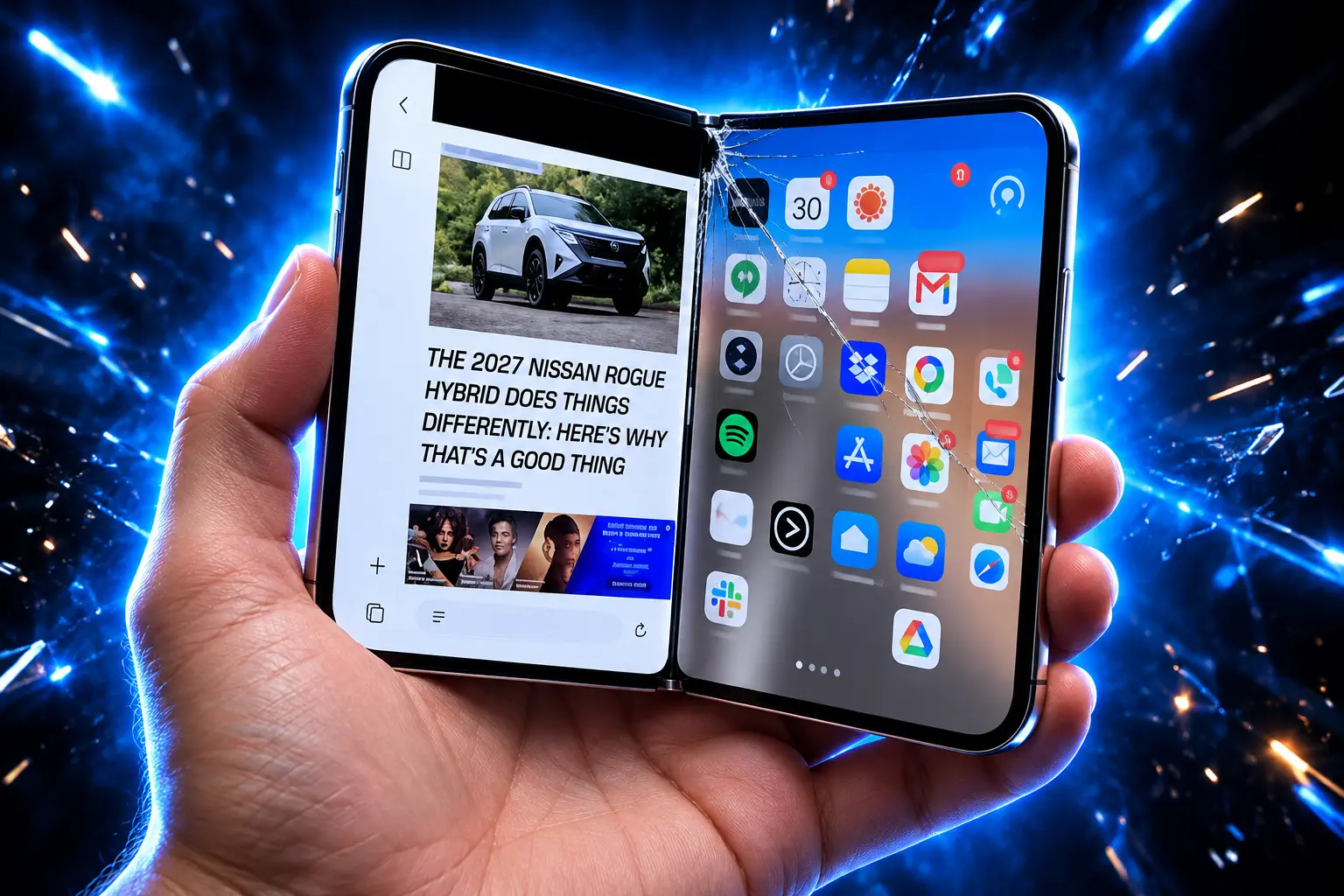
Owners then posted photos of inner screens cracking along the hinge, some after a handful of folds, some with a bright line spreading from the fold. One pattern that keeps showing up is a stiff or popping hinge, then a line across the panel. Another is a hinge that goes loose after a pop during ordinary typing, with the flex easy to repeat. That is the same failure mode the first Samsung Galaxy Fold taught the market in 2019, and it is the conservative reason to let a first-generation foldable age in public before you pay $1,999 for one.
We are aware of an issue impacting the inner display on a small number of iPhone Duo units. If users experience issues with their iPhone Duo display, they should contact AppleCare for a replacement.
Apple statement, October 26, 2026
Apple said most units are not susceptible and that the ones that fail tend to show it soon after first use. You do not need AppleCare+ for that replacement. If you bought from a carrier, Apple wants the call to go to AppleCare, not the carrier. The company has not named a cause or a unit count, and it has not announced a recall.
THE FIRST EIGHT DAYS
- October 16, 2026: Pre-orders open in the United States, with Apple Upgrade leasing from $57.99 a month for 24 months.
- October 23, 2026: iPhone Duo goes on sale in star white and night sky, from $1,999 for 256GB.
- October 25, 2026: iFixit publishes its teardown and a 5 out of 10 repair score, and flags the hinge as the stress point.
- October 26, 2026: Apple issues the “small number of units” statement and tells owners to contact AppleCare.
- October 30, 2026: Apple circulates an internal memo to Apple Stores and authorized service providers on how to inspect and replace cracked inner displays.
Kyle Wiens, iFixit’s chief executive, described the hinge as dozens of parts built to extreme precision, where a manufacturing variance or a grain of sand can kill the panel it is supposed to protect. Apple has not said whether the fault sits in the display, the hinge, or the way the two meet. Fine M-Tec, named as a hinge supplier in trade coverage, has denied that its parts are at fault. Until Apple publishes a cause, the practical advice is simple: if the hinge catches, stop folding it, photograph the line, and call AppleCare while the one-year warranty still frames it as a defect instead of a $999 accident.
Closed, It Is Built to Live in a Pocket
Samsung’s recent Folds make a big phone bigger. Apple went the other way. Closed, iPhone Duo is 3.31 inches wide, 4.64 inches tall, and 0.44 inch (11.3 mm) thick, closer to a passport than to an iPhone 18 Pro Max. Opened it is 6.48 inches across and only 0.21 inch (5.2 mm) thick, which Apple calls the thinnest iPhone ever. Weight is 254 grams either way, five grams more than the 18 Pro Max and Apple’s heaviest iPhone. The Galaxy Z Fold 8 is listed at 201 grams and 9.7 mm folded, so the Duo gives up a lot of pocket slimness for that short, wide shape.
In the hand, the extra mass is easy to miss. In a front pocket it is harder to ignore, and Apple’s cases add more. The hinge is firm, holds at odd angles, and clicks shut on magnets. Opening it is a two-handed job. After that, one-handed use is no worse than a Pro Max. Volume keys sit on the top edge when the phone is closed, an odd place if you are on a call. The side button holds Touch ID. There is no Face ID, and that absence shows up every time you pick the phone up from a different angle. Teach iOS as many fingerprints as you have patience for.
Ceramic Shield 2 covers the outer face, Ceramic Shield covers the back, and the frame is mirror-polished grade 5 titanium with a 3D-printed hinge cover. MagSafe still grabs a desk stand when the phone is folded and droops when it is open, because the magnet array and the weight no longer line up the way they do on a slab iPhone. Dual eSIM, no physical tray. Camera Control is here. The Action button is not.
The Inner Display Is Why You Unfold It
The 7.6-inch inner Super Retina XDR panel is 50 percent larger than the iPhone 18 Pro Max screen, Apple says, at 1878 by 2670 pixels and 430 ppi. The 5.4-inch outer panel is 1398 by 2034 at 460 ppi and is billed as 90 percent of the screen area of iPhone 18 Pro. Both run ProMotion up to 120Hz, Always On, and 3000 nits peak outdoors. The inner finish is a nano-texture polymer that cuts glare, hides the crease, and feels closer to paper than to glass. Direct sun does not wash it out. An Apple Pencil (USB-C) works after iOS 27.2, and you can feel the nib skip on the crease.
THE TWO SCREENS
- Inner panel: 7.6-inch folding OLED, nano-texture, 430 ppi, the 50 percent jump over iPhone 18 Pro Max.
- Outer panel: 5.4-inch OLED, 460 ppi, short and wide, much more usable than the old iPhone 13 mini’s tall 5.4-inch slice.
- Shared traits: 1000 nits typical, 1600 nits HDR peak, 3000 nits outdoor peak, 2,000,000:1 contrast.
- Battery claim: up to 24 hours of typical use, 44 hours of video on the outer display, 31 hours on the inner.
Hold it in landscape and iOS treats the inner screen like two iPhone pages side by side. Part-fold it and the two halves bias away from the hinge. In portrait, the home screen sits in the middle with unused strips down both sides. Open an app on the outer display, unfold, and it fills the inner one. Two apps at once is a landscape trick: swipe up, drag a second app left or right. Close the phone and the app you touched last rides over to the cover screen. Apple still will not let you pin a pair of apps to launch together, which Samsung’s Folds have done for years. Video apps that support Picture in Picture can park a stream on the top half and leave a second app underneath.
The surprise is how often the outer 5.4-inch panel is enough. The short, wide ratio is easier to type and tap than the mini ever was, and the knowledge that a 7.6-inch sheet is one unfolding away changes how small feels. People who live on the largest iPhone still end up doing mail, messages, and camera work without opening the fold. That habit will only break if developers put features on the inner canvas that the cover cannot match.
Apps and Cameras Still Trail the Pro Max
Apple’s own apps lead. Mail and Messages show a list and a preview on the inner screen. A pre-release Slack build used a desktop-like layout. Darkroom uses the extra space for editing. Netflix, Zoom, and Slack were on Apple’s launch list of third-party apps already taking advantage of the fold. A lot of everything else still floats in a sea of black. You can magnify a portrait app to fill more of the panel, which makes it bigger without making it more useful. Bluesky, Gmail, and Google Voice were among the titles still waiting on a layout that treats 7.6 inches as something other than a stretched iPhone. The Made for iPhone Duo App Store badge is Apple’s prod for that work, and it is a screenshot rule as much as a compliment.
That lag is the early-adopter tax, and it is also why the Duo is a poor laptop replacement on day one even if you clip on a compact Bluetooth keyboard. Browsing, reading, and video already feel better on the inner screen than on any other iPhone. Work mail is faster when the list and the message share a display. The 8.5-inch iPad mini is still larger, and it still will not fit in a pocket, which is why a lot of people who own both grab a laptop once a bag is in play. The Duo is the first iPhone that can argue its way into that bag. Apps have to finish the argument.
WHERE THE DUO GIVES GROUND
- No Face ID: Touch ID in the side button is fast, and you will train it from more angles than you expect.
- No dedicated telephoto: 48MP Fusion main and 48MP Fusion Ultra Wide, 2x optical-quality crop, then software to a crunchy 10x. The 18 Pro Max keeps 4x optical and variable aperture.
- Inner selfie camera: It peeks through the pixels and is fine for FaceTime. For actual selfies, the 12MP Center Stage camera cut into the outer screen is sharper.
- Split apps: Landscape only, no saved pairs, so the Fold 8 still wins the two-app habit.
The main cameras land close to last year’s iPhone 17 Pro, minus the telephoto. Night shots stay looking like night instead of a noon scene with a moon in it. Smart Take, Duo Preview, and Kid Cue (Peanuts animations on the outer display to pull a child’s eyes to the lens) are the folding tricks a slab iPhone cannot copy. Dual Capture and Duo FaceTime let someone in the room join on the cover screen. None of that replaces a missing 4x lens if you are a regular zoomer.
Under the glass sits the A20 Pro, the same class of chip as the Pro phones, with a custom vapor chamber and dual batteries. Geekbench scores that match iPhone 18 Pro are the point: you are not buying a slower iPhone to get a hinge. Hands-on use has backed Apple’s 24-hour typical-use claim, with half a charge left after a heavy day. Wired charging hits about 50 percent in around 20 minutes with a 60W adapter. MagSafe and Qi2 top out at 25W. Messages via satellite, 5G on Apple’s C2 modem, Bluetooth 6, and Wi-Fi 7 are standard. Speed is not the problem. The cameras and the App Store are.
What Do You Give Up Versus the 18 Pro Max?
The honest rival is not the Galaxy Z Fold 8. It is Apple’s own $1,299 iPhone 18 Pro Max, which still has better cameras, Face ID, a simpler pocket drop, and every app already laid out for a tall rectangle. The Duo costs $700 more at 256GB, $2,199 at 512GB, $2,599 at 1TB, and $3,199 at 2TB. That last figure is MacBook Pro money for a phone whose inner glass is $999 to replace.
DUO VERSUS THE 2026 FLAGSHIPS
| Spec | iPhone Duo | iPhone 18 Pro Max | Galaxy Z Fold 8 | Pixel 11 Pro Fold |
|---|---|---|---|---|
| U.S. starting price | $1,999 | $1,299 | $1,899 | $1,899 |
| Inner / cover display | 7.6 in / 5.4 in | One slab display | 7.6 in / 5.5 in | 8.0 in / 6.5 in |
| Weight | 254 g | 5 g lighter | 201 g | 239 g |
| Folded thickness | 11.3 mm | Not a foldable | 9.7 mm | 10.1 mm |
| Dust and water | IP68 | IP68 class | IP48 | IP68 |
| Telephoto | 2x crop | 4x optical | None on the base Fold 8 | 5x optical |
| Inner screen repair | $999 | Not applicable | $579 / $419 | $568 |
Android still wins on weight, on cover-screen typing, and on software that has had years to learn a fold. The Duo wins on IP68, on the matte inner panel, and on staying inside iOS. Pixel 11 Pro Fold is the camera fold, with a 5x telephoto the Duo never got. Fold 8 Ultra goes thinner still, at 8.9 mm folded, if you want to pay $2,099 and live with IP48. None of those phones is the one a typical iPhone owner will actually cross-shop. They will cross-shop the 18 Pro Max, then wince at $1,999, then look at the $999 inner screen.
A Foldable That Still Needs AppleCare+
The hardware fan’s case is easy to make. The inner display is the best screen Apple has put on a phone. The closed body is the first foldable that feels designed for a front pocket instead of a jacket. Battery life holds up. The chip is not a compromise. For every person who lights up when it opens, another asks what the point is, and that split is useful. A category that spent years as a punchline now has an iPhone in it, and the iPhone is also the one you treat like a laptop panel that happens to fold.
If the inner screen fails as a manufacturing defect, Apple is replacing the phone and you do not need the paid plan. If it fails as a drop, a pocket full of grit, or a hinge that Apple decides was abused, you are looking at $999 or $1,499 unless AppleCare+ is already on the receipt. That is the product. Insure it, or wait until the App Store catches up and the hinge has a longer public record than eight days.

One UI 9.5 Beta Puts the Galaxy S26 on Last Year’s Clock

DBS Puts a 24/7 USDC Window Inside the Bank

European Startups Head for $81 Billion as First Checks Shrink

US Stocks Lost $1.3 Trillion Before Nvidia’s Beat

Home Depot Bets on Finance Chief Richard McPhail as CEO

Aramco Crash Kills 14 Two Days After Oil Restart

Salah Captained Egypt to Their First World Cup Win

Zelda’s 40th Switch 2 Ships Without a Zelda Game

Apple Labor Day Deals Hide June’s Memory Price Hike

El Niño Puts Israel’s Needed Winter Rain on a Flood Clock
-
 BUSINESS5 months ago
Aramco Crash Kills 14 Two Days After Oil Restart
-
 NEWS6 months ago
Salah Captained Egypt to Their First World Cup Win
-
 GAMING2 months ago
Zelda’s 40th Switch 2 Ships Without a Zelda Game
-
 NEWS3 months ago
Apple Labor Day Deals Hide June’s Memory Price Hike
-
 NEWS4 months ago
El Niño Puts Israel’s Needed Winter Rain on a Flood Clock
-

 GAMING2 months ago
Palworld 1.0.4 Adds Palpedia Search After the 1.0 Launch
-

 NEWS4 months ago
Saudi Visa Routes Split Nigerian Travelers Into Two Speeds
-

 BUSINESS9 months ago
BAE’s 60-Year Saudi Franchise Now Runs Through Taif