
NEWS
Google Cuts Nano Banana 1K Images and Raises Token Fees
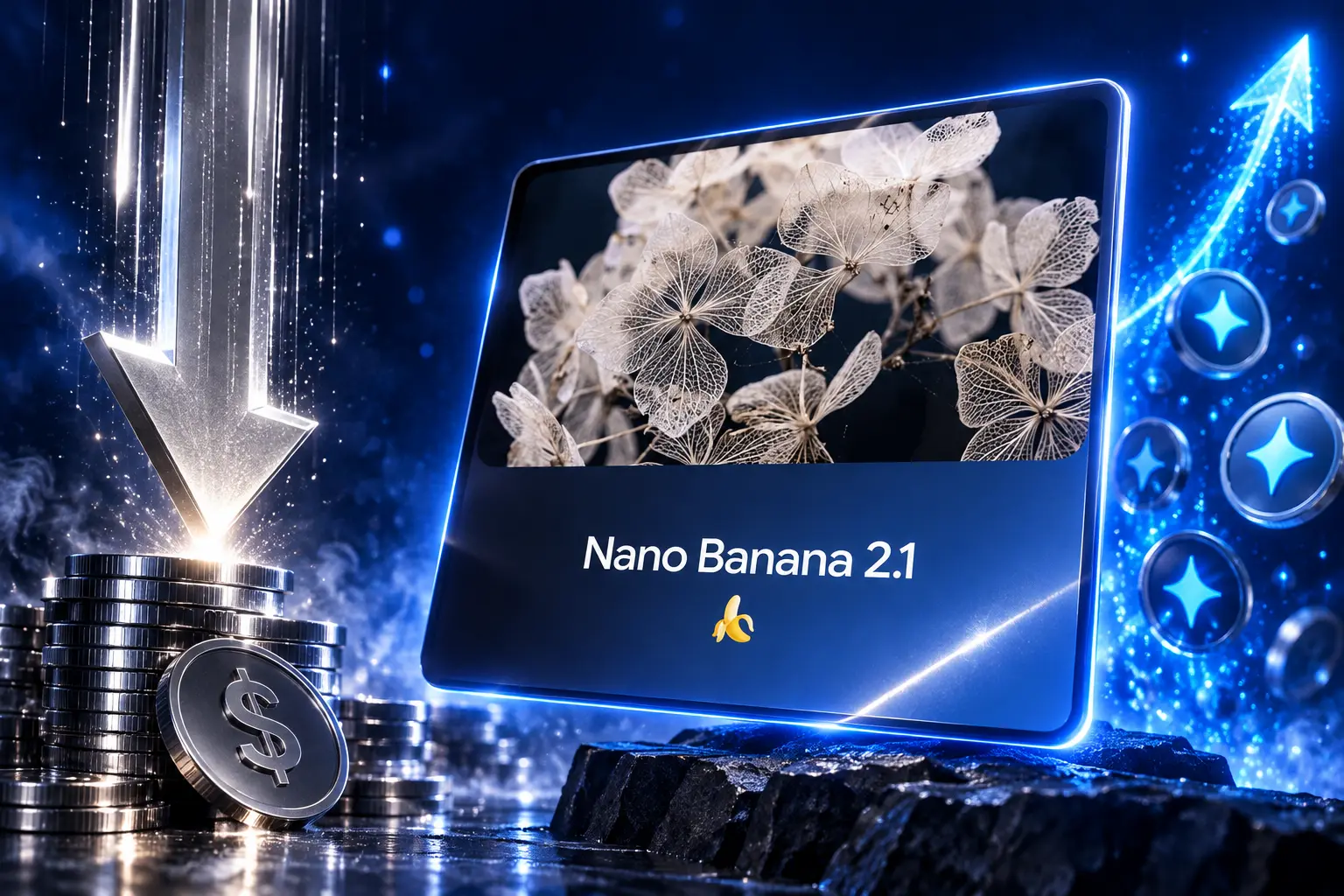
Nano Banana 2.1 halves 1K image output to $0.0336, but 4K frames and thinking tokens do not fall by the same cut.

Google listed Nano Banana 2.1 on the Gemini API on October 6, 2026, at $0.0336 for a 1K image. That figure is about half the $0.067 Nano Banana 2 charged for the same size.
A 4K frame is not half off. Google bills it at 3,780 image tokens, or $0.113, down about 25% from $0.151. The model ID is gemini-nano-banana-2.1, and it is rolling out in the Gemini app, AI Mode in Search, Google Ads, Google AI Studio, Flow, Stitch, and the Gemini Enterprise Agent Platform.
The 50% Cut Stops at 1K and 2K
On the Gemini API, image output is a token bill, not a flat sticker. A 1K still (1024×1024) uses 1,120 image tokens. A 2K still (2048×2048) uses 1,680. Both of those sizes now cost half of what Nano Banana 2 charged, because the image-token rate fell from $60.00 to $30.00 per million.
Four-K does extra work. Google’s pricing page counts a 4096×4096 frame at 3,780 tokens, which is about 1.5 times the 2,520-token load that produced Nano Banana 2’s $0.151 4K price. Half the rate times more tokens is why 4K lands at $0.113, not at half of $0.151. Batch jobs take another 50% off those image rates, so a 1K batch still is $0.0168 and a 4K batch still is $0.0567.
STANDARD PAID-TIER IMAGE OUTPUT
| Model | 1K | 2K | 4K |
|---|---|---|---|
| Nano Banana 2.1 | $0.0336 | $0.0504 | $0.113 |
| Nano Banana 2 | $0.067 | $0.101 | $0.151 |
| Nano Banana Pro | $0.134 | $0.134 | $0.24 |
| Nano Banana 2 Lite | $0.0336 | n/a | n/a |
The rest of the invoice moved the other way. Text, image, and video input on 2.1 is $1.50 per million tokens, three times Nano Banana 2’s $0.50. Text and thinking output is $7.50 per million, 2.5 times the old $3.00. There is no free API tier. Those paid-tier image token rates are only the picture; a long edit with several reference stills and a search-grounded prompt pays the higher input and thinking lines too.
Search, Ads, and Gemini Get It Together
Google did not ship 2.1 as an API-only SKU. The same October 6, 2026 post that introduced the model said it would start rolling out that day across consumer, ads, and cloud surfaces.
Meet Nano Banana 2.1, our latest image generation and editing model 🍌
This upgraded version outperforms our previous models across the board, with notable leaps in visual design, mask-based editing, and subject consistency to help you create more natural-looking images. pic.twitter.com/d858DrzrF3
— Google (@Google) October 6, 2026
WHERE 2.1 IS ROLLING OUT
- Gemini app: Native image create and edit for logged-in users as the sequential rollout reaches each account.
- AI Mode in Search: The banana control under the search box in the Google app, where a prompt can return a generated still instead of a web thumbnail.
- Google Ads: In-house creative inside Google’s own ad tools, so a campaign can make variants without a third-party image API.
- Builder tools: Google AI Studio, Flow, Stitch, and the Gemini Enterprise Agent Platform, which is the cloud path for production agents.
That bundle is the part a per-image price chart misses. If Search, Ads, and Gemini make the picture, Google is not paying OpenAI or a reseller for the pixels. Enterprise docs still block generating real people on that platform tier, so the ads path is product shots, layouts, and invented scenes, not a lookalike of a named person.
How Nano Banana 2.1 Keeps a Face Intact
Google’s model page calls 2.1 the high-efficiency counterpart to Gemini 3 Pro Image (Nano Banana Pro). It takes text, image, video, and PDF, and it returns image and text. The documented input cap is a 131,072 token window, with 32,768 tokens of output, which is far tighter than the million-token window on some Gemini text models.
One request can fuse up to 14 reference images, keep up to four characters looking like themselves, and hold up to ten objects. That is the feature people building serial portraits actually need, because a face that morphs between outfit changes is useless for a catalog or a character strip. Wide frames got a narrower fix: tiling artifacts on 1:4, 4:1, 1:8, and 8:1 at 2K and 4K are listed as closed. Default output size is 1K.
Nicole Segaran, a product manager on Google DeepMind’s image models, posted after the launch that the new checkpoint beats the last ones on generation and editing, and that it draws raccoons eating croissants.
Nano Banana 2.1 outperforms our previous models across image gen and editing capabilities. And it makes great drawings of raccoons eating croissants!
Nicole Segaran, image models PM, Google DeepMind, on X
The cost catch sits in the thinking meter. Gemini 3 image models think on every call; thinking is on by default and cannot be switched off in the API. Nano Banana 2.1 adds a medium rung between minimal and high, and medium is the default. The model may sketch up to two interim images while it plans the shot, and the last of those is the finished frame. Those thinking tokens bill at $7.50 per million. Grounding with Google web search and image search can sit on top of that: 5,000 free search requests a month, shared across Gemini 3.x models, then $14 per 1,000 requests. Every generated still carries a SynthID watermark.
Google Deprecated Nano Banana 2 Without a Shutdown Date
The October 6, 2026 Gemini API release notes made gemini-3.1-flash-image, the Nano Banana 2 endpoint, deprecated with no shutdown date. The named replacement is gemini-nano-banana-2.1. Google’s deprecations table repeats that line: Nano Banana 2 is deprecated, 2.1 has no shutdown date, and the original Nano Banana (gemini-2.5-flash-image) is scheduled to shut down on March 15, 2027.
THE NANO BANANA MODEL LINE
- October 2, 2025: Original Nano Banana, gemini-2.5-flash-image, is listed as released; shutdown is set for March 15, 2027, with Lite as the listed replacement.
- May 28, 2026: Nano Banana 2 (gemini-3.1-flash-image) and Nano Banana Pro (gemini-3-pro-image) reach general availability.
- June 30, 2026: Nano Banana 2 Lite (gemini-3.1-flash-lite-image) reaches general availability for cheap 1K output.
- October 6, 2026: Nano Banana 2.1 reaches general availability and Nano Banana 2 is deprecated.
Changing the model string is the required step. Teams that stay on gemini-3.1-flash-image keep the older $0.50 input rate and the $0.067 1K image until Google names a kill date, and they miss the 2.1 quality and panorama fixes. Teams that move now pay more for prompts and thinking and less for the still.
What GPT Image 2 Charges for a 1K Square
OpenAI’s current GPT Image 2 card still prices a medium 1024-pixel square at $0.053, with low quality at $0.006 and high quality at $0.211. Nano Banana 2.1’s $0.0336 1K output sits under that medium line and well above the low line. It is not the cheapest 1K still on the market; it is cheaper than OpenAI’s medium default and cheaper than Nano Banana Pro’s $0.134 1K.
The token rates have started to rhyme. OpenAI’s GPT Image 2.5 Sunburst and Flare list image output at $30.00 per million tokens, the same image-output rate Google now prints for 2.1. The fight at the workhorse tier is no longer a wild gap in the million-token line. It is quality, editing, and whether Search grounding is worth $14 per thousand queries after the free bucket.
Small Faces and Brand Logos Slip Through
The first production use is serial portraits, not gallery demos. People generating influencer sets are treating the four-character lock as a way to put a second person in the frame and keep a story going, then editing one garment instead of rolling a new shot. Tight selfies and half-body crops hold up better than a small face in a wide room, which still smears. Quoted caption text in the prompt is the reliable path for on-image words, and it wants to be large.
Busy product shelves are a different leak. The model will pull real brand marks off a skincare rack or a sneaker wall unless the prompt asks for plain, unbranded labels. That matters inside Google Ads as much as it does on a creator timeline, because an invented scene that reprints someone else’s logo is a takedown, not a variant. Side-by-sides with GPT Image 2.5 already split: some prompts look cleaner on 2.1, and some still look better on OpenAI’s newer image stack. Pro remains the listed premium for hard layout and brand-faithful work, at $0.24 for 4K.
For a 1K still with a short prompt and thinking held at minimal, the new rate is a real cut. For a 4K, search-grounded, multi-reference edit at the medium default, the invoice is a different product than the 50% headline.
Frequently Asked Questions
What Is the Gemini API Model ID for Nano Banana 2.1?
The stable ID is gemini-nano-banana-2.1. It accepts text, image, video, and PDF, and it returns image and text. Batch API is supported. Caching, function calling, Live API, Maps grounding, and URL context are not.
Can You Turn Off Thinking on Nano Banana 2.1?
No. Thinking cannot be disabled in the API. You can set the level to minimal, medium, or high, and medium is the default. Nano Banana 2 only offered minimal or high and defaulted to minimal, so a migrated app that never set the field will think more, and those tokens bill at $7.50 per million.
Do Nano Banana 2.1 Images Carry a Watermark?
Yes. Every generated image includes a SynthID watermark in the pixels. The product also attaches C2PA Content Credentials as signed file metadata. A screenshot can strip the C2PA record and still leave SynthID, which is the point of using both.
When Does the Original Nano Banana Model Shut Down?
Google’s deprecations table sets March 15, 2027 as the shutdown date for gemini-2.5-flash-image, the first Nano Banana endpoint. The listed replacement for that original model is gemini-3.1-flash-lite-image, not 2.1.

Christa Pike Survived the Execution Tennessee Would Not Pause

Musk’s Oligarch Charge Hits a Queue of Three

Circle Puts USDC and EURC Into SAP Pay Workflows

Ring’s First Smart Lock Skips Home Wi-Fi for Sidewalk

GTA 6 Puts Cash Back on the Story Path

Aramco Crash Kills 14 Two Days After Oil Restart

Salah Captained Egypt to Their First World Cup Win

Apple Labor Day Deals Hide June’s Memory Price Hike

Zelda’s 40th Switch 2 Ships Without a Zelda Game

Palworld 1.0.4 Adds Palpedia Search After the 1.0 Launch
-
 BUSINESS3 months ago
Aramco Crash Kills 14 Two Days After Oil Restart
-
 NEWS4 months ago
Salah Captained Egypt to Their First World Cup Win
-
 NEWS1 month ago
Apple Labor Day Deals Hide June’s Memory Price Hike
-
 GAMING4 weeks ago
Zelda’s 40th Switch 2 Ships Without a Zelda Game
-
 GAMING4 weeks ago
Palworld 1.0.4 Adds Palpedia Search After the 1.0 Launch
-

 NEWS3 months ago
El Niño Puts Israel’s Needed Winter Rain on a Flood Clock
-

 ENTERTAINMENT4 months ago
A 1909 Arizona Gazette Hoax Built the Grand Canyon Egyptian Cave Myth
-

 ENTERTAINMENT1 month ago
King Charles Letter Keeps Harry and Meghan as Private Citizens