
ENTERTAINMENT
A 1909 Arizona Gazette Hoax Built the Grand Canyon Egyptian Cave Myth
On April 5, 1909, the Arizona Gazette claimed ancient Egyptians lived in a Grand Canyon cave. A century later, the Smithsonian is still debunking the hoax.

A single 1909 Arizona Gazette article started the Grand Canyon Egyptian cave hoax that is still being circulated 117 years later. The piece, ‘Explorations in Grand Canyon,’ described a Smithsonian Institute explorer who said he had found a vast underground citadel packed with Egyptian mummies, hieroglyphic tablets, and copper idols high in the cliffs. The story was anonymous. The men it named never existed. The Smithsonian, the National Park Service, and the Grand Canyon Historical Society have spent more than a century trying to put the claim to rest.
The 1909 article ran a formula a 19th century traveling salesman named Joe Mulhattan had already used on American newspapers: a lone frontiersman, a famous institution’s name, and a discovery large enough to rewrite schoolbooks. The same playbook now resurfaces on social media every few years, propped up by a salesman’s documented history, a federal map dotted with Egyptian place names, and the Smithsonian’s name in the original byline.
The 1909 Article That Started It All
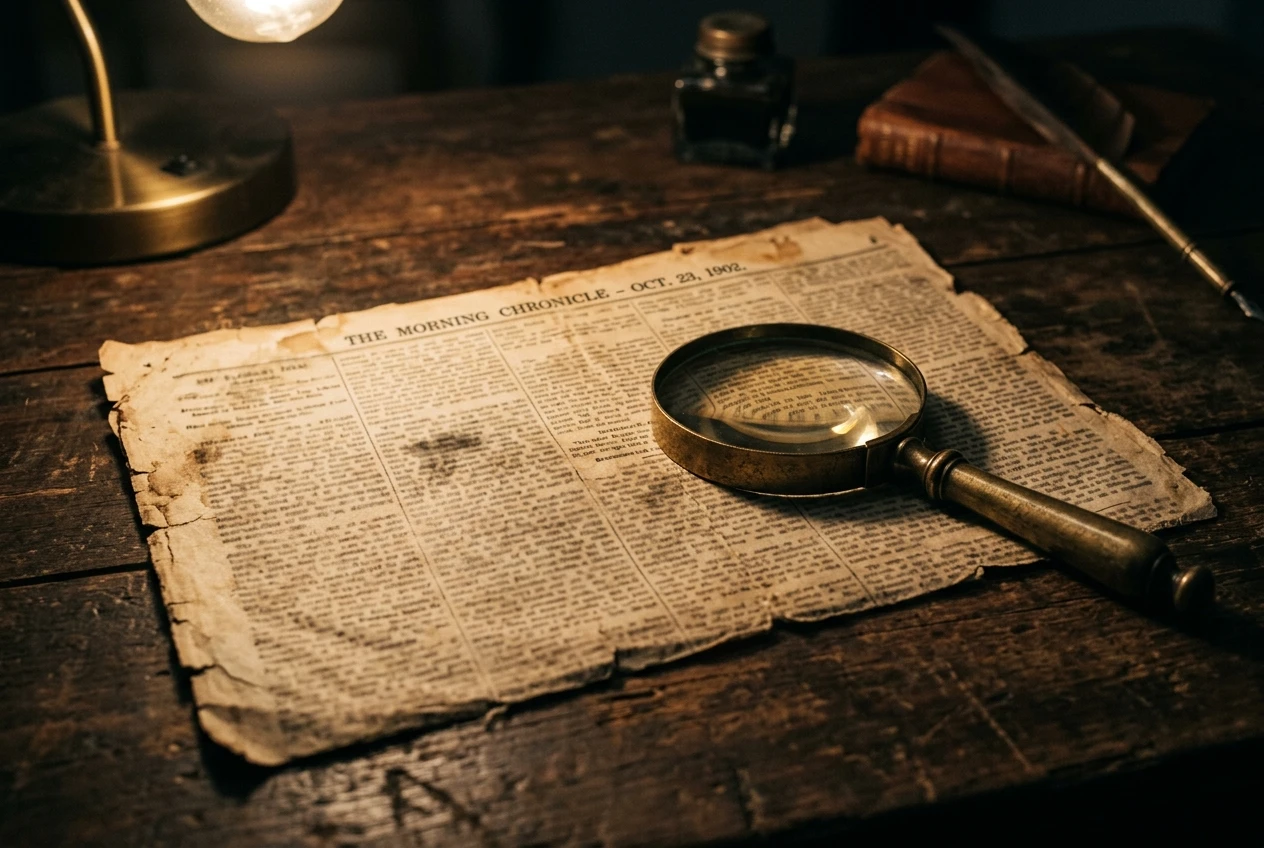
Under the headline ‘Explorations in Grand Canyon: Mysteries of Immense Rich Cavern Being Brought to Light… Remarkable Finds Indicate Ancient People Migrated from Orient,’ an unnamed reporter described a cave 1,486 feet down the sheer canyon wall about forty-two miles upriver from El Tovar Canyon, found during a boat trip down the Colorado. The author wrote that the Smithsonian was financing the dig, and quoted the explorer’s report: ‘The archaeologists of the Smithsonian Institute, which is financing the expeditions, have made discoveries which almost conclusively prove that the race which inhabited this mysterious cavern, hewn in solid rock by human hands, was of oriental origin, possibly from Egypt, tracing back to Ramses.’ The full archive of the 1909 article survives in mirrors and reprinted compendiums, and the 1909 Gazette headline that lit the fuse is the only place that exact language appears.
The story listed copper idols ‘sitting cross-legged, with the lotus flower or lily in each hand,’ walls ‘carved with mysterious hieroglyphics,’ a crypt of mummies, and a hall ‘capable of holding 50,000 people.’ It folded in Native American origin stories, claiming that ‘among the Hopi Indians the tradition is told that their ancestors once lived in an underworld in the Grand Canyon.’ No photographs, no artifacts, and no follow-up coverage ever appeared in the Gazette, which is now defunct. The Smithsonian’s own spokesperson later pointed out a giveaway in the very first sentence: the article refers to the ‘Smithsonian Institute.’ The correct name is the Smithsonian Institution, and Smithsonian editors have called that single word the most obvious tell that the original report was invented.
The Two Men the Smithsonian Has Never Heard Of
The article introduced two named protagonists. G.E. Kinkaid was described as ‘the first white child born in Idaho’ and as a Smithsonian archaeologist with ‘thirty years… in the service of the Smithsonian Institution.’ Professor S.A. Jordan was his Smithsonian colleague, and the two, the article said, had jointly explored the cave.
Neither man can be found. The recorded first white child born in Idaho was a woman named Eliza Spalding, and Google searches, census records, and the Smithsonian’s Department of Anthropology all come up empty for Kinkaid, for Jordan, and for any excavation of this kind at the Grand Canyon. A March 1909 issue of the Arizona Gazette had already run a shorter, vaguer piece by the same paper about the same ‘explorer,’ but it made no mention of Egypt, mummies, or a cave.
The story carried no byline, and the paper never identified its author, and that anonymity is part of why the tale has survived: a century of debunkers have chased the men at the center of it and found only the men in the article, and the central evidence does not exist outside the pages of the Gazette.
The Smithsonian Says It Never Happened
No institution has had to answer for the 1909 story more often than the Smithsonian. Inquiries arrive in a steady stream, and the Institution’s answer has been the same for at least a quarter century.
The first thing I can tell you, before we go any further, is that no Egyptian artifacts of any kind have ever been found in North or South America. Therefore, I can tell you that the Smithsonian Institution has never been involved in any such excavations.
The statement came from a Smithsonian Institution spokesperson responding to media inquiries about the Grand Canyon rumor, and it has been reproduced in numerous debunkings of the 1909 story. The denial is also on the record in writing. In 2000, a representative of the Institution told an inquirer by email that ‘the Smithsonian’s Department of Anthropology has searched its files without finding any mention of a Professor Jordan, Kincaid or a lost Egyptian civilization in Arizona.’ Discover’s reporting on the hoax reproduces the Anthropology Department’s 2000 no-records search.
Grand Canyon National Park has been equally firm. Officials at the park have said no such cave exists and no such expedition took place, and they have stressed that the story erases the history of the eleven Native American tribes with ties to the canyon. The two denials, from the Smithsonian and from the National Park Service, come from the two institutions the 1909 story cited as authorities, and they have not shifted in more than a century.
Even if the cave existed, the logistics do not match the account. The Grand Canyon’s cliffs are largely impassable, and moving crates of idols, copper tools, and mummies out of a cave 1,486 feet down a sheer wall would have required a logistical operation the 1909 article never describes, a point Haley Johnson, president of the Grand Canyon Historical Society, made in a single line: ‘it would have been impossible to haul all those supposed ‘artifacts’ into such a remote and inaccessible cave without a helicopter.’
The Salesman Behind the Lie
For most of the 20th century, the 1909 story was treated as a curiosity. Then, in 2009, a researcher named Don Lago, writing for the Grand Canyon Historical Society’s magazine The Ol’ Pioneer, traced the piece to a known 19th century newspaper hoaxer. Lago’s article, titled Looks Like a Mulhatton Story, is summarized by the Pima County Public Library, which keeps a reference page on the rumor and points readers to Don Lago’s 2009 research on the 1909 hoax.
Joe Mulhattan was a traveling salesman who, in the 1870s and 1880s, made a second career out of selling newspapers tall tales. The New York Times profiled him in 1891.
Joe Mulhattan is known in every city in the United States and has probably caused more trouble in newspaper offices than any other man in the country. His wild stories, written in the most plausible style, have more than once caused special correspondents to hurry from coast to coast to investigate some wonderful occurrence which only existed in the imagination of the great liar.
The profile appeared in The New York Times of 1891 and summarized the damage Mulhattan had done to American newspaper offices over the previous two decades. His other fabrications included tales of Egyptian mummies in a Kentucky crystal cave and astronomers pinpointing the Star of Bethlehem, both circulated to newspaper offices in the same era. He did not, on the evidence so far published, profit from his lies, and the Arizona Republic’s columnist, writing in 2008, summarized the question as it stood: ‘Whether the source bamboozled the Gazette or if the Gazette bamboozled its readers isn’t quite clear. However, it is safe to say the whole thing was a hoax.’ Mulhattan is the most likely author; no one has confirmed it on the record.
The Egyptian Names That Keep the Myth Alive
The 1909 story would have died faster if the Grand Canyon map did not look the way it does. The canyon’s official map names a string of features for figures from Egyptian mythology, and a tourist who has heard the conspiracy theory can find apparent support for it on a federal brochure. The named landmarks include:
- Isis Temple, named for the Egyptian goddess of healing and magic.
- Horus Temple, named for the falcon-headed sky god.
- Cheops Pyramid, a butte named for the pharaoh who built the Great Pyramid at Giza.
- Temple of Ra, named for the Egyptian sun god.
These names are the work of a 19th century geologist, not of any ancient migration. Clarence Dutton, who led a detailed geological survey of the Grand Canyon in 1882, gave many of the canyon’s landmarks the names of figures from world mythology. The National Park Service describes Dutton as the canyon’s ‘poet geologist’ and quotes his associate, Frederick Dellenbaugh, who objected at the time: ‘I had several arguments with him on the subject as I object violently to Oriental and Egyptian nomenclature.’ The full account of the 1882 naming argument over Egyptian terms is on the Park Service site, and it makes clear the names are a Victorian-era fashion, not an archaeological claim. Other landmarks on the same map take their names from Greek and Roman gods and from Arthurian legend, including Apollo Temple, Guinevere Castle, and Galahad Point. Dutton believed that a feature as grand as the Grand Canyon deserved names drawn from all the world’s cultures and religions.
Why a 117-Year-Old Story Won’t Die
The Gazette story did not make national news in 1909, and most Arizona papers ignored it. A Flagstaff weekly, the Coconino Sun, was the only contemporary paper to reprint or comment on it, and it pointed at Mulhattan at the time. For the next half century, the story sat largely in the dustbin of regional journalism.
The revival began in 1962, when the piece was reprinted in Arizona Cavalcade, a collection of clippings from Arizona’s early history. A second revival came in 1992, when David Hatcher Childress, a writer who promotes fringe archaeology, included the tale in his book ‘Cities of North and Central America’ and used the Smithsonian’s own no-record response as evidence of a cover-up. From there the story migrated into cable television. The History Channel’s ‘America Unearthed’ treated the Grand Canyon cave as a real possibility, and the podcast host Joe Rogan has aired the claim on his show.
Social media has shortened the cycle. The story resurfaces on YouTube, TikTok, and Facebook whenever a new account reposts the 1909 article or a slickly edited video tour. National Park Service archaeologists say the question of the ‘Kincaid cave’ is one of a small set of recurring asks they field year after year, regardless of how often the answer is published.
The 1909 article also flattens a real and complicated history. Eleven Native American tribes hold ties to the Grand Canyon, and their oral traditions, pictographs, and petroglyphs span thousands of years. A single anonymous 1909 story about a fictional explorer has, for more than a century, competed with that record on the same shelf, and on social media it often outdraws it. The Smithsonian, the National Park Service, and the Pima County Public Library all keep public responses to the 1909 story, and each has been updated or cited in recent years as the rumor resurfaces. Haley Johnson put the wider point in a sentence the Park Service still echoes: ‘someone needed something eye-catching to print, and a local mischief maker may have spun an old story into some sort of local lore to attract readers.’
Frequently Asked Questions
What did the 1909 Arizona Gazette article actually claim?
It claimed that a Smithsonian Institute explorer named G.E. Kinkaid had found a vast cave 1,486 feet down a Grand Canyon cliff and that the cave held copper idols, hieroglyphic tablets, mummies, and passageways that pointed to an ‘oriental’ civilization, possibly Egyptian, dating to the era of Ramses. The author was anonymous, and no photographs, no follow-up coverage, and no artifacts ever appeared.
Who were G.E. Kinkaid and S.A. Jordan?
The 1909 article painted Kinkaid as a 30-year Smithsonian veteran and Jordan as a learned professor, but neither man has a verifiable record outside the Arizona Gazette. The Smithsonian’s Department of Anthropology has no files on either, and the documented first white child born in Idaho was a woman, Eliza Spalding.
Has the Smithsonian ever covered up Egyptian artifacts in the Grand Canyon?
No. The Smithsonian has stated on the record that it has no record of any expedition matching the 1909 story, and the National Park Service has issued the same denial. The full statement of denial is on the Institution’s website and has been reproduced in repeated debunkings of the rumor since 2000.
Why do Grand Canyon landmarks have Egyptian names like Isis Temple?
The canyon’s Egyptian-named buttes and mesas, including Isis Temple, Horus Temple, Cheops Pyramid, and Temple of Ra, were named in the 1880s by the geologist Clarence Dutton, who wanted the canyon’s landmarks to reflect mythologies from around the world. Dutton’s colleague Frederick Dellenbaugh objected at the time, but the names stuck and remain on the official map today.
Who was Joe Mulhattan?
Joe Mulhattan was a 19th century traveling salesman who built a side career out of planting fake stories in American newspapers, so often that the New York Times profiled him in 1891. The Grand Canyon Historical Society researcher Don Lago, writing in 2009, named Mulhattan as the most likely author of the 1909 article, on the strength of the tale’s style and the only contemporaneous paper, the Coconino Sun of Flagstaff, that picked up the Gazette’s piece.

Ninja Theory Staff Face Redundancy After Two Xbox Sales Collapse

U.S. Slows Jet Parts to Squeeze China’s Flying Fleets

PEGI Pulled the GTA 6 Age Rating After Cocaine Details

Northwestern’s Smaller Ryan Field Gave Penn State Nowhere to Hide

Novartis Signs a $7.8 Billion Chinese mRNA Deal

Aramco Crash Kills 14 Two Days After Oil Restart

Salah Captained Egypt to Their First World Cup Win

Apple Labor Day Deals Hide June’s Memory Price Hike

Palworld 1.0.4 Adds Palpedia Search After the 1.0 Launch

Zelda’s 40th Switch 2 Ships Without a Zelda Game
-
 BUSINESS3 months ago
Aramco Crash Kills 14 Two Days After Oil Restart
-
 NEWS4 months ago
Salah Captained Egypt to Their First World Cup Win
-
 NEWS1 month ago
Apple Labor Day Deals Hide June’s Memory Price Hike
-
 GAMING4 weeks ago
Palworld 1.0.4 Adds Palpedia Search After the 1.0 Launch
-
 GAMING4 weeks ago
Zelda’s 40th Switch 2 Ships Without a Zelda Game
-

 NEWS3 months ago
El Niño Puts Israel’s Needed Winter Rain on a Flood Clock
-

 BUSINESS8 months ago
Egypt Bets EGP 638 Billion Can Open Sinai to Investors
-

 BUSINESS2 months ago
Egypt Seeks Two Extra El-Dabaa Reactors Before First Power