
ENTERTAINMENT
Wild Horse Nine Reaches Theaters on Rapa Nui’s Terms
Wild Horse Nine opens Nov. 6 as the second feature shot on Rapa Nui, a CIA Chile story that required the island’s consent.

Wild Horse Nine opens in U.S. theaters on Nov. 6, the second feature ever filmed on Rapa Nui and Martin McDonagh’s first movie since The Banshees of Inisherin.
John Malkovich already has Venice’s Volpi Cup. Searchlight is selling a CIA two-hander. The people who had to say yes first live on the island the cameras borrowed.
The Second Feature Ever Shot on Rapa Nui
McDonagh told a Venice press conference that only one film had been made there before, Kevin Reynolds’s 1994 adventure Rapa-Nui, which Kevin Costner helped produce. Getting a second crew onto the island meant shipping cameras and period cars by boat from Santiago, because there was no local film apparatus waiting on the dock.
Producer Graham Broadbent said Blueprint Pictures worked with the Chilean company Fábula to reach the island council about 12 months before the shoot, long enough for both sides to decide they could stand each other. The statues the world knows as moai are sacred, Broadbent said, and there are about 1,000 of them. The rule he kept repeating was simple.
Our idea was ‘leave nothing behind’. Take in what we take, leave nothing behind.
Graham Broadbent, producer, Venice press conference
McDonagh put the same pressure on tone. He wanted the Rapa Nui people to feel respected, he said, and to see, when the finished film reached them, that the cameras had come for the island’s beauty and for the weight of the moment, not for a postcard. Rapa Nui National Park, which holds most of the archaeological sites, was inscribed on UNESCO’s World Heritage List in 1995. The park itself dates to 1935.
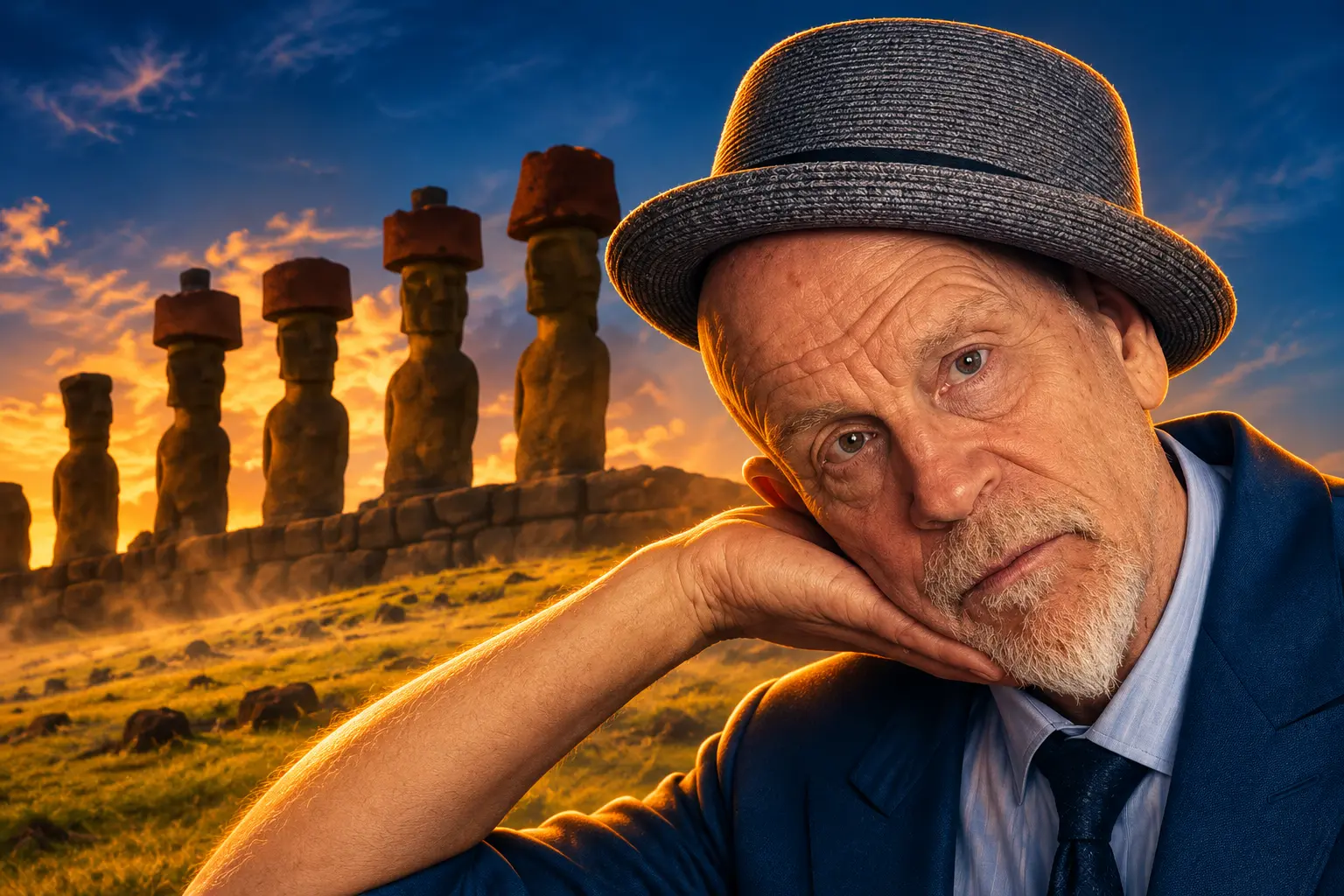
Ma’u Henua Let the Crew In on Island Terms
Those sites have been managed by the Ma’u Henua community since Nov. 23, 2017, after a 50-year concession and an indigenous vote of more than 86 percent. Chile’s tourism board said filming was coordinated with Ma’u Henua. Archaeologists and specialists watched the work each day, and community members stayed on set. The production sat down before cameras rolled to lock timetables, camera positions, and ground that could not be crossed.
Rapa Nui filmmaker Leonardo Pakarati helped run the local side. He told Chilean reporters that about 80 people from the island were hired, out of roughly 200 who worked the shoot. None of the lead actors is Rapa Nui. McDonagh spent about two and a half months on the island. Cast call was late February 2025, with cameras up in March. In April the company moved to the mainland for a rayuela club in Conchalí, Santiago’s international airport, and the city center, and it wrapped on April 28, 2025.
THE RAPA NUI SHOOT
| Stage | When | Where |
|---|---|---|
| Island filming | Late February through March 2025 | Rapa Nui, including Hanga Roa streets, a gym, a café, and Hotel Iorana |
| Mainland Chile | April 2025, wrapped April 28 | Conchalí, Arturo Merino Benítez airport, central Santiago |
| Local hires | About 80 of roughly 200 workers | Coordinated with Ma’u Henua; Leonardo Pakarati on local production |
| World premiere | Sept. 3, 2026 | Venice Film Festival, Sala Grande |
| U.S., U.K., Ireland opening | Nov. 6, 2026 | Searchlight Pictures |
Searchlight has also set a community screening on the island in the second week of November 2026, after Chilean theaters started on Nov. 5. Getting there from the mainland is still a 5.5-hour flight from Santiago, which is why so few features ever try.
THE TERMS THE ISLAND EXTRACTED
- A year of talks: Broadbent’s team approached the council about 12 months before shooting so trust could form before lights arrived.
- A ship from Santiago: Cameras, crew, and 1970s cars came in by sea because the island had no standing film crew.
- Daily supervision: Archaeologists and Ma’u Henua members stayed on set and barred ground the production could not cross.
- Local payroll: About 80 of roughly 200 workers were island hires, with Pakarati on the local production.
- A home screening: Searchlight scheduled a community showing in the second week of November 2026.
Blueprint Pictures’ Graham Broadbent and Pete Czernin produced with Film4 and Fábula. McDonagh and Anita Overland are also producers. Carter Burwell wrote the score. The finished film runs 1 hour 58 minutes and is rated R for violence, blood, mature themes, and adult language.
A 62-Page Report on Covert Action in Chile
The movie is set in the weeks before the Sept. 11, 1973, coup that overthrew Salvador Allende, the first Marxist to win the presidency of a Latin American liberal democracy, and that opened a 17-year military dictatorship. Searchlight’s own synopsis says CIA agents Chris and Lee are dispatched from Santiago to Easter Island by their bureau chief, MJ, and that a bond with two rebellious students threatens to knock the trip sideways.
The public file on that period is not a two-hander. On Dec. 4, 1975, the Senate Select Committee led by Frank Church released a 62-page staff study, Covert Action in Chile, 1963-1973, based on top-secret CIA operational records. It found that covert United States involvement in Chile in that decade was extensive and continuous, first to block Allende, then to make him ungovernable. The committee judged it far from clear that Chile had posed a severe threat to U.S. national security, the only case it said should justify covert action.
The same study said $8 million went into the three years between the 1970 election and the 1973 coup, much of it to opposition parties and media. It found no evidence of direct U.S. operational involvement in the 1973 coup itself, while recording that Washington had tried to foment a coup in 1970 and had stayed in intelligence contact with Chilean officers who were plotting. The National Security Archive later published Richard Helms’s notes from a Nov. 6, 1970, NSC meeting, three days after Allende’s inauguration, in which President Nixon said, “If there is a way to bring A[llende] down, we should do it.”
McDonagh’s film is looser than that paperwork. He has described the two agents as visiting the island in the midst of orchestrating the coup, and the finished plot still carries a conspiracy large enough for a dying man, a dictaphone, and a twitchy boss. The comedy can afford that. The 1975 record cannot, because its damning finding is bureaucratic: money, media, and a climate for a coup, not two wisecracking officers on a sightseeing leash.
FROM THE CHILE FILE TO OPENING NIGHT
- September 15, 1970: Nixon orders CIA Director Richard Helms to stop Allende from taking office, a directive the Church Committee later read into the public record.
- 1970 to 1973: The committee’s Chile study tallies $8 million in covert spending on opposition parties and media after the election.
- September 11, 1973: The Chilean military overthrows Allende and begins a 17-year dictatorship.
- December 4, 1975: Church’s committee releases the 62-page covert-action study and holds the first public hearing on CIA regime-change operations.
- In Bruges post-production: McDonagh first visits Rapa Nui, hoping the island might play like a character, and spends about 15 years turning that trip into a script.
- Early 2025 to Nov. 6, 2026: The company shoots on the island and in Santiago, premieres at Venice on Sept. 3, 2026, and opens in U.S. theaters.
That gap between the file and the fable is where some viewers fall off. The CIA satire asks you to accept two chatty officers as a stand-in for a decade of covert work. The dying-partner talk is the movie McDonagh actually kept. One of those layers can carry a multiplex. Both at once is the bet.
Who Carries the Film’s Chilean Conscience?
Chris Carlisle is Malkovich, a veteran officer whose body is failing and whose mouth will not stay shut, with or without morphine. Lee Chesterfield is Sam Rockwell, the younger partner and minder. Steve Buscemi plays MJ, the Santiago chief with a professional interest in whatever Chris keeps muttering into a recorder. Parker Posey is Marge, Lee’s wife. Tom Waits is Jim, Chris’s brother, including in Monument Valley scenes McDonagh wanted because he thought of the whole movie as a kind of Western.
The political heat does not sit with those men. It sits with Monica and Alicia, university students played by Chilean actress Mariana di Girolamo and Argentine actress Ailín Salas, who cross the agents’ path on the island. Chilean actress Paola Giannini also appears. McDonagh has called di Girolamo a future living legend and said her character’s hope, which he tied to what Chile had in the early 1970s, is the piece of the story he cares about most.
That allows him to question what he’s been doing all these years; it’s her hope and dreams, which is, I guess, what Chile had in those early ’70s. It’s the most important part of the story for me. And it could have gone very dark if they hadn’t connected properly.
Martin McDonagh, writer-director
He has been “fascinated and horrified” by what the CIA did in Chile since his teens, he said, and only about four years ago did he see how to fuse that file with the island. Until then the script was two men, first a father and a son. The CIA plot turned them into Chris and Lee, with a “gentle shadow” of that older pairing still on them, “or an old married couple.” Awards chatter will keep selling Malkovich. McDonagh keeps pointing at the student who still believes the country in front of her is hers.
Malkovich Wins Venice and Walks Into Awards Season
Wild Horse Nine had its world premiere in competition at the 83rd Venice Film Festival on Sept. 3, 2026, McDonagh’s third straight feature to launch on the Lido after Three Billboards Outside Ebbing, Missouri and The Banshees of Inisherin. The Sala Grande ovation ran 14 minutes. The jury gave Malkovich the Volpi Cup for best actor. The film then played Telluride and moved through Toronto and London before this week’s commercial opening.
Malkovich has two prior Oscar nominations, both in supporting roles, for Places in the Heart and In the Line of Fire. He has never won, and he has not had a lead like this in a long time. Rockwell already has an Oscar from Three Billboards, which took seven Academy Award nominations and acting statues for him and Frances McDormand. Banshees went to nine Oscar nominations, including picture, director, and original screenplay. McDonagh’s short Six Shooter won the live-action short Oscar in 2006. This is his fifth feature.
Searchlight, which also released Banshees, is putting Wild Horse Nine into U.S., U.K., and Irish theaters on Nov. 6. The official trailer is the studio’s own invitation, moai and bickering agents in the same frame.
McDonagh wrote Lee for Rockwell, a partner from the play A Behanding in Spokane, Seven Psychopaths, and Three Billboards. They rehearsed in January at the Public Theater in New York before Malkovich flew down in mid-February. McDonagh asked them, for the first time in his film work, to treat the dialogue like jazz on the offbeat, not new lines but new timing, and he says he wants to keep that looseness.
A Love Story After Five Versions of the Script
He has spent about 15 years on the piece, through five fully different versions. The CIA version went through two. An early draft was plot-heavy. The one he shot, he said, had to let the twists go.
“It just had to be sort of a love story about these two guys,” McDonagh said. He still will not explain the title. The island’s wild horses, which he did not know about on that first visit, sit in the script and on the poster, and he would rather leave the phrase mysterious until he has worked out the answer. Chris is trying to write a memoir while he can still hold a thought. MJ would prefer those pages never leave the room. Holy crosses keep turning up near a man whose working life was calculated killing. The jokes are sour, and they are the point of the talk.
He has watched it with audiences and said it now feels uncomfortably current, including the habit of interfering with another country’s democracy. That is a large claim for a film he also describes as a love story. The Church Committee’s Chile study is the colder document, and it is still in print. Wild Horse Nine is the version that had to get past Ma’u Henua, hire 80 islanders, and put two Latin American students in the frame so an American killer would have someone left to disappoint.
The island gets the film back in the second week of November, at the community screening Searchlight promised when it asked to borrow the heads. McDonagh said he wanted the Rapa Nui people to see what the crew was trying to do. That showing is the one audience the production cannot spin.

One UI 9.5 Beta Puts the Galaxy S26 on Last Year’s Clock

DBS Puts a 24/7 USDC Window Inside the Bank

European Startups Head for $81 Billion as First Checks Shrink

US Stocks Lost $1.3 Trillion Before Nvidia’s Beat

Home Depot Bets on Finance Chief Richard McPhail as CEO

Aramco Crash Kills 14 Two Days After Oil Restart

Salah Captained Egypt to Their First World Cup Win

Zelda’s 40th Switch 2 Ships Without a Zelda Game

Apple Labor Day Deals Hide June’s Memory Price Hike

El Niño Puts Israel’s Needed Winter Rain on a Flood Clock
-
 BUSINESS5 months ago
Aramco Crash Kills 14 Two Days After Oil Restart
-
 NEWS6 months ago
Salah Captained Egypt to Their First World Cup Win
-
 GAMING2 months ago
Zelda’s 40th Switch 2 Ships Without a Zelda Game
-
 NEWS3 months ago
Apple Labor Day Deals Hide June’s Memory Price Hike
-
 NEWS4 months ago
El Niño Puts Israel’s Needed Winter Rain on a Flood Clock
-

 GAMING2 months ago
Palworld 1.0.4 Adds Palpedia Search After the 1.0 Launch
-

 NEWS4 months ago
Saudi Visa Routes Split Nigerian Travelers Into Two Speeds
-

 BUSINESS9 months ago
BAE’s 60-Year Saudi Franchise Now Runs Through Taif