
BUSINESS
Warsh Holds Rates and Leaves a December Hike Unlocked
Warsh held the Fed rate at 3.75% to 4% and left December open, betting more data can stand in for a hike six days before the midterms.

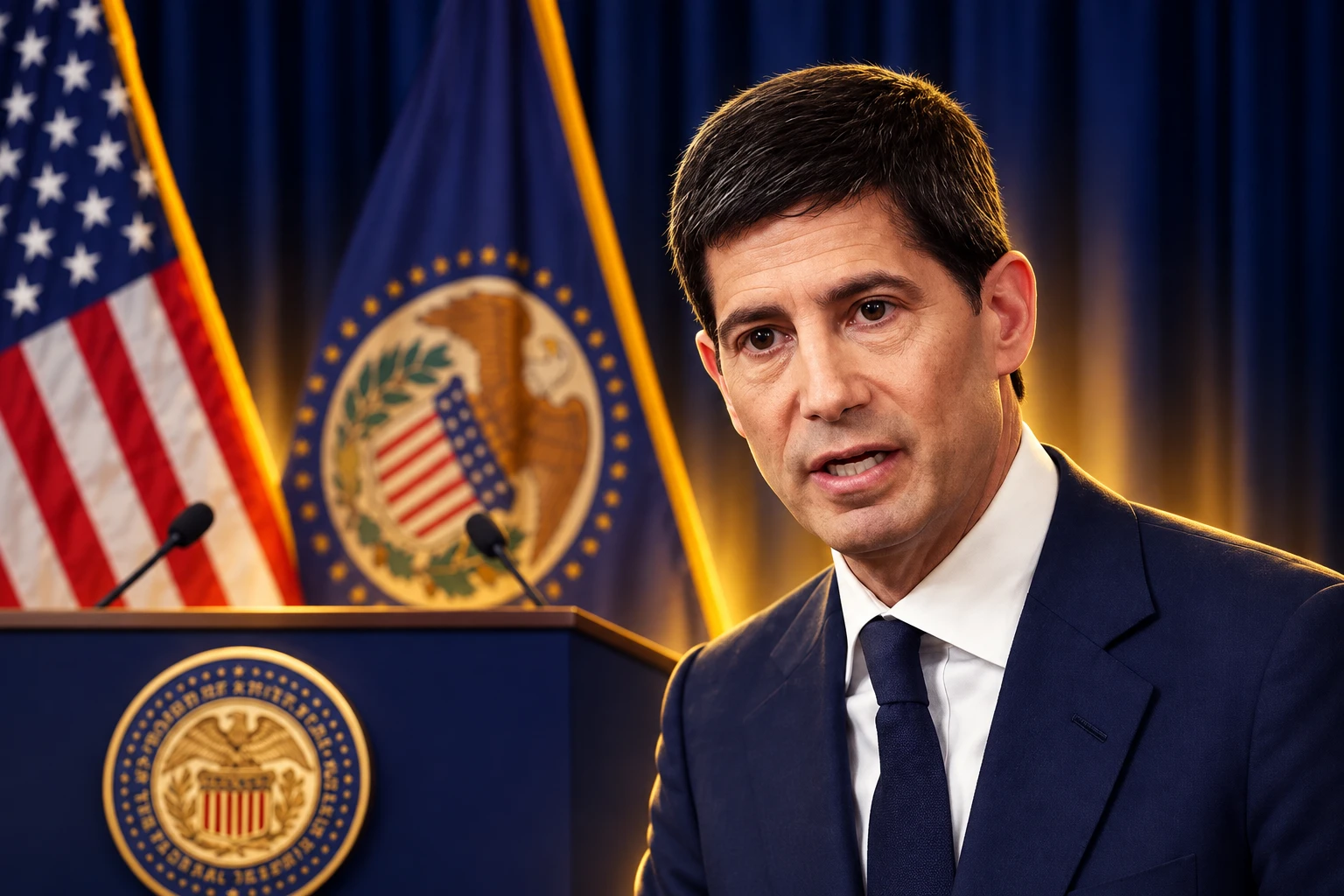
Federal Reserve Chair Kevin Warsh held the policy rate at 3.75% to 4% on October 28 and declined to lock in another increase. Two colleagues voted to raise it that day. He said the stretch before the December 8-9 meeting is “information rich,” and that the 2% inflation goal is not a soft target “somewhere in the twos.”
The hold landed six days before the November 3 midterms, after the first rate increase in three years on September 16. On October 29 the Commerce Department then posted faster growth and faster prices, which is the first hard test of the wait he asked for.
The Committee Holds at 3.75% to 4%
The Federal Open Market Committee 10-2 vote to hold rates kept the federal funds target in the band set on September 16. The statement upgraded the growth line from a “solid pace” to a “strong pace,” left inflation described as “elevated,” and swapped last month’s action cue for a line about gathering more information. Lisa D. Cook, a Fed governor, and Beth M. Hammack, president of the Cleveland Fed, voted to raise the range by a quarter point at this meeting.
The Board kept the interest rate paid on reserve balances at 3.90%, effective October 29, and left the primary credit rate at 4.0%. Overnight repurchase operations stay at 4.0%, and overnight reverse repos stay at 3.75%. Those settings keep money-market rates pinned inside the same band the Committee just refused to lift.
HOW THE STATEMENT CHANGED FROM SEPTEMBER
| Item | September 16 | October 28 |
|---|---|---|
| Vote | 12-0 quarter-point hike | 10-2 hold |
| Funds target | Raised to 3.75% to 4% | Held at 3.75% to 4% |
| Growth language | Solid pace | Strong pace |
| Inflation language | Remains elevated | Remains elevated |
| Policy cue | Today’s action will support a timelier return to 2% | More information will help set the stance for a timely return to 2% |
Warsh has been chair for about five months. In his opening remarks he walked through a stronger first half, with GDP revised from 1.8% to 2.4%, and said the third quarter looked even faster, with consumer spending likely running above 3% and business investment likely rising at about a double-digit pace. Job gains, he said, have kept pace with the workforce, and the four-week average of unemployment-insurance claims is running at the lowest level in generations.
Then the turn: Americans are “still dealing with inflation that has been running above the Committee’s objective for close to six years.” He put the two-day discussion on the price-stability side of the dual mandate, not the jobs side. “It’s our responsibility to get inflation down,” he said.
Why the Chair Would Not Hike on Wednesday
The question in the room was the obvious one. Inflation has not moved back to 2%. The labor market, on his own telling, is in good shape. Most of his colleagues had already talked as if another increase this year was the base case. So why wait?
Ensuring price stability, Colby, quashing inflation is not about some fixed individual date on a calendar. Same way it’s not about some isolated data point. If it were about those two things, this job would be easier, and we wouldn’t be suffering from nearly six years of inflation above target.
Kevin Warsh, Federal Reserve chair, October 28 press conference
He called the last five months a package of “new monetary medicine.” The first dose, he said, was a hard 2% target, not a band in the twos. The second was taking responsibility instead of blaming other people. The third was a public framework, laid out at Jackson Hole, for how policy is supposed to work. September was the first time this Committee “removed a dose of accommodation.” He will not treat the next meeting as a date circled in ink.
WHAT HE PUT IN THE MEDICINE
- The target: Officials “doubled down” on 2% as measured by the PCE index, and he said there is “no soft inflation target.”
- The September hike: A unanimous quarter-point increase that he now describes as the first action in that package, not the last.
- The signposts: He said inflation compensation in swaps and other market measures has moved the right way, even with the world “quite unsettled.”
Asked whether the current funds rate might already be the right one, he refused the out. “If we had a firm conclusion about the conduct of monetary policy, we’d announce it to much fanfare today,” he said. The “overwhelming judgment” in the room, as he put it, is that the medicine is “starting to work some,” and that the coming stretch is likely to add clarity. He also said, without hedging, that price stability has not been achieved. “If the crux of your question is you haven’t delivered yet, you haven’t achieved price stability, you’re right about that. But we’re working on it.”
That is the wager. He is asking markets, households, and his own colleagues to treat a skip as discipline rather than a retreat, while he also refuses the one tool chairs have used for a decade: a clear hint. He does not submit a projection “dot” and said he does not plan to. He told a reporter he has “18 quite independent colleagues,” and that he is not “some kind of all-knowing person sending messages out.”
The prepared remarks went out on the Fed’s own account as a PDF, which is the cleanest primary record of the hold he wanted on the record.
Read Chairman Warsh's full opening statement from the #FOMC press conference (PDF): https://t.co/TPqQ7MKO7m pic.twitter.com/1SUkOfaU0T
— Federal Reserve (@federalreserve) October 28, 2026
Thursday’s Inflation Print Lands at 3.6%
The first batch of that “information rich” interval arrived the next morning. The Bureau of Economic Analysis said the PCE price index increased 3.6 percent from a year earlier in September, up from 3.4% in August. Core prices, which strip out food and energy, rose 3.1% from a year earlier, up from 3.0%. From August to September the headline index rose 0.5% and the core index rose 0.3%. That leaves headline inflation 1.6 points above the Committee’s goal.
The same release showed personal income up 0.2% in the month and consumer spending up 0.5% in current dollars. Real disposable income fell 0.3%. The personal saving rate was 3.8%. Real spending was flat. In plain terms, households spent more because prices rose, not because they bought a lot more stuff.
THE PRINTS THAT LANDED ON OCTOBER 29
- Headline PCE: 3.6% over 12 months, after 3.4% in August, with a 0.5% rise in the month.
- Core PCE: 3.1% over 12 months, after 3.0% in August, with a 0.3% rise in the month.
- Real GDP: Up at a 3.4 percent in the third quarter annual rate, after 2.2% in the second quarter.
- Next PCE drop: October personal income and outlays are due November 25, well before the December vote.
The GDP advance estimate said investment, consumer spending, and government spending lifted output, with a drag from exports. Real final sales to private domestic purchasers, the sum of consumer spending and private fixed investment, rose 4.9% in the third quarter after 4.6% in the second. That is the demand picture Warsh called strong on Wednesday, now with an official stamp.
A miss this wide, after a hold, is why the wait is going to be argued in public. The September consumer price index reading had already pointed toward a year-end increase. PCE is the gauge the Committee writes into its goal, and it moved further from 2%, not closer. The next PCE report on November 25, and the jobs and CPI prints that land before December 8, are now the live inputs for a vote he would not take on October 28.
Cook and Hammack Wanted a Quarter Point Now
The dissent is the part of the hold that will not age off the statement. Cook had not dissented on a rate decision before. Hammack has been a steady vote for higher rates this year, including in July when she wanted a hike and the Committee stood pat. On October 28 they lined up together for a quarter-point increase, and they lost 10-2.
Cook is also the governor President Donald Trump has tried to remove, on allegations about mortgage paperwork. The Supreme Court blocked an earlier attempt to take her off the Board. A White House hearing on her status was already on the calendar when she cast the vote. A first dissent in that setting is a fact about the Committee, not a sideshow: the one governor the White House has tried to fire voted for tighter policy a week before the midterms, while the chair held.
Hammack had already made her case in public. In an October 12 speech she said she would rather move in small steps than sit through long pauses. The published tally now puts that view on the statement. Other officials who have leaned hawkish did not join her this time, including some who had been expected to. The split is narrow enough to keep December live and wide enough that Warsh still had the room to wait.
He was asked, six days before November 3, whether the midterms factored in. “Politics played no role in the decision,” he said. “I just spent two days with my colleagues upstairs. I didn’t hear an utterance about politics.” He added that the coming period is information-rich “having nothing to do with politics.” The calendar still sits where it sits. The vote was announced on October 28. The election is November 3. The next scheduled rate decision is December 8-9.
He Will Not Call Financial Conditions Tight
Credit is where the hold either does work or does not. Since September, Warsh said, financial and credit conditions “have tightened for some businesses and households, much as we would expect.” Market investors, he said, are “becoming somewhat more discerning in their capital allocations.” Then the line that will be clipped for weeks: he is unwilling and unable to call them tight.
That phrasing keeps another increase available. If conditions were already tight, the case for waiting would be stronger. If they are only “tighter,” the Committee can argue that the September quarter-point has not yet done the job. He said the Committee is “not uncomfortable” with the tightening that has shown up, and that this is how policy is supposed to work: through financial conditions, not by “throwing sand in the gears of the economy and throw people out of work.”
He does not buy the idea that the expansion is too hot. “Is the economy running too hot? Is the economy running too strong? That isn’t the judgment of most of my colleagues,” he said. Higher growth, in his telling, is partly better productivity, which he thinks has been rising for a couple of years, however badly it is measured. “Economic growth is higher, but that doesn’t tell me that economic growth is somehow causing inflation and making our job harder.”
Energy is the supply shock he would not wave away. “Energy and related prices have moved higher again in recent weeks,” he said, and the job is to stop relative price changes in some sectors from broadening out. He also would not pretend drivers do not see it. “I am not going to be the guy who says that oil prices haven’t gone up. And when they fill up their tank, they don’t see it.” Near-term inflation expectations have risen, he said, because households are doing what the Fed is doing: looking out the window. Further out, he said, most measures still show confidence that the central bank will deliver 2%.
On the investment boom in new computing, he rejected the claim that rates cannot touch it. “Interest rates get in the cracks. Interest rates affect directly or indirectly almost everything.” Since early September, he said, investors inside and outside the technology complex have started to discriminate among projects, and credit spreads have widened for some assets. Capex, he added, is no longer a narrow high-tech story. It has been “broadening,” which makes it harder to argue that strength lives in one insulated pocket.
For households on floating-rate debt, and for firms that roll loans or delay hiring, a skip is not a cut. The funds rate is still where September put it. Another quarter-point in December would lift the ceiling of the band to 4.25%. He did not promise that move. He also did not take it off the table. Savers keep the higher yields that arrived with the September increase. Borrowers keep waiting for cheaper credit that this Committee has not offered.
December 8 and 9 Stay Live
The next regular policy meeting is December 8-9, with a press conference on December 9. Minutes of the October meeting are due November 18. Between those dates sit the midterms, another CPI report, another jobs report, and the November 25 PCE release. Futures still treat a December quarter-point increase as more likely than another hold. That pricing is not a decision, and Warsh spent half an hour refusing to turn it into one.
THE PATH FROM THE FIRST HIKE TO THE NEXT VOTE
- September 16, 2026: The Committee raises the funds rate by a quarter point to 3.75% to 4% on a 12-0 vote, the first increase in three years.
- October 28, 2026: The Committee holds that range on a 10-2 vote. Cook and Hammack prefer a quarter-point increase. Warsh calls the coming stretch information-rich and will not pre-commit.
- October 29, 2026: PCE inflation prints at 3.6% over 12 months and core at 3.1%. Real GDP is estimated at a 3.4% annual rate in the third quarter.
- November 3, 2026: Midterm elections. Warsh said they played no role in the October vote.
- November 25, 2026: Next personal income and outlays release, the last full PCE reading before the December meeting.
- December 8-9, 2026: Next scheduled rate decision and press conference, the date the October skip either holds or gives way to another quarter-point.
He also used the press conference to change the meeting calendar starting next fall. The Committee will keep eight meetings a year. In 2027, one of those eight will be a strategy session with no funds-rate vote and no policy statement. In 2028 he expects two strategy meetings and six policy meetings. The point, he said, is to reserve time for “the left side of the decimal point,” the big questions, while still judging the economy at “timely, regular, and information-rich intervals.” That redesign is about how often the Committee is even in a position to hike. It is not a forecast of 2027 rates, and he did not offer one.
Heather Long, chief economist at Navy Federal Credit Union, called October a “hawkish skip” and wrote that a December increase “seems very likely.” The other live reading is harsher: if inflation has sat above target for close to six years, a hold six days before an election looks like delay, which is why Cook and Hammack wanted the quarter-point on Wednesday. Both readings can sit on the same transcript. Warsh would not pick one for the cameras.
December 8-9 is now the date that wager gets marked to market. He held at 3.75% to 4%, left financial conditions in a zone he will not call tight, and told the country the 2% goal still binds. Thursday’s 3.6% inflation print and 3.4% growth reading did not settle whether that wait was earned. They made the next vote more expensive to get wrong.
Disclaimer: This article is news reporting and analysis of Federal Reserve policy and recent economic data, and it is for information only. It is not investment, tax, legal, or lending advice, and it is not a recommendation to take or avoid any loan, bond, deposit, or other financial product. Readers who are weighing a mortgage, a business credit line, or a portfolio change should speak with a licensed financial adviser, a qualified mortgage professional, or a certified public accountant before acting. Rate levels, inflation figures, and market pricing reflect the official statements and data releases cited here and can change with the next print and with the Committee’s December vote.

One UI 9.5 Beta Puts the Galaxy S26 on Last Year’s Clock

DBS Puts a 24/7 USDC Window Inside the Bank

European Startups Head for $81 Billion as First Checks Shrink

US Stocks Lost $1.3 Trillion Before Nvidia’s Beat

Home Depot Bets on Finance Chief Richard McPhail as CEO

Aramco Crash Kills 14 Two Days After Oil Restart

Salah Captained Egypt to Their First World Cup Win

Zelda’s 40th Switch 2 Ships Without a Zelda Game

Apple Labor Day Deals Hide June’s Memory Price Hike

El Niño Puts Israel’s Needed Winter Rain on a Flood Clock
-
 BUSINESS5 months ago
Aramco Crash Kills 14 Two Days After Oil Restart
-
 NEWS6 months ago
Salah Captained Egypt to Their First World Cup Win
-
 GAMING2 months ago
Zelda’s 40th Switch 2 Ships Without a Zelda Game
-
 NEWS3 months ago
Apple Labor Day Deals Hide June’s Memory Price Hike
-
 NEWS4 months ago
El Niño Puts Israel’s Needed Winter Rain on a Flood Clock
-

 GAMING2 months ago
Palworld 1.0.4 Adds Palpedia Search After the 1.0 Launch
-

 NEWS4 months ago
Saudi Visa Routes Split Nigerian Travelers Into Two Speeds
-

 BUSINESS9 months ago
BAE’s 60-Year Saudi Franchise Now Runs Through Taif