
ENTERTAINMENT
Montenegro’s Oscar Film Arrives With the Mountain Unsettled
To Hold a Mountain heads to Film Forum as Montenegro’s Oscar entry, even as the army still wants drills on Sinjajevina.

Submarine Deluxe released the first trailer for To Hold a Mountain on October 30, ahead of a New York opening. The 105-minute film is already Montenegro’s entry for the 99th Academy Awards. It follows shepherd Mileva Gara Jovanović and her daughter Nada Stanišić on the Sinjajevina plateau, where an army range has hung over summer grazing since 2019.
The cultural state is treating the Sundance winner as a calling card. The defense ministry is not done with the grass the film was made to defend.
The Army Still Wants the Pasture
Prime Minister Milojko Spajić wrote on X on July 10, 2025 that the government had scrapped the training ground. “Today we annulled the initiative to create a military training ground on Sinjajevina,” he said, calling it a sign the state hears its citizens. Defence Minister Dragan Krapović had already asked the cabinet to kill the plan. Save Sinjajevina, the civic group that led the camps, called the vote historic and pushed for a nature park.
Fifteen months later the same plateau was full of tents again. On October 16, 2026, the Ministry of Defense said a military exercise set for the next day would wait “until the conditions are met.” Dozens of herders, reporters, and activists had been camped on the mountain for days and said they would not let the drill go ahead. On October 25 the ministry came back with a harder line: the exercise was postponed, not cancelled, and the Army of Montenegro “will not give up on it.”
THE FIGHT FOR SINJAJEVINA
- June 5, 2017: Montenegro deposits its accession papers and joined NATO on 5 June 2017 as the alliance’s 29th member.
- September 2019: The government decides to form a military training ground on Sinjajevina for the Army of Montenegro, two years after accession.
- Late 2020: Herders and allies occupy the plateau as human shields; training is paused that December and does not restart for years.
- July 10, 2025: Spajić announces the cabinet has annulled the training-ground initiative.
- October 16, 2026: The defense ministry delays a live exercise after tents go up on the mountain, then says the army will not abandon it.
The English-language trailer talk is awards chatter. The argument that still has bodies on it is the one in those tents. Sinjajevina is about 40 km long and 15 km wide, a karst plateau of about 450 km2 at roughly 1,600 meters. The movement’s own pages count 120,000 hectares of highland pasture, enough, they say, for up to 200,000 sheep and 10,000 cattle. Settlements on the mountain fell from 8,521 people in 1961 to 4,678 in 2011. About 250 families still come up in summer. The plant list runs to around 1,300 species, 56 of them found only in the Balkans, with 43 bat species and 161 bird species recorded.
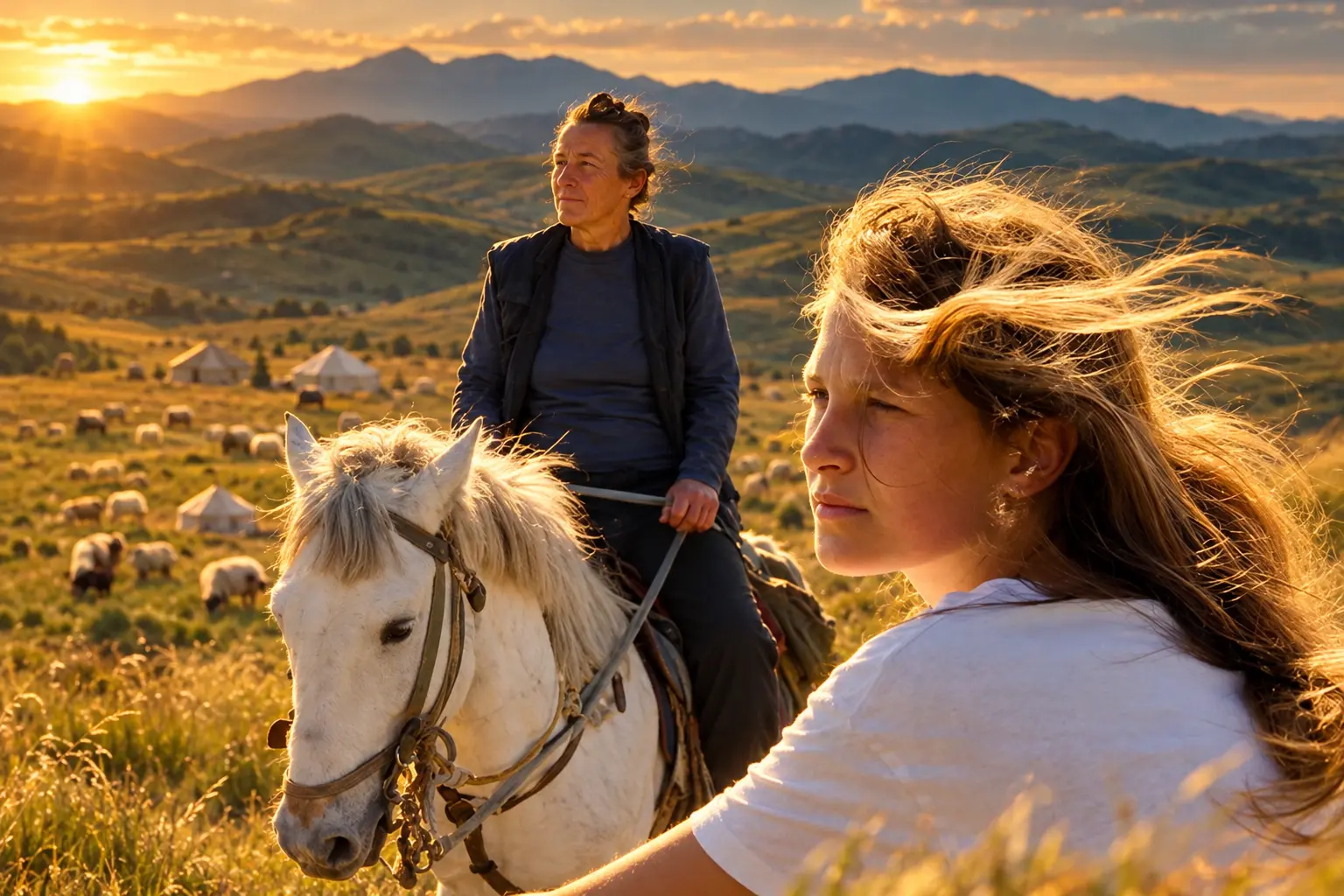
Gara on a White Horse Started the Film
Co-directors Biljana Tutorov and Petar Glomazić did not begin with a protest manifesto. Tutorov has said the first sight of the plateau felt like walking into an Old Masters painting, dirty pinks and deep greens, gold and purple. Glomazić grew up herding in northern Montenegro with his aunts and wanted a slow film about that life. The story locked, Tutorov said, when Gara rode in on a white horse and spoke to neighbors about the coming drills.
Sinjajevina is our only way of life.
Mileva Gara Jovanović, Save Sinjajevina
The film stays with Gara and Nada, who is 13 when we meet her, through summers of cheese-making, herb gathering, and long walks after stray animals. They call the mountain Mother. Nada is also moving toward adulthood inside a family history the film feeds slowly, including the aftertaste of domestic violence and the chance to break that cycle. Film Forum’s notes put the political fight beside that private one, and say the camera gives the dispute a closeness that press conferences never will.
One of the Directors Helped Found the Protest
Glomazić is not a visitor with a camera. Sundance’s own film page lists him as co-founder and vice president of the Save Sinjajevina Civic Initiative. He has said the documentary grew out of that activism, and that Sinjajevina is the second-largest alpine pasture in Europe. The French-language text of the communities’ 2026 “territory of life” declaration names him as a vice president beside Gara. The crew lived in a shepherd’s cottage near the women. Cinematographer Eva Kraljević, who has a Montenegrin father and training in psychotherapy, shot with them until, Tutorov said, the three of them felt like family.
They spent eight years on the mountain, from 2018 to 2025, and more than 230 shooting days in a hut with no electricity, internet, or phone signal, drinking from a spring. Tutorov has described an ethical pact that was never written down: they would not hurt or betray Gara and Nada. In one morning scene Gara reads coffee grounds and then tells Nada, on camera, the facts of her early childhood. The directors left the room. Kraljević left the camera running. They later told Gara they would cut it. Gara said they had to use it, that she and Nada wanted it in.
The President Called It a Lesson in Democracy
On February 24, 2026, President Jakov Milatović received Tutorov, Glomazić, Gara, and Nada after the Sundance win. His office said the prize was the most significant international honor a Montenegrin film had ever received. He then awarded Gara the Order of the Montenegrin Flag for her work to keep Sinjajevina, and for showing that one person’s stubbornness can move a community. Tutorov later recalled his aside to the filmmakers.
WHAT THE STATE HAS DONE WITH THE FILM
- The medal: Milatović pinned the Order of the Montenegrin Flag on Gara on February 24, 2026.
- The line: Tutorov said the president told them, “I would like to thank you guys for teaching us democracy.”
- The screening: Officials planned to show the film in Strasbourg as Montenegro took the presidency of the Council of Europe.
- The twist: The directors called the Oscar submission “quite a twist” under a government trying to break with three decades of one-party rule.
That is a lot of state affection for a movie about people who blocked the army. It is also a split inside the same government. Culture and the presidency are exporting Gara. Defense is still looking for a weather window.
Montenegro Chose the Film Unanimously for the Oscars
The Ministry of Culture and Media named Planina, the local title, as Montenegro’s official Oscar candidate on September 17, 2026. A seven-member committee chaired by actress Dubravka Drakić voted in secret and, the ministry said, voted as one. The public call ran from August 4 to September 4. Two fiction features, 15 i po and Vidra, were in the pile with the documentary. Under new Academy rules the Sundance documentary grand prize also gives the film a festival path into the same race. Nominations are due January 21, 2027. The 99th Academy Awards are set for March 14, 2027.
THE PRIZE SHELF BEFORE DECEMBER
| Prize or step | Where it landed |
|---|---|
| World Cinema Grand Jury Prize: Documentary | Sundance Film Festival, January 30, 2026 |
| Heart of Sarajevo, Best Feature Documentary | Sarajevo Film Festival |
| Grand Prix | Millennium Docs Against Gravity, Poland |
| Best Documentary Directors | RiverRun, Winston-Salem |
| Official international feature submission | Montenegro, 99th Academy Awards |
| Documentary shortlist of 15 | European Film Awards, nominations November 14, 2026 |
The Sundance jury, announcing the World Cinema Grand Jury Prize, called the film “the truest example of the power of cinema to make the personal political.” It was the first film from Montenegro to play the festival. Tutorov and Glomazić told the Library Center Theatre crowd on January 26, 2026, that they had been working on it for more than seven years. The running time on the U.S. listing is 105 minutes. Ardor Films in Podgorica and Wake Up Films in Novi Sad produced it with partners in France, Slovenia, and Croatia. Quentin Laurent and Rok Biček are among the producers. George Cragg edited. Draško Adžić wrote the score. The film is also on the IDA Documentary Awards shortlist and on DOC NYC’s short list, with IDFA in Amsterdam still ahead. Tutorov said it had already played more than 50 festivals, with about 40 more booked.
What Those Days on the Mountain Caught
At the Park City premiere Tutorov refused to sell the film as a briefing paper. She said it was about love, and that love might work as a political tool in a shivering world. Glomazić told that first-night audience it was also the first time a Montenegrin film had stood in that room. The camera’s job, on the evidence of the trailer and the stills, is patient: wide rock, sheep on a grade, morning light on the tops, Gara on the white horse.
HOW THE FILM WAS BUILT
- The hut: The crew shot more than 230 days from a shepherd’s cottage with no power or signal, on katun Okrugljak and around it.
- The horse: Tutorov has said the film began, for her, the day Gara rode in to warn the community about military operations.
- The coffee cup: Kraljević kept one angle on a private morning the directors had left, and Gara ordered them to keep it.
- The chorus: Tutorov started to treat the mountain as a Greek chorus, a witness to the women’s story and to the others around it.
The trailer is the first look most U.S. viewers will get at that pact. Submarine Deluxe put it out the day before Halloween, with the New York date already locked.
Pat Mullen, writing in POV, called the finished film “a quietly powerful feminist fable.” Screen Daily’s review, filed from Sundance, grouped it with patient observational work and noted an immersive portrait that does not slide into nostalgia. The specimen on screen is small on purpose: a woman, a girl, cheese, weather, and a helicopter that should not be there.
When To Hold a Mountain Opens in New York
Submarine Deluxe will give the film its U.S. start with a December 16 opening at Film Forum, then a national rollout, then HBO and HBO Max in early 2027. The European Film Awards shortlist is already in motion, with nominations due November 14, 2026 and a January 16, 2027 ceremony in Athens. That does not change the ministry’s October wording. The exercise is delayed. The army, by its own account, has not let go.
Gara still has the medal. Nada still has a mountain that the family calls Mother. The trailer that landed on October 30 sells a finished work. The plateau, two weeks earlier, was a camp again.

One UI 9.5 Beta Puts the Galaxy S26 on Last Year’s Clock

DBS Puts a 24/7 USDC Window Inside the Bank

European Startups Head for $81 Billion as First Checks Shrink

US Stocks Lost $1.3 Trillion Before Nvidia’s Beat

Home Depot Bets on Finance Chief Richard McPhail as CEO

Aramco Crash Kills 14 Two Days After Oil Restart

Salah Captained Egypt to Their First World Cup Win

Zelda’s 40th Switch 2 Ships Without a Zelda Game

Apple Labor Day Deals Hide June’s Memory Price Hike

El Niño Puts Israel’s Needed Winter Rain on a Flood Clock
-
 BUSINESS5 months ago
Aramco Crash Kills 14 Two Days After Oil Restart
-
 NEWS6 months ago
Salah Captained Egypt to Their First World Cup Win
-
 GAMING2 months ago
Zelda’s 40th Switch 2 Ships Without a Zelda Game
-
 NEWS3 months ago
Apple Labor Day Deals Hide June’s Memory Price Hike
-
 NEWS4 months ago
El Niño Puts Israel’s Needed Winter Rain on a Flood Clock
-

 GAMING2 months ago
Palworld 1.0.4 Adds Palpedia Search After the 1.0 Launch
-

 NEWS4 months ago
Saudi Visa Routes Split Nigerian Travelers Into Two Speeds
-

 BUSINESS9 months ago
BAE’s 60-Year Saudi Franchise Now Runs Through Taif