
NEWS
Strawberry Ships Its AI Browser After OpenAI Folded Atlas
Strawberry 1.0 leaves beta as a Swedish team browser, two months after OpenAI shut Atlas, selling shared companions more than a new chat window.

Stockholm’s Strawberry shipped version 1.0 of its AI browser on October 26, 2026. The 12-person studio wants offices to run AI colleagues inside the tabs where logins already live.
OpenAI closed its own standalone browser, Atlas, on August 9, after 292 days. Strawberry still asked people to delete Chrome.
OpenAI Folded Its Browser in 292 Days
ChatGPT Atlas arrived on Mac on October 21, 2025, as a full browser built around an agent that could move across the open web. On July 9, 2026, OpenAI said it was retiring that app and folding browser work into ChatGPT and Codex. The help page is blunt: Atlas is scheduled to stop working on August 9, 2026, and bookmarks would not move on their own.
That is 292 days from launch to shutdown. Strawberry 1.0 landed 78 days later. Charles Maddock, Strawberry’s chief executive, still sells a download you put on the Dock. He also says the real rivals are Claude, ChatGPT, Grok Bot and Gemini, not other browsers.
The split is the whole launch. US labs spent a year learning that people will let an agent into Chrome or into a desktop chat app, and that they will not rebuild muscle memory around a new window. A Swedish team of 12 is shipping the new window anyway, because that is where the cookies, the CRM, and the messy tabs already sit.
Perplexity’s Comet is still a standalone AI browser. Claude in Chrome and Gemini in Chrome keep the agent inside a browser companies already manage. Strawberry is the other bet: replace the browser, then treat the agents as colleagues the whole team can share.
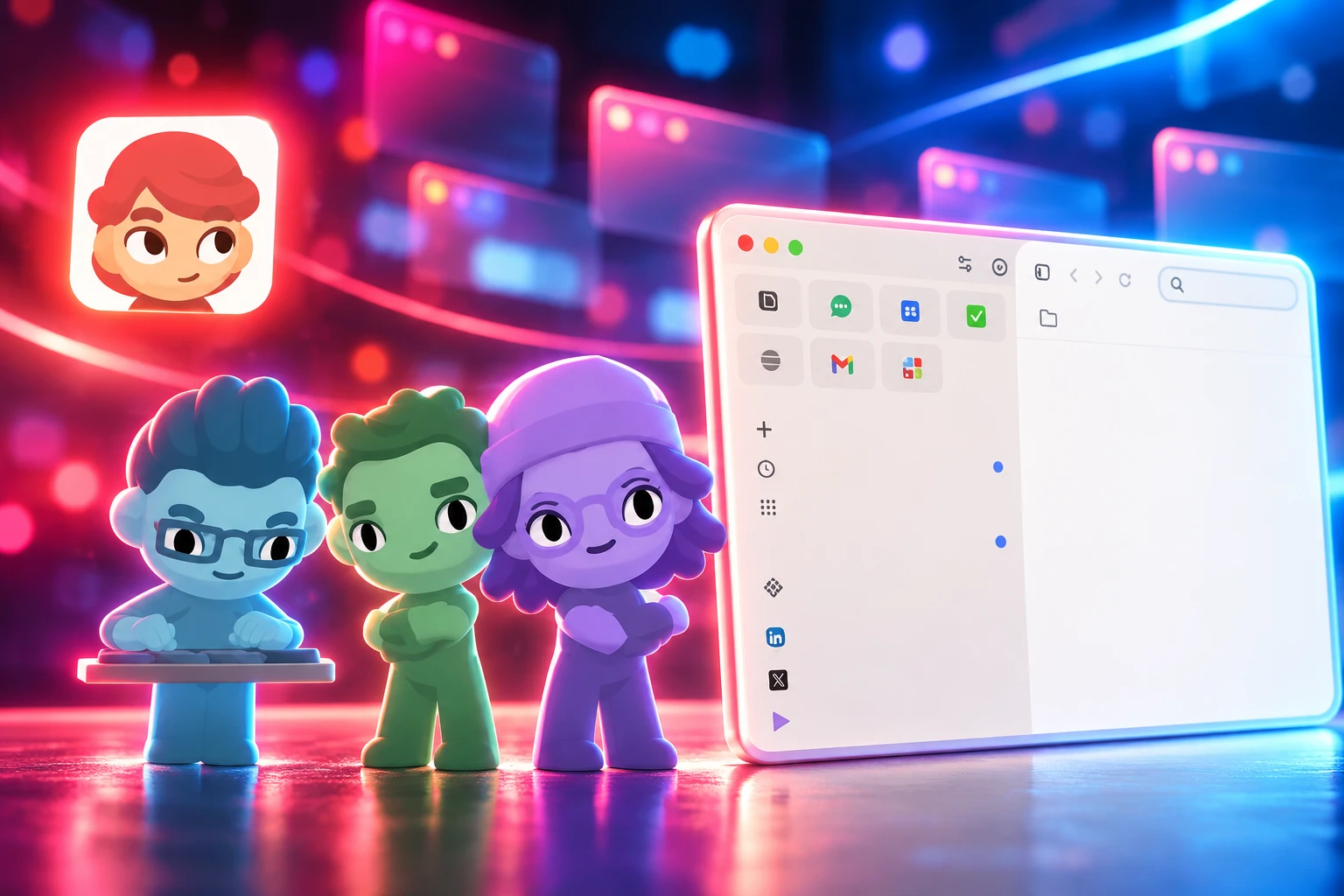
What Ships Inside Strawberry 1.0
Strawberry is a desktop app for macOS and Windows, not a skin on Chrome. Maddock’s line for that choice is simple. Daily work is not ten files on a disk, he said. It is ten tabs. Companions, the company’s name for agents, open those tabs, click, type, and pause before they send mail, publish a post, or change a record.
The 1.0 notes, posted from Stockholm, spend as much time on faces as on plumbing. You pick a color and a face, or hit randomize. You can also hire one of nine companions that arrive with a job already loaded, such as Sales Sally or Talent Theo, then spend the first chat teaching them how you work.
NEW IN VERSION 1.0
- Custom faces: Each companion gets a look you choose, and it is still the same worker you had in beta.
- Companion Plaza: On a New Tab page, the crew hangs around the chat box between jobs, and you click one to put it to work.
- Nine starters: Ready-made hires include Sales Sally, Talent Theo, Executive Ellis, Marketing Martin, and Consulting Cora.
- Meetings page: Recordings, transcripts, summaries, decisions, and action items sit in one place, and transcripts now tell speakers apart.
- Library: Projects, files, and shared team work live in one searchable shelf with previews and recovery.
Those faces sit on a year of quieter shipping. In May 2026 the beta picked up more than 100 apps, including Apollo, QuickBooks, Greenhouse, and Klaviyo, and it began running Chrome extensions. Companions can plan a job, spin up helpers in isolated tabs, and research hundreds of accounts in parallel. They can work in a sandboxed folder on the Mac or PC. Routines fire on a clock or when a Gmail message lands.
Nine Ready-Made Colleagues
The homepage sells the starters as output, not chat. Sales Sally is pitched as 100 qualified leads with outreach in your voice. Talent Theo is pitched as 10 researched candidates scored against what the team needs. Executive Ellis writes a morning brief and follow-ups. Marketing Martin finds what already worked, then drafts posts by channel. Consulting Cora turns a client call into a proposal.
You can also build one from scratch around a process and a schedule. The company says a companion remembers preferences and gets better the more you work together, because it is tied to the team’s tabs, logins, and shared skills. Maddock told launch-day readers that cookies store the usual way, companions just open tabs, and extra profiles can split what each agent may touch.
Meetings Stay on the Computer
Version 1.0 also records Google Meet, Zoom, and Teams from the user’s machine, so no extra bot has to join the call. The companion then writes notes, pulls action items, and answers questions about what was said. Later on October 26, the company account said GPT-6.1 Terra was live in 1.0, and Maddock posted that credit spend fell with the new model.
Passwords, history, and cookies stay on the device, and the company says passwords are never shown to Strawberry or to model vendors. Chats are a different store. Since August 2026 they have been saved, encrypted, to a Strawberry account, so you can sign in on another computer and continue. The homepage lists SOC 2 and GDPR, and says the firm does not sell user data.
A Companion the Whole Team Can Hire
The feature Maddock keeps returning to is not a prettier chat. It is the fact that the person who already knows how to wring work out of Claude usually keeps that setup on one laptop.
Today the person who is great with Claude keeps all of it on their own laptop
Charles Maddock, CEO and co-founder, Strawberry
Version 1.0 is built to copy that setup across a team. A recruiter can train a companion on sourcing, then hand the same companion, skills, and memory to the next person. Maddock named Lovable, Tandem Health, and ElevenLabs as teams already using that shared layer. He has said hundreds of teams run it.
Lovable, the Swedish AI coding startup, is in the story twice. Its founders backed the seed, and the company is using Strawberry to source engineers. Tandem Health, a Swedish health-tech firm, is on the same early list. ElevenLabs, the voice-AI company, is the new name Maddock added on launch day.
That loop is cozy, and it is also the point. If the colleague who knows your Greenhouse board, your HubSpot fields, and your meeting decisions lives in a browser only this vendor ships, switching later is not a matter of exporting bookmarks. Atlas already showed what happens to bookmarks when the window dies. They stay behind.
The Plans Are Named Like Jobs
Strawberry prices the product like a hire, which is more honest than calling it a browser add-on. Browsing itself does not spend credits. Credits move when a companion chats or acts. The allotment refreshes each month and does not roll over. Extra credit is $10 per 1,000.
STRAWBERRY MONTHLY PLANS
| Plan | Price | Monthly credits | Company pitch |
|---|---|---|---|
| Free | $0 | 500 | Try the essentials |
| Intern | $20 | 6,000 | Help a few hours a week |
| Part-Time | $85 | 25,000 | A colleague on whole projects |
| Full-Time | $250 | 75,000 | A few new hires on workstreams |
Paid seats add Expert mode, a choice of models, and priority at peak hours. You can point the app at an existing ChatGPT plan to save credits. Team billing adds shared companions, shared skills, admin controls, and a pot of credits per paid seat. The public Intern plan at $20 a month is the first paid rung; Part-Time and Full-Time sit at $85 and $250.
People who installed 1.0 the same day were already asking how long 75,000 credits last when several companions research in parallel, scrape logged-in pages, and draft follow-ups. That is the live cost question. The line about saving a team more than 100 hours a week is the company’s own pitch, not a published time study.
Lovable, ElevenLabs and the Stockholm Users
Strawberry was founded in 2023 by Maddock, Sebastian Thunman, the chief operating officer, and Arian Hanifi, the chief technology officer. Maddock is in his mid-twenties and had already sold a climate-tech startup. On October 14, 2025, the company raised $6 million in funding led by General Catalyst and EQT Ventures, with the founders of Lovable, Supabase, and Hugging Face in the round.
FROM SEED TO VERSION 1.0
- 2023: Maddock, Thunman, and Hanifi found Strawberry in Stockholm.
- October 14, 2025: The company raises $6 million, led by General Catalyst and EQT Ventures.
- October 2025: A beta opens to 10,000 people who had signed up in advance.
- February 2026: Downloads open to anyone on Mac and Windows.
- May 2026: The beta adds meeting recording, Chrome extensions, and more than 100 apps.
- August 9, 2026: OpenAI’s Atlas browser stops working.
- October 26, 2026: Strawberry 1.0 leaves beta.
Yuri Sagalov, a partner at General Catalyst, backed the browser as the front line for AI, and said the team’s design sense and Maddock’s community work were the edge. Sandra Malmberg and Gustav von Sydow at EQT Ventures said they had known Maddock before the company existed and were buying a shot at global scale. Maddock has said a later round would come when Strawberry is ready to push across Europe and the United States.
The browser is fast becoming the front line for AI, and the Strawberry team is at the center of that shift.
Yuri Sagalov, Partner, General Catalyst
Early user notes on the site are narrower than the launch film. Marta Mierzejewska, a senior technical recruiter at Zapier, said she had been using it to source niche roles and liked the Ashby hookup. Damian Pawłowski at lablab.ai wrote that he got 270-plus leads with no manual work and more than 10 hours back. Those are recruiting and prospecting jobs, which is where a logged-in browser agent has an obvious surface: LinkedIn, a spreadsheet, a CRM.
Delete Chrome Is a Hard Ask
Launch morning, Maddock posted a three-line list. Delete Chrome. Delete Granola. Delete Claude. Granola is a meeting-notes app. Claude is the assistant he says power users currently keep to themselves. The clip under the post is the 1.0 film.
Delete Chrome
Delete Granola
Delete ClaudeStrawberry 1.0 is here, the AI browser that saves your team >100h/week pic.twitter.com/XXb6bkd7Fa
— Charles Maddock (@charles_maddock) October 26, 2026
He also offered code PH50 for 50% off the first month, and a “0-year anniversary” hat he said would be gone in a week. The bravado is doing a lot of work. OpenAI already spent 292 days on a Mac-only agent browser, then told users to export bookmarks and move into the ChatGPT desktop app and a Chrome extension. Asking a finance team, a hospital, or a recruiter shop to make Strawberry the daily driver is that same habit change, with a 12-person vendor and $6 million behind it.
The product that does not need anyone to delete Chrome is the shared companion: a worker that already knows the tabs, pauses before it sends, and can be handed to the next person on the team. The product that does need a new Dock icon is the browser around it. Strawberry 1.0 puts both in one installer, free to try, with 500 credits a month, and then bills like a hire.
Whether a companion trained on one recruiter’s Greenhouse habits still helps the next hire, without turning into another tool to watch, is the test the 1.0 notes cannot answer. The window is on Mac and Windows. The colleagues are for sale. Chrome is still where most of the tabs are.

One UI 9.5 Beta Puts the Galaxy S26 on Last Year’s Clock

DBS Puts a 24/7 USDC Window Inside the Bank

European Startups Head for $81 Billion as First Checks Shrink

US Stocks Lost $1.3 Trillion Before Nvidia’s Beat

Home Depot Bets on Finance Chief Richard McPhail as CEO

Aramco Crash Kills 14 Two Days After Oil Restart

Salah Captained Egypt to Their First World Cup Win

Zelda’s 40th Switch 2 Ships Without a Zelda Game

Apple Labor Day Deals Hide June’s Memory Price Hike

El Niño Puts Israel’s Needed Winter Rain on a Flood Clock
-
 BUSINESS5 months ago
Aramco Crash Kills 14 Two Days After Oil Restart
-
 NEWS6 months ago
Salah Captained Egypt to Their First World Cup Win
-
 GAMING2 months ago
Zelda’s 40th Switch 2 Ships Without a Zelda Game
-
 NEWS3 months ago
Apple Labor Day Deals Hide June’s Memory Price Hike
-
 NEWS4 months ago
El Niño Puts Israel’s Needed Winter Rain on a Flood Clock
-

 GAMING2 months ago
Palworld 1.0.4 Adds Palpedia Search After the 1.0 Launch
-

 NEWS4 months ago
Saudi Visa Routes Split Nigerian Travelers Into Two Speeds
-

 BUSINESS9 months ago
BAE’s 60-Year Saudi Franchise Now Runs Through Taif