
NEWS
Sort A Brick Bets a Faster Sorter Can Make Reuse Pay
Sort A Brick’s new line sorts 3,600 LEGO bricks an hour, but its chief says the machine must profit before the company copies it across 40 halls.

Sort A Brick’s new machine sorts 3,600 LEGO bricks an hour, and its chief says the line must profit before anyone copies it. The Lithuanian company opened a shop of refurbished sets in October 2026 and wants as many as 40 sorting lines by 2030. Ilya Malkin, the CEO, is treating the second-generation sorter as a test of whether certified used LEGO can pay as a factory business.
Demand is not the open question. Mixed bins already sit in homes, restoration slots are full, and more than 75 per cent of listed shop stock sold in the first week. The open question is whether a hardware line on pre-seed money can clear a profit before it is cloned.
The Second Machine Has to Pay for Itself
Hardware firms have to buy the kit before they know if the market works. Malkin said results at a very small scale can mislead, that the demand they have seen is encouraging, and that they still need to show the business works at scale. He put the second machine at the centre of that test.
We expect this new generation to make the operation profitable, which would allow us to start replicating the system. You can’t scale something that’s losing money every time you operate it.
Ilya Malkin, CEO, Sort A Brick
The company, legally Br1ck UAB, runs from Terminalo Street in Lithuania’s Kaunas district. Malkin founded it in 2023 with Aurimas Slapšys, the managing director. FIRSTPICK led a €1.15 million round in October 2024, with angels including Vinted co-founder Mantas Mikuckas and €200,000 from the founders. Tracker pages later put total funds near $1.7 million. In October 2025 the team was seeking €3 million to scale its first industrial conveyor.
That is thin capital for pilot centres in Europe and the United States in 2027, and for 40 lines by 2030. The wager is simple enough: this line has to make money, then they copy it.
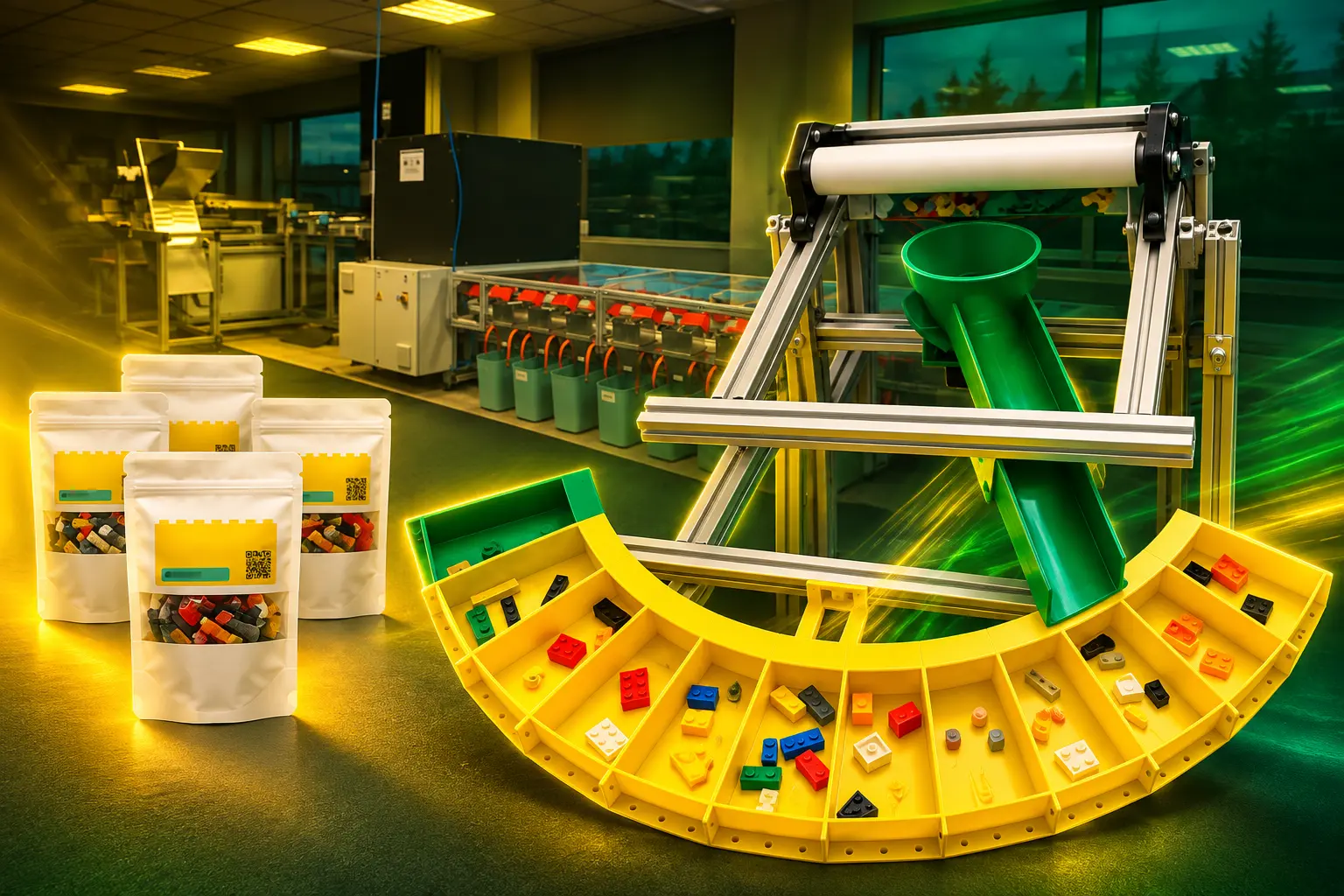
3,600 Bricks an Hour, Then a Human Check
Cameras identify each brick and software matches the pile against set inventories, so the plant can see which complete models can be rebuilt from the mix. The new machine scans bricks from all sides. A redesigned distribution system and ten times more output containers let it work on hundreds of sets at once. Overall capacity is five times higher on about three times the floor space.
THE SECOND-GENERATION LINE
| Measure | Figure |
|---|---|
| Sorting rate | Up to 3,600 bricks an hour |
| Speed vs the prior machine | Four times faster |
| Plant capacity | Five times higher |
| Physical footprint | About three times larger |
| Output containers | Ten times more |
| Automatic recognition | More than 93 per cent |
| Sent to manual stations | 7 per cent |
The system now spots more than 93 per cent of pieces on its own. The other 7 per cent go to a semi-manual station. A person still checks every finished set, Malkin said, because the company wants to guarantee completeness. The original machine was a prototype run in three shifts, about 22 hours a day, and still could not process enough.
Recognition moved from shape to colour and then to printed pieces, each step harder than the last. Malkin said the team adds AI features only when they raise the share of bricks the line can read, and that copying a calibrated machine is not straightforward because small hardware differences throw the cameras off. Shape models can transfer more easily than colour, which needs machine-specific calibration.
Why Restoration Orders Sit for a Year
Sort A Brick now runs two lines. It still restores a customer’s own mixed collection, and it sells refurbished sets it has assembled from bricks it bought. Malkin said the shop waited on better quality and consistency, and on legal work, before it opened.
Restoration demand has been the easy part. Some customers will wait years. The average order is around €500, and people often send 14 or 15 kilograms of mixed bricks. Paying that in one instalment puts people off even when the cost per set is lower, which is why a single refurbished set at about €10 or €15 exists at all. The target is around half the price of an equivalent new set, with older and rarer models priced higher.
The company’s site still says restoration and brick-buying slots are at full capacity. It has received nearly 2,000 restoration requests from 41 countries and processed more than 700 kilograms of mixed bricks, with Germany a core market. That gap, a long queue against a modest processed weight, is the capacity problem the new line is meant to shrink.
A sample collection report on the site shows what the software does with one mixed bin: 21.6 kilograms, 22,222 parts, dated 1990 to 2024. It found 93 restorable sets that would cost €3,045 new. Completing all of them is listed at €540.05, including €430 to sort 17.2 kilograms at €25 a kilogram and €110.05 for 844 missing parts. Leftover unmatched bricks weigh 4.4 kilograms. Trade-in on the same page is €12 a kilogram.
HOW A MIXED BIN BECOMES A SET
- Bricks in: Families send boxes of loose bricks they no longer use, or sell the mix to the company.
- Clean and inventory: Bricks are cleaned, inspected, and matched against restorable set lists.
- Sort and complete: Missing parts are sourced and the pieces are sorted into ready-to-build sets.
- Verify and pack: Each set is checked as clean, complete, and made of genuine parts only.
The shop is the release valve for people who will not write a €500 cheque. Public sales of refurbished sets started on 1 October 2026. Customers in 20 EU countries have bought more than 1,100 sets, and more than 75 per cent of listed inventory sold in the first week. The next drop is listed for Thursday, 19 November 2026, at 19:00. Each set is sold as one of the clean, complete, and verified sets on the company’s site, with a replacement promise if a piece is missing or not genuine, and a QR code for building instructions.
Complete Used Sets Are the Thin Slice
The aftermarket is large. Completeness is the scarce bit. Sort A Brick puts the global secondary LEGO market at about €800 million and says only €80 million of that is complete used sets. It estimates a market for certified refurbished sets could reach €4.7 billion by 2036 if automated sorting makes large-scale restoration pay. Those last two figures are the company’s own, and the 2036 number is a conditional forecast, not a booking.
THE USED-LEGO MARKET SORT A BRICK IS CHASING
| Slice | Size | Whose figure |
|---|---|---|
| Global secondary LEGO market | About €800 million | Sort A Brick |
| Complete used sets | About €80 million | Sort A Brick |
| Independent resale and events, 2024 | $705 million | WILCO Toys |
| Certified refurbished sets by 2036 | €4.7 billion (estimate) | Sort A Brick |
| LEGO Group revenue, 2024 | $11.7 billion | WILCO Toys |
WILCO Toys, which aggregates eBay, BrickLink, and selected shop data, puts the $705 million independent resale market for 2024 beside LEGO Group revenue of $11.7 billion that year. The two secondary-market totals are not the same basket. WILCO’s number is a 2024 independent-resale estimate; Sort A Brick’s €800 million is the company’s current global secondary figure. Both point the same way: used LEGO already trades, and complete sets are the expensive, annoying part of that trade.
The LEGO Group bought BrickLink, the main fan marketplace for parts and sets, in 2019. That platform still prices loose pieces and incomplete lots as everyday inventory. A certified complete set at about half the new-box price is a different product from a bag of unsorted bricks, and it collides with the incomplete listings that make up most of the used trade. Mixed household bins are already a chore people cannot finish by hand, which is why a year-long restoration queue existed before the shop opened. The bottleneck is factory time, not interest.
LEGO Replay Sends Donated Bricks to Classrooms
LEGO Group already runs a circular path for used bricks, and it is not a shop. LEGO Replay, launched in the United States in 2019 and later extended to Canada and the United Kingdom, takes donations, cleans them, and sends mixed boxes to schools and charities. By the programme’s fifth anniversary in October 2024 it had distributed 191,000 Replay boxes across the US and the District of Columbia, putting 300 million bricks back into play for more than 10,000 educators and nearly 400,000 children. Those bricks are sorted and inspected by hand.
The company’s sustainability pages also point to Brick Take-Back pilots in the USA as it tests how fans prefer to hand bricks back. Replay boxes are a mix of elements from many sets, packed for open play, not rebuilt official models. Sort A Brick is selling the opposite object: a named set, complete, with instructions. One programme is a donation channel. The other is trying to industrialise completeness and price it.
Lawyers Flag Fights Over Images and Provenance
The legal work is as much a scaling limit as the cameras. Sort A Brick filed a patent application in Sweden on the original machine and got confirmation in about nine months, Malkin said. Timing the second filing against publication of the first has been harder, because a public first application can complicate protection for the newer line.
Resale law in the EU turns on trademark exhaustion: once a genuine product is placed on the market in the European Economic Area, the brand owner generally cannot stop further sales of that item. Exhaustion can fail if the goods are altered. Courts have backed LEGO against sellers who modified bricks, including by adding parts and third-party logos. Reassembling genuine, unmodified pieces into complete official sets is the closer question, and Malkin said the company’s lawyers have already warned that intellectual property disputes could arise as it grows.
THE LEGAL CHECKLIST AS THE COMPANY GROWS
- Patent timing: The second machine’s filings have to land before the first application becomes public in a way that blocks them.
- Commercial images: The company photographs models at its own building events rather than lifting official box art.
- Provenance: When mixed bricks arrive without receipts, staff identify the sets and ask sellers to confirm they owned them.
- Brand distance: Sort A Brick states it is independent of the LEGO Group and is not affiliated, endorsed, or authorised by it.
Malkin said they take that caution seriously as volume rises. The shop’s guarantee (genuine bricks only, replacements for anything that is not) is also a legal posture. It is how a refurbisher tries to stay on the exhaustion side of the line rather than the modification side.
Pilot Centres Wait on a Line That Makes Money
The expansion map is public and still conditional on the Kaunas line paying its way.
FROM A KAUNAS LINE TO 40 SORTING HALLS
- 2023: Malkin and Slapšys found Sort A Brick in Lithuania.
- October 2024: FIRSTPICK leads a €1.15 million round.
- October 2025: The first industrial sorting conveyor goes to work, and the company seeks €3 million to scale it.
- 1 October 2026: Public sales of refurbished sets begin.
- October 2026: The second-generation machine, rated at 3,600 bricks an hour, is unveiled.
- 19 November 2026: The next refurbished-set release is listed at 19:00.
- 2027: Pilot sorting centres in Europe and the United States are planned.
- 2030: The ambition is as many as 40 sorting lines worldwide.
Malkin has also talked about other durable, modular toys, including Playmobil and BRIO wooden railways, if the parts stay valuable enough to justify the machines. He said there are more than 100,000 different types of parts to identify, and that another category needs variety, residual value, and a way to organise the pieces. He still sees a decade of work in LEGO alone. Larger halls, he said, should let schools watch the machines, so reuse is something children can see rather than a slogan on a box.
The 40-line map only opens if this factory stops losing money on every hour it runs. Malkin said there is enough LEGO in circulation to keep the company on this market for another decade. Copying the line still waits on a profit from the one already built.

One UI 9.5 Beta Puts the Galaxy S26 on Last Year’s Clock

DBS Puts a 24/7 USDC Window Inside the Bank

European Startups Head for $81 Billion as First Checks Shrink

US Stocks Lost $1.3 Trillion Before Nvidia’s Beat

Home Depot Bets on Finance Chief Richard McPhail as CEO

Aramco Crash Kills 14 Two Days After Oil Restart

Salah Captained Egypt to Their First World Cup Win

Zelda’s 40th Switch 2 Ships Without a Zelda Game

Apple Labor Day Deals Hide June’s Memory Price Hike

El Niño Puts Israel’s Needed Winter Rain on a Flood Clock
-
 BUSINESS5 months ago
Aramco Crash Kills 14 Two Days After Oil Restart
-
 NEWS6 months ago
Salah Captained Egypt to Their First World Cup Win
-
 GAMING2 months ago
Zelda’s 40th Switch 2 Ships Without a Zelda Game
-
 NEWS3 months ago
Apple Labor Day Deals Hide June’s Memory Price Hike
-
 NEWS4 months ago
El Niño Puts Israel’s Needed Winter Rain on a Flood Clock
-

 GAMING2 months ago
Palworld 1.0.4 Adds Palpedia Search After the 1.0 Launch
-

 NEWS4 months ago
Saudi Visa Routes Split Nigerian Travelers Into Two Speeds
-

 BUSINESS9 months ago
BAE’s 60-Year Saudi Franchise Now Runs Through Taif