
NEWS
SoftBank Bets $500 Million on Agile Robots’ Factory Path
SoftBank doubled down on Agile Robots at $8.5 billion, backing a Bavarian humanoid factory after Pepper and Boston Dynamics. The round still hides shipment counts.

SoftBank led a $500 million Series F in Agile Robots on November 12, valuing the Munich company at $8.5 billion. Nvidia, Hitachi Group and T.Capital joined a round that takes total invested capital to $2 billion.
The check is a follow-on. SoftBank Vision Fund 2 already led Agile’s $220 million Series C in September 2021, when the German Aerospace Center spin-off was still selling force-controlled arms from dual offices in Munich and Beijing. Five years later the same backer is paying for a humanoid plant and a US push, after Pepper’s maker went into receivership and Boston Dynamics passed to Hyundai.
SoftBank Bets Again on a Company That Already Ships
Dennis Chang, managing partner at SoftBank Investment Advisers, called Agile a firm that can “execute at industrial scale.” That line is the wager. Most humanoid names still live on pilots and videos. Agile’s own release puts more than 20,000 robotic solutions into factories already, across automotive, consumer electronics, logistics and healthcare.
The new money is the $500 million Series F at $8.5 billion, about €450 million, and Chang said SoftBank was “pleased to continue partnering with Dr. Chen.” Continue is the load-bearing word. This is the second major SoftBank cheque into the same company, at most 8.5 times the “exceeding $1 billion” floor Agile gave itself in 2021.
SOFTBANK’S ROBOTICS LEDGER
- March 2012: Buys French humanoid maker Aldebaran for $100 million.
- June 2014: Unveils Pepper, the consumer robot Masayoshi Son billed as able to read emotion.
- June 2017: Buys Boston Dynamics from Alphabet, adding Atlas and Spot to the group.
- September 2021: Vision Fund 2 leads Agile’s $220 million Series C at a valuation exceeding $1 billion.
- 2021: Hyundai takes 80 percent of Boston Dynamics in a deal that values that company at $1.1 billion.
- 2025: Aldebaran, by then no longer a SoftBank unit, is placed in receivership.
- 2026: SoftBank sells its remaining 9.65 percent of Boston Dynamics to Hyundai for $325 million.
Pepper stopped reaching the scale Son promised. Spot did reach customers, but Boston Dynamics never became the commercial engine those purchase prices implied. Agile is the opposite bet: fewer backflips, more lines that already run.
China’s foreign-investment review also blocked SoftBank’s planned $5.4 billion buy of ABB’s robotics business on November 4, with SoftBank later saying both sides were still working on the transaction. A German company that wants a US plant is, for now, a cleaner path than a Swiss unit stuck in Shanghai.
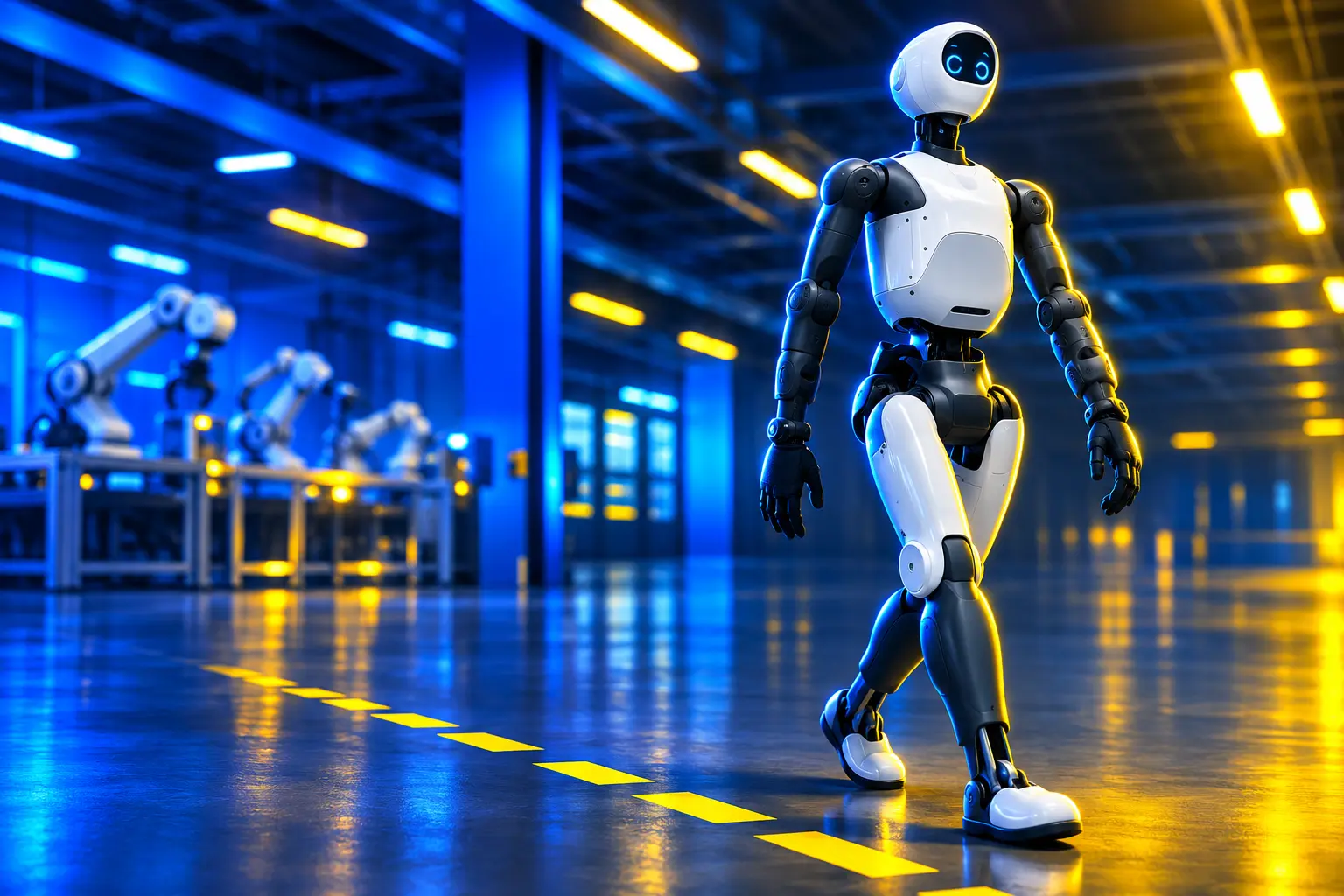
A Bavarian Plant Can Build 10,000 Humanoids a Year
Early in 2026 Agile opened a plant in Fürstenfeldbruck, just west of Munich, and said the site can make up to 10,000 legged and wheeled humanoid robots a year. That figure is a ceiling. It is not a shipment report, and founder-CEO Dr. Zhaopeng Chen would not say how many finished humanoids have already left the building.
At a Physical AI media day in early September, the company said the lines were turning out about 10 humanoid systems a day, with a goal of about 2,000 units by the end of 2026. One- and two-arm stations already mount joints and arms; final body assembly was still manual because variants keep changing. Wheeled humanoid torsos on mobile bases ferry parts along those same lines.
FURSTENFELDBRUCK ON PAPER
- Ceiling: Up to 10,000 legged and wheeled humanoids a year, per the company.
- September run-rate: About 10 humanoid systems a day at the media day.
- 2026 build target: About 2,000 units by year end.
- 2027 talk: Output could double or triple, according to company comments around the round.
Chen told interviewers he expects 2026 sales of about €600 million, a doubling. He also put humanoids already in the field at 3,000 to 4,000, a founder figure that sits inside the official 20,000-solution total rather than replacing it. Former Apple executive Rory Sexton, who has walked the plant, put the pitch in six words: “the factory is the product.”
What the $500 Million Is For
Agile said the round will fund a deeper US presence, more production in Germany, new industrial applications and entry into further markets. Chen was blunter with German interviewers: the United States is an important market, and the next factory will probably be built there. Plans discussed around the round point to Auburn Hills, Michigan, after Agile took assets of Thyssenkrupp Automation Engineering on both sides of the Atlantic.
WHERE THE CHEQUE IS MEANT TO GO
- United States: Sales, applications and a probable next factory, with Auburn Hills named as a candidate site.
- Germany: More output at Fürstenfeldbruck and other domestic capacity.
- Product: Faster work on industrial applications and on Agile ONE mass production, which Chen said starts in 2027.
- People: More engineers on a payroll that already lists more than 3,500 staff, including more than 2,000 in research and development, and more than 650 patents.
Talks described in June had sketched a raise of about $800 million, with SoftBank weighing more than $300 million of it. The close came in at $500 million. SoftBank’s exact slice of the final round was not disclosed, and neither was the split with Nvidia, Hitachi and T.Capital.
T.Capital, the corporate venture arm of Deutsche Telekom, is the European industrial-telecom cheque on the cap table. The firm €2.3 billion for Deutsche Telekom is the pool it invests from, across a Ventures book and a larger Tech Fund. Deutsche Telekom has also already listed Agile among users of its Munich Industrial AI Cloud, so the round extends a relationship that was already live in compute, not only in equity.
Arms, Hands and a Bought Factory Floor
Agile was founded in 2018 by DLR researchers, with Chen’s own work sitting on dexterous five-fingered hands. The company still sells the unglamorous kit that pays bills: robotic arms, hands, autonomous mobile robots, plus the models that run them. Customers named around the business include Foxconn, the Apple assembler, and test work at Audi in Ingolstadt.
The humanoid that carries the valuation story is Agile ONE, launched in November 2025. It stands 174 cm tall, weighs 69 kg, has 40 degrees of freedom and carries about 20 kg. Each hand has 21 joints. In October the company showed Agile ONE SN, a compact research unit on Nvidia’s Jetson Thor and Isaac GR00T stack, and Chen said Agile plans to build 1,000 to 2,000 of those in 2027.
NVIDIA announces new Isaac tools for agents as Agile Robots unveils Agile ONE SN, a reference humanoid for robotics research. 🦾
Built on NVIDIA Isaac GR00T and powered by Jetson Thor, Agile ONE SN gives researchers and developers an integrated platform to develop, train and… pic.twitter.com/igl8owSqiS
— NVIDIA Robotics (@NVIDIARobotics) October 21, 2026
The stack around that robot was assembled by purchase as much as by lab work. Agile lists BÄR Automation, Franka Robotics, idealworks and Krause Automation, the last of those taken from thyssenkrupp AG, as the group that covers research arms, mobile robots and shop-floor deployment.
Chen still talks like a scientist who wandered into a cap table. “Physical AI will fundamentally change how the world builds, moves and makes things,” he said with the round. “Our vision is intelligent robots working alongside people in factories and warehouses everywhere, and Agile Robots is determined to lead that shift.” At the September media day he went further, saying the market for Physical AI will be 10 times larger than the car market. That is a founder’s ceiling, not a booked order.
Figure’s $39 Billion Makes Agile Look Cheap
Chen told German interviewers Agile is now the most valuable robotics company in Europe, moving past Metzingen’s Neura Robotics, which was valued at about $7 billion after a Series C of up to $1.4 billion in June. Against the US names that dominate the humanoid conversation, the Munich price still looks like a discount.
WHAT THE LAST ROUND WAS PRICED AT
| Company | Latest disclosed valuation | Last large round |
|---|---|---|
| Figure AI | $39 billion | Series C, September 2025 |
| Agile Robots | $8.5 billion | $500 million Series F, November 2026 |
| Neura Robotics | $7 billion | Series C up to $1.4 billion, June 2026 |
| Apptronik | $5.5 billion | Series A extension, February 2026 |
Figure’s last disclosed price is more than four times Agile’s. Figure is still widely described as a pilot-stage humanoid maker. Agile is the one publishing a 10,000-unit plant and a 20,000-solution installed base, and still asking a fifth of Figure’s headline value. That gap is the long side of SoftBank’s trade. It is also the risk: if investors are really paying for biped theatre, a company that still makes most of its living on arms and wheeled bases can look mis-labelled at $8.5 billion.
Hitachi Wants Factory Intelligence, Not a Demo
Hitachi did not wander into the cap table. On September 29 the Japanese group announced a co-creation partnership on Physical AI, pairing its HMAX Industry software with Agile’s arms, mobile robots and Agile ONE. Hitachi wants robots that can pick, load and change over without a fixed script, and it plans to sell the combined stack to factories worldwide. Its edge chips, meant to handle vision and touch at low power, are part of the same package.
Physical AI will only transform industry if it works reliably on the factory floor, and at scale. Hitachi brings more than a century of manufacturing and operational technology expertise, a global customer base and its edge AI semiconductor technology. We contribute AI-powered robotics solutions, from robotic arms and mobile robots to our humanoid Agile ONE, that are already proven in industrial operations worldwide.
Dr. Zhaopeng Chen, founder and CEO, Agile Robots SE, Hitachi partnership statement, September 29, 2026
Nvidia’s seat is the compute layer under that pitch, already visible in Agile ONE SN. Hitachi’s seat is distribution into plants that will not buy a humanoid as a science project. SoftBank’s seat is the balance sheet that has now priced the whole stack at $8.5 billion. The three cheques pull in the same direction: lock industrial channels before the next US or Chinese humanoid raise resets the comps.
How Many Humanoids Have Shipped?
Agile has not published a humanoid shipment or order book with the Series F. The Fürstenfeldbruck ceiling is public. The 2026 build target of about 2,000 units is public. Chen’s interview range of 3,000 to 4,000 humanoids already deployed is public. What left the new plant, and what a customer has actually paid for, is not.
WHAT WE KNOW
- Installed base: More than 20,000 robotic solutions worldwide, per the company, covering arms, mobile robots and humanoids together.
- Founder humanoid count: Chen put humanoids already deployed at 3,000 to 4,000.
- Plant: Fürstenfeldbruck opened early in 2026 with a stated 10,000-unit annual ceiling.
WHAT IS UNCONFIRMED
- Humanoid orders: No backlog, ASP or paid-unit figure was released with the round.
- Plant output: Chen declined to say how many Fürstenfeldbruck humanoids have been delivered.
- US factory: Auburn Hills is a candidate, not a confirmed groundbreaking.
The sharper reading of the round is that a 10,000-unit plant is a ceiling, not a backlog. A 2,000-unit 2026 target is a build plan, not a disclosed order book. People who actually put robots on lines keep asking a plainer question than $8.5 billion: how many units run unattended at 3 a.m. in a real plant. Until Agile prints that number, SoftBank is paying for capacity, channels and a DLR pedigree, and only partly for biped volume.
Chen has started talking about a future listing, with no timetable attached, and he has framed the company as Europe’s answer to a market splitting between China and the United States. “Physical A.I. is one of the solutions for Europe,” he said. “In the new era of physical A.I., Europe stands a chance.” The Series F buys him time to prove the plant can sell what it can stamp.
Frequently Asked Questions
Has SoftBank Funded Agile Robots Before?
Yes. SoftBank Vision Fund 2 led a $220 million Series C on September 10, 2021, at a valuation exceeding $1 billion, the round that made Agile a unicorn. That syndicate also included Xiaomi Group, Foxconn Industrial Internet, Chimera Investments under the Abu Dhabi Royal Group, Sequoia China, GL Ventures, Linear Capital and Midas. The 2026 Series F is a follow-on at a much higher price, not a first meeting.
What Software Runs Agile Robots’ Machines?
The company’s control layer is AgileCore, a software platform it has sold alongside hardware since the early product set. That early set also included DIANA, a force-controlled arm with joint-torque sensing aimed at precision assembly and medical work, plus five-fingered hands that grew out of Chen’s DLR research. The Series F is being sold as Physical AI on top of that stack, not as a replacement for it.
What Is T.Capital’s Role in the Round?
T.Capital is Deutsche Telekom’s corporate venture unit, investing from a book it says runs to €2.3 billion across a Ventures strategy and a Tech Fund. Tech Fund tickets are listed at €50 million to €300 million, which is the band that fits a late-stage robotics cheque, though Agile did not disclose T.Capital’s exact amount. Telekom had already named Agile as a user of its Munich Industrial AI Cloud before the round closed.
When Did Agile ONE Launch, and What Can It Do?
Agile ONE, the full-size industrial humanoid, launched in November 2025. It is 174 cm tall, weighs 69 kg, has 40 degrees of freedom, carries about 20 kg and uses five-fingered hands with 21 joints each. The company has given a walking speed of 2 m/s. Chen said mass production of Agile ONE starts in 2027. A smaller research sibling, Agile ONE SN, runs on Nvidia Jetson Thor and Isaac GR00T; Chen has talked about building 1,000 to 2,000 of those in 2027.
Who Founded Agile Robots, and Where Did the Science Come From?
Zhaopeng Chen and Peter Meusel founded the company in 2018 as a spin-off from the German Aerospace Center’s Institute of Robotics and Mechatronics in Oberpfaffenhofen. Chen spent years at DLR on humanoid hands and still describes himself first as a scientist. Fürstenfeldbruck, the town that now hosts the humanoid plant, is Meusel’s hometown. The firm is organised as Agile Robots SE and says it employs people from almost 60 nations across more than 20,000 square meters of lab space.
Disclaimer: This article is news reporting and analysis of a private funding round, and it is for information only. It is not investment advice, a solicitation to buy or sell any security, or a recommendation to participate in any private round or future listing of Agile Robots, SoftBank Group, Nvidia, Hitachi or Deutsche Telekom. Readers who are considering an investment in robotics, private technology companies or listed backers of this round should consult a licensed financial adviser or securities professional who can review their own facts. Figures, valuations, plant capacities and round terms are those given by the companies and other sources named in the piece as of the dates of those statements, and they can change with later filings, restatements or operating results.

One UI 9.5 Beta Puts the Galaxy S26 on Last Year’s Clock

DBS Puts a 24/7 USDC Window Inside the Bank

European Startups Head for $81 Billion as First Checks Shrink

US Stocks Lost $1.3 Trillion Before Nvidia’s Beat

Home Depot Bets on Finance Chief Richard McPhail as CEO

Aramco Crash Kills 14 Two Days After Oil Restart

Salah Captained Egypt to Their First World Cup Win

Zelda’s 40th Switch 2 Ships Without a Zelda Game

Apple Labor Day Deals Hide June’s Memory Price Hike

El Niño Puts Israel’s Needed Winter Rain on a Flood Clock
-
 BUSINESS5 months ago
Aramco Crash Kills 14 Two Days After Oil Restart
-
 NEWS6 months ago
Salah Captained Egypt to Their First World Cup Win
-
 GAMING2 months ago
Zelda’s 40th Switch 2 Ships Without a Zelda Game
-
 NEWS3 months ago
Apple Labor Day Deals Hide June’s Memory Price Hike
-
 NEWS4 months ago
El Niño Puts Israel’s Needed Winter Rain on a Flood Clock
-

 GAMING2 months ago
Palworld 1.0.4 Adds Palpedia Search After the 1.0 Launch
-

 NEWS4 months ago
Saudi Visa Routes Split Nigerian Travelers Into Two Speeds
-

 BUSINESS9 months ago
BAE’s 60-Year Saudi Franchise Now Runs Through Taif