
NEWS
Releaf Bets on Paper Mills After Leaf Pulp Stalls
After its leaf-cellulose process stalled on cost, Releaf is betting mill partnerships and a luxury laminate can make fallen-leaf paper pay.

Releaf processed about 1,000 tonnes of urban leaves on its French pilot in 2025, founder Valentyn Frechka said in November 2026. He is preparing twice that volume next season. The Ukrainian-founded, Paris-based firm now feeds the output into other companies’ paper machines.
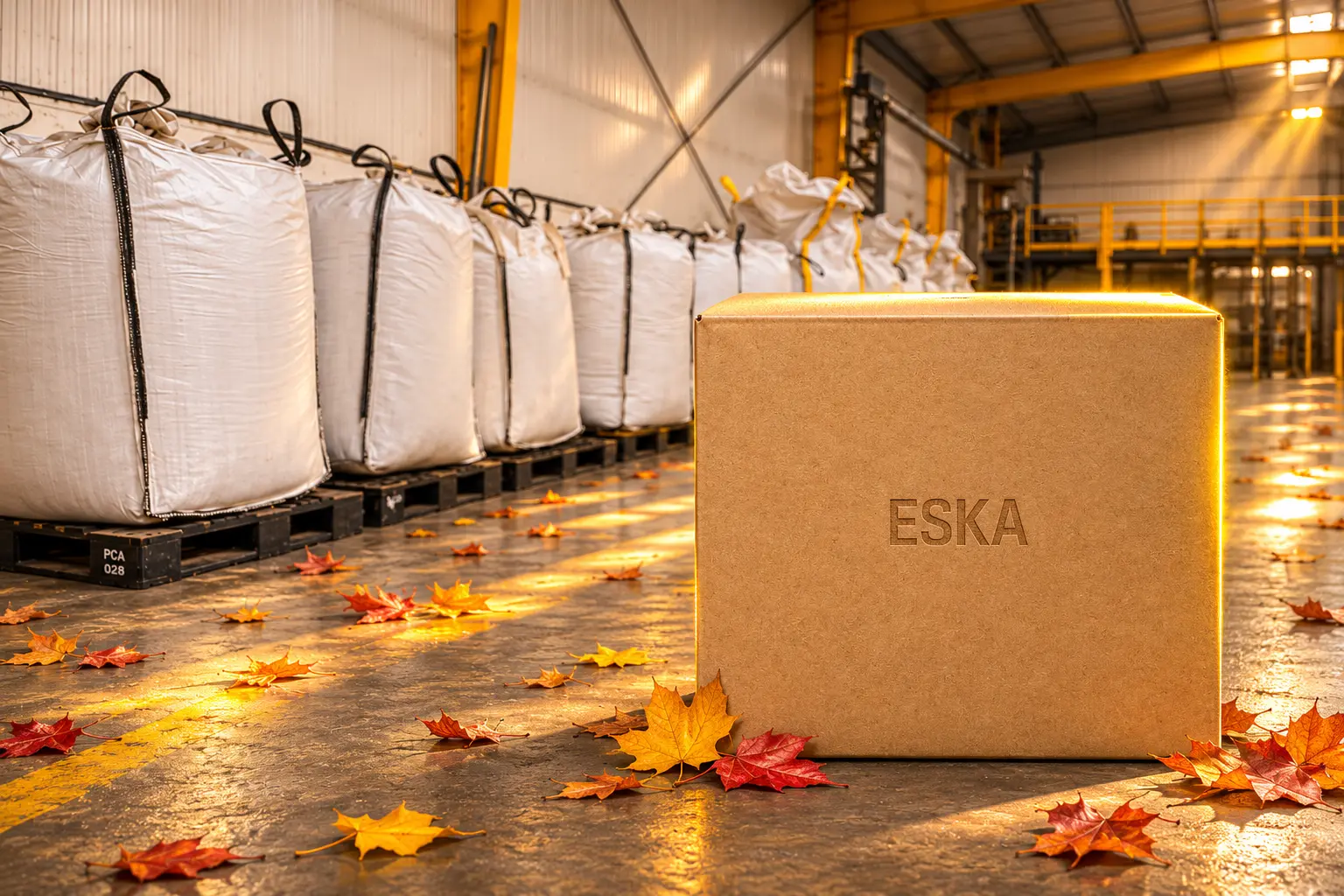
That wager sits on a new mill SKU, not a leaf-pulp plant. In September 2026, RDM Group and its Dutch unit Eska launched Eska Leaf, recycled solid board with a fallen-leaf paper laminate, at LUXE PACK Monaco.
A Leaf Skin on Someone Else’s Board
Eska Leaf is the first product that puts Releaf inside a European board mill’s catalogue. The sheet is Eska’s recycled solid board with a Releaf leaf-paper laminate on the face, made so the leaf texture stays visible on luxury boxes and book covers. On Eska’s board list, the grade is described as recycled board made from recycled paper and fibres derived from actual fallen leaves.
The pairing is the strategy in physical form. Releaf keeps the leaf conversion. Eska, a solid-board specialist in RDM Group and a house that has sold identity boards since 1879, runs lamination, customisation and mill volume. Leaves are collected in large cities, including Paris, then processed for the face paper. The stack debuted at Eska’s booth RC02 at the Grimaldi Forum from 28 to 30 September 2026.
Eska Leaf shows what’s possible when we combine our fibre expertise with a partner like Releaf: a material that reduces pressure on forests, tells a story about where it comes from and still meets the standards our customers expect from solid board.
Krzysztof Krajewski, chief sustainability and innovation officer, RDM Group
Frechka called the same deal a way to put “a new class of leaf-based materials into premium packaging.” The public story around his company still describes a clean swap, leaf pulp instead of trees. The SKU RDM will sell is a visible leaf skin on board Eska already knew how to make.
The Cellulose Process Lost on Cost
Frechka started as a school project in Ukraine, asking why paper had to come from felled trees when cities already rake leaves. He co-founded Releaf Paper in 2020, then moved the company to France in 2022 after Russia’s invasion. The European Commission’s EIC Accelerator granted €2.5 million that December toward a pilot line. In 2024 he took second place in the European Patent Office’s Young Inventors Prize.
The prize file still describes the original chemical route. Leaves are ground and softened, then treated with sodium hydroxide, hydrogen peroxide and acetic acid so cellulose can be pulled without wrecking the leaf structure. The pulp is mixed with bio-fillers for bags and board. That method, as the patent office wrote it, yields one tonne of cellulose from 2.3 tonnes of fallen leaves, equal to 17 trees by usual methods.
Industrial cost did not follow the prize copy. Oleksandr Sobolenko, the former co-founder and chief executive who handled finance, said the patented method produced a semi-finished product that could not compete with wood paper on quality or cost. A 2024 patent set a floor of 10% leaves in the furnish. Frechka later said the share rose to 20-30% depending on the grade after the French line was upgraded.
Capacity was the other break. The French line had been talked up at 10,000 tonnes of pulp a year. Frechka confirmed it could produce about 200 tonnes of pellets. In August 2025 he sent 50 kg of fibre to prospective partners. He took executive control on 17 July 2025, the team was cut, and the pilot-industrial line was paused. Sobolenko sold his stake in 2026 and left. Frechka now runs Releaf Paper France SAS as founder and CEO.
FROM SCHOOL BENCH TO MILL FLOOR
- 2020: Frechka co-founds Releaf Paper in Ukraine after the school cellulose experiments.
- December 2022: The company, now based in France, receives a €2.5 million EIC Accelerator grant for a pilot line.
- 2024: A new patent sets a 10% leaf floor; the Île-de-France pilot opens; Frechka takes second in the Young Inventors Prize.
- 17 July 2025: Frechka returns as executive lead during the co-founder split; the chemical line’s pellet output is about 200 tonnes against a 10,000-tonne pulp promise.
- 2026: Sobolenko sells his stake. In September, RDM Group and Eska launch Eska Leaf at LUXE PACK Monaco.
Two process families now sit side by side. A dry mechanical route makes a filler that existing paper machines can take. A chemical and thermal route still pulls short fibres meant to behave like wood cellulose. The filler path is the one that can enter a mill without asking that mill to rebuild itself.
Why Releaf Refuses to Build a Mill
Frechka’s working rule is to stay an engineering house and let paper groups make the sheet. He has said a mill is a huge capital and skills bet, and that a partner mill taking the fibre is the proof that matters. “If you position yourself as a breakthrough company that’s going to compete directly with major corporations, you’re already putting yourself in a difficult position,” he said. “These are enormous businesses with established infrastructure and supply chains. Trying to disrupt that model by introducing something completely new often doesn’t work.”
He puts the same point in mill language. For a plant making 500,000 tonnes of paper a year, he has argued that a steady 100,000 tonnes of other fibre could be interesting if it cuts cost and holds quality. “When you approach an industrial manufacturer, you need to speak their language. You can’t simply arrive with an interesting sustainability story. You need to demonstrate that your material works technically and makes economic sense.”
That is the bet after the cellulose stall: sell a mill-ready fraction, not a rival mill. Releaf keeps the conversion know-how in house, especially the steps that turn leaves into fibres and filler, and pays for none of the dryer sections, recovery boilers or finishing lines. The risk, which Frechka himself flags, is that paper groups move slowly when a new furnish can spoil a reel.
Paris Leaves, Dortmund Talks, French Mills
Cities already collect the feedstock. “They did it before Releaf existed, and they’ll continue doing it,” Frechka said. Leaves left on streets rot and get slick. Collected loads usually go to compost or to incinerators. Compost from leaves is low-value and often needs public money. Incinerators dislike the sand and minerals that come in with street rakes, because those grit loads wear boilers.
WHAT CITIES ALREADY DO WITH FALLEN LEAVES
- Street risk: Uncollected leaves rot and make pavements slippery, so municipal crews already run a seasonal collection.
- Compost: The usual outlet has little market value and often depends on public subsidy.
- Incineration: Sand and minerals in street-collected leaves can damage boilers over time.
- Releaf’s pitch: Frechka says working with the company could cut municipal disposal costs by at least half.
Seasonality is the operational problem, and Frechka treats storage as core intellectual property. Large volumes arrive in a short autumn window. The preparation line strips contaminants, then bales and preserves the leaves so they do not rot in the yard. “This allows us to store approximately 400 kilograms of leaves in one cubic metre,” he said. From there the bales go dry or wet, depending on whether the order is filler or fibre.
Paris alone could yield tens of thousands of tonnes depending on the collection area, he estimates. Releaf is talking with a partner in Dortmund about the German version of the same model, and it lists city and mill ties in France, Germany, the Netherlands and Italy, including several French municipalities and three of France’s largest paper groups. Global brands have tested the materials, among them Uber Eats, Chanel, L’Oréal, Samsung and Rituals. Uber previously ran a Paris pilot with leaf-based bags for local restaurants.
1,000 Tonnes Against Europe’s Paper Output
Scale is still the open number. Frechka’s own mill example needs 100,000 tonnes of alternative fibre to get a 500,000-tonne machine interested. The pilot processed about 1,000 tonnes of material in 2025. Next season is planned at about 2,000 tonnes, twice the prior throughput, still a long way from that 100,000-tonne figure.
THE VOLUME GAP
| Measure | Figure | What it counts |
|---|---|---|
| Releaf pilot, 2025 | about 1,000 tonnes | Material processed on the French line |
| Releaf target, next season | about 2,000 tonnes | Twice the 2025 throughput |
| French chemical line, 2025 | about 200 tonnes of pellets | Output Frechka confirmed, against 10,000 tonnes of pulp once promised |
| Supply Frechka says could interest one mill | 100,000 tonnes | For a mill making 500,000 tonnes a year |
| Cepi paper and board, 2025 | 77.4 million tonnes | European industry output |
The Confederation of European Paper Industries said paper and board production declined by 1.6% in 2025, to 77.4 million tonnes. First-quarter 2026 output was already down 2.4% on the same period of 2025. Packaging grades were broadly flat, with containerboard up 1.6% to 32.9 million tonnes and cartonboard down 5.4%. Graphic papers fell 7.3%. Import penetration hit 7.7% of EU consumption. Cepi director general Jori Ringman called the pattern a slow drift with consequences for industrial capacity.
Those industry tonnes are the market Releaf wants a slice of, and they are also why a 2,000-tonne season does not yet rewrite furnish. Frechka’s argument is that mills will take a cheaper, less jumpy fibre if it runs. Wood is still the cash cost that hurts. WoodMarket Prices data from ResourceWise show fibre took more than 70% of manufacturing cash costs at Austrian and Finnish pulp mills in the fourth quarter of 2025, about 73% in Austria, and 64-67% in Sweden.
Kering, LVMH and the Local-Box Hypothesis
Paper is the first market on purpose. Frechka calls it the familiar grade, a way to build a book of business before coatings, moulded packs and bioplastics. Current selling effort is on paper for corrugated packaging and bags, with printing, graphic and luxury grades behind that. Luxury is concentrated, especially among specialist mills in Italy, which is one reason the RDM-Eska door matters.
The other luxury problem is geography. Paper made in Europe often travels to China, India or Indonesia for converting, then comes back as finished boxes. Frechka’s hypothesis is to keep the fibre, the paper and the pack close to European houses. “We’re currently validating that approach with several customers, including discussions with Kering and LVMH, as well as independent luxury brands,” he said. “Of course, we’re not suggesting that every luxury brand will replace all its existing packaging. But there are clear opportunities in e-commerce packaging and secondary packaging.”
Those are talks, not purchase orders. The mill product that exists is Eska Leaf, a seasonal-looking face on recycled board, aimed at boxes and covers where the material has to carry a story as well as a load. Longer term, Frechka wants Releaf to look like a materials company in the wood-processing sense, with money from paper put back into moulded packaging, biocomposites and polymers. “The opportunity is much broader than paper alone,” he said.
Plot-Level Wood Rules Arrive in December
A separate clock is running on virgin wood. Medium and large operators fall under the EU deforestation regulation as later amended from 30 December 2026. Products made entirely from recovered waste sit outside that net. Mixes that still contain virgin fibre need traceability to origin. Empty packaging sold as a product can be in scope; packing used only to ship something else generally is not. Cepi has been rewriting mill guidance for that split, including a 28-page update published on 28 October 2026.
Fallen urban leaves are a city waste stream, not a forest plot, which is part of Frechka’s supply-chain pitch. He has also argued that European buyers flinch at fibre made far away when routes can snap. Cepi says the industry already sources an all-time high 92% of its wood, and nearly all of its recycled fibre, from Europe. A leaf fraction that runs on existing machines would sit inside that local logic if mills can get the price and the quality to land.
THE CLOCK ON VIRGIN WOOD
- Start date: The deforestation rules apply from 30 December 2026 for medium and large operators.
- Recovered fibre: Goods made entirely from qualifying recovered waste fall outside the regulation.
- Virgin mix: Any remaining virgin fibre still needs origin traceability.
- Industry wood: Cepi says 92% of wood used by European mills already comes from Europe.
Trees still take five or ten years to grow, Frechka notes, for a shopping bag that may last two hours. If a filler or a face paper can match performance at a comparable price, from a stream cities already pay to shift, he thinks mills will look. The 2,000-tonne season he has lined up is the next test of that claim, against a European industry that made 77.4 million tonnes of paper and board in 2025, and against a luxury SKU whose leaf content is a laminate on recycled board.

One UI 9.5 Beta Puts the Galaxy S26 on Last Year’s Clock

DBS Puts a 24/7 USDC Window Inside the Bank

European Startups Head for $81 Billion as First Checks Shrink

US Stocks Lost $1.3 Trillion Before Nvidia’s Beat

Home Depot Bets on Finance Chief Richard McPhail as CEO

Aramco Crash Kills 14 Two Days After Oil Restart

Salah Captained Egypt to Their First World Cup Win

Zelda’s 40th Switch 2 Ships Without a Zelda Game

Apple Labor Day Deals Hide June’s Memory Price Hike

El Niño Puts Israel’s Needed Winter Rain on a Flood Clock
-
 BUSINESS5 months ago
Aramco Crash Kills 14 Two Days After Oil Restart
-
 NEWS6 months ago
Salah Captained Egypt to Their First World Cup Win
-
 GAMING2 months ago
Zelda’s 40th Switch 2 Ships Without a Zelda Game
-
 NEWS3 months ago
Apple Labor Day Deals Hide June’s Memory Price Hike
-
 NEWS4 months ago
El Niño Puts Israel’s Needed Winter Rain on a Flood Clock
-

 GAMING2 months ago
Palworld 1.0.4 Adds Palpedia Search After the 1.0 Launch
-

 NEWS4 months ago
Saudi Visa Routes Split Nigerian Travelers Into Two Speeds
-

 BUSINESS9 months ago
BAE’s 60-Year Saudi Franchise Now Runs Through Taif