
NEWS
Querio Raises $5 Million to Put Analytics in GitHub
Querio launched with $5 million so data teams can keep metric logic in GitHub, after Claude and Slack started returning conflicting revenue numbers.

London analytics startup Querio launched on October 27, 2026 with $5 million in total funding, putting company metric logic in a GitHub repo the data team owns. Staff already ask Claude, ChatGPT and Slack for revenue. They often get three numbers back.
The round is not a new dashboard vendor. It is a bet that the data team has to own the definitions those assistants read, or spend the week reconciling them.
Querio Puts the Whole Analytics Stack in GitHub
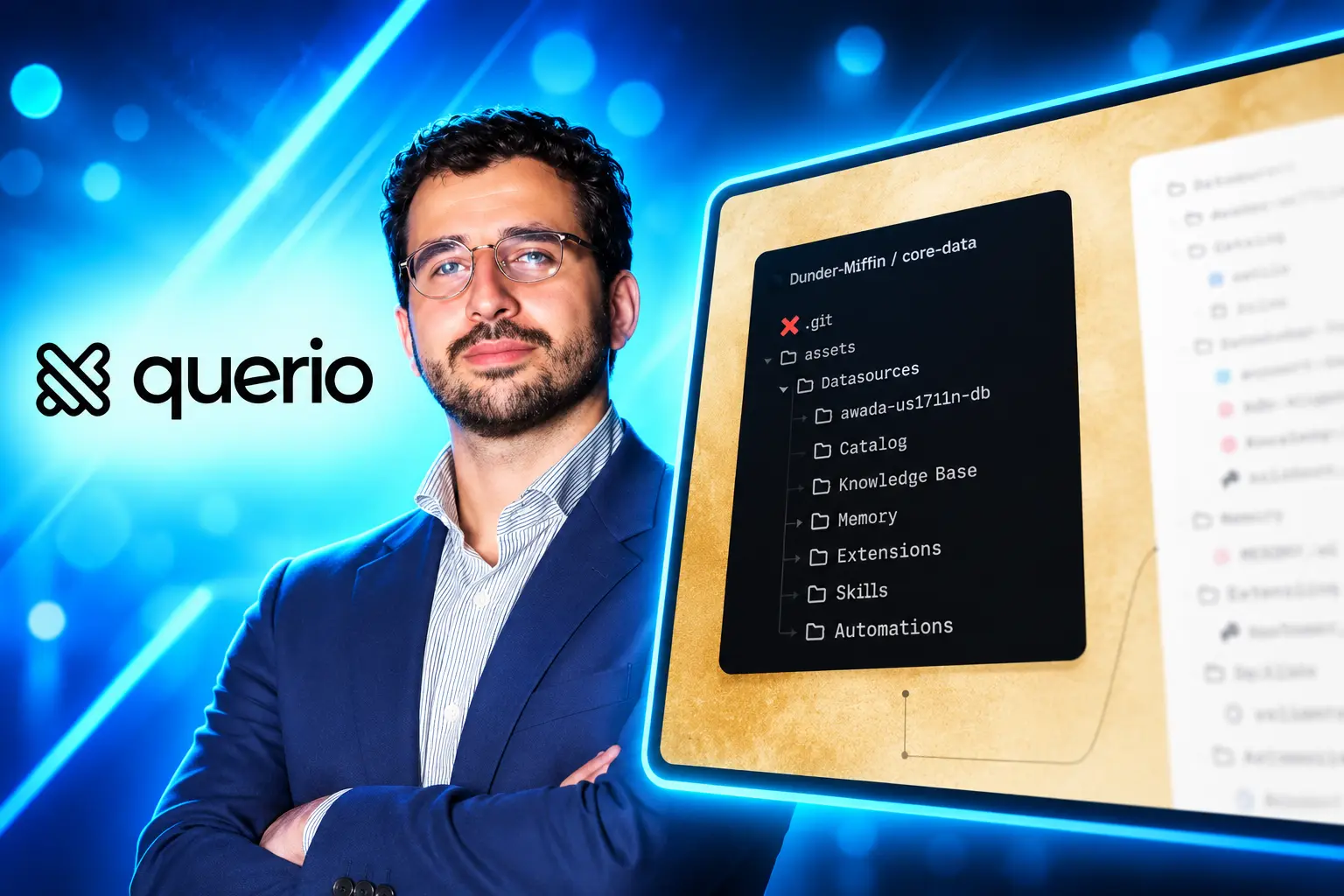
Querio, founded in 2024 by chief executive Rami Abi Habib and chief technology officer Javier Bonilla, stores metrics, dashboards, notebook models and security permissions as versioned files in the customer’s own GitHub. The company’s October 27, 2026 press release says business users can ask the same question in Claude, ChatGPT or Slack and get the same answer, because every tool reads that repo. The data team still approves each change before anyone else sees it.
The launch page frames the raise as a bid to kill the modern data stack, with backing from BMW i Ventures, LAUNCH, Haatch Ventures, Araya, Forum Ventures and Secways, plus angels tied to OpenAI, Google, Robinhood and Slack. Abi Habib posted the same pitch on X the same day, calling Querio the first analytics platform that puts the entire data stack in a git repo you own, and offering an open-source move out of locked BI tools to anyone who commented.
Introducing Querio
The first analytics platform that puts your entire data stack in a git repo you own
Querio makes your agents 100% consistent on your data
Comment 'data teams' and i'll send you our open-source repo to move your BI tool to a git repo you own pic.twitter.com/tFc2WhNtwb
— rami (@ramiabih) October 27, 2026
That “first” claim does not survive a trip through the last decade of analytics-as-code. The useful part of the launch is narrower: one repo the data team controls, agents that propose fixes, and a person who still has to sign them.
LIVE ON THE LAUNCH PAGE
- Context: Shared business knowledge the customer owns, kept as files rather than inside a vendor product.
- Developer tools: Model Context Protocol, Slack, a command line and an API, so agents and humans hit the same definitions.
- Notebooks: A place to ask, inspect the SQL or Python, and go deeper without exporting a spreadsheet.
- Dashboards, reports and embeds: Shared views and in-product analytics that still read the same repo.
The company says the platform works with existing data warehouses, is SOC 2 Type II certified, and can be tried for free. It also named OpenVPN and agree.com as companies already on it. A seven-person team is listed on the launch page, including founding designer Mariia Krutsko and founding engineers Nikolay Alexandrov, Mohammed Hussain and William Hirth, plus founding operator Daniel Merighi.
Three Revenue Numbers From One Question
The problem Querio is selling against is not a missing chart. It is a renamed CRM field that breaks a dashboard, a Slack bot that then says no deals closed, and Claude that invents a third total. Abi Habib used that exact sequence in the press release. Data teams, he said, spend their time reconciling those answers instead of doing new work.
For thirty years, analytics tools have kept a company’s logic inside the vendor’s product, where it’s hard to move and hard for AI to work with. Now everyone is asking data questions in Claude, Slack and wherever else they work, and they get three different revenue numbers. We built Querio so the data team owns that logic, and every AI tool in the company answers from it.
Rami Abi Habib, co-founder and CEO, October 27, 2026 press release
Bonilla put the trust problem in one line. Companies want to use AI with their data, he said, but they need to trust the answer. Querio’s pitch is that agents can take more of the grunt work if a person still gates every change that reaches the business.
Abi Habib has been circling that gap since Amazon. In a company essay on why he built Querio, he wrote that SQL and Python let him find projects, fund them and prove them, and that he recorded about $140 million in savings for Amazon’s supply chain in three years. Other product managers on his teams, he wrote, waited four to five weeks for a central data team. Amazon still bought Tableau licenses. When GPT-3 appeared, a schema-to-SQL helper became the tool his colleagues actually used.
He spent five years at Amazon, including technical product work on robotics and Alexa. The wait-time story is why the new product is aimed at the whole company, not only at analysts who already live in Looker. The irony is sitting in that history. The assistants that were supposed to end the ticket queue now manufacture extra tickets, because each one writes its own version of revenue.
What Unshackle Pulls Out of Tableau and Looker
The weapon next to the paid product is unshackle, a free open-source unshackle migration tool that copies metrics, dashboards and permissions out of a BI product and into files in a Git repo the customer owns. It is Apache 2.0, needs Python 3.11 or newer, and runs without buying Querio. The README is blunt about fidelity. What it cannot translate faithfully is marked TODO(unshackle), with the original formula beside it. It does not guess.
Metrics land in the Apache Ossie semantic format, a vendor-neutral YAML and JSON spec, incubating at Apache, that used to be called Open Semantic Interchange. Dashboards become Jupyter notebooks, one SQL query and one chart per tile. Table and column descriptions go to a catalog folder. Permissions become Cedar policies and SQL row filters. Glossaries become Markdown. The extract step reads a vendor API or a file export, writes those folders, and leaves the original BI tool untouched. A report then lists, per dashboard, what moved and what still blocks the rest. A verify command compares migrated queries with the source tool’s own numbers.
UNSHACKLE SOURCE TOOLS
| Tool | Maturity | File import if you cannot use the API |
|---|---|---|
| Tableau | Most complete | .twb,.twbx,.tds,.tdsx |
| Power BI | Real projects | .pbip, model as TMDL |
| Looker | Real projects | LookML Git checkout or.zip |
| Qlik Sense | Saved exports | qlik app unbuild folder |
| Amazon QuickSight | Saved exports | .qs asset bundle |
| Metabase | Saved exports | API only |
Seven more connectors sit behind that table: Lightdash, Apache Superset and Redash as saved exports, and Omni, Hex, ThoughtSpot and Sigma at an early stage. That is 13 source tools in all. The repo showed 269 commits and about 1,270 offline tests when it was pushed on launch day, with a Tableau demo that migrates a saved export and checks a dashboard’s numbers. API pulls get usage, sharing and, for most tools, the SQL the vendor itself runs. File imports carry less, and the report is supposed to say what is missing.
Tableau extracts, Excel and CSV files have no warehouse behind them. Migrate asks whether to copy that data into a git-ignored folder so notebooks can run locally. Copying Hyper extracts needs Tableau’s Hyper API. For teams that already live in dbt, Abi Habib’s launch thread told them to put Querio in the same repo and fix analytics in one pull request. Company docs also say Querio can read a dbt project’s semantic_manifest.json, so MetricFlow metrics stay defined once.
Who Put $5 Million Behind the London Seed?
The press release lists BMW i Ventures first among investors, then LAUNCH, the fund run by Jason Calacanis, then Haatch Ventures, Araya, Forum Ventures and Secways. It does not call anyone the lead. Forum Ventures said on X that it backed Abi Habib and Querio in its Winter 2024 accelerator cohort, and congratulated the team on the $5 million launch. The company’s LinkedIn thanks also named Scott Walbrun at BMW i Ventures, plus Id4 Ventures and TrueSight Ventures, which the press release omitted.
BMW i Ventures is the independent venture arm of BMW Group, set up in 2011 in Mountain View, California. It did not publish a comment on this deal. The industrial interest is easy to read without one. A car group that already funds software for plants and supply chains has a stake in metric logic that can move when the BI vendor changes.
THE PATH TO THE $5 MILLION
- 2023: Abi Habib builds a text-to-SQL prototype after watching colleagues wait weeks for answers, then leaves Amazon.
- January 16, 2024: He is appointed Querio director in 2024 at QUERIO LTD, company number 15417368, a UK filing that lists him as an American resident in London.
- Winter 2024: Forum Ventures takes the company into its accelerator cohort.
- October 27, 2026: Querio launches with $5 million in total funding and publishes unshackle the same day.
THE ROUND IN FOUR LINES
- The money: $5 million in total funding, announced with the product launch rather than as a numbered series.
- The split: The company has not disclosed how much of that total is new cash versus earlier cheques.
- The use: The funds will be used to invest in Querio’s technology.
- The headcount: Seven people named on the launch page, with LinkedIn listing a two to 10 person company in London and a Texas address in Wimberley.
Marty Madrid, founder and a general partner at Adventure Fund, and a professor at Northwestern University, replied to the launch post that he could not imagine life without Querio now that his team has it. That is one named user, not a booked pipeline. Capital raised is still not customer revenue, and the company did not publish seat counts, contract values or a retention figure with the $5 million.
Git-Native Analytics Already Had a Crowd
The sharpest objection to the launch is not that GitHub is a bad place for metric files. It is that this is not a new place. Cube has shipped analytics as code since 2018. Evidence.dev and Lightdash, from 2021, already keep the stack in a repo. LookML made Looker a modelling language inside Google’s BI tool. dbt turned transformations, and then metrics through MetricFlow, into YAML next to the warehouse models. Calling the result the first git-native analytics platform oversells the file format and undersells the extractor.
WHERE EXPERTS DISAGREE
- Querio’s launch line: Abi Habib presents a git repo the data team owns, plus agents, as the thing that finally takes company logic out of the vendor product.
- The as-code record: Cube, Evidence, Lightdash, LookML and dbt already treat definitions as files. The missing piece for most teams has been getting those files out of Tableau, Looker and Power BI without a six-month rewrite.
- The second-wave bet: Zach Mandell, staff product manager for the dbt Semantic Layer at dbt Labs, argued on October 27, 2026 that the first semantic-layer wave roughly five years ago mostly did not reach production, and that AI agents give a second wave a real shot.
Mandell’s timing is the tell. dbt is making the same “agents need governed metrics” argument on the same day a seven-person London shop is giving away a Tableau extractor. The market is not short of semantic layers. It is short of a way to leave the last one. Unshackle is built for that job. Whether teams then pay Querio for the agent that rewrites reports, instead of staying on dbt Cloud, Cube or Looker with an MCP plug, is the actual commercial test.
Company comparison posts already concede the overlap. One Querio article on the dbt Semantic Layer says the files half of that product is what Querio was built around, and that it does not replace MetricFlow. That is a quieter, more accurate claim than the launch video.
The Agent Spots a CRM Rename Before Anyone Sees It
Once the files are in GitHub, the paid layer is the agent loop. Sales renames a field in the CRM. The agent is supposed to spot the break, patch every report and definition that depends on it, and send the data team one update to approve. After that, Claude, Slack and the dashboard are meant to quote the same number. If the human never approves, the business never sees the change.
That loop is why BMW i Ventures and a Calacanis fund can sit on the same cap table as a free Apache 2.0 extractor. Unshackle is the door out of Tableau. The $5 million is for the watchman who stands at the door: context, permissions, MCP, notebooks and the approve step. Abi Habib’s X thread told people to connect with MCP, the CLI, or by pointing an agent at the repo, then to define context and permission in one place. Dashboards, data apps and automations, he wrote, come with that setup.
The launch is live. Careers are open, with the company saying it believes in a London office and still works remotely because staff have families abroad. Unshackle can be pip-installed tonight by a team that never talks to sales. The harder question is the one the assistants created. If every employee can ask for revenue in Slack, someone still has to own the file that says what revenue means, and someone has to click approve when that file changes.

One UI 9.5 Beta Puts the Galaxy S26 on Last Year’s Clock

DBS Puts a 24/7 USDC Window Inside the Bank

European Startups Head for $81 Billion as First Checks Shrink

US Stocks Lost $1.3 Trillion Before Nvidia’s Beat

Home Depot Bets on Finance Chief Richard McPhail as CEO

Aramco Crash Kills 14 Two Days After Oil Restart

Salah Captained Egypt to Their First World Cup Win

Zelda’s 40th Switch 2 Ships Without a Zelda Game

Apple Labor Day Deals Hide June’s Memory Price Hike

El Niño Puts Israel’s Needed Winter Rain on a Flood Clock
-
 BUSINESS5 months ago
Aramco Crash Kills 14 Two Days After Oil Restart
-
 NEWS6 months ago
Salah Captained Egypt to Their First World Cup Win
-
 GAMING2 months ago
Zelda’s 40th Switch 2 Ships Without a Zelda Game
-
 NEWS3 months ago
Apple Labor Day Deals Hide June’s Memory Price Hike
-
 NEWS4 months ago
El Niño Puts Israel’s Needed Winter Rain on a Flood Clock
-

 GAMING2 months ago
Palworld 1.0.4 Adds Palpedia Search After the 1.0 Launch
-

 NEWS4 months ago
Saudi Visa Routes Split Nigerian Travelers Into Two Speeds
-

 BUSINESS9 months ago
BAE’s 60-Year Saudi Franchise Now Runs Through Taif