
NEWS
OneSoil’s Recovery Landed in Africa, Not Latin America
After a 70% audience loss in Russia and Ukraine, OneSoil made South Africa its second Pro country and put a paid AI agronomist on the phone.

South Africa is now OneSoil’s second-strongest country for paid precision tools, after a Swiss farm-software firm lost about 70% of its users when war closed Russia and Ukraine. The company still sells variable-rate maps. The product it is pushing hardest is a chat on a phone that does not need a tractor.
Katya Kheistver, OneSoil’s CPO and COO, described a rebuild that looks, on a slide, like a classic geographic pivot. The paying map tells a ruder story. Latin America was the planned substitute for huge Eastern European fields. Africa, led by South Africa, became the second-largest region by revenue after Europe.
OneSoil Lost the Market It Was Built For
OneSoil was founded in 2017, after Europe’s Sentinel-2 programme put frequent, free crop imagery within reach of a small software team. Sentinel-2A went up on 23 June 2015 and Sentinel-2B on 7 March 2017. The pair carry 13 spectral bands for land and vegetation and can revisit Earth’s land surfaces every five days at the equator.
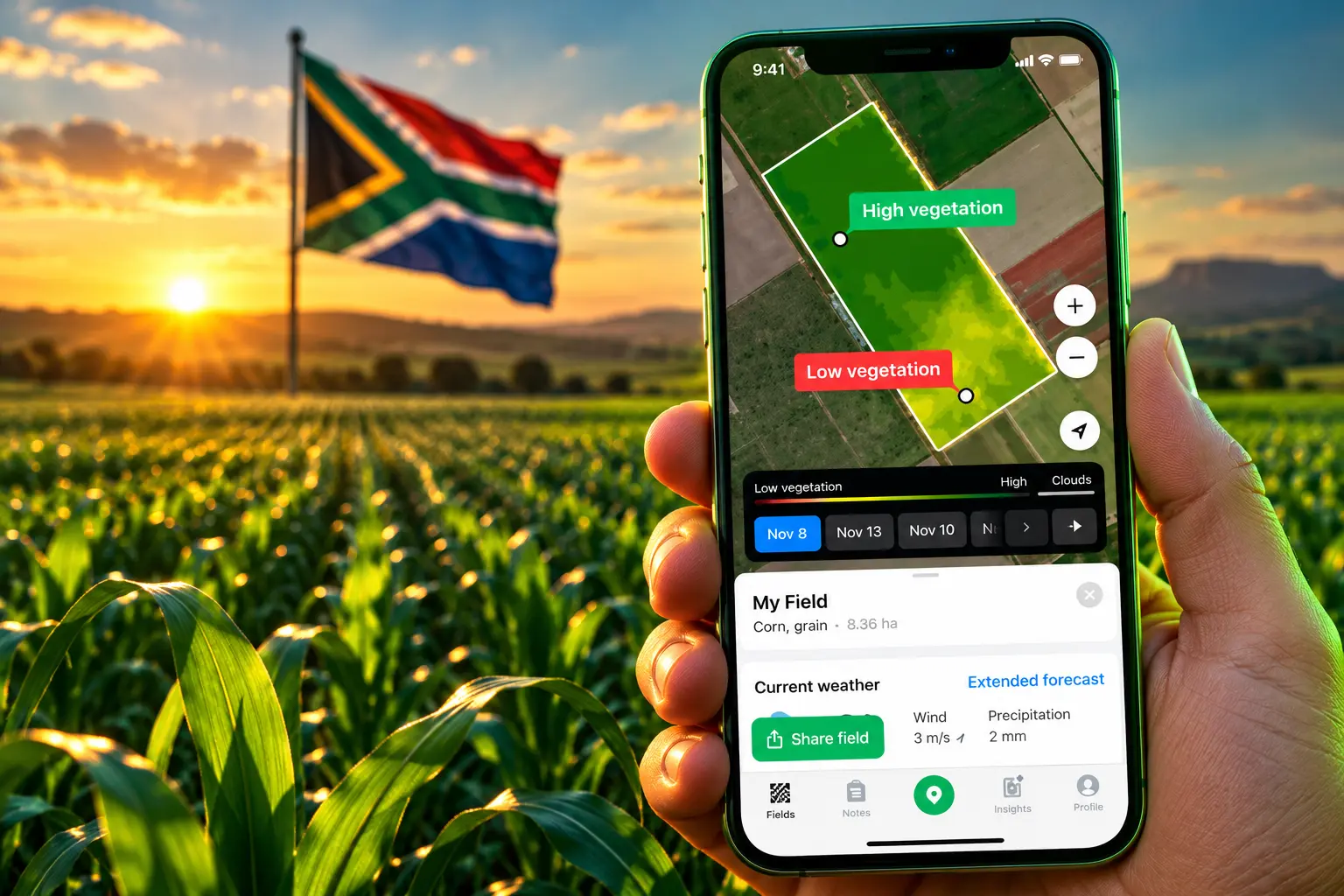
The first product was a mobile app that let a farmer watch vegetation, flag trouble, and share notes. That mattered in Ukraine, where a manager on 2,000 hectares cannot walk every field every day. The app was free, which filled the models that draw field boundaries and name crops. OneSoil Pro, with variable-rate maps for fertiliser and seed, was meant to turn that audience into revenue in early 2022.
About 70% of the audience then sat in Russia and Ukraine. Kheistver said the company had already put serious time and investor money into Pro. “Then the war began, and we had to reinvent ourselves almost overnight.” OneSoil refused to charge in Russia. It kept supporting Ukrainian farmers, who were in no mood to buy precision tools. Agriculture’s agriculture, forestry and fishing share of GDP in Ukraine was 10.9% in 2021 and 7.6% in 2025, on World Bank figures.
THE PATH OFF THE ORIGINAL MAP
- 2017: OneSoil is founded around Sentinel-2 imagery and a free farmer app.
- Early 2022: OneSoil Pro is ready to sell, with about 70% of users in Russia and Ukraine.
- 2022-2024: Three layoff rounds cut a staff of about 70 to 80 down toward 30, and all three co-founders leave.
- 2025: The company says it reached break-even, and Africa becomes its second-largest Pro market.
- June 14, 2026: AI Agronomist ships in the mobile app, funded with $1 million from existing backers.
The original customer was a large, machine-rich farm that could pay for maps a spreader could read. That customer did not vanish from the product sheet. It vanished from the revenue plan that was supposed to carry 2022.
The Latin American Copy That Did Not Stick
On paper, Brazil and Argentina were the obvious replacement. Fields are large. Machinery is advanced. Variable-rate work has a clear job. One of the three co-founders, Sasha Yakovlev, had lived in Argentina in 2016 and was already hunting the first Latin American contacts before the Swiss company even existed in its current form. After 2022, OneSoil still stood up teams in Brazil and Argentina.
The region was harder than the map suggested. Input firms already hand farmers digital tools with the seed and the chemical. Bayer’s Climate FieldView digital farming platform is sold in Brazil as part of a wider agronomy offer, and Abdalah Novaes, Bayer’s digital-agriculture lead for Latin America, has said growers who spent more than 150,000 reais a year on the company’s products already qualify for free access. When the map and the weather come bundled with the bag, a separate Swiss subscription has to justify itself twice.
Kheistver also pointed to tax pressure, thin state support in some markets, and weather risk. OneSoil did not abandon Latin America. It stopped treating it as Ukraine with better weather.
100,000 African Hectares, and South Africa Ranked Second
South Africa, which had looked like a side bet, outperformed the copy. Africa is now OneSoil’s second-largest region by revenue after Europe, and South Africa supplies most of that African revenue. In company figures for 2025, South Africa also ranked second in the world for OneSoil Pro use, behind whatever European country still sits first, while East African partners led global partner activations.
Roger Blewett, who leads OneSoil in Africa, wrote in September 2026 that the firm had activated more than 100,000 hectares of OneSoil Pro on the continent that year. That is a paid precision layer, not the free map. It is also a rounding error next to the 70 million hectares that about 140,000 annual app users monitor worldwide. The two numbers measure different products, and the gap is the business: lots of eyes on fields, a much smaller paid core.
Blewett’s Kenya example was not a phone chat. It was a large irrigated farm working with Cropnuts agronomists on basal fertiliser plus topdressed nitrogen and potassium.
A KENYA IRRIGATED FERTILIZER TRIAL
| Program | Cost (USD) |
|---|---|
| Without variable-rate application | 1,288,483 |
| With variable-rate application | 1,200,258 |
| Net saving after soil testing and related costs | 49,000 |
South African commercial growers ran similar head-to-heads against flat rates and, OneSoil says, saved money without giving up yield. At NAMPO 2026, weather-station maker METOS said its field sensors now feed the OneSoil platform, a hardware handshake aimed at those same commercial acres.
The irony is not that Africa is “untapped.” South Africa’s grain and horticulture belts already buy guidance systems and variable-rate kit. The surprise is that this was the market that paid, while the Latin American twin of Ukraine did not.
After the Founders Left, Unit Economics Took Over
Usevalad Henin, Slava Mazai and Yakovlev all left within two years of the invasion. Kheistver said the firm went through three rounds of layoffs, “and every one was extremely painful.” Headcount went from about 70 to 80 before the war to about 30, with hiring only now creeping back.
The 2020-2021 habit, she said, was to grow a single user metric and wait for a sale. “We moved away from that approach towards building a business with positive unit economics. We’re operating much more like a conventional business than a company focused primarily on venture capital-driven growth. That shift helped us survive.”
THE REBUILT P&L
- Revenue vs 2021: OneSoil has reported 106% revenue growth compared with 2021.
- Break-even: The company says it reached break-even in 2025.
- 2026 plan: It expects negative EBITDA in 2026 as a choice to scale, not as a surprise.
- Fresh cash: In June 2026 it took $1 million from current and new investors, including Belarusian entrepreneur Yury Melnichek of Melnichek Investments.
Melnichek is not a new name on the cap table. In 2017 he had already pushed the founders toward a free, global farmer platform rather than a services shop. That free layer is why the app still opens without a sales call or an email address. The 2026 cheque was earmarked for the thing that now sits on top of it.
What the AI Agronomist Does
On 14 June 2026, OneSoil switched on AI Agronomist inside the iOS and Android app. The company says the feature was built with $1 million from current investors. It is a chat tied to one field. It already has that field’s satellite history, weather, terrain, soil, and whatever the farmer later types or photographs. It is not bolted to a seed or chemical catalogue.
Farmers pick a field from ready-made boundaries and start. No machinery has to be connected. OneSoil Pro, the variable-rate suite planned as the 2022 cash engine, is a separate subscription. The assistant lives on a monitoring plan. If you already pay for Pro, the mobile extras open with it. Pricing for the AI plan scales with workspace size; Pro pricing scales with region and hectares, with a 14-day trial.
WHAT THE ASSISTANT DOES ON ITS OWN
- Daily pass: It checks every field every day and pins a spot worth walking to.
- Weekly write-up: It sends a detailed field analysis every 7 days, using recent weather and field work.
- Three-month read: It looks at vegetation, soil moisture and weather over 3 months, plus relief, soil type and field history.
- Photo check: A farmer can send a leaf picture and get a likely disease or pest with a confidence level.
- Any language: Users can write or speak in their own language, and the crop is the one set on the field.
Kheistver said the system mixes satellite imagery, weather, field boundaries, crop recognition and productivity-zone models with five specialised agents. In the company’s telling, the difference from ChatGPT, Claude or Gemini is not the chat window. It is the field file, plus a habit of asking for more evidence. If a farmer suspects disease, the assistant is supposed to request a walk and a photograph before it names a pesticide.
What makes our system different from a general-purpose AI model is the information and agricultural expertise behind it. We combine satellite imagery, weather data, field boundaries, crop recognition, and productivity-zone models.
Katya Kheistver, CPO and COO, OneSoil
OneSoil’s own agronomists, the company says, set what the agent should flag and when it should wait. A typical 1,000-hectare farm, it argues, is more than 20 fields; the pitch is one answer instead of 20 dashboards. Rival farm apps still describe OneSoil as satellite-only. That slight is also the distribution trick. A planter does not have to be plugged in before the first question.
Input Giants Still Bundle the Software Free
Kheistver is not trying to turn OneSoil into a full farm-management system. The stated job is field monitoring and a next action, not payroll, inventory, or a closed loop that ends in a particular product. In some markets, she said, farmers are tired of digital services that exist to move fertiliser.
Independence is the sales line that survives that fatigue. Agricultural companies have asked to buy OneSoil’s data. The firm says it has never sold farmers’ personal data and does not intend to. “You might make money from selling that information once, but what happens to the relationship with your users afterwards? Trust is extremely important in agriculture. Our terms and conditions make clear that we don’t share farmers’ personal data.”
Trust is also why the assistant is built to stall. Bad advice on a spray or a rate is not a chatbot embarrassment. It is a season. OneSoil trained the agent on field history accumulated since 2017, then ran it past farmers, agronomists and partners in several countries before charging for it. Technology, Kheistver still says, does not retire the human agronomist. Farms often want a person in the loop before they buy a machine or change a practice.
Where Agronomists Are Scarce, a Chat Fills In
The Africa thesis Kheistver now sells is not only South Africa’s commercial belt. Kenya, Tanzania and Nigeria, she said, have younger farmers who already live on phones and can skip some of the old digital steps. In those places, a qualified agronomist is often expensive or hard to reach. The app is being asked to stand in for a visit.
“Many farmers are relatively young and comfortable using mobile technology, so they can move directly to more advanced solutions,” she said. “Farmers don’t necessarily need to find and pay for an agronomist. They can download the app and get agricultural guidance much faster, in real time.”
That is a different customer from the 2,000-hectare Ukrainian farm that justified the original satellite stack. OneSoil still wants that large farm, and it still sells Pro maps into John Deere’s Operations Center. It also wants to be the first digital tool a smaller farmer ever opens, then a ladder into paid monitoring and, later, variable rate.
A newer African cheque sits beside that ladder. In October 2026, OneSoil said that through local distributor Environet it had been chosen as the digital platform for TASC’s SOLUM soil-carbon project in South Africa, listed with the Gold Standard. TASC supplies a registered biostimulant at no cost, covers each farmer’s OneSoil subscription, and keeps the carbon rights. Reduced tillage and cover crops are encouraged. The software bill does not land on the farmer.
OneSoil also works in Kenya and Tanzania and says it is moving toward Nigeria. For a product born on Sentinel images of Eastern European grain, the next seat may be a phone in a market where the agronomist never arrives, and the tractor never talks.

One UI 9.5 Beta Puts the Galaxy S26 on Last Year’s Clock

DBS Puts a 24/7 USDC Window Inside the Bank

European Startups Head for $81 Billion as First Checks Shrink

US Stocks Lost $1.3 Trillion Before Nvidia’s Beat

Home Depot Bets on Finance Chief Richard McPhail as CEO

Aramco Crash Kills 14 Two Days After Oil Restart

Salah Captained Egypt to Their First World Cup Win

Zelda’s 40th Switch 2 Ships Without a Zelda Game

Apple Labor Day Deals Hide June’s Memory Price Hike

El Niño Puts Israel’s Needed Winter Rain on a Flood Clock
-
 BUSINESS5 months ago
Aramco Crash Kills 14 Two Days After Oil Restart
-
 NEWS6 months ago
Salah Captained Egypt to Their First World Cup Win
-
 GAMING2 months ago
Zelda’s 40th Switch 2 Ships Without a Zelda Game
-
 NEWS3 months ago
Apple Labor Day Deals Hide June’s Memory Price Hike
-
 NEWS4 months ago
El Niño Puts Israel’s Needed Winter Rain on a Flood Clock
-

 GAMING2 months ago
Palworld 1.0.4 Adds Palpedia Search After the 1.0 Launch
-

 NEWS4 months ago
Saudi Visa Routes Split Nigerian Travelers Into Two Speeds
-

 BUSINESS9 months ago
BAE’s 60-Year Saudi Franchise Now Runs Through Taif