
BUSINESS
Nvidia’s Drop Pulled Indexes While Most Stocks Rose
Nvidia’s 5.47% drop took 22 points off the S&P 500, even as most stocks rose and the biggest AI buyers kept 2026 spending guides.

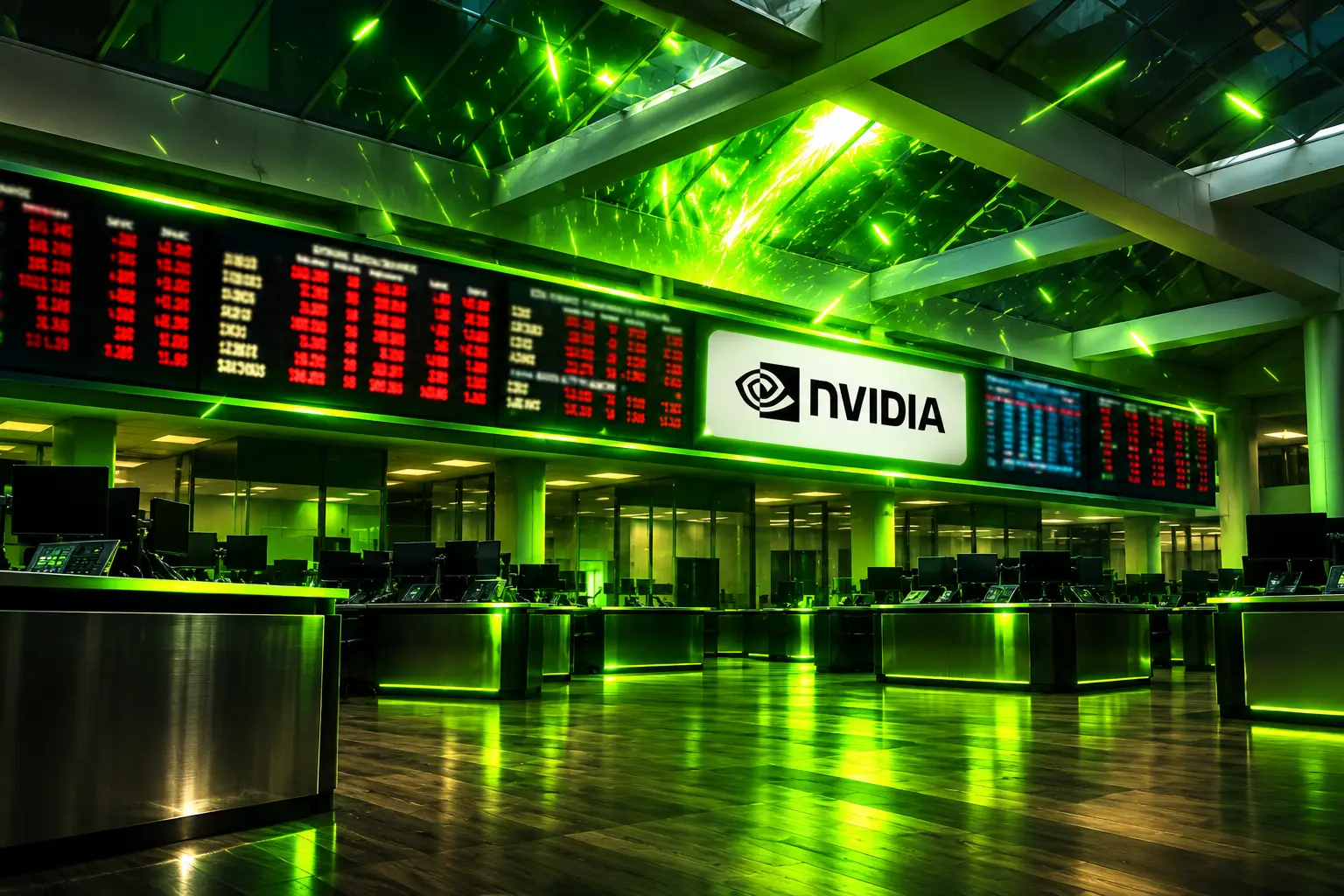
Nvidia’s 5.47% drop on November 10 took 22.07 points off the S&P 500, even as most member stocks rose. AMD gained 1.30% the same day, and the semiconductor ETF barely moved.
Chipmakers still set the ceiling for the indexes. After Wednesday’s close, Nvidia fell about 8% on reports that its board was preparing to remove chief executive Jensen Huang, and Nasdaq-100 futures dropped nearly 1% with it.
Nvidia Subtracted 22 Points While Most Stocks Rose
The S&P 500 closed at 7,520.93, down 0.38%, a loss of 29.01 points, and Nvidia supplied 22.07 of those points, the largest single move of the session in either direction. Breadth ran the other way: 244 of 491 index members finished higher, so a handful of giant technology names did the damage while the rest of the market held closer to flat.
October consumer prices had already turned the tape cautious, with the headline up 0.4% and the core up 0.3%, and traders priced a harder Federal Reserve path into the session. The extra slide in Nvidia was company-specific. Shares closed at $168.89, down from $178.67 on Monday, the same day independent directors hired the law firm Wachtell, Lipton, Rosen and Katz to assist a board investigation of Huang. Microsoft subtracted another 8.05 points, falling 2.2%. Amazon added 3.36 points on a 1.48% gain.
TUESDAY, NOVEMBER 10
| Index | Close | Change | Nvidia point drag |
|---|---|---|---|
| S&P 500 | 7,520.93 | -0.38% | 22.07 |
| Dow Jones | 52,231.89 | -0.30% | 58.13 |
| Nasdaq 100 | 27,740.79 | -0.60% | 107.64 |
The Nasdaq 100’s 166.83-point decline was the steepest of the three, and Nvidia’s 107.64-point hit was more than four times any other name, with only 34 of 99 members higher. The Nasdaq Composite lost 0.74% to 25,065.87. Technology as a sector fell 1.14%, and Nvidia accounted for more than half of that sector loss. None of those index moves ranked as large against the past year. They ranked as concentrated.
Huang Told Staff the Board Had Opened a Probe
On November 8, Nvidia’s board said it was opening an independent investigation after reporting that Huang had been the target of a foreign intelligence effort. A committee of independent directors, with outside counsel, will run the inquiry. The board said it had no reason to believe that U.S. national security or company secrets were compromised, and that Huang would keep leading the company without interruption. “Today’s news will not slow NVIDIA,” the company said.
Huang sent staff a memo the same day. He apologized to his wife, Lori Huang, and to employees, and he said he would cooperate with the review.
I was unfaithful to my wife. My actions hurt her and our children. There is no excuse for what I did. I am deeply sorry.
Leading NVIDIA is the privilege of my life. My responsibility is to serve you and be worthy of your trust. I have fallen short of that responsibility. I am fully committed to NVIDIA and will work to earn back your confidence.
Jensen Huang, Nvidia chief executive, staff memo of November 8, 2026
The reporting at the center of the probe concerns Alice Huang, a Singapore-based executive at Megaspeed, an Nvidia customer, whom U.S. officials have described as a Chinese intelligence asset. Beijing has called that intelligence claim groundless. Huang has not been accused of a crime. President Donald Trump said the FBI was looking into the matter and that he had spoken with Huang, who told him he did not know the woman was a spy. Further reporting on Wednesday described a second relationship with an Nvidia executive who reported to him, and that second account helped drive the after-hours selling.
A proposed shareholder lawsuit in San Jose federal court seeks to cover investors who bought stock between October 9, when Nvidia denied claims about Megaspeed’s China ties, and November 8, when the board announced the investigation. The legal track is separate from the trading track. The trading track is that one person’s job is now a priced input for anyone who owns an index fund.
THE WEEK THE PROBE HIT THE TAPE
- November 5, 2026: The PHLX Semiconductor Index falls 12.25% in a broad post-midterm dump, with all 30 members lower.
- November 8, 2026: Nvidia’s board opens an independent investigation and Huang sends the staff memo; the company says he remains chief executive.
- November 9, 2026: Nvidia falls 4.27% to $178.67 while the S&P 500 rallies 2.35% to 7,549.94 and the Nasdaq Composite jumps 2.74% to 25,253.14.
- November 10, 2026: Nvidia falls 5.47% to $168.89, independent directors bring in Wachtell, and the stock does most of the index damage.
- November 11, 2026: Nvidia rebounds 2.87% to $173.73 in regular trading, then drops about 8% after the bell on reports the board is preparing to remove him.
- November 17, 2026: Nvidia is scheduled to report quarterly results, with prior guidance for $108 billion of revenue, plus or minus 2%.
Bruce Zaro, managing director at Granite Wealth Management, put the succession problem in one question after the after-hours reports: Huang “was the one who led the marvelous rise of Nvidia,” he said, and “the question would be, can someone step up if Jensen has to resign or is forced out?” That is the discount index futures were trading on Wednesday night. There is no public Tim Cook waiting in the org chart, and the people who built CUDA did it under Huang.
AMD and Broadcom Moved Higher the Same Day
If Tuesday had been a verdict on AI data-center demand, the other large chip stocks would have moved with Nvidia. They did not. AMD gained 1.30%. Broadcom climbed about 4%. The iShares Semiconductor ETF, which had jumped 7.5% on Monday from 136.53 to 146.76, closed Tuesday at 146.59, near unchanged. Micron and Intel slipped 1% and 2%. The group was mixed. Nvidia was not.
Monday had already shown the split. While Nvidia dropped 4.27% on the first session after the board’s announcement, AMD surged 13.26% to $508.58 on a Google Cloud collaboration and an analyst upgrade, and the rest of the chip complex participated in a technology rebound. By Wednesday’s regular close the pattern was louder. AMD and Broadcom were higher again in the cash session, then added about 4% and 3% after hours as Nvidia was sold. Money that still wants AI silicon, but does not want Huang-event risk, has an obvious pair of doors.
That rotation does not make AMD a substitute for Nvidia’s training stack. It does show that traders are no longer treating the semiconductor complex as one trade. A governance shock at the largest name is a bid for the next two, even as it is a hit to the indexes that overweight the first.
November 5 Hit Every Name in the SOX
The Huang week landed on a group that was already wounded. Two sessions after Democrats took control of Congress in the midterm elections, chip stocks were sold as a bloc on worries that new regulation could pull the AI buildout’s peak earlier than investors had modeled. The PHLX Semiconductor Index fell 12.25% to 9,011.14 on November 5, its worst session since the March 2020 crash, and every one of its 30 members traded lower. The S&P 500 lost 4.36% to 7,353.73. The Nasdaq Composite lost 5.52% to 24,315.00. That tape was the opposite of Tuesday’s: broad, indiscriminate, and tied to the spending cycle rather than to one chief executive.
The same slide produced Nasdaq’s worst week since June, when energy was the rare corner that held up as AI names were dumped. From the June 22 record, the damage is still large even after this week’s partial bounce.
SOX FROM THE JUNE RECORD
- June 22 record: The index closed at 14,634.70, the high for the cycle.
- November 5 crash: It closed at 9,011.14, down 12.25% on the day and 38% below that peak.
- November 10 print: It closed at 9,998.33, still deep in the hole, on the day Nvidia did the index damage alone.
- November 11 bounce: It closed at 10,564.10, 27.81% below the June record and still a bear-market drawdown.
A 38% peak-to-trough into November 5 is the kind of move that used to stay inside a sector fund. It no longer does, because the same names sit at the top of the S&P 500 and the Nasdaq 100. When the SOX has a 12.25% day, the benchmarks have a 4% to 5% day. When only Nvidia has a 5.47% day, the benchmarks still sag, just more quietly, and with better internals.
The Four Biggest Buyers Have Not Cut Spending
The usual explanation for chip weakness is that customers are about to stop buying. The customers have not said that. Alphabet, Amazon, Meta, and Microsoft have guided to $720 billion to $740 billion of 2026 capital spending, company by company, after October earnings. Alphabet’s range is $195 billion to $205 billion. Amazon still points to about $220 billion of cash capex in its third-quarter release. Meta narrowed to a $135 billion to $145 billion range, including finance-lease principal. Microsoft has talked to about $170 billion for the calendar year.
2026 CAPITAL SPENDING GUIDES
| Company | 2026 guide | Latest quarter | Year-earlier quarter |
|---|---|---|---|
| Amazon | About $220 billion | $77.3 billion | $35.1 billion |
| Alphabet | $195 billion to $205 billion | $51.4 billion | $24.0 billion |
| Microsoft | About $170 billion | $39.4 billion | $19.4 billion |
| Meta | $135 billion to $145 billion | Range narrowed in the October release | |
Alphabet, Amazon, and Microsoft each roughly doubled year-earlier capital spending in the latest quarter. Alphabet finance chief Anat Ashkenazi said spending would increase significantly in 2027. Amazon has said it expects to spend meaningfully more next year as well. Microsoft did trim its calendar figure, citing delayed third-party data-center capacity, which is a timing issue rather than a cancelled build. The cash-flow strain is real: several of these firms are spending faster than they generate free cash, which is why the debate about returns will not die. It is a different debate from “they stopped ordering chips.”
Nvidia’s own last printed quarter still reads like a company that cannot fill demand. On August 26 it reported $96.22 billion of revenue, up 105.8% year over year, with $89.02 billion from data center, and it guided the next quarter to $108 billion, plus or minus 2%. Huang said on that call, “We’ve got a huge year coming up next year, and it’s going to be pretty extraordinary.” Those numbers have not been withdrawn. Wednesday’s regular session even caught a bid from CoreWeave, which jumped 24.7% after saying it expects to become profitable in 2028, a reminder that some of Nvidia’s customers can still calm the spend-anxiety when they show a path to earnings. Then Huang headlines took the microphone back after the bell.
How Much of the S&P 500 Is Nvidia?
Nvidia accounted for 7.1% of the S&P 500 as of November 2, before this slide, according to a breakdown of the six largest technology weights. That is one name. The Magnificent Seven, Apple, Microsoft, Nvidia, Alphabet, Amazon, Meta, and Tesla, together made up 33.7% of the benchmark in November, with a combined market value of $23.6 trillion. On the Nasdaq-100, Nvidia’s official weight was 8.36% on September 30, and Nvidia, Micron, and AMD together were 17.59%, more than a third of the top ten. In the VanEck Semiconductor ETF, Nvidia was 20.6% as of November 10, large enough to drive the fund on its own.
WHERE ONE STOCK SITS
- S&P 500: Nvidia was 7.1% of the index on November 2, so a 5.47% move is a 22-point event, not a sector footnote.
- Nasdaq-100: An 8.36% official weight in September, before the October-November drawdown, explains why 107.64 points disappeared with one name on Tuesday.
- Chip ETFs: A 20.6% weight in SMH means the “semiconductor trade” is still, in large part, an Nvidia trade.
- The seven giants: At 33.7% of the S&P 500, the group can lift or sink the benchmark even when hundreds of other members go nowhere.
By Wednesday’s regular close Nvidia was at $173.73, about 27% below its October 6 record close of $239.24, and it was still heavy enough to shove index futures around after dark. The second effect of the AI concentration trade is simple arithmetic. Once a founder-led chipmaker is 7% of the S&P 500, a board meeting about that founder is a market event. Index investors who never bought Nvidia on purpose own the succession question anyway.
After the Bell, Futures Fell With Nvidia Again
Wednesday’s cash session had looked like a pause. The S&P 500 rose 1.31% to 7,619.38, the Dow added 0.49% to 52,486.49, and the Nasdaq Composite gained 1.60% to 25,466.19, with Nvidia up 2.87% in that bounce. Then the ouster reports hit, shares dropped about 8% in extended trading, S&P 500 futures slipped 0.4%, and Nasdaq-100 futures fell nearly 1%. AMD and Broadcom were bid again. The mechanism from Tuesday repeated after dark: one stock, then the futures, then everyone who thought they owned a diversified index.
WHAT WE KNOW
- The probe: Nvidia’s board has opened an independent investigation, hired outside counsel, and said it has no reason to believe secrets were compromised.
- The job, for now: As of the November 8 statement, Huang remains chief executive and the company said he would keep leading without interruption.
- The tape: Nvidia’s 5.47% drop on November 10 did most of the S&P 500’s damage while most stocks rose; the about 8% after-hours drop on November 11 moved index futures again.
WHAT IS UNCONFIRMED
- An ouster: Reports that the board is preparing to remove Huang, and that it could meet as soon as November 12, have not been confirmed by the company.
- A successor: No replacement has been named, and any short list remains in the realm of rumor.
- A change in orders: There is still no company statement that large customers have cancelled AI chip buys.
The next hard number on demand is the November 17 earnings report and whatever Huang, or whoever is still in the chair, says about data-center orders. Until then the indexes are tied to a board process that index funds cannot vote on and cannot hedge with a sector rotation that actually diversifies them, because the same name is the sector.
Nvidia does not have to lose the AI trade for the S&P 500 to have a bad afternoon. It only has to fall 5.47% while it is still 7.1% of the index. That is the pressure chipmakers now put on the market, and it is no longer a story about whether the four biggest buyers still plan to spend. They do. The new story is that one chief executive’s job has the same weight.
Disclaimer: This article is news reporting and market analysis for information only. It is not investment advice, a recommendation to buy or sell Nvidia, AMD, Broadcom, any semiconductor ETF, or any index fund, and it is not a forecast of earnings, board actions, or legal outcomes. Readers should consult a licensed financial adviser or broker who can review their own holdings, time horizon, and risk tolerance before making any trade. Share prices, index levels, spending guides, and the status of Nvidia’s board investigation reflect the public sources cited as of November 12, 2026, and all of those figures and facts can change with the next session, filing, or statement.

One UI 9.5 Beta Puts the Galaxy S26 on Last Year’s Clock

DBS Puts a 24/7 USDC Window Inside the Bank

European Startups Head for $81 Billion as First Checks Shrink

US Stocks Lost $1.3 Trillion Before Nvidia’s Beat

Home Depot Bets on Finance Chief Richard McPhail as CEO

Aramco Crash Kills 14 Two Days After Oil Restart

Salah Captained Egypt to Their First World Cup Win

Zelda’s 40th Switch 2 Ships Without a Zelda Game

Apple Labor Day Deals Hide June’s Memory Price Hike

El Niño Puts Israel’s Needed Winter Rain on a Flood Clock
-
 BUSINESS5 months ago
Aramco Crash Kills 14 Two Days After Oil Restart
-
 NEWS6 months ago
Salah Captained Egypt to Their First World Cup Win
-
 GAMING2 months ago
Zelda’s 40th Switch 2 Ships Without a Zelda Game
-
 NEWS3 months ago
Apple Labor Day Deals Hide June’s Memory Price Hike
-
 NEWS4 months ago
El Niño Puts Israel’s Needed Winter Rain on a Flood Clock
-

 GAMING2 months ago
Palworld 1.0.4 Adds Palpedia Search After the 1.0 Launch
-

 NEWS4 months ago
Saudi Visa Routes Split Nigerian Travelers Into Two Speeds
-

 BUSINESS9 months ago
BAE’s 60-Year Saudi Franchise Now Runs Through Taif