
BUSINESS
Niche Bookstores Multiply in a Market Amazon Already Owns
Niche bookstores keep opening, led by romance rooms, even as U.S. bookstore sales sit far below the 2010s and most trade dollars still go online.

The American Booksellers Association counted 605 new independent bookstores in 2025, lifting membership to 3,417 companies at 3,783 locations. Niche bookstores, especially romance rooms built for BookTok readers, did a visible share of that opening work.
The till did not swell with the keys. Census figures for stores that make most of their money from books put U.S. bookstore sales at $8.19 billion in 2025, up 4.2% from $7.86 billion in 2024 and still 26.5% below the $11.14 billion those stores rang up in 2016.
Independent Bookstores Multiplied While the Till Stayed Small
Allison K. Hill, the association’s chief executive, called 2025 a banner year in her annual letter and, in the next breath, the hardest year on record for the shops she represents. Costs, tariffs, book bans, and what she termed Amazon’s chokehold all sat on the same page as the growth.
The census behind her letter is blunt. Its count found that 605 new stores opened across the country in 2025, against 65 closures, a net gain of 540. Openings ran 87% above the year before. Membership rose 19% and is up 151% over the six years Hill has held the job, the highest mark since the late 1990s.
THE INDIE REBOUND
| Year | ABA members | What moved |
|---|---|---|
| 2009 | 1,651 | Low point after Amazon and the chain wars |
| 2018 | 2,470 | 49% above 2009, per Harvard’s Ryan Raffaelli |
| 2025 | – | 605 openings, 65 closures |
| May 15, 2026 | 3,417 companies, 3,783 locations | 19% membership rise |
Harvard Business School professor Ryan Raffaelli, who has tracked the trade since the Amazon years, had already logged that 2009-to-2018 climb in a working paper. The latest ABA snapshot extends the same arc: more doors, more formats, and a trade group that now counts pop-ups and book vans beside ordinary shops.
A January 2026 sales survey of 382 member stores found 73.3% had higher 2025 sales than 2024. Another 15.4% had not been open long enough to compare the two years, which is itself a tell. A boom that young will always look strong in a year-over-year poll, because so many of the respondents did not exist the year before.
Among shops that did post a gain, 22% said sales were up 6% to 10%, 17% said 11% to 20%, 9.4% said 3% to 5%, and 8.4% said 21% to 30%. Holiday sales, Thanksgiving through year-end, were up at 66.3% of responding stores. ABA’s own IndieCommerce platform logged a 21.52% sales increase over 2024 after most of its older web stores moved onto a new version of the software.
The $8.19 Billion Ceiling
Store counts and store dollars have not been telling the same story. The $8.19 billion in 2025 bookstore sales, drawn from the Census Bureau’s Annual Retail Trade Survey for outlets that take at least half their revenue from books, sits below 2019’s $8.93 billion and far below 2016. The money moved online years ago and largely stayed there.
WHERE THE BOOK DOLLAR SITS
- Bookstore till: $8.19 billion in 2025, $7.86 billion in 2024, $11.14 billion in 2016.
- Trade share, 2024: Online retailers, led by Amazon, took 52% of U.S. trade sales, up from 49% the year before.
- Physical stores, 2024: $4.7 billion, or 22% of trade, up 4.3% on the year and 74.1% over five years.
- Trade market: $21.2 billion in 2024, up 4.4%, per the Association of American Publishers.
Those channel figures are publisher receipts, not the Census till, so they are a different cut of the same animal. They agree on the shape. In 2024, physical retailers took 22% of trade sales while online retail took 52% and rose 11%. A shop can have its best year in a decade and still be standing in a smaller room.
Romance Shops Are Opening Faster Than the Rest
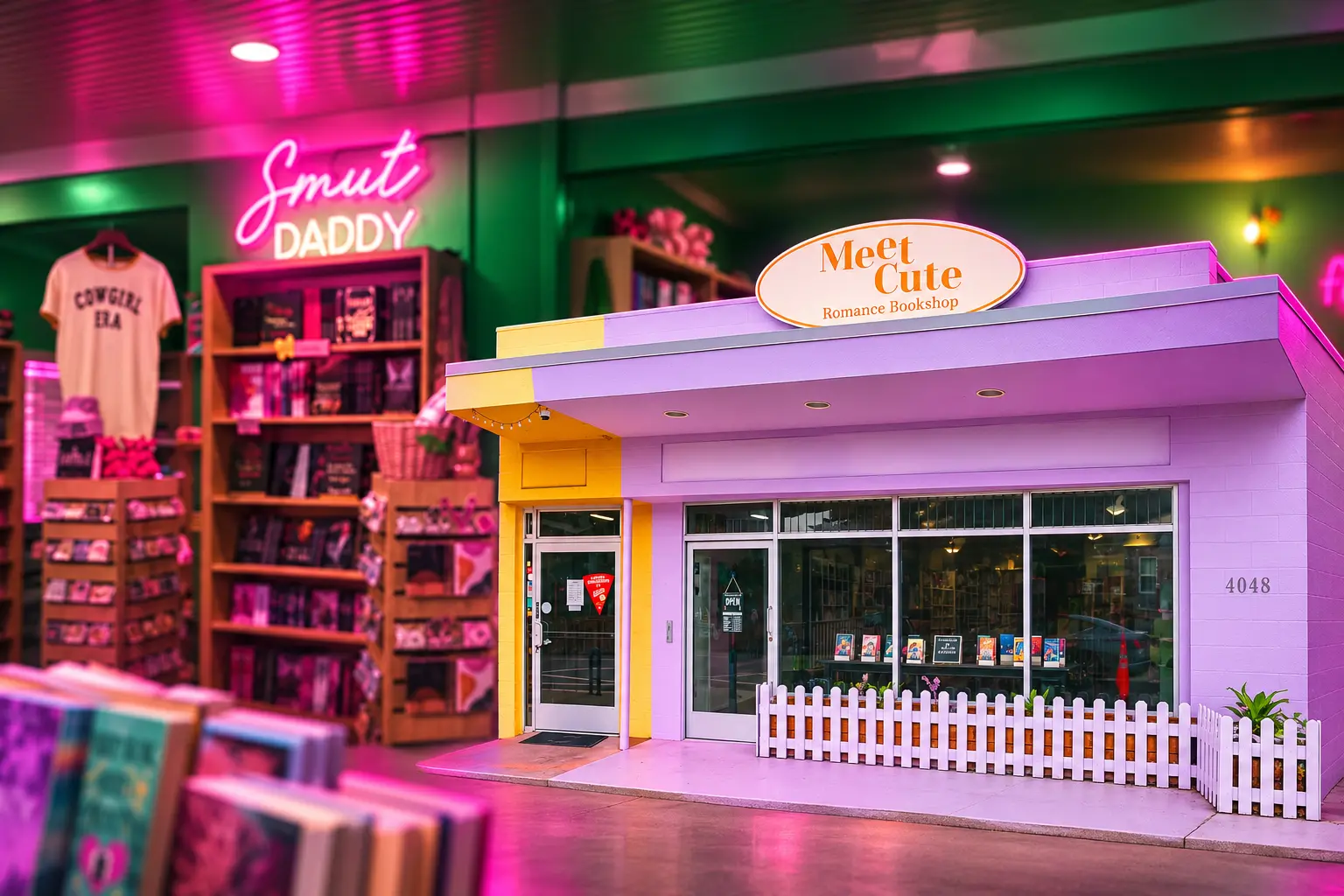
The new keys are not evenly spread across literature. Romance-only rooms, many of them first stores run by readers who met each other on TikTok, have gone from a handful of experiments to a trackable chain of storefronts in under four years.
Researcher Lady Jane’s Romance Bookstore Directory, updated through October 31, 2026, lists 240 physical romance shops in the United States, 70% of the 341 brick-and-mortar romance stores she counts in 12 countries. Add online shops and pop-ups and her worldwide total is 544, 390 of them American.
U.S. PHYSICAL ROMANCE SHOPS
| Year-end | U.S. shops | Change |
|---|---|---|
| 2022 | 5 | – |
| 2023 | 18 | up 260% |
| 2024 | 68 | up 278% |
| 2025 | 161 | up 132% |
| Oct. 31, 2026 | 240 | net +79 in 2026 |
From 2023 to 2025 the U.S. physical count rose 794%. In 2026 through October, 83 U.S. romance shops opened and 4 closed. Worldwide, 113 opened and 7 closed, a net gain of 106. Then October itself cooled: 5 openings and 2 closures, the slowest month of the year on her list.
The hashtag that feeds the rooms, #BookTok, had drawn more than 370 billion views by late 2026. Jane Rodriguez, who owns The New Romantics, has said the feed now writes the order sheet.
#BookTok determines a lot of what we put in our store.
Jane Rodriguez, owner, The New Romantics
That line is a business model, and it is also a trap. A romance shop that only mirrors the app can feel like a franchise without a franchisor: the same sprayed edges, the same romantasy spines, the same table of enemies-to-lovers. Readers who want older category romance, translated work, or anything the algorithm has not blessed walk into a “niche” store and find a national template. Focus built the room. Sameness can empty it.
The named shops still have local texture. Heart Swell opened on North Campbell Avenue in Tucson as a romance store with wine, beer, and a bar. Forced Proximity in Findlay, Ohio, began as a 7-by-14-foot trailer that Brit Kirkwood and her partner took to a county flea market before they signed a lease. The Burning Ember opened on Pacific Avenue in Santa Cruz as a romantasy room. The Spicy Librarian in Denver and Flutter Romance Bookstore in Austin were already in the 2025 wave. The Ripped Bodice, which opened in Culver City in 2016 and later added Brooklyn, is the elder in a very young category.
A SAMPLE OF THE NEW ROOMS
- Heart Swell, Tucson: Romance titles beside a wine and cocktail list, grand opening October 16, 2026.
- Forced Proximity, Findlay: A trailer-first shop that proved demand at a Hancock County flea market, then took a building.
- The Burning Ember, Santa Cruz: A romantasy specialist on Pacific Avenue, opened in late October 2026.
- The Ripped Bodice: The 2016 Culver City original that showed a romance-only floor could hold.
ABA’s 2025 class was broader than romance. Of the 605 openings, 81 were BIPOC-owned and 45 were Black-owned. Indie Bookstore Day that year drew 1,645 participating stores. The romance numbers simply move faster than the rest of the map.
Why a Narrow Shelf Beats a Warehouse
Amazon already sells the long tail, overnight, at a price a small shop cannot match. The stores that keep opening are not trying to win that race. They sell a shorter shelf, a person who has read the stock, and a reason to come back on a weeknight.
Raffaelli’s study of the post-2009 rebound grouped that work under community, curation, and convening. Owners leaned on buy-local campaigns. Staff pointed readers to books that would never win an algorithm. Stores turned themselves into rooms that hosted talks, clubs, game nights, and children’s hours. Some of the shops he studied ran more than 500 events a year.
In fact, some bookstores now host over 500 events a year that bring people together.
Ryan Raffaelli, professor, Harvard Business School
A specialist shop can put a debut or a midlist title on a table and keep it there, which a general retailer with a weekly reset will not do. That is a real service to writers who do not have a BookTok army. It is also unpaid marketing if the customer photographs the table, then buys the same book for less on a phone in the parking lot. Hill’s letter still treats that leak as a structural fact of the trade, not a passing habit.
The other way shops recapture a click is to own a piece of it. Bookshop.org, the public-benefit marketplace launched in 2020, says it has sent more than $49 million for local bookstores and now backs 2,500-plus shops, passing along more than 80% of its profit margin. ABA’s IndieCommerce tools sit in the same fight: keep the browse in the room, or at least keep the checkout off Amazon.
Pop-Ups, Vans, and Stores With No Lease
The 605 figure is easy to misread as 605 new Main Street leases. It is not. ABA’s census mixed four formats, and the non-storefront share is large enough to change what “opening a bookstore” means.
HOW THE 605 BROKE DOWN
- Storefronts: 399 ordinary shops with a door and a rent bill.
- Pop-ups: 106, including rooms like Banyan Books in St. Petersburg, Florida.
- Mobile: 77, including vans and trailers such as Wandering Quills Bookshop in Westerville, Ohio.
- Online-only: 23 member businesses with no public floor.
A trailer that hits flea markets and festivals can test a town before anyone signs a five-year lease. A pop-up can ride a holiday rush and fold. Those formats help explain how openings could jump 87% in a year of thin margins. They also mean some of the “takeover” can vanish as fast as it appeared, because the overhead that makes a shop durable is the same overhead these formats are designed to dodge.
Hill wrote that ABA staff visited 160 stores in 2025 and watched hundreds more online. The letter spends as much ink on debt restructurings, harassment, copyright fights, and ADA lawsuits as it does on the ribbon cuttings. Growth and strain arrived together.
Barnes & Noble Came Back to the Same Streets
The chain that once defined big-box bookselling is expanding again. Elliott Investment Management’s subsidiary bought Barnes & Noble in 2019, when the company had 627 stores. It has since added more than 100 locations over two years, putting new shops into the same walkable districts that independents just reclaimed.
In Chicago, the owner of Volume Books blamed a new Barnes & Noble for closing a shop that had lasted a decade. Hill’s warning on that kind of collision is plain: even a small drop in sales can decide a bookstore’s year. A specialist that lives on one genre has less room to absorb a new competitor two blocks over, even if that competitor is a chain now stocking warmer tables and hosting its own events.
General independents still open too. Hey Books! in San Diego is the ordinary neighborhood shop in ABA’s own examples. The mix matters, because a city can gain a romance bar and lose a general store in the same twelve months and still show up as a net gain in a national census. The map redraws at street level in both directions.
Half the Trade Dollar Goes to Web Stores
Publishers still cash most of the check online. Physical stores grew in 2024, and they have grown a lot since the pandemic low, but they grew from a hole. Online retail grew faster last year and still holds 52% of trade. The Census till for bookstores, $8.19 billion, never climbed back to the 2010s. More ABA members are splitting a channel that did not get bigger.
That is the leftover, and it can last. A shop that sells judgment, a calendar of nights, and a shelf a reader already trusts does not need Amazon’s volume. It needs repeat visits and a rent it can pay when the romantasy wave moves on. October’s five romance openings, the year’s slowest month on the specialty tracker, are an early look at that test. The next chapter in the trade will be written by the shops that are still open after the ribbon is gone.

One UI 9.5 Beta Puts the Galaxy S26 on Last Year’s Clock

DBS Puts a 24/7 USDC Window Inside the Bank

European Startups Head for $81 Billion as First Checks Shrink

US Stocks Lost $1.3 Trillion Before Nvidia’s Beat

Home Depot Bets on Finance Chief Richard McPhail as CEO

Aramco Crash Kills 14 Two Days After Oil Restart

Salah Captained Egypt to Their First World Cup Win

Zelda’s 40th Switch 2 Ships Without a Zelda Game

Apple Labor Day Deals Hide June’s Memory Price Hike

El Niño Puts Israel’s Needed Winter Rain on a Flood Clock
-
 BUSINESS5 months ago
Aramco Crash Kills 14 Two Days After Oil Restart
-
 NEWS6 months ago
Salah Captained Egypt to Their First World Cup Win
-
 GAMING2 months ago
Zelda’s 40th Switch 2 Ships Without a Zelda Game
-
 NEWS3 months ago
Apple Labor Day Deals Hide June’s Memory Price Hike
-
 NEWS4 months ago
El Niño Puts Israel’s Needed Winter Rain on a Flood Clock
-

 GAMING2 months ago
Palworld 1.0.4 Adds Palpedia Search After the 1.0 Launch
-

 NEWS4 months ago
Saudi Visa Routes Split Nigerian Travelers Into Two Speeds
-

 BUSINESS9 months ago
BAE’s 60-Year Saudi Franchise Now Runs Through Taif