
ENTERTAINMENT
Patinkin Ties Jewish Safety to El-Sayed’s Senate Bid
Mandy Patinkin says Jewish safety depends on Abdul El-Sayed, a pitch that reopens the candidate’s Israel and Brotherhood file in a two-point Michigan Senate race.

Mandy Patinkin told Jews on Oct. 23 that their safety in America depends on sending Abdul El-Sayed to the Senate. The actor, known for The Princess Bride and Yentl, pointed Michigan voters to the campaign vote page and said Jewish safety depends on a real multiracial democracy. El-Sayed, a Michigan-born doctor and the Democratic nominee, faces former Republican congressman Mike Rogers. The Marist Poll, fielded Oct. 15 through Oct. 18 among 1,185 registered voters, put the contest at 50 percent to 48 percent among likely voters, a margin inside its plus or minus 4.3-point error.
Patinkin made Jewish safety the reason to vote for him. El-Sayed had told interviewer Linsey Davis four days earlier that Israel is not actually America’s friend.
Patinkin Tied Jewish Safety to a Michigan Senate Bid
The Oct. 23 tape is a campaign ad with a famous Jewish face. Patinkin warned that when courts weaken and equal protection fails, minorities pay first, and that Jews have seen that pattern. He attacked Rogers for standing with President Donald Trump and refusing to accept the 2020 election. He said masked government agents taking people off the streets should set off alarm bells for Jews.
Jewish safety is tied to the health of our democracy, he said, and El-Sayed is the candidate who understands that. The clip went to X with the Senate hashtags and a donate-and-vote link. Replies poured in from Jewish critics who heard a different safety problem in the same name.
Help get @abdulelsayed elected to the senate! Jewish safety depends on a real multiracial democracy—and Abdul is the one fighting to protect it.
Get involved and help at https://t.co/91JBRnq4ddhttps://t.co/XFXFuvAjrw
We know how much it matters to live in a country where our… pic.twitter.com/jz6RdE2GLj
— Mandy Patinkin (@PatinkinMandy) October 23, 2026
If El-Sayed wins on Nov. 3, he would be the first Muslim elected to the U.S. Senate. The seat is open because Sen. Gary Peters, a Democrat from Bloomfield Township, is not running again. Patinkin treated that choice as a democracy test. His critics treated it as a test of whether Jewish safety can run through a nominee who will not call Israel an ally.
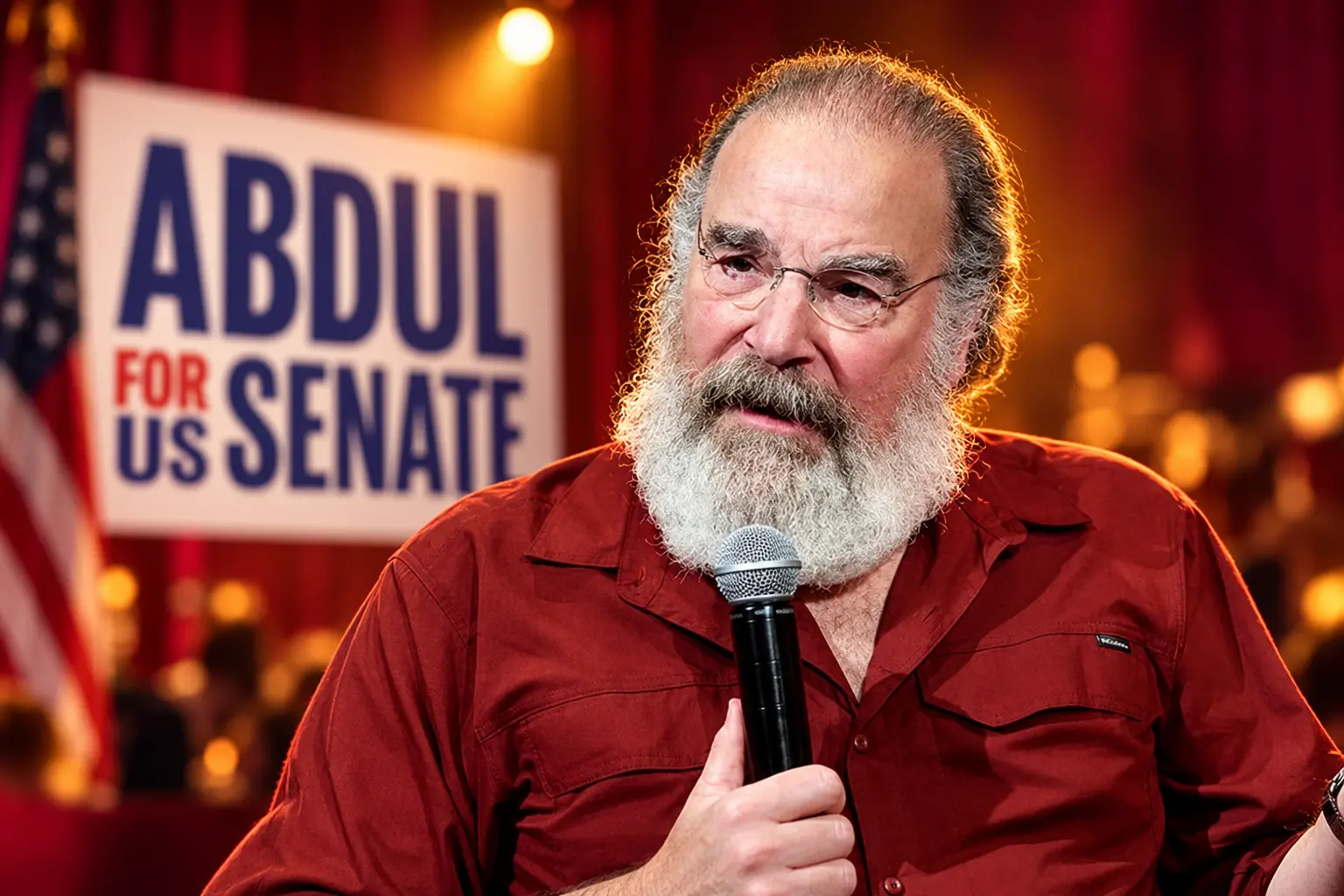
What El-Sayed Told Voters About Israel
On Monday, Oct. 19, Linsey Davis asked El-Sayed whether he considers Israel an American ally. He answered with a kids-and-money analogy, then closed the door.
An ally that takes your money to push you into wars you shouldn’t be fighting is not an ally. I think it’s time for us to realize that Israel is not actually our friend.
Abdul El-Sayed, Democratic Senate nominee, in an interview with Linsey Davis
He had already said the Israeli government has done nothing but use the United States, and that the Israeli military has done heinous things, full war crimes, genocide. He said the country should get serious about whether it subsidizes that government. He opposes U.S. military aid for foreign governments, including Israel, and has called Israel a rogue state. Michigan rabbis who later petitioned him also cited his descriptions of Israel as bloodthirsty and evil, and his refusal to affirm Israel’s right to exist as a Jewish state.
EL-SAYED’S ISRAEL FILE THIS CYCLE
- Military aid: He says U.S. tax dollars should not drop bombs for apartheid, wars America has no business fighting, or genocide, and should be spent at home instead.
- Hasan Piker: The Twitch streamer headlined campus rallies, including at Michigan State on April 7, and appeared at El-Sayed’s primary night party at Detroit’s Majestic Theatre.
- Piker’s record: Piker has said Hamas is a thousand times better than Israel and, in a line he later apologized for, that America deserved 9/11. He also said that if Jews keep putting out the idea they are singularly invested in Israel, someone will take action against American Jews.
- The break: El-Sayed disavowed Piker’s comments about Jewish Americans, told associates he had called Piker because the rhetoric was costing votes, and said he would not campaign with him again.
- Oakland County: After an attack on a synagogue there, El-Sayed said hurt people hurt people, then apologized to those hurt by the remark.
That is the file Patinkin asked Jews to set beside democracy and masked agents. Rogers has used Piker in ads. One House Democrat in the Michigan delegation has refused to campaign with El-Sayed over the tie. The safety pitch does not erase those facts. It puts them on a bigger stage.
Rogers Still Leans on a 2012 Morsi Letter
Rogers, a former FBI agent, said the day after the Aug. 4 primary that El-Sayed had pledged his support to the Muslim Brotherhood. El-Sayed has denied any ties and asked why the subject is even in debate. A review of the public record found no evidence he has belonged to the group. The paper Rogers keeps waving is real, and narrower than the slogan.
In 2012, El-Sayed was listed with 45 other Egyptian Americans on an open letter backing the revolutionary decisions taken by Egyptian President Mohamed Morsi. The letter demanded that Morsi purge the police and media of holdovers from Hosni Mubarak’s dictatorship and say that authority would be temporary. Morsi was a senior Brotherhood official, elected that year as the nominee of its Freedom and Justice Party. El-Sayed’s campaign declined to comment on the letter. The year before, he had written that even if the Brotherhood took power, the ensuing state would look nothing like Iran.
On Jan. 13, 2026, the United States imposed terrorist designations on three chapters of the group, which was founded in Egypt in 1928. The State Department listed the Lebanese chapter as a Foreign Terrorist Organization. Treasury listed the Egyptian and Jordanian chapters as Specially Designated Global Terrorists for material support to Hamas. Lorenzo Vidino, who directs George Washington University’s Program on Extremism, notes the movement is decentralized: Tunisia’s branch has competed in elections, while Hamas, a Brotherhood offshoot, made violence its foundation.
THE BROTHERHOOD CLAIMS VERSUS THE FILE
| Claim | What is on the record |
|---|---|
| Pledged support to the Brotherhood | El-Sayed denies it; no affiliation evidence has been produced |
| The 2012 letter | He signed a letter backing Morsi’s decisions and a purge of police and media holdovers |
| Family ties | Half-sister Eman Abdelhadi wrote in 2012 that the family had long been MB and that their mother was active in the group in the early 1970s |
| How he was raised | Born in Rochester Hills; parents divorced when he was 3; raised in Michigan by his father and stepmother |
| His answer | I have no ties. We have no ties. He called the tweets hearsay and said his mother and sister are not on the ballot |
| Campus years | Vice president and president of the Muslim Students Association at the University of Michigan, 2003 to 2007; MSA’s 1963 founders included Brotherhood members, among others |
| Public disavowal | At an Oct. 17 town hall, asked to disavow the Brotherhood, he said, Sure. Yeah, absolutely. |
Rogers also says El-Sayed takes money from people who support Hamas, Hezbollah, and al-Qaeda, a charge built on donors tied to CAIR and the Islamic Society of North America. Those groups were named unindicted co-conspirators in a 2007 Hamas financing case, were not charged, and deny the terrorist label. The federal government has not designated them. The Brotherhood attack is the closing argument Rogers wants. El-Sayed calls it a dual-loyalty smear of the kind aimed at John F. Kennedy over Catholicism and at Barack Obama over his father’s origin.
Michigan Jews Were Already Split in September
Michigan’s Jewish population is estimated at 130,000, just over 1 percent of the state. Most of that community has voted Democratic. The establishment, rabbis and federation leaders, has mostly opposed El-Sayed. Rogers has courted Jewish Democrats and called his rival anti-Jew. Former congressman Andy Levin, a onetime synagogue president, said 30 to 40 percent of Jews are going to vote for Abdul, and that he thinks it will be more.
On Sept. 17, more than 620 Jewish voters, in a letter from Michigan Jewish voters sponsored by Bend the Arc: Jewish Action, said they intend to vote for El-Sayed as a check on Trump even though they do not agree with everything he stands for. Signers included Levin; Jessica Decky Alexander, chair of the Michigan Democratic Jewish Caucus; and Eli Savit, the Democratic nominee for attorney general. Some were enthusiastic. Others kept reservations about Israel and about language from El-Sayed’s allies.
These concerns remain serious for many of us, and we will vote for El-Sayed. We understand that a vote is not a valentine; it’s a strategic chess move.
Open letter by more than 620 Michigan Jewish voters, Sept. 17, 2026
They called El-Sayed clearly the better choice for Jews on health care, democracy, abortion, and voting rights, and said Rogers’s agenda makes Jews less safe. Levin’s father, former Rep. Sander Levin, 95, issued a rare retirement endorsement with significant disagreements on the Israeli-Palestinian conflict, and said he had never failed to support the full Democratic ticket.
A separate group of rabbis and Jewish leaders had just launched a petition they described as an invitation, not an ultimatum. They said their congregations represent about 40,000 Michigan Jews and listed five non-negotiables, including condemnation of antisemitic threats, support for Jewish sovereignty in Israel, a two-state solution, and full political participation for Zionists. Rabbi Aaron Starr of Congregation Shaarey Zedek in Southfield said he appreciated some apologies and some Middle East comments, and that it was not enough. He said he was concerned El-Sayed had been talking out of both sides of his mouth.
El-Sayed told a Sept. 10 audience that Jewish safety is paramount to him, like the safety of Christians, Muslims, Hindus, and Sikhs, and that on foreign policy they would have to disagree agreeably. He has also said his commitment to Jewish safety is the same as his commitment to the safety of his own daughters. Patinkin arrived six weeks later as a national amplifier of that line, not as the person who invented the split.
Two Points Separate El-Sayed and Rogers
Marist’s likely-voter sample has El-Sayed ahead by two points among likely voters, 50 percent to 48 percent. Among independents who are likely to vote, he leads 50 percent to 44 percent. Fifty-one percent of likely voters think he will win. Other late surveys have also shown a race inside a few points. Democrats have not lost this Senate seat since 1994. Rogers is trying to flip it with an argument about Israel, the Brotherhood, and Piker.
El-Sayed won the Aug. 4 Democratic primary against Rep. Haley Stevens, a four-term congresswoman from Birmingham who ran as a Zionist Democrat, by about one point. United Democracy Project, the super PAC tied to the American Israel Public Affairs Committee, spent about $30.6 million in that primary, according to federal filings, about $10.5 million for Stevens and about $20.1 million on ads against El-Sayed. It was the most the group had spent on a single race, above a prior high of about $14.5 million in 2024 against then-Rep. Jamaal Bowman in New York. El-Sayed won anyway and made that spend a centerpiece of his pitch to Democratic voters.
FROM THE PRIMARY TO NOV. 3
- April 7, 2026: El-Sayed campaigns with Hasan Piker at Michigan State.
- August 4, 2026: El-Sayed wins the Democratic primary against Stevens by about one point.
- August 20, 2026: Piker’s stream on American Jews and Israel blows through the party; El-Sayed disavows the comments and later says he will not campaign with him again.
- September 17, 2026: More than 620 Jewish voters publish the strategic-chess-move letter for El-Sayed.
- October 17, 2026: El-Sayed disavows the Muslim Brotherhood at a town hall.
- October 19, 2026: He tells Linsey Davis Israel is not actually our friend.
- October 23, 2026: Patinkin posts the Jewish-safety video.
- October 25, 2026: Patinkin posts a second video, still naming Abdul as the answer.
- November 3, 2026: Michigan votes.
A Hollywood clip cannot move 130,000 people by itself. In a race Marist measures at two points, a fight inside that community is large enough for both campaigns to work. Patinkin’s video is useful to El-Sayed if it steadies Jewish Democrats who already wanted a Senate check on Trump. It is useful to Rogers if it reminds everyone else of the ABC line and the Piker rallies.
Henhouse Keys and a Wood Cricket Insult
Gad Saad, the evolutionary behavioral scientist and author of Suicidal Empathy, did not treat the tape as a standard celebrity favor. He wrote that Patinkin was a self-loathing degenerate, lobotomized wood cricket Jew, and that he despised Patinkin more than he despised El-Sayed. In a separate reply he called Patinkin an imbecilic wood cricket Jew who knew nothing about Islam in the real world.
Here we go: @PatinkinMandy is a Self-Loathing Degenerate, Lobotomized Wood Cricket Jew.
I despise Patinkin more than I do @AbdulElSayed. pic.twitter.com/RBsWvfqXsr
— Gad Saad (@GadSaad) October 23, 2026
Spencer Pratt, the former mayoral candidate, put the same objection in a fable. In order to protect the flock, we must give the henhouse keys to the fox, he wrote. The fox understands the dangers we face better than anyone. John Ondrasik, the Five for Fighting singer, wrote that he had read of Jews who supported the Nazis and never thought he would see one in 2026.
The henhouse line is the clean version of a charge that filled the replies: a Jewish-safety ad for a nominee who will not call Israel a friend sounds, to those voters, like a joke they have already heard. The crude kapo insults are the ugly version of the same claim. A few users thanked Patinkin and said they were voting for El-Sayed. The loud argument was that democracy-as-safety is being asked to stand in for Israel-as-ally, and that the substitute does not hold.
Did the Second Video Change His Record?
On Oct. 25 Patinkin came back with another tape. He said Abdul is not the scary person opponents want people to fear, and that the scare stories lean on a Muslim name, invented Sharia, and accusations about who he is connected to. He asked Jews to hear their own history in that talk. He said he understood real threats, real grief, and real reasons to worry about Jewish safety. Then he asked who would protect the democracy that has helped keep Jews safe in America, and answered with one name. Abdul.
He did not walk back the Oct. 23 safety claim. He did not address the ABC interview, the 2012 letter, or Piker. He asked people not to be told what to believe about Abdul, and then told them whom to credit with their safety. The record El-Sayed takes into Nov. 3 is the same one he took in on Oct. 22: a two-point race, a Jewish community that is already writing dueling letters, a disavowal of the Brotherhood, and a public finding that Israel is not actually our friend.
Patinkin wanted the last word to be democracy. Michigan will decide the Senate seat on Nov. 3 with that word on one ad and Israel on the other.

One UI 9.5 Beta Puts the Galaxy S26 on Last Year’s Clock

DBS Puts a 24/7 USDC Window Inside the Bank

European Startups Head for $81 Billion as First Checks Shrink

US Stocks Lost $1.3 Trillion Before Nvidia’s Beat

Home Depot Bets on Finance Chief Richard McPhail as CEO

Aramco Crash Kills 14 Two Days After Oil Restart

Salah Captained Egypt to Their First World Cup Win

Zelda’s 40th Switch 2 Ships Without a Zelda Game

Apple Labor Day Deals Hide June’s Memory Price Hike

El Niño Puts Israel’s Needed Winter Rain on a Flood Clock
-
 BUSINESS5 months ago
Aramco Crash Kills 14 Two Days After Oil Restart
-
 NEWS6 months ago
Salah Captained Egypt to Their First World Cup Win
-
 GAMING2 months ago
Zelda’s 40th Switch 2 Ships Without a Zelda Game
-
 NEWS3 months ago
Apple Labor Day Deals Hide June’s Memory Price Hike
-
 NEWS4 months ago
El Niño Puts Israel’s Needed Winter Rain on a Flood Clock
-

 GAMING2 months ago
Palworld 1.0.4 Adds Palpedia Search After the 1.0 Launch
-

 NEWS4 months ago
Saudi Visa Routes Split Nigerian Travelers Into Two Speeds
-

 BUSINESS9 months ago
BAE’s 60-Year Saudi Franchise Now Runs Through Taif