
NEWS
Magic Vision Raises €600k to Watch Homes Carers Cannot Staff
Magic Vision closed €600,000 for Silver Eye, a no-wearable fall sensor already in Italian care homes, backed by SixS, which already serves 300 cooperatives.

Magic Vision, a nine-person Italian startup, closed a €600,000 round on 28 October 2026 to sell Silver Eye, a wall sensor that watches for falls without a wearable.
The money came from SixS, a firm whose software already runs inside more than 300 Italian social cooperatives, plus Italian business angels in law, compliance and company building. Silver Eye is already hanging in homes and care sites, with more than 200 sensors installed and a target of over 100 people monitored by the end of 2026.
Silver Eye Is Already on Italian Walls
The round paid to finish the product and start selling it, not to prove that cameras can see a person on the floor. Magic Vision, based in Meda in the province of Monza and Brianza, was founded in 2023 by six people who have built computer vision tools together since 2017, including an automated filming rig and a self-flying drone, and the company now employs nine people in total.
THE ROUND IN FOUR FIGURES
- The cheque: €600,000 from SixS and Italian business angels with law, compliance and company-building skills.
- The kit: more than 200 sensors already in Italian pilot and commercial sites.
- The year-end bar: over 100 people under watch by the end of 2026.
- The payroll: nine people, six of them co-founders.
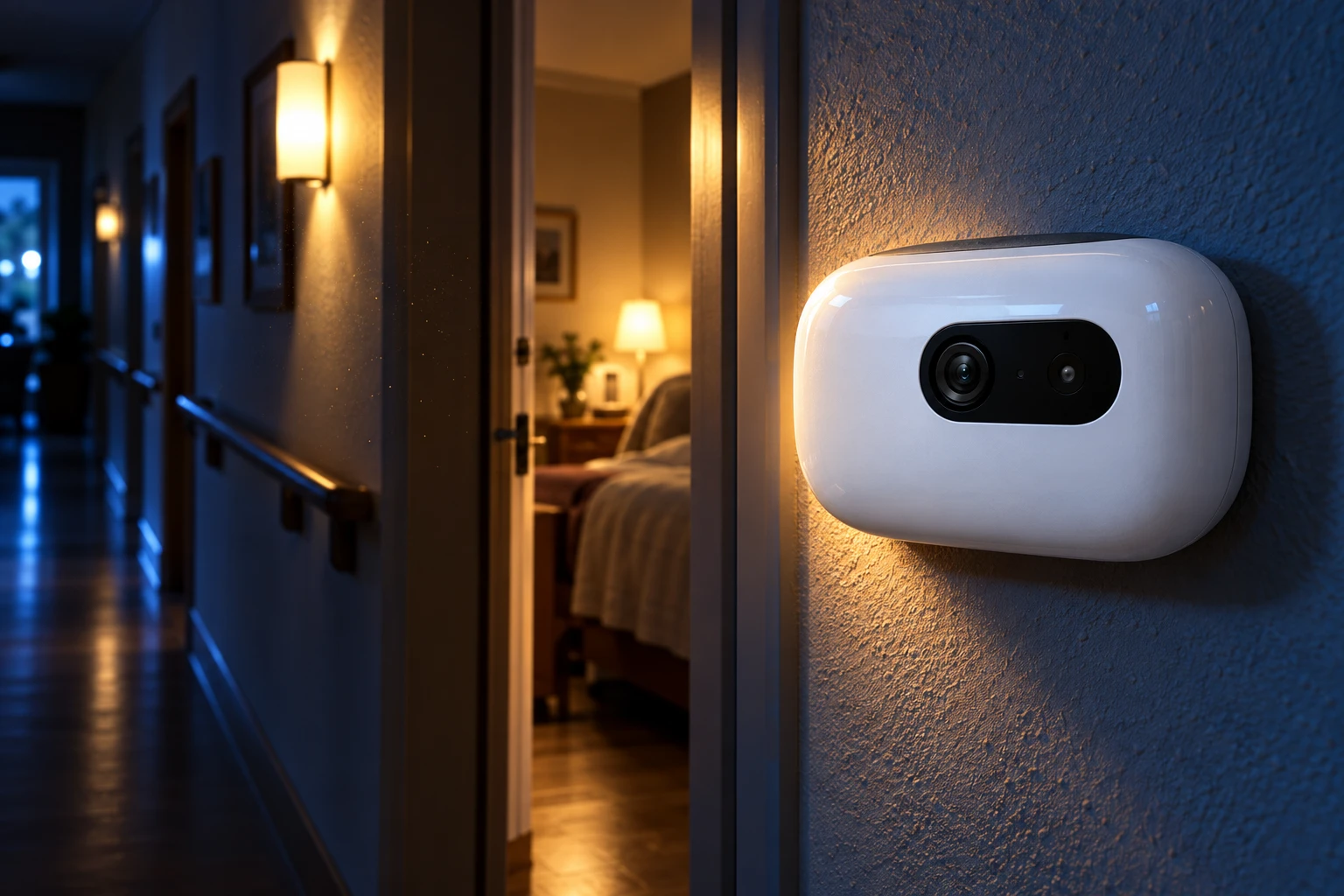
Silver Eye uses environmental sensors and on-device AI to flag falls, odd changes in how someone moves or rests, and other events that may need a person in the room. It is meant for private homes, senior living, cohousing and residential care, including shared rooms where more than one person may be present. Caregivers get an alert when the system thinks someone should intervene.
If the installed base stays at more than 200 sensors and the company hits over 100 people watched, that is more than two units for each person on the books. Homes and wards do not have one risk zone. Bathrooms, bedrooms and corridors each take a puck, and the hardware count will keep running ahead of the headcount.
The Grandfather Who Lay on the Floor All Day
Federico Lanzani, co-founder and chief technology officer, has said the product started with his grandfather, who fell and stayed on the floor for an entire day. The wait, not the drop, is the part families remember, because a fall that no one sees becomes a night on the tiles.
The idea for Silver Eye came from a personal experience: when my grandfather fell and remained on the floor for an entire day, I started looking for a solution that could prevent something similar from happening again.
Federico Lanzani, co-founder and CTO, Magic Vision
Wearable alarms and emergency buttons were the obvious tools, and they failed the test that actually matters in a kitchen at 3 a.m. Lanzani has said those devices had significant limitations, so the company used its AI work to spot risk without asking a person to wear a gadget or press a button.
Why Wearables Fail the People They Are Sold To
A pendant only works on a neck. Fall-detection papers keep repeating the same field note, that older people resist or forget wearables, and a watch that lives on a charger is an empty promise. Magic Vision’s bet is that the sensor has to work when the person does not cooperate.
WHY THE PENDANT STAYS IN THE DRAWER
- Memory: people take the device off to sleep, bathe or charge it, which is when many falls happen.
- Pride: a visible alarm reads as a loss of independence, so some users refuse it even when a family has paid.
- The button: emergency pendants still need a conscious press, which a person on the floor may not manage.
- Upkeep: batteries, pairing and straps turn a safety tool into another chore for the household.
The loud product is a crash alert. The quieter one, and the one care staff can actually roster around, is a change in gait, in how long it takes to stand from a chair, and in night wandering, because those shifts show up before the hip breaks. Silver Eye’s own pitch already includes activity and rest patterns and behavioural anomalies, which is the layer therapists use when they are not waiting for a floor impact.
2.7 Million Italians Over 75 Live Alone
Italy is the oldest country in Europe and the second oldest in the world after Japan, and the buyer for a wall sensor is the household that cannot put a nurse in every hallway. ISTAT population projections put people aged 65 and over at 24.7% of the population, a share headed to 34.5% by 2050, or more than 18 million people.
ITALY’S CARE MATH
| Group | Now | Later |
|---|---|---|
| People 65 and older | 24.7% of Italy | 34.5% by 2050, over 18 million |
| People 85 and older | 4.1% in 2025 | 7% by 2050 |
| People 75 and older living alone | about 2.7 million | more than half of women past 75 live alone |
| Nurses leaving the job | 80,000 due 2026-2035 | peak of 17,600 in 2038 |
About 2.7 million people aged 75 and over live alone. The national nursing federation, FNOPI, counts 1.1 million informal caregivers and warns of 80,000 nurse retirements from 2026 to 2035, with a single-year peak of 17,600 in 2038. Italy already sits below the EU average of 8.5 nurses per 1,000 people, and frailty and chronic illness already take 70% of national health-service spending. For the 2025/2026 academic year, applications to nursing degrees failed to fill the places on offer, even though 89.1% of graduates had jobs within a year.
On 21 October 2026 the World Health Organization restated that falls remain the second-leading cause of unintentional injury deaths after road injuries, with about 842,000 deaths from falls worldwide in 2023, and that 71% of those deaths were among people aged 60 and older. WHO’s own playbook still centres on balance exercise, which a Cochrane review found cut the fall rate by about 23% in trial groups, and on home-hazard work, which cut rates by 38% among people already at higher risk. Silver Eye does not replace that work. It sells the hours after a fall when nobody is in the flat.
SixS Already Works With 300 Cooperatives
SixS is not a venture fund. Since 2007 it has built Gecos, a web HR and planning tool for Italian social cooperatives, and it says it now works with more than 300 of those organisations. Those co-ops already roster home-care visits, residential shifts and the paperwork that follows a night call, which is the exact desk that receives a fall alert.
A cheque from that vendor is a bet that Silver Eye can sit beside software care workers already open each morning. The angels in the round, described as people with law, compliance and company-building skills, match a product that handles health-adjacent data in private homes. Magic Vision is not selling a gadget off a website to grandchildren. It is selling into operators who already hold the keys, the rotas and the liability.
Lorenzo Mauri, co-founder and chief executive, has tied the product to staff who are running out. Population ageing, he said, is putting pressure on care systems that must meet growing needs with limited resources and staff, and technology can help by watching people without pause and calling for help when it is needed.
No Images Leave the Room
Silver Eye processes data on the device through edge AI and, the company says, does not store or transmit images. It is sold as a risk detector rather than a CCTV feed, which is the only way a camera-like object gets through the front door of a bathroom or a shared ward.
That pitch has a cost. A pendant can be left in a drawer; a wall unit cannot. Consent is a one-time yes, after which the person being watched has little day-to-day control, a problem that gets sharper when the resident has dementia and a relative signs the form. Magic Vision says the system looks only at what it needs to spot risk and then alerts a caregiver, and that it can run in rooms with more than one person. Those claims will be tested in Italian residential homes, where staff already juggle false alarms and families already argue about dignity.
Privacy is also the distribution story. A co-op that already files sensitive user data through Gecos is likelier to accept a sensor that never sends a picture than a cloud camera that does. The compliance angels in the round are there for that reason, because a leak in an RSA corridor ends the product faster than a missed fall.
The Next Round Is €1.5 Million
The company is already preparing a €1.5 million capital increase to hire Italian partners and distributors, start a European push, and win a first foreign client within 24 months. Mauri has said the €600,000 let Magic Vision bring the technology to market and get ready for that next phase.
With Silver Eye, we want to enable new care models that help older people remain independent while supporting families and care professionals.
Lorenzo Mauri, co-founder and CEO, Magic Vision
The path to this round ran through Milan’s deep-tech circuit. Magic Vision was incubated at PoliHub and backed by ComoNExT’s NExT Accelerator and Paradigma Exponential Hub, which helped the founders meet investors. The Milan Monza Brianza Lodi Chamber of Commerce also gave the team a €30,000 Switch2Product grant in the 2023-2024 edition, when PoliHub described the project as software that lets caretakers watch older and frail people in private homes and nursing homes and warn them in time.
FROM SCHOOL PROJECTS TO A SALES ROUND
- 2017: Six future co-founders start building computer vision projects together while still in school.
- 2023: Magic Vision is founded in Meda by Lorenzo Mauri, Federico Lanzani, Matteo Labadini, Francesco Iaia, Andrea Mandressi and Davide Figini.
- 2023-2024: The team takes the €30,000 Chamber of Commerce Switch2Product grant after incubation at PoliHub.
- 28 October 2026: The company closes €600,000 with SixS and Italian angels, with more than 200 sensors already installed.
- End of 2026: Target of over 100 people monitored.
- Next 24 months: Planned €1.5 million round, Italian distributor network, and a first client outside Italy.
The six founders still sit on the product. Mauri is chief executive, Lanzani is chief technology officer, and Matteo Labadini is chief financial and operating officer, with Iaia, Mandressi and Figini on computer vision, full-stack and network work. Nine people cannot cover Italy. The €1.5 million is for other people’s vans, contracts and care-home keys, which is why SixS was in the first round at all.
By 31 December 2026 the company wants over 100 people on the system. That is a small number next to 2.7 million older Italians who already live alone, and it is the number a nine-person shop can actually service while it still answers the phone when a sensor goes off.
Disclaimer: This article is news reporting on a private company funding round and a care-monitoring product. It is for information only and is not medical advice, not a recommendation to buy, install or rely on any sensor, and not investment advice. Families, care staff and older people should speak with a qualified physician or licensed care planner before changing how a person is watched at home, and anyone considering an investment should speak with a licensed financial adviser. Company figures come from statements dated 28 October 2026, population figures come from ISTAT projections, nursing-workforce figures come from FNOPI, and fall deaths come from WHO estimates for 2023, and those numbers can change.

One UI 9.5 Beta Puts the Galaxy S26 on Last Year’s Clock

DBS Puts a 24/7 USDC Window Inside the Bank

European Startups Head for $81 Billion as First Checks Shrink

US Stocks Lost $1.3 Trillion Before Nvidia’s Beat

Home Depot Bets on Finance Chief Richard McPhail as CEO

Aramco Crash Kills 14 Two Days After Oil Restart

Salah Captained Egypt to Their First World Cup Win

Zelda’s 40th Switch 2 Ships Without a Zelda Game

Apple Labor Day Deals Hide June’s Memory Price Hike

El Niño Puts Israel’s Needed Winter Rain on a Flood Clock
-
 BUSINESS5 months ago
Aramco Crash Kills 14 Two Days After Oil Restart
-
 NEWS6 months ago
Salah Captained Egypt to Their First World Cup Win
-
 GAMING2 months ago
Zelda’s 40th Switch 2 Ships Without a Zelda Game
-
 NEWS3 months ago
Apple Labor Day Deals Hide June’s Memory Price Hike
-
 NEWS4 months ago
El Niño Puts Israel’s Needed Winter Rain on a Flood Clock
-

 GAMING2 months ago
Palworld 1.0.4 Adds Palpedia Search After the 1.0 Launch
-

 NEWS4 months ago
Saudi Visa Routes Split Nigerian Travelers Into Two Speeds
-

 BUSINESS9 months ago
BAE’s 60-Year Saudi Franchise Now Runs Through Taif