
NEWS
Machenta’s $40 Million Bet on Robots That Learn Once
Creandum and Union Square Ventures put $40 million on a London lab that trains robots in simulation, then teaches a new job from one demo.

Machenta, an 11-person London lab, raised $40 million in seed funding on October 27 to teach robots a new physical job from a single demonstration. Creandum and Union Square Ventures co-led the round as the Imperial College London spinout left stealth. Imperial College called it the largest seed a UK robotics startup has ever raised.
The cheque buys a wager most of physical AI has declined. Machenta trains its model only in simulation, then asks a robot to copy a task after watching it once. Rivals still pay people to collect real-world demos by the hour.
A Record Seed for an 11-Person London Lab
The company did not disclose a valuation. Dealroom ranked the round in the 99.6th percentile of all-time UK robotics seed rounds, across a sample of 271. The funds are meant to scale the model with more compute and simulated data, and to grow the team at a new office and lab in King’s Cross.
Edward Johns, professor of robot learning at Imperial College London, is chief executive. Vitalis Vosylius, his former PhD student, is chief technology officer. On the launch thread, Johns thanked Creandum partner Kathi Wilhelm, Union Square Ventures managing partner Rebecca Kaden, Hussein Kanji, and Jonno Evans, along with other angels. Hoxton Ventures had already backed Machenta in 2025, before this seed.
Johns put the claim in public the same morning, with uncut lab video rather than a polished product reel.
Today we’re out of stealth, and we’ve raised a $40m seed round co-led by @creandum and @usv, to bring Instant Robot Learning to life.
For the past few months, we‘ve been busy building a new company.
Machenta.
This follows results from a new kind of robot foundation model we’ve… pic.twitter.com/DrLyyloJ0I
— Edward Johns (@Ed__Johns) October 27, 2026
“Intelligence is not so much about what you can already do, it’s about how quickly you can learn to do something new,” Johns said. “Humans don’t need to see the same thing over and over before they can do it. If you take some objects, and show somebody what to do with them, they’ll probably then be able to do the same task immediately. We’ve spent years trying to understand what it would take for robots to learn at the speed of a human. That is what instant robot learning is about.”
Show It Once, Then Step Back
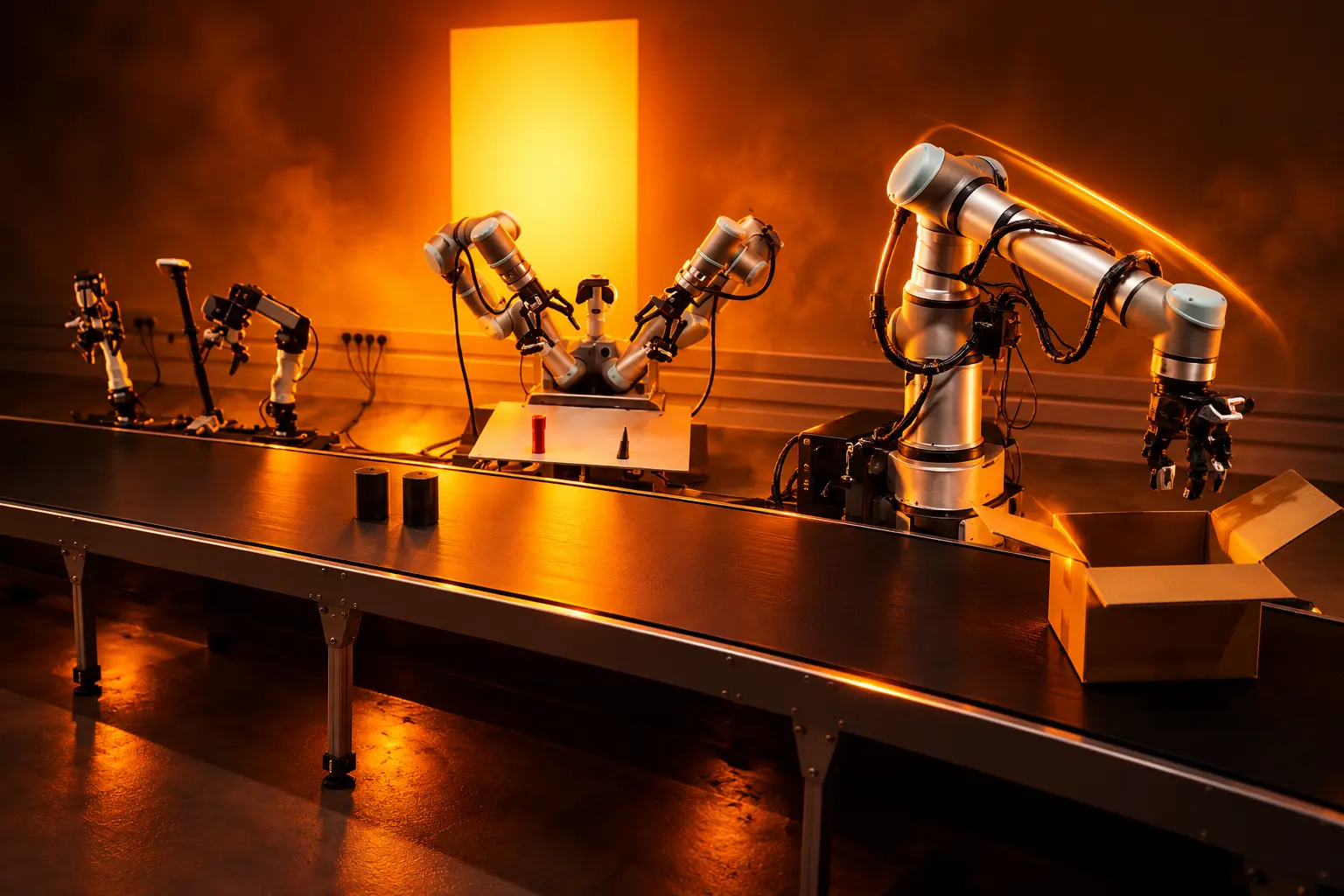
The usual robot-learning loop still looks like a data project. Someone collects hours or days of demos, the model trains for hours or days, and only then does the arm run the job. Machenta’s pitch cuts the middle. A person walks up, shows the task once on objects the robot has not seen, often shuffles those objects, and steps back. The same pre-trained weights then run the job.
The company calls that stack a vision-demo-action model. A language command does not carry the prompt. A demo does, plus a live camera feed, and the network predicts the next action in a closed loop. The weights are not updated for the new job. They were trained to learn how to learn, using a meta-learning setup whose training data is generated in simulation.
Machenta says the foundation model was trained entirely in simulation, “without a single pixel of real-world training data.” At test time, both the teaching demo and the camera come from the real world. The lab’s answer to the sim-to-real gap is that it never tried to memorise a simulated packing cell. It tried to learn the function of copying a demo, across a huge range of randomised fake scenes, so that a real room is just another environment to adapt to.
That is a research claim, not a factory certificate. It is also why the demos are uncut. If learning is instant, the teaching and the first attempt can live in one take.
FOUR WAYS TO TEACH THE SAME WEIGHTS
- Leader-follower: A person drives a leader arm and the robot copies, then runs alone after one pass.
- VR controller: The teacher moves a virtual grip, and the same model still reads the demo as the prompt.
- Kinaesthetic teaching: Someone physically guides the arm through the motion, then lets go.
- Bare hands: Early tests show the model can take a human-hand demo and run it on a gripper or a humanoid hand.
The same weights, the company says, already run on six different robots with different camera setups. In one clip, three arms with three gripper types and three teaching modes are put on a small assembly line. Machenta says a single person automated that line in two minutes, a job it compares with weeks of ordinary integration and manual programming.
When a parallel-jaw gripper could not pack shoes tightly, the team iterated on the physical prompt until a double handover appeared: flip the shoe between arms, then seat it in the box. Johns calls that loop physical vibe coding. Each change in the demo changed the behaviour immediately, which is only possible if there is no overnight training run in between.
What the Weekend Trials Showed
Uncut video is not a reliability study. So the company designed a few self-resetting jobs and let the model run for an hour on each over a weekend. The tasks are simple on purpose. They are also the only continuous scores Machenta has put on the page.
THE WEEKEND TRIALS
| Task | Attempts | Successes | Misses |
|---|---|---|---|
| Block into a bowl | 74 | 74 | 0 |
| Screwdriver handover | 78 | 78 | 0 |
| Stand a bottle upright | 99 | 97 | 2 |
The two bottle misses, the company says, sit at 0:46 and 0:52 in the video, one from a possible collision and one from the arm’s kinematic limits. “While these tasks are relatively simple, the results are very encouraging,” the lab wrote. “But this is just the beginning.”
That sentence is the honest part of the launch. The published hour is a bowl, a screwdriver, and a bottle, not a full packing shift with new SKUs, lighting changes, and tired fixtures. The next phase, Machenta says, is to scale simulated experience, model size, and compute, and to see whether harder jobs become instantly learnable the same way. The homepage is still a waitlist for early access to the model, not a sales page for a shipped product.
Rivals Still Collect the Real World
The rest of the category is not waiting on a weekend in King’s Cross. Crunchbase counted $9.9 billion of venture money into robotics startups in the third quarter of 2026, more than double the $4.3 billion in the same quarter of 2025. China has taken $13.2 billion of robotics funding this year, the United States $12.1 billion. Against that, $40 million is a rounding error. It is also a different bet.
WHO IS BUYING WHAT
| Approach | Example | Latest disclosed cheque |
|---|---|---|
| Sim-only instant learning | Machenta | $40 million seed |
| Real-world robot brain | Skild AI | $1.4 billion Series C, January 2026 |
| UK humanoid hardware | Humanoid | $152 million Series A at $1.35 billion post-money |
Skild’s January round valued the company at more than $14 billion. Tracxn had already counted $258 million across 12 UK robotics rounds by late August, before Machenta appeared, with Humanoid’s Series A as the heavy cheque. Record seed is not record year.
Machenta’s own technical note names Rhoda AI, Generalist, and Skild AI as groups that have started to use in-context learning for robots, while still scaling real-world data collection. Johns’s lab is arguing the other way: the fastest path to diversity is simulation, with reality reserved for that single teaching pass. If that is wrong, the $40 million buys a beautiful demo stack. If it is right, the bottleneck in a small shop stops being a data team and starts being the person who can show the job once.
Robots become so much more useful when they can instantly pick up a new task and get to work right away. The industry is pouring enormous amounts of capital into collecting real-world data and training robots one task at a time, but Machenta is changing this. Whether this is for a robot in the factory or at home, we need general-purpose AI which can adapt quickly in the same way that humans can.
Rebecca Kaden, Managing Partner, Union Square Ventures
That is the investor version of the bet. It still has to survive contact with messy benches, not just self-resetting bottles.
Six Years Before Machenta Had a Name
The company is new. The argument is not. Johns made one-shot physical learning the focus of Imperial’s Robot Learning Lab about six years ago, after leading robot learning at Dyson and taking a Royal Academy of Engineering fellowship in 2018 on sim-to-real transfer. Vosylius joined as a PhD student in 2020, from Vilnius University, and became first author on the papers that turned the question into a method. When they incorporated MACHENTA LTD on July 21, 2025, Wilhelm wrote, almost the entire lab walked over with them.
THE ROAD FROM THE LAB
- 2020: Vosylius starts his PhD as Johns’s lab treats fast physical learning as the main problem.
- 2023: Implicit Graph Alignment, at CoRL, shows few-shot in-context imitation from graph alignments trained on deformed objects in simulation.
- 2025: The Instant Policy paper at ICLR 2025 is an oral, and wins best paper at the conference’s robot-learning workshop.
- November 2025: Science Robotics puts on its cover a method that taught a robot 1,000 everyday tasks in under 24 hours, one demonstration each.
- 2025: Machenta is founded in London and Hoxton Ventures invests.
- October 27, 2026: The company leaves stealth with the $40 million seed.
Instant Policy is the scientific parent of the launch. Vosylius and Johns treat in-context imitation as a graph: objects, the robot, and future actions sit on nodes built from segmented point clouds. A diffusion model learns to denoise that graph. Training data is not a warehouse of human teleop. It is an endless pool of simulated pseudo-demos, random trajectories that still share a semantic motion, generated with almost no human labelling. At test time the context is one or two real demos, and the policy runs closed-loop, including when someone shoves the objects.
The 1,000-task cover paper is a different method, Multi-Task Trajectory Transfer, built on splitting a motion into alignment and interaction and retrieving the right demo at test time. It is not the VDA product. It is evidence that the same group had already spent years squeezing one-shot teaching in the real world before it had a company name.
The Money Buys Compute, Not a Product Line
Wilhelm’s diligence story is almost too neat, which is why it matters. When Creandum visited the lab, the partners did not only watch the house demos. They brought their own Creandum caps, a paper roll, and a Chinese lucky cat, showed the task once with one object, then moved the props. Wilhelm wrote that the robot “executed flawlessly.” In her account, Machenta is bounded by compute, because everyone else is bounded by how much real-world data they can collect.
Very few teams in robotics can point to a body of work like this, which has repeatedly changed what people thought was possible. The team at Machenta has spent years breaking through this extremely hard problem, long before there was a company around it. They’re not starting with just a theory of how robots can learn like humans; they’re building on years of experience actually making it happen.
Kathi Wilhelm, Partner, Creandum, backing note, October 27, 2026
Andreas Klinger, a European investor who says he has watched the demos for more than a year, wrote that after one showing the robot can repeat the new task almost every time. That is still a lab loop. It is also why the launch landed as a narrative break rather than as another data-collection round: no giant vision tower, no overnight post-training, a person shows it, the arm tries it.
The open test is not whether an 11-person lab can raise a record UK robotics seed. It already did. The test is whether a model that went 74 for 74 on blocks in a bowl can hold a packing cell through a shift of new objects, new layouts, and the ugly recoveries that never appear in a self-resetting script. The $40 million is now compute, headcount, and simulated worlds pointed at that question.
Disclaimer: This article is news reporting and analysis of a private company’s funding round and research claims. It is for information only and is not investment advice, a solicitation, or a recommendation to buy or sell any security or to back any private round. Readers who are considering an investment in robotics, AI, or early-stage private companies should consult a qualified financial adviser or licensed investment professional who can review their own circumstances. Figures, headcount, product claims, and round details reflect the company, investor, and data-provider sources available on October 27, 2026, and may change as filings, deployments, or later rounds appear.

One UI 9.5 Beta Puts the Galaxy S26 on Last Year’s Clock

DBS Puts a 24/7 USDC Window Inside the Bank

European Startups Head for $81 Billion as First Checks Shrink

US Stocks Lost $1.3 Trillion Before Nvidia’s Beat

Home Depot Bets on Finance Chief Richard McPhail as CEO

Aramco Crash Kills 14 Two Days After Oil Restart

Salah Captained Egypt to Their First World Cup Win

Zelda’s 40th Switch 2 Ships Without a Zelda Game

Apple Labor Day Deals Hide June’s Memory Price Hike

El Niño Puts Israel’s Needed Winter Rain on a Flood Clock
-
 BUSINESS5 months ago
Aramco Crash Kills 14 Two Days After Oil Restart
-
 NEWS6 months ago
Salah Captained Egypt to Their First World Cup Win
-
 GAMING2 months ago
Zelda’s 40th Switch 2 Ships Without a Zelda Game
-
 NEWS3 months ago
Apple Labor Day Deals Hide June’s Memory Price Hike
-
 NEWS4 months ago
El Niño Puts Israel’s Needed Winter Rain on a Flood Clock
-

 GAMING2 months ago
Palworld 1.0.4 Adds Palpedia Search After the 1.0 Launch
-

 NEWS4 months ago
Saudi Visa Routes Split Nigerian Travelers Into Two Speeds
-

 BUSINESS9 months ago
BAE’s 60-Year Saudi Franchise Now Runs Through Taif