
NEWS
Kokott Tells EU Judges to Reopen Google’s AdSense Fine
Kokott says the court that scrapped Google’s €1.49 billion AdSense fine used the wrong duration test and should send the case back.

Advocate General Juliane Kokott told the EU’s top court on 12 November 2026 to throw out Google’s 2024 win against a €1,494,459,000 AdSense fine. She asked the judges to send the file back to the General Court, and she said any new penalty must shrink because 2016 is already off the table.
The opinion in Case C-826/24 P is not a ruling, and the fine does not spring back into force. What she put on the table is the test Brussels must meet when it adds up exclusive contracts on a digital platform.
Back to the General Court
Kokott’s set aside and referred back proposal is the whole operative result. The Court of Justice would wipe the 18 September 2024 judgment in Case T-334/19 and return the dispute to the lower court, which still has to hear Google’s unused arguments on the size of the bill.
The Commission’s decision of 20 March 2019, C(2019) 2173 final in Case AT.40411, had ordered Google LLC to pay €1,494,459,000, about $1.7 billion, with Alphabet Inc. jointly and severally liable for €130,135,475. That decision is still dead until a new General Court judgment says otherwise. Press release No 164/26, issued in Luxembourg the same Thursday, made the limit plain: the Advocate General’s view does not bind the Court of Justice, whose judges have now started work.
THE ADSENSE FILE, DATE BY DATE
- 2010: A German company complains to the Federal Cartel Office, which transfers the file to the European Commission.
- 2011 to 2017: Microsoft, Expedia and Deutsche Telekom add complaints about search ads on third-party sites.
- July 2016: The Commission opens a case on three clauses in Google Services Agreements, then issues a statement of objections.
- September 2016: Google removes or amends the clauses. The Commission later timed the infringement to 6 September 2016.
- 20 March 2019: The Commission adopts Decision C(2019) 2173 final and sets the penalty at €1,494,459,000.
- 18 September 2024: The General Court, after a hearing on 2, 3 and 4 May 2022, annulled the Commission decision in full.
- 12 November 2026: Kokott delivers her opinion in Case C-826/24 P, ECLI:EU:C:2026:969, and proposes a fresh first-instance judgment.
The Commission did not appeal the finding that it had not shown exclusionary effects for 2016. Kokott said that slice of the 2024 judgment is therefore final and “must be taken into account in the new decision on the fine.” Any revived bill is a shorter one before the General Court even opens Google’s other points.
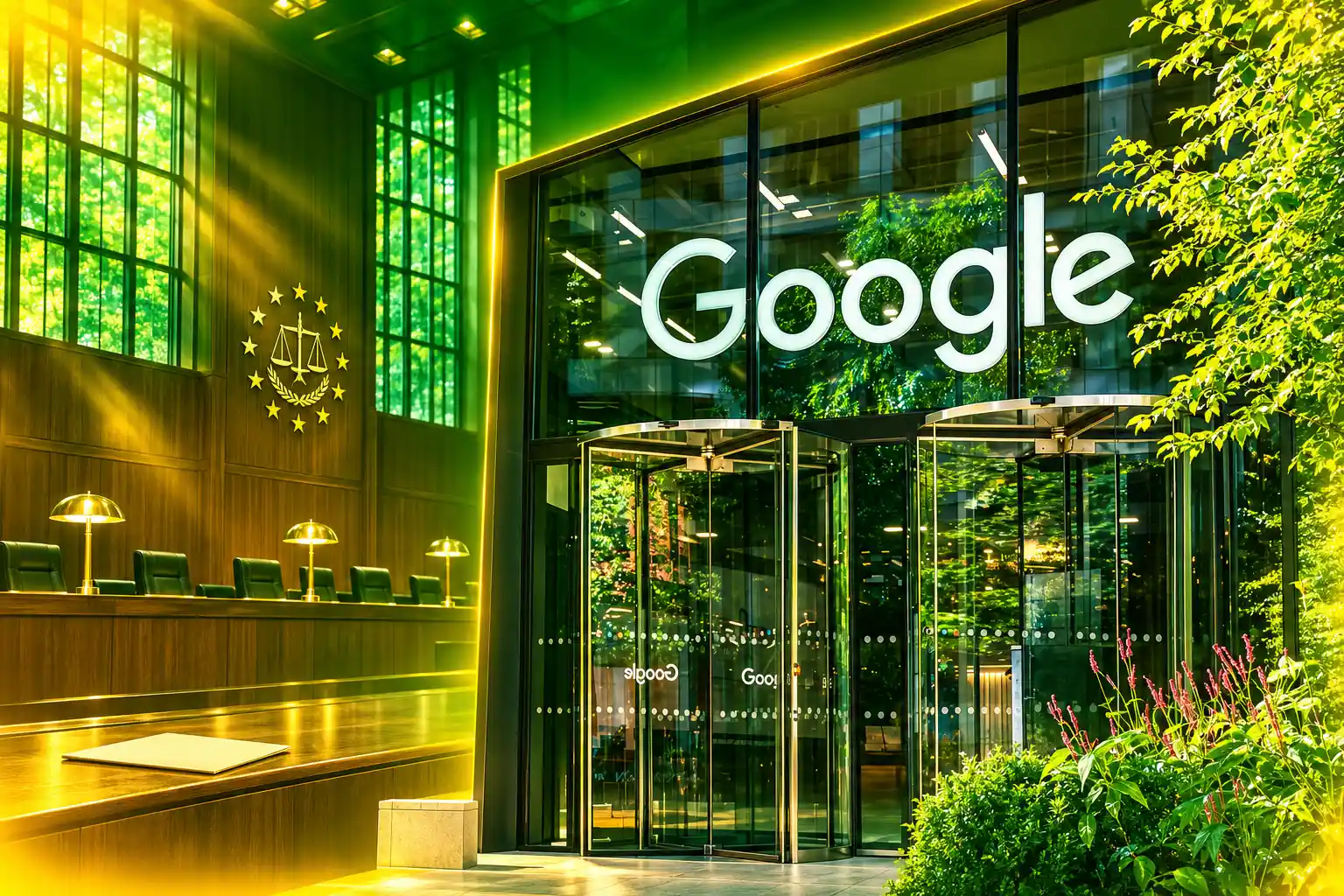
The Lower Court Asked Too Much on Duration
The fight is the Intel criteria from the Court of Justice judgment of 6 September 2017 in Case C-413/14 P, at paragraph 139. Those criteria are how a court tests whether exclusive contracts imposed by a dominant firm shut rivals out. Duration of the commitment is one of them, and it is the point both sides chose to die on.
Google’s line, recorded in Kokott’s introduction, is competition on the merits. Direct-partner contracts often ran only a few years, even when they were later renewed, so after each term the demand those sites represented could have been bid for. If rivals failed to win it, Google said, that was because their product was weaker, not because the clauses locked the door.
The General Court accepted a large part of the Commission’s market work, including dominance on online search advertising intermediation in the EEA, then still threw the decision out. It said the Commission had added successive contract periods together without checking whether publishers could switch at renewal or use a unilateral termination right. Many GSAs, the court said, lasted only a few years at a time.
The Court of Justice thus has an opportunity to clarify the scope of the Intel criteria, in particular the criterion of the duration of contractual commitments and its relationship with the other criteria, and to shed further light on the associated requirements with which the Commission must comply in examining and demonstrating exclusionary effects.
Juliane Kokott, Advocate General, opinion in Case C-826/24 P
She told the judges the lower court had imposed “excessive requirements as to the scope of the examination of the criterion of duration” and had not weighed that finding against the other Intel factors it had already treated as made out. A cumulative look at the contracts, in her view, was enough. She also said that once exclusionary effects stand, the finding that the three clauses could not form a single and continuous infringement falls with it.
That is the second-order stake. If the Court of Justice adopts her reading, Brussels does not have to dissect every publisher’s renewal and exit clause before it can treat a stack of exclusive dealing as foreclosure on a platform market. Google still gets a 2016 haircut and a new hearing on quantum. The method travels further than this file.
Three Clauses Covered a Decade of Contracts
Google has run AdSense since 2003. AdSense for Search lets sites with their own search boxes show Google search ads and share the click revenue. The case is not about the standard online contract that small publishers click through. Kokott’s opinion states that those “online partners” are outside the proceedings. The file is about Google Services Agreements negotiated with “direct partners,” built from templates Google rewrote in March 2009.
THE THREE ADSENSE CLAUSES
- Exclusivity clause: Until March 2009, a direct partner could not run on the listed sites a service identical, substantially similar, or in direct competition with Google’s AFS offering.
- Placement clause: From March 2009, the partner had to show a minimum number of Google search ads and could not place rival ads above them or directly beside them.
- Prior authorisation clause: Also from March 2009, the partner needed Google’s approval before changing how search ads, including rivals’ ads, were displayed.
The Commission treated the three as separate abuses that together ran from 1 January 2006 to 6 September 2016. It said they shared one aim: keep competing intermediaries off the best publisher inventory, and by that route protect Google on search advertising and on general search. After March 2009 the hard exclusivity clause and the matching “English clause” left the template; the placement and prior-authorisation terms took their place, which the General Court later described as a relaxed exclusivity for the sites they covered.
Google changed the paper in September 2016, two months after the statement of objections. The conduct the Commission still wanted to punish had already stopped. The 2024 to 2027 appeal is about a closed period, not a live product rule, which is why a locked 2016 finding now cuts the bill even if Kokott wins on the law.
Microsoft, Expedia and Deutsche Telekom Complained First
The first complaint, in 2010, came from a German firm to the Federal Cartel Office and moved to Brussels. Between 2011 and 2017, Microsoft, Expedia and Deutsche Telekom joined. Those names sit on the demand side of search ads on other people’s sites: a software firm selling Bing ads, a travel publisher selling queries, a telecoms group with portal inventory. Surfboard Holding BV of Zeist, in the Netherlands, and Vinden.NL intervened at first instance on Google’s side of the courtroom.
The Commission’s 2019 theory was that rivals such as Microsoft and Yahoo could not grow an alternative intermediation service while the GSAs reserved the profitable slots. The General Court still held that Brussels had not shown the clauses actually deterred publishers from going elsewhere, or blocked rivals from a significant part of the EEA market, once duration and the missing 2016 coverage data were taken seriously. It also held that the Commission had not shown a knock-on hit to innovation, to Google’s position on national search-ad markets, or to consumers.
That split is why 2024 looked like Google’s one clean court win against a Commission antitrust penalty. Kokott is now asking the Court of Justice to say the win rested on the wrong question about duration, not on a finding that the clauses were harmless.
Google’s Android and Shopping Fines Already Stand
Kokott is not new to Google’s Luxembourg docket. She delivered the January 2024 Shopping opinion in Case C-48/22 P, on the Commission’s 27 June 2017 comparison-shopping decision and its €2.42 billion fine. She delivered the Android opinion on 19 June 2025 in Case C-738/22 P. On 2 July 2026 the Court of Justice dismissed Google’s Android appeal and confirmed the penalty as revised by the General Court: €4,125,000,000, with Alphabet jointly liable for €1,520,605,895, down from the original €4,342,865,000.
AdSense was the outlier because a court had actually wiped the decision. The rest of the Article 102 docket did not wait for this opinion.
GOOGLE’S EU PENALTIES STILL IN FORCE
| Case | Decision | Amount | Status |
|---|---|---|---|
| Shopping | 27 June 2017 | €2.42 billion | Upheld by the General Court |
| Android | Revised after partial annulment | €4,125,000,000 | Confirmed by the Court of Justice on 2 July 2026 |
| AdSense for Search | 20 March 2019 | €1,494,459,000 | Annulled 18 September 2024; Kokott proposes a rehearing |
| DMA Search ranking | 23 July 2026 | €460 million | Commission non-compliance decision |
| DMA Play steering | 23 July 2026 | €430 million | Commission non-compliance decision |
On 23 July 2026 the Commission also issued two Digital Markets Act fines totalling €890 million: €460 million for self-preferencing shopping, hotels, transport and sports results on Google Search, and €430 million for steering limits on Google Play. Those are live-conduct tools under Regulation (EU) 2022/1925, not a replay of 2006 to 2016 GSAs. Even a quiet ending for AdSense would leave that newer machinery in place.
What Can the Court of Justice Still Change?
The Court of Justice rules on points of law. It does not, on Kokott’s proposed path, put the 2019 number back on Google’s invoice. If it follows her, the General Court retries the case, must cut the fine for 2016, and must finally deal with Google’s unused pleas on quantum. If it does not follow her, the 2024 annulment stands and the Commission’s AdSense decision stays void.
WHAT WE KNOW
- The recommendation: Set aside the 18 September 2024 judgment and send Case T-334/19 back for a new ruling.
- The 2016 cut: The Commission left the no-foreclosure finding for 2016 unchallenged, so any new fine has to fall.
- The product: Only negotiated GSAs with direct partners are in the case; standard online-partner contracts are not.
Those three points are already in the opinion and the 2024 judgment. They will not move when the Court of Justice speaks.
WHAT IS UNCONFIRMED
- The judgment: No date has been set. A 2027 ruling is the working assumption from the appeal timetable, not a fixture.
- The new figure: Nobody has calculated the reduced fine. That arithmetic belongs to a future General Court, and only if the appeal succeeds.
- The Intel holding: Until the Court of Justice writes it down, the duration test in digital exclusive dealing is still the 2024 version.
The Court’s own press account posted the French note from Luxembourg on 12 November 2026, the morning the opinion landed.
#CJUE #AG Kokott : le #TribunalUE a considéré à tort que la @Commission_UE n’avait pas démontré les effets d’éviction des pratiques contractuelles de @Google liées à #AdSense #Concurrence 👉 https://t.co/7eftsYifY2
— Cour de justice UE (@CourUEPresse) November 12, 2026
The AdSense name most publishers argue with Google about on any given day is a payments and policy product on standard terms. The Luxembourg file is a closed set of negotiated GSAs, already rewritten in 2016, whose legal test is still open. Judges in Luxembourg now decide whether the Commission had to walk through each renewal, or whether a stack of exclusive dealing on a dominant platform can be read as a whole.

One UI 9.5 Beta Puts the Galaxy S26 on Last Year’s Clock

DBS Puts a 24/7 USDC Window Inside the Bank

European Startups Head for $81 Billion as First Checks Shrink

US Stocks Lost $1.3 Trillion Before Nvidia’s Beat

Home Depot Bets on Finance Chief Richard McPhail as CEO

Aramco Crash Kills 14 Two Days After Oil Restart

Salah Captained Egypt to Their First World Cup Win

Zelda’s 40th Switch 2 Ships Without a Zelda Game

Apple Labor Day Deals Hide June’s Memory Price Hike

El Niño Puts Israel’s Needed Winter Rain on a Flood Clock
-
 BUSINESS5 months ago
Aramco Crash Kills 14 Two Days After Oil Restart
-
 NEWS6 months ago
Salah Captained Egypt to Their First World Cup Win
-
 GAMING2 months ago
Zelda’s 40th Switch 2 Ships Without a Zelda Game
-
 NEWS3 months ago
Apple Labor Day Deals Hide June’s Memory Price Hike
-
 NEWS4 months ago
El Niño Puts Israel’s Needed Winter Rain on a Flood Clock
-

 GAMING2 months ago
Palworld 1.0.4 Adds Palpedia Search After the 1.0 Launch
-

 NEWS4 months ago
Saudi Visa Routes Split Nigerian Travelers Into Two Speeds
-

 BUSINESS9 months ago
BAE’s 60-Year Saudi Franchise Now Runs Through Taif