
NEWS
Indivi Buys Cogitat to Catch Alzheimer’s Drug Signals Earlier
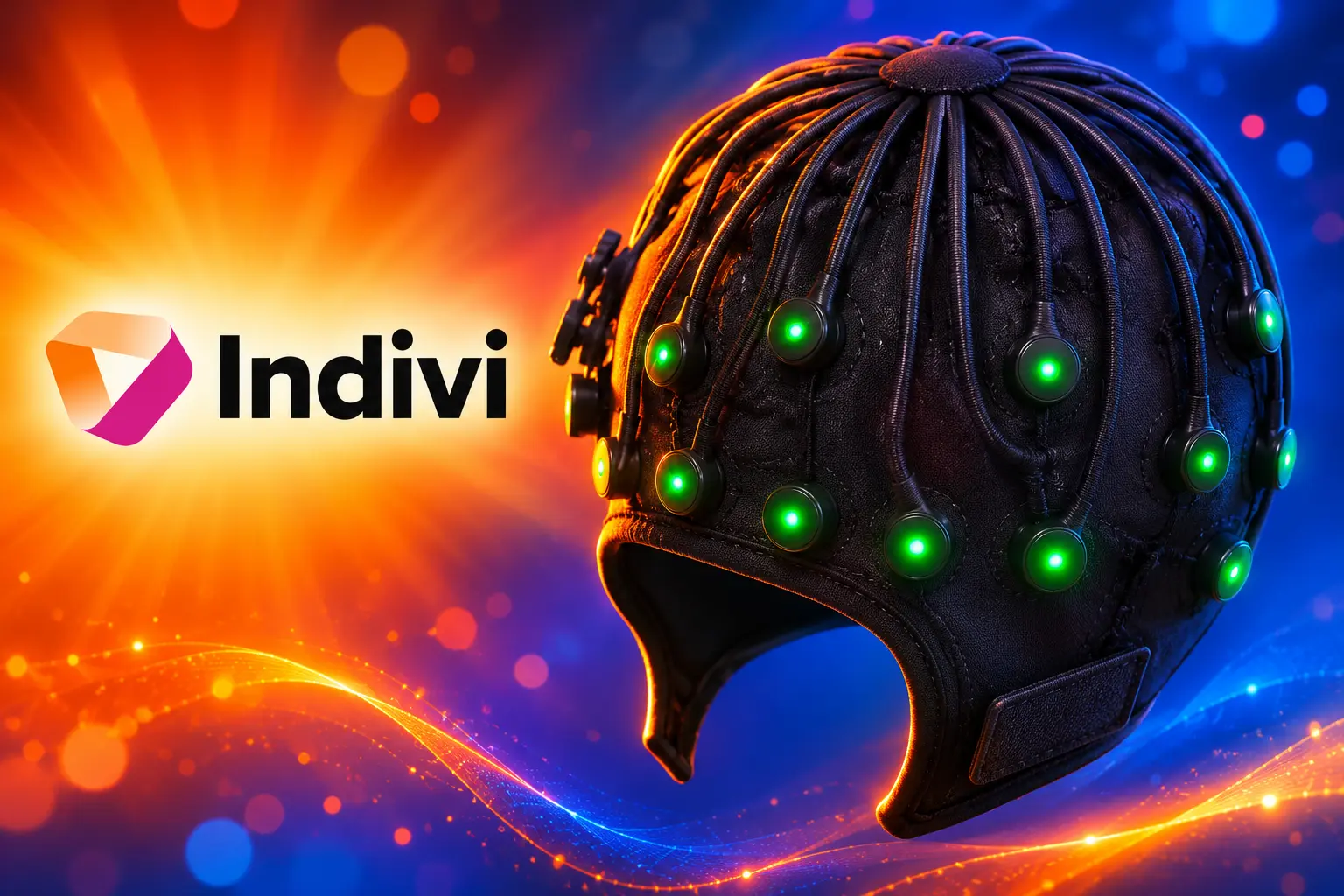
Indivi bought Cogitat’s NeuroRVQ EEG model to tighten early Alzheimer’s trials, closing a phone-plus-clinic measurement stack rather than launching a consumer.

Swiss neurotech firm Indivi bought Imperial College London spin-out Cogitat on 17 November 2026, folding the NeuroRVQ EEG foundation model into a stack built to catch Alzheimer’s treatment effects before memory tests move. Deal terms were not disclosed.
Indivi, based in Basel with offices in Córdoba, Spain and Boston, Massachusetts, sells smartphone motor and cognitive tests to trial sponsors. Cogitat spent six years teaching software to read brainwaves from anyone, on almost any headset, without a per-person training session. The buy puts that decoder next to phones and clinic EEG, aimed at earlier go or no-go calls in brain-drug studies.
Indivi Pays an Undisclosed Price for a Universal EEG Model
Guilhem Dupont, Indivi’s chief executive and founder, framed the model as a closer read on biology than the firm’s current tools allow, with drug developers as the first customer and other brain-health products as a later option.
Cogitat’s EEG foundation model changes that, decoding brain activity and revealing signals far closer to the underlying biology than ever before. That opens up exciting opportunities: initially the potential to provide drug developers earlier data on how new treatments are working for brain conditions, and, in the long-term, could inform the future development of next-generation brain health technologies beyond life sciences.
Guilhem Dupont, CEO and founder, Indivi
Allan Ponniah, Cogitat’s chief executive and founder, said the model works across each brain’s own signal pattern without individual training, and that the gap it targets is the failure to spot early biology that predicts whether a treatment will work. Indivi said it will keep developing NeuroRVQ with Cogitat’s AI and science team.
WHAT WE KNOW
- The buyer: Indivi is a 2012 Basel company whose platform already covers Parkinson’s disease, multiple sclerosis, facioscapulohumeral muscular dystrophy, and Alzheimer’s disease and related dementias.
- The asset: Cogitat, founded in December 2020 as an Imperial computing spin-out, supplies NeuroRVQ, a foundation model trained to tokenise EEG and run on new people and devices without a calibration sitting.
- The stated use: Indivi wants earlier reads on experimental Alzheimer’s treatments, then possible health and consumer tools that turn EEG into a score a clinician or user can act on.
WHAT IS UNCONFIRMED
- The price: Neither side published cash, equity, or earnout terms.
- The endpoint: No regulator has qualified NeuroRVQ as a primary Alzheimer’s trial measure.
- The 2026 study: Indivi has not posted results from the amyloid-drug proof-of-concept trial it said it would start in 2026.
Ponniah, a craniofacial surgeon and Royal Free NHS consultant, has sold the same no-training property for stroke games and operator monitoring. Dupont spent a decade in psychiatry brands at Janssen and Roche before founding Indivi in September 2012. The overlap is the product: a decoder that does not need a fresh model for every scalp.
Phones, Clinic EEG, Then a Foundation Model
The Cogitat purchase is the third layer Indivi has added since it licensed a Biogen phone battery. In March 2024 it took Konectom, a smartphone tool for remote neurology measures, and ran it inside Biogen and Denali Therapeutics’ Phase 2b LUMA study of BIIB122 in early Parkinson’s. In October 2025 it paired that functional layer with Clouds of Care, a Belgian group whose work is resting-state EEG, event-related potentials, overnight sleep recordings, and electrical source imaging tied to each person’s MRI.
A month later Indivi closed a CHF 15 million Alzheimer’s biomarker round led by Ava Investors. The firm said the money would start a 2026 proof-of-concept study looking for functional and EEG markers that move more clearly than today’s scores when amyloid-clearing drugs are given. Shibeshih Belachew, Indivi’s chief medical officer, has argued that Phase 2 is where neuroscience programmes stall because a modest effect sits inside noisy measures.
THE 2024 TO 2026 MEASUREMENT STACK
- 26 March 2024: Licenses Konectom from Biogen and takes on digital operations for the LUMA Parkinson’s study.
- 15 October 2025: Partners with Clouds of Care on clinic EEG, event-related potentials, and sleep recordings for early Alzheimer’s and Parkinson’s trials.
- 12 November 2025: Closes CHF 15 million from Ava Investors to hunt treatment-response markers in amyloid-drug studies.
- 17 November 2026: Buys Cogitat and brings NeuroRVQ in-house as the model layer on those EEG streams.
Clouds of Care still records the traces. NeuroRVQ is the software that is supposed to keep the fast, small wiggles other models smooth away, then compare them across patients who never sat through a calibration block. Michel Vounatsos, chair of Clouds of Care, has called deep phenotyping essential if Alzheimer’s and Parkinson’s programmes are going to succeed as populations age. Indivi’s pitch to sponsors is smaller, better-powered early trials, not a headset in every home.
What NeuroRVQ Beats on Public BCI Tests
NeuroRVQ is not a giant language model with a medical coat. The EEG foundation model has 5.9 million parameters. The tokenizer in front of it has 76 million. Lead author Konstantinos Barmpas and colleagues at Imperial and Cogitat argue that the gain comes from how the signal is cut into tokens, not from stacking more layers.
Raw EEG is split into one-second patches, run through convolutions at several time scales, then packed into residual vector-quantisation codebooks. A decoder rebuilds the patch from its Fourier spectrum, with a loss that treats phase as an angle so high-frequency detail is not thrown away. In the up to 15 percent on five BCI tasks comparison, that design beat other EEG foundation models on public motor, event-related potential, sleep, and eyes-open tasks. A NeurIPS 2026 project page reports lower reconstruction error than BrainOmni (0.219 against 0.350 under NeuroRVQ’s own band and normalisation).
NEURORVQ ON FIVE PUBLIC BCI TASKS
| Model | Motor | ERP | Memory | Sleep | Eyes | Parameters |
|---|---|---|---|---|---|---|
| NeuroRVQ-EEG | 70.0 | 87.6 | 57.4 | 72.8 | 86.9 | 5.9 million |
| NeuroGPT | 68.2 | 75.7 | 59.7 | 67.4 | 82.7 | 79.5 million |
| LaBraM | 63.0 | 82.2 | 52.6 | 65.2 | 79.9 | 5.8 million |
| CBraMod | 61.4 | 77.7 | 57.4 | 63.5 | 83.9 | 4.9 million |
| BrainOmni | 58.5 | 72.3 | 51.8 | 57.6 | 85.2 | 37.8 million |
Scores are balanced accuracy in percent under subject-independent cross-validation, from the IEEE MLSP 2025 brainwave-model protocol as listed on the NeuroRVQ project page. NeuroRVQ leads on four of five tasks and trails NeuroGPT on memory (57.4 against 59.7), which is the column closest to the cognition Alzheimer’s sponsors actually pay for. Those tasks are motor imagery, event-related potentials, working memory, sleep staging, and eyes open against eyes closed. None is an amyloid-drug readout.
Alzheimer’s Sponsors Need a Cleaner Early Signal
A 2014 tally of 244 disease-modifying Alzheimer’s compounds tested from 2002 to 2012 found a 99.6 percent failure rate, with one regulatory approval in that window. Amyloid antibodies later reached the market on plaque clearance and modest slowing of decline. The measurement problem Dupont is selling against did not vanish with those labels. Early trials still lean on slow clinical scales, lumbar punctures, and PET, then discover in Phase 2 that a biological nudge did not show up as function.
EEG is cheap, repeatable, and close to synapses firing, and it can be taken before a memory clinic score shifts. That is the case Indivi is making. It is also an old case. Standard EEG markers have been tried for years as stand-ins for spinal-fluid and scan positivity, and they have not replaced those tests in pivotal programmes. Indivi’s claim is that a foundation model which keeps gamma-band detail, and which does not need a new training set for each site’s headset, can see a drug effect that band-power summaries miss.
That claim is still a plan. The CHF 15 million note tied the 2026 study to people already on amyloid-lowering therapy, which is the setting where a faster pharmacodynamic marker would matter most, because sponsors already know plaques are moving and still cannot always see patients moving. Belachew has said the modest Phase 2 signal in disability is where programmes die, buried in measurement noise. NeuroRVQ is being asked to unbury it.
Indivi’s Doctor Was Already on the Alzheimer’s Paper
The leap from sleep staging to Alzheimer’s is smaller inside the two labs than the press line suggests. Cogitat’s technology page lists a 2026 NeurIPS workshop paper, Benchmarking EEG Foundation Models for Decoding Alzheimer’s Disease-Relevant Neural Dynamics, with Belachew among the authors, beside Barmpas, Na Lee, Yannis Panagakis, Nikolaos Laskaris, Dimitrios Adamos, and Stefanos Zafeiriou. The corporate close follows a paper trail that already ran through Indivi’s chief medical officer.
Cogitat’s public technical claim is the same property a multi-site trial needs. Its device-agnostic decoders without calibration are sold as software that plugs into research-grade or consumer EEG, as long as the cap covers the right cortex, and that won the NeurIPS 2021 BEETL transfer-learning contest against more than 110 teams. Imperial said the motor-imagery entry finished 5 percent above second place and 16 percent above third, and first overall. A trial that ships different headsets to different countries is, in software terms, that contest run at sponsor scale.
Zafeiriou, Cogitat’s scientific lead and a machine-learning professor in Imperial’s Department of Computing, and Adamos, the chief technology officer and an Imperial honorary senior research fellow, built the company on that transfer problem. Adamos has said anatomical and headset differences are what kept EEG in the lab. Indivi is betting the same fix helps a drug team compare Week 0 with Week 12 across sites, not that a patient will steer a cursor.
Stroke Games and Pilot Headsets Built the Decoder
Until this week’s buy, Cogitat’s named products were not Alzheimer’s batteries. In July 2023 Imperial said the company had started early stroke research with UCLH, backed by a £500,000 Innovate UK grant, with production studio UNIT9 and Dr Robert Simister, clinical lead for stroke at University College London Hospitals. The design was a virtual hand that moved when a patient imagined moving, including when the limb would not. They planned to record 20 stroke patients and take a prototype into NHS care.
Simister said a hybrid model would let one therapist mix clinic visits with remote game sessions and raise the dose of practice. Ponniah called the grant vital for an under-served stroke market. A later Innovate UK feasibility award, CogiMotion, put £100,000 into linking that decoder to upper-limb rehab robots from 1 September 2025 to 31 August 2026. The project file is closed. UKRI’s abstract says Cogitat’s software needs under five minutes on motor-cortex EEG, against 30 to 50 minutes of setup for older BCI pipelines.
COGITAT’S PATH BEFORE THE SALE
- NeurIPS 2021: First place in the BEETL EEG transfer contest, motor imagery and sleep, more than 110 teams.
- NHS stroke: £500,000 Innovate UK grant in 2023 with UCLH and UNIT9 for imagined-movement games.
- CogiMotion: £100,000 Innovate UK study, September 2025 to August 2026, to drive rehab robots from motor imagery.
- NATO DIANA: 2025 defence cohort; CogiSense cognitive-load monitoring taken from TRL 4 to TRL 7 at Estonia’s aviation academy.
The defence line, CogiSense, measured attention, load, and stress in pilots during simulated emergencies, with no per-operator calibration. A UK patent application, GB2519985.2, is pending on the core decoding. The same generalisation that lets a pilot skip a mapping session is what Indivi wants when a Phase 2 Alzheimer’s site in Boston and another in Spain ship different caps. The company’s own posts still talked about thought-enabled software. The buyer’s next sentence is treatment efficacy in dementia.
Open Weights Meet an Unqualified Alzheimer’s Endpoint
NeuroRVQ’s EEG tokenizer, EEG foundation model, and sister ECG and EMG weights were released for anyone to download, with training code on GitHub and hooks in Braindecode. Barmpas has said high-fidelity tokenisation matters more than scale, a claim that matches a 5.9 million-parameter model beating a 79.5 million-parameter rival on four public tasks. Indivi has not said whether those public weights stay up, or how NeuroRVQ will be locked down inside a trial platform that already treats Konectom as licensed medical software.
The missing piece is not another BCI leaderboard. It is a pre-specified Alzheimer’s analysis that shows NeuroRVQ moving when an amyloid drug is given, in a window where ADAS-Cog and CDR-SB still sit still, with enough sites and headsets to prove the no-calibration pitch. Until that dataset exists, sponsors still have PET, plasma p-tau, and the same noisy Phase 2 scales Belachew has been warning about. Indivi now owns the model it wants to put on those EEG streams. The price of that option was not published. The test of it will be.
Frequently Asked Questions
Does NeuroRVQ Work on Body Signals Besides EEG?
Yes. The NeuroRVQ family includes released tokenisers for electrocardiograms (76 million parameters) and muscle recordings (144 million parameters), plus a photoplethysmography tokeniser, with an ECoG version listed as coming later. Indivi’s stated use of the buy is brain EEG in neurology trials, not heart or muscle monitoring, so those other weights are a research line rather than the Alzheimer’s product.
Which Frequency Bands Does the Tokenizer Try to Preserve?
The paper groups classic EEG bands as delta (0.5 to 4 Hz), theta (4 to 8 Hz), alpha (8 to 13 Hz), beta (13 to 30 Hz), and gamma (above 30 Hz), and trains the decoder to rebuild amplitude and phase in each, including the fast, low-amplitude gamma that older tokenisers often flatten. That is a reconstruction goal on public EEG, not evidence that gamma change equals an Alzheimer’s drug effect.
Who Founded Cogitat Besides Allan Ponniah?
Six people are listed as cofounders: Ponniah as chief executive, Dimitrios Adamos as chief technology officer, Stefanos Zafeiriou as scientific lead, Nikolaos Laskaris as neuroinformatics lead, Irene Kotsia as data and machine-learning lead, and Yannis Panagakis as AI lead. Several trained at Aristotle University of Thessaloniki before the Imperial spin-out, and the company keeps a Greek subsidiary in that city.
Why Would a Multi-Site Trial Want a Decoder That Skips Per-Person Training?
Older motor-imagery pipelines often need a long mapping session each time a new patient or headset appears, which UKRI’s CogiMotion abstract puts at 30 to 50 minutes. Cogitat’s claim is a sub-five-minute setup on any cap that covers motor cortex, with no individual training. In an Alzheimer’s network that might mean the same model scoring a dry headset in a US home and a wet cap in a European clinic, which is the operational problem Indivi is buying its way out of, if the scores hold.
Disclaimer: This article is news reporting on a corporate acquisition and published research. It is informational only and is not medical advice, a diagnosis, or a recommendation to start, stop, or change any Alzheimer’s or neurology treatment. It is also not investment advice and does not tell readers to buy, sell, or hold securities in Indivi, Cogitat, or any drugmaker named here. Anyone making a care decision should speak with a qualified physician; anyone making an investment decision should speak with a licensed financial adviser. Figures, trial plans, and product statuses reflect the company papers, grants, and model cards cited here and may change as the integration and the 2026 studies proceed.

One UI 9.5 Beta Puts the Galaxy S26 on Last Year’s Clock

DBS Puts a 24/7 USDC Window Inside the Bank

European Startups Head for $81 Billion as First Checks Shrink

US Stocks Lost $1.3 Trillion Before Nvidia’s Beat

Home Depot Bets on Finance Chief Richard McPhail as CEO

Aramco Crash Kills 14 Two Days After Oil Restart

Salah Captained Egypt to Their First World Cup Win

Zelda’s 40th Switch 2 Ships Without a Zelda Game

Apple Labor Day Deals Hide June’s Memory Price Hike

El Niño Puts Israel’s Needed Winter Rain on a Flood Clock
-
 BUSINESS5 months ago
Aramco Crash Kills 14 Two Days After Oil Restart
-
 NEWS6 months ago
Salah Captained Egypt to Their First World Cup Win
-
 GAMING2 months ago
Zelda’s 40th Switch 2 Ships Without a Zelda Game
-
 NEWS3 months ago
Apple Labor Day Deals Hide June’s Memory Price Hike
-
 NEWS4 months ago
El Niño Puts Israel’s Needed Winter Rain on a Flood Clock
-

 GAMING2 months ago
Palworld 1.0.4 Adds Palpedia Search After the 1.0 Launch
-

 NEWS4 months ago
Saudi Visa Routes Split Nigerian Travelers Into Two Speeds
-

 BUSINESS9 months ago
BAE’s 60-Year Saudi Franchise Now Runs Through Taif