
NEWS
Harman Bets Drops Can Revive the Shared Mixtape
Harman launched Drops, an invite-only clip app that pays labels and hands off to Apple Music, Qobuz and TIDAL, while skipping Spotify.

Harman launched Drops on November 9, 2026, a free US app that plays 10 to 30 second song clips and hands full tracks to Apple Music, Qobuz and TIDAL. Spotify is not on that list. The Samsung-owned audio company opened an invite-only waitlist for iOS and Android, and it is asking listeners to share the part of a song that actually hits.
That is a mixtape bet from a speaker company, aimed at labels that want licensed clips and at streamers that already bill the user. It is also a cold start: nobody outside the invite pool can test whether friends will actually open it.
Harman Is Betting on the Best 30 Seconds
The official Drops launch release out of Stamford, Connecticut frames the product as a way to find a next song through a lyric, a hook, a beat, or a caption from someone you trust. Clare Hunter, general manager of Drops at HARMAN, put the gap in blunt terms. People already text friends a track, then have to add the timestamp because the good bar is rarely the first one.
You send a friend a song and say, ‘You have to hear this.’ Then you end up texting, ‘Skip to 1:47, that’s the best part.’ The part that hits usually isn’t the first few seconds, and there wasn’t a good way to share just that moment.
Clare Hunter, General Manager of Drops, HARMAN
Each Drop is a user-picked passage of 10 to 30 seconds, shown with lyrics, official album art, licensed artist photos, and a caption. Harman says the audio and the pictures are original recordings and licensed stills, not generative stand-ins. The company also says it pays rights holders and reports plays back to partners, so a clip is supposed to count like a real listen on the connected service.
Hunter has a second origin story that is more personal. She said she used to spend hours making mixtapes, picking the songs, the order, and the cover, and that Drops is the version of that she always wanted. The app’s own line is shorter: find what hits, drop by drop.
HARMAN posted the same pitch the day it opened the list, pointing people at the waitlist and a short explainer video.
Introducing Drops, a new music discovery experience from HARMAN that makes finding emerging artists & songs more personal & connected through music clips shared by people whose taste you trust. Join the waitlist at https://t.co/XTAbjatpnE. What is Drops? https://t.co/Kzz9hGGH1X pic.twitter.com/hvLOMlNot7
— HARMAN (@Harman) November 9, 2026
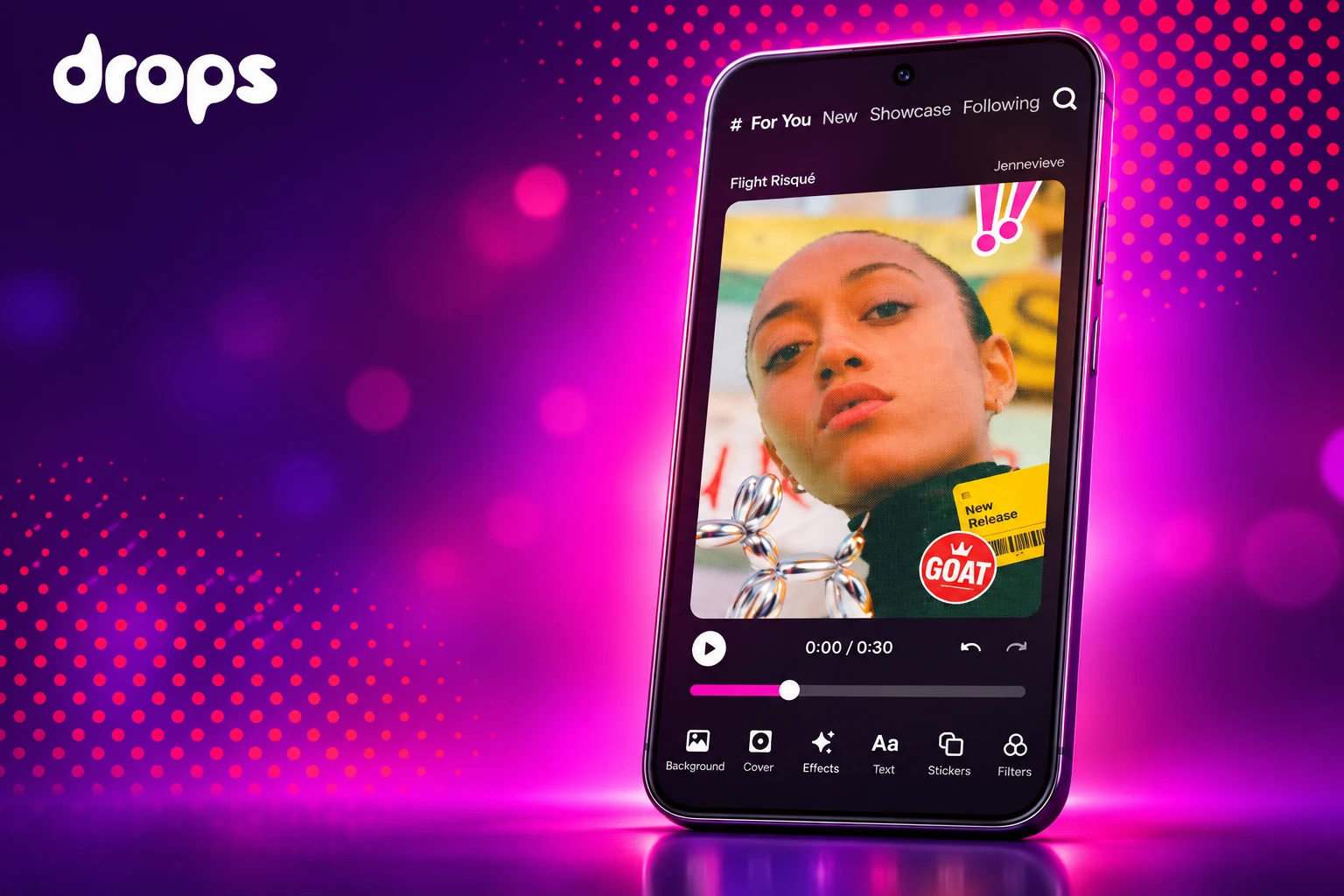
Four Feeds and a Handoff to Full Tracks
Drops is built as a vertical scroll of those clips, closer to a short-video feed than to a library. The difference is what you hear. There is no full song inside the app unless you jump out to a linked account. Harman is explicit that Drops is meant to sit beside a subscription the user already has, not replace it.
The preview is free. Navigation is four named tabs, plus hashtags for trending cues, and the usual social tools: like, comment, repost, follow, direct messages, and a save folder branded as a Droplist or collection.
THE FOUR FEEDS
- For You: A ranked stream of clips Harman says is personalized from taste and engagement, even as the company talks up human recommendations.
- New: Fresh posts, the tab for people who want the latest Drop rather than a tailored mix.
- Showcase: A lane for tastemakers and highlighted clips, the closest thing to an editorial shelf.
- Following: Only people you chose, which is where the mixtape pitch either becomes a habit or dies.
That For You tab is the quiet concession. Harman still uses software to rank what you see. The bet is that the object in the feed is a licensed moment with a name on it, and that the friend who posted it matters more than the model that sorted it.
When a clip sticks, the handoff is the product. Users with Apple Music, Qobuz, or TIDAL can open the full track in the service they already pay for. Everyone else can save the Drop and wait for a wider partner list that Harman has not promised on a date.
Apple Music, Qobuz and TIDAL Made the Cut
The launch stack is lopsided on purpose. Apple Music, Qobuz and TIDAL are the only streaming names Harman printed. Qobuz and TIDAL are the hi-fi pair that serious listeners already keep beside a mass-market app. Apple Music is the one with a real US subscriber base. Spotify, which MIDiA Research put at 31.4% of global paid music subscriptions at the end of 2025, is absent.
That absence is the wager’s main risk. Luminate counted 1.4 trillion on-demand audio streams in the United States in 2025. A discovery app that cannot send a saved clip into the service most paying customers already open has to win on taste, not on convenience. Spotify users can still scroll the snippets. They just cannot finish the song in one tap.
DROPS LAUNCH PARTNERS
| Name | Role at launch |
|---|---|
| Universal Music Group | Major-label catalog |
| Beggars Group | Independent label group |
| EMPIRE | Distributor |
| Symphonic Distribution | Independent distributor |
| UnitedMasters | Independent-artist platform |
| LyricFind | Licensed lyrics |
| Xperi | Music data |
| MusicBrainz | Music data |
| Apple Music | Full-track handoff |
| Qobuz | Full-track handoff |
| TIDAL | Full-track handoff |
| Spotify | Not listed |
Harman also cited unnamed music publishers and performing rights organizations. The named labels skew toward companies that live on discovery: UnitedMasters and Symphonic both went on the record because a clip feed is a way for independent acts to show up beside a Universal track. Andrew Migdail, vice president of distribution and sync operations at UnitedMasters, said so much of discovery is built to recommend what is already popular, and that Drops is built to surface what is next. Jorge Brea, founder and chief executive of Symphonic Distribution, said independent artists need more ways to be found through the music itself and the people who believe in it.
The Idea Took Shape After Harman Bought Roon
Hunter said the concept started to form after Harman took in Roon, the audiophile library and multi-room playback software. That deal is the industrial logic under a consumer app that looks, at a glance, like a TikTok clone.
HARMAN is not a social startup. It lists JBL, Harman Kardon, AKG, Bowers & Wilkins, Denon, and Marantz among its audio brands, says more than 50 million vehicles use its in-cabin tech, and employs about 26,000 people. Samsung Electronics bought the company for $8 billion in March 2017. Roon gave that hardware group a software brain for people who already care which DAC is in the chain.
HARMAN’S PATH TO DROPS
- 2015: Roon’s founders, a small team of Sooloos and Meridian veterans, begin the library and discovery product that later became the reference app for high-end digital listening.
- March 2017: Samsung completes its $8 billion purchase of Harman, folding car audio, headphones, and living-room brands under the same owner as Galaxy phones.
- November 27, 2023: Harman’s 2023 Roon purchase is announced. Roon is to run as a standalone unit, with more than 160 audio brands and more than 1,000 high-performance devices in its certified web.
- November 9, 2026: Drops opens as an invite-only US preview, a phone-first clip feed that sends finished listens back to Apple Music, Qobuz, and TIDAL.
Roon’s note to subscribers at the time of the sale promised that memberships, billing, and device support would continue, and that the community forum would stay up. Enno Vandermeer, then Roon’s chief executive, said the team wanted to do more and could lean into that work without the frayed nerves of a self-funded startup. Drops is the first mass-market face of that “more.” It does not require a Roon core, a Nucleus server, or a certified streamer. It asks for a phone and an invite.
A Roon Labs developer circulated the launch link the same day, with no extra comment. That silence fits a split that Harman has not closed in public: Roon remains the heavy listening room, Drops is the shareable 30 seconds, and nobody has said how, or if, a Droplist will ever land in a Roon queue.
Apple Already Buried One Social Music Network
Shared snippets are not a new idea. Apple opened Ping inside iTunes in 2010 as a music social layer, then shut it on September 30, 2012, two years later. Apple said Ping drew one million sign-ups in 24 hours. Tim Cook later told an All Things Digital audience that customers had voted with their time and did not want to put much energy into it.
Jon Irwin, then president of the subscription service Rhapsody, put a sharper reason on the failure. Sharing on Ping meant listening to a 30 second sample, he said, and the feed showed purchases rather than what you actually played. Apple later added Connect inside Apple Music and then wound that down too. Friends already had text threads, group chats, and Instagram stories. A music company social network was extra work for a weak reward.
Drops repeats the short-clip mechanic and tries to change the rest of the deal. The clip is licensed, not a leftover iTunes preview. The full song is supposed to open in a service the user already pays for, so nobody is being marched to a buy button. Rights holders are on the masthead on day one. Those are real design choices. They do not answer the reason Ping withered, which was that people already had a place to send a song.
The public reaction so far is mostly silence. Outside a handful of tech roundups and Harman’s own post, there is no loud argument about price, quality, or whether the For You ranking feels human. Invite walls do that. They also hide whether anyone will open a Drop that is not from a person they already talk to every day.
Who Gets Paid When a Clip Plays?
Harman says Drops pays rights holders, reports plays to partners, and lets those plays count toward streams on the connected services, so a 20 second hook is not supposed to be a royalty-free teaser. That is the offer to Universal, Beggars, EMPIRE, Symphonic, and UnitedMasters, and it is the contrast with short-video apps that spent years fighting over how a snippet should be licensed, credited, and paid.
The data vendors sit under that promise. LyricFind supplies licensed lyrics. Xperi and MusicBrainz supply the metadata that makes a clip match a real release instead of a guess. Publishers and collecting societies are named as a class, not as a signed list, which leaves the songwriter side less visible than the master-side labels.
What the company will not do, it says, is generate the record or the picture. Songs appear as released. Artwork is official. Artist photos are licensed. In a year when fake tracks and fake covers are cheap to make, that is a sales line as much as an ethics line, and it only holds if the catalog stays clean once the waitlist opens.
The money flow still depends on the handoff. A Drop that never becomes a full play on Apple Music, Qobuz, or TIDAL is a very short stream. Labels that signed on are betting users will tap through. If they bounce, the clip was a postcard, not a sale.
The Waitlist Is the Product for Now
Drops is in preview. Harman has not published invite counts, retention, or a date for an open US download, let alone a launch outside the United States. The public door is the Drops waitlist page, which asks people to get on the list or redeem an invite, then repeats the same three moves: scroll, save, Drop the best part.
WHAT WE KNOW
- The terms: Free preview, US only, iOS and Android, invite-only at launch.
- The clip: 10 to 30 seconds with lyrics, official art, licensed photos, and a caption.
- The pipe: Full tracks via Apple Music, Qobuz, and TIDAL; plays reported; rights holders paid.
- The rule: No generative AI for audio or visuals, per Harman.
WHAT IS UNCONFIRMED
- Spotify: No launch integration and no public timetable for one.
- Scale: No waitlist size, no open-access date, no markets beyond the United States.
- Roon: No stated link between a Droplist and a Roon library or a certified streamer.
The mixtape pitch only works if a small group of people with overlapping taste get in together. A ranked For You tab can fake that for a week. It cannot fake a friend who knows why you needed bar 1:47. Harman has the licenses, the hi-fi streamers, and a parent that already sits in cars and living rooms. It still has to get the invite to the person you would have made a tape for.

One UI 9.5 Beta Puts the Galaxy S26 on Last Year’s Clock

DBS Puts a 24/7 USDC Window Inside the Bank

European Startups Head for $81 Billion as First Checks Shrink

US Stocks Lost $1.3 Trillion Before Nvidia’s Beat

Home Depot Bets on Finance Chief Richard McPhail as CEO

Aramco Crash Kills 14 Two Days After Oil Restart

Salah Captained Egypt to Their First World Cup Win

Zelda’s 40th Switch 2 Ships Without a Zelda Game

Apple Labor Day Deals Hide June’s Memory Price Hike

El Niño Puts Israel’s Needed Winter Rain on a Flood Clock
-
 BUSINESS5 months ago
Aramco Crash Kills 14 Two Days After Oil Restart
-
 NEWS6 months ago
Salah Captained Egypt to Their First World Cup Win
-
 GAMING2 months ago
Zelda’s 40th Switch 2 Ships Without a Zelda Game
-
 NEWS3 months ago
Apple Labor Day Deals Hide June’s Memory Price Hike
-
 NEWS4 months ago
El Niño Puts Israel’s Needed Winter Rain on a Flood Clock
-

 GAMING2 months ago
Palworld 1.0.4 Adds Palpedia Search After the 1.0 Launch
-

 NEWS4 months ago
Saudi Visa Routes Split Nigerian Travelers Into Two Speeds
-

 BUSINESS9 months ago
BAE’s 60-Year Saudi Franchise Now Runs Through Taif