
NEWS
Samsung Puts Improved Privacy Display on Two S27 Phones
Samsung will put an improved Privacy Display on the Galaxy S27 Pro and Ultra, leaving the S27 and S27+ without the panel.

Samsung will put an improved Privacy Display on the Galaxy S27 Pro and Galaxy S27 Ultra, and leave it off the S27 and S27+. Industry notes on November 2 also give those two phones extra screen brightness for direct sun. The Pro becomes the first non-Ultra Galaxy S phone with the filter.
That split is the same cut Samsung is already making with the new camera plateau. A summer supply-chain plan to put the privacy panel on all four phones did not hold.
A Summer Plan to Put Privacy on All Four Phones
Privacy Display shipped first on the Galaxy S26 Ultra after Unpacked on February 25. It is a hardware filter, not a film. You can switch it for the whole screen, for selected apps, or for notification pop-ups, and a Maximum Privacy Protection mode blanks the side view harder.
By July, Korean supply notes said the S27, S27+, S27 Pro, and S27 Ultra would all get the panel. That would have been a rare gift to the base model, which usually misses items such as faster charging. Those notes also said a cheaper BOE panel for the vanilla S27 had fallen through, so Samsung Display would supply the set.
September reporting walked the claim back. The Pro and Ultra would share the privacy OLED, Color Filter-on-Encapsulation, a 200MP main camera, and a 16MP front camera. The S27 and S27+ would not get the filter. The November 2 exclusive locks that map and adds an upgraded version of the feature, plus extra brightness, on the same two phones.
HOW THE RUMOR SHRANK
- February 25, 2026: Galaxy S26 Ultra launches with Privacy Display as an Ultra-only hardware mode.
- February 26, 2026: Samsung Display publishes UL Solutions tests of its Flex Magic Pixel OLED.
- July 2, 2026: Supply notes put Privacy Display on all four Galaxy S27 models.
- September 9, 2026: Later industry notes limit the panel to the S27 Pro and S27 Ultra, with COE on those two phones.
- October 10, 2026: Tipster Sawyer Galox lists a Privacy Display v.2 with sharper image quality while the filter is on.
- November 2, 2026: New notes say Pro and Ultra get the upgraded filter and extra brightness; S27 and S27+ get neither.
Samsung has not confirmed the split. The four-phone mainline itself is already the company’s first. The privacy panel is how that extra SKU gets Ultra-grade glass while Plus stays a large S27.
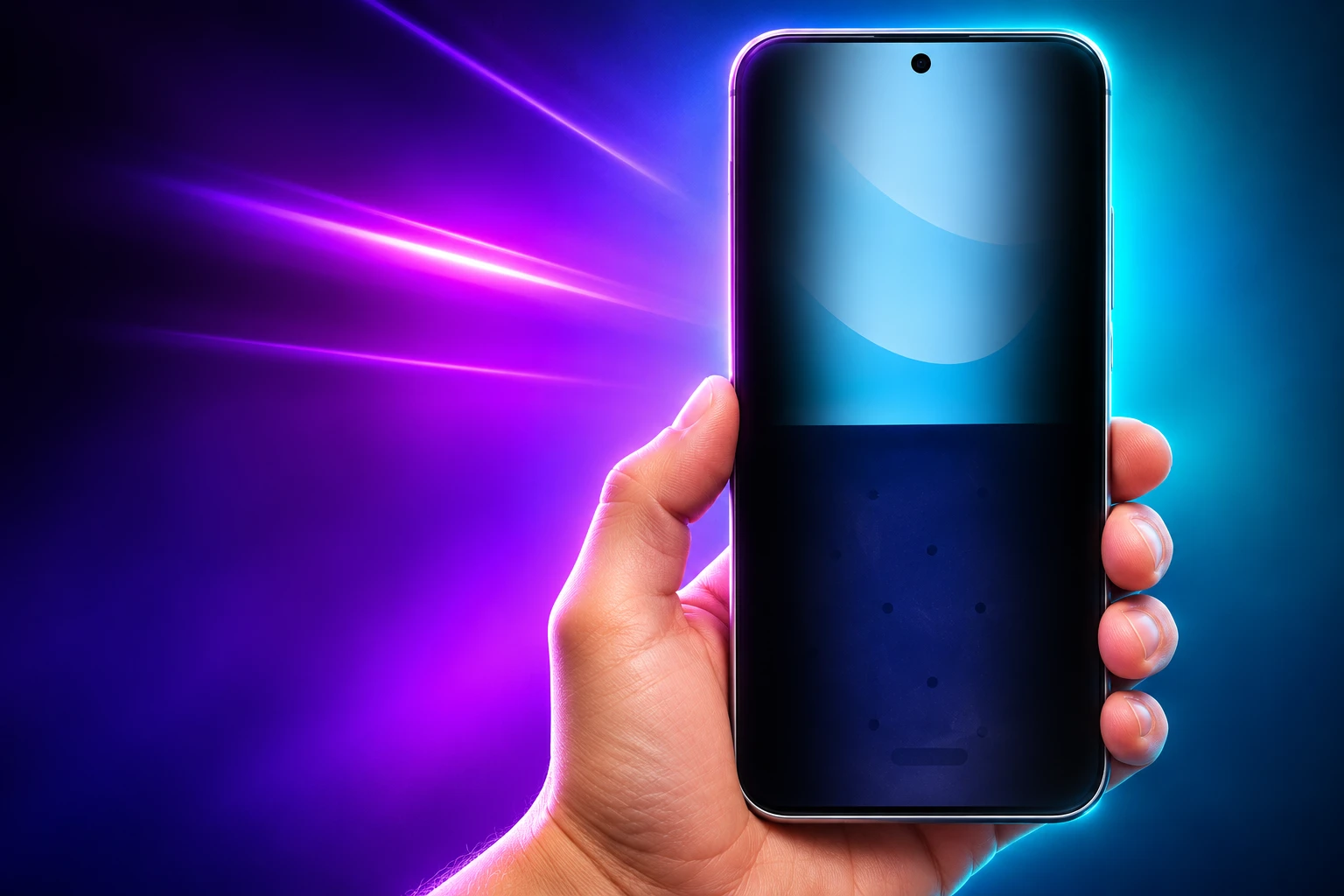
Privacy Mode Drops Brightness From 1,000 to 636 Nits
The filter works by splitting the OLED into wide pixels and narrow pixels. With the mode off, both sets light up and the screen behaves like a normal panel. With it on, the wide pixels dim or shut off, and the narrow pixels fire mostly straight ahead, so a person at your shoulder sees a dark slab.
Samsung Display built that trick as Flex Magic Pixel privacy technology on its polarizer-free LEAD stack, branded LEAD 2.0 when the privacy layers ride along. A tall black matrix around half the pixels blocks sideways light. COE, which folds polarization into the thin-film stack, frees the height that matrix needs. The company first showed Flex Magic Pixel at MWC in 2024 and brought a demo phone to MWC26 on March 2.
The cost showed up in lab use of the S26 Ultra. Turn Privacy Display on at a 1,000 nits setting and measured brightness falls to 636 nits, a drop of 364 nits, or more than a third. Manual full-screen brightness tops out at 1,380 nits on that phone, so the hit is ugly outdoors. Contrast falls with it. Some owners also flagged a softer image and eye strain with the mode left on, which is the obvious complaint hanging over any “improved” sequel.
A hardware privacy filter that parks half the pixels will throw away resolution and nits unless the next panel is denser, or the remaining pixels are brighter. That is the entire bet in the S27 upgrade. Extra brightness on Pro and Ultra is not a side note. It is how you keep the filter usable at noon.
What the S27 Pro Inherits From the Ultra
The Pro is the new compact flagship, and the privacy panel is only one Ultra item it is in line to copy. September notes also gave Pro and Ultra the same 200MP main camera, a 50MP ultrawide with autofocus, and that 16MP front camera. The Ultra still pulls away on zoom, with a 50MP telephoto at 5x optical. The Pro is described with a 10MP or 12MP telephoto. S Pen stays on the Ultra.
Both of those phones also pick up the new rear camera plateau. The S27 and S27+ keep a vertical stack close to the current generation. In other words, the back of the phone now tells you which OLED you bought.
S27 PANEL AND CAMERA SPLIT
| Model | Privacy Display | Camera plateau | Main camera |
|---|---|---|---|
| Galaxy S27 | No | No | 50MP |
| Galaxy S27+ | No | No | 50MP |
| Galaxy S27 Pro | Upgraded | Yes | 200MP |
| Galaxy S27 Ultra | Upgraded | Yes | 200MP |
The same September notes said Pro and Ultra would share Qualcomm’s next flagship silicon. That lines up with a broader chip calendar in which the Snapdragon 8 Elite Gen 6 series arrived in September on TSMC’s 2nm node, alongside Apple’s A20 family and MediaTek’s Dimensity 9600 Pro. Memory prices are still climbing into this cycle, which makes a cheaper OLED on Plus an easy place to protect margin.
Last Year’s Camera Stack Stays on the Plus
For a decade the Plus was the large-screen buy if you did not want Ultra money or Ultra bulk. The S27+ still gets the bigger slab. It does not get the privacy OLED, the extra brightness, the camera plateau, or the 200MP main sensor. It shares the S27’s 50MP-class rear stack.
That is a problem in daily use, not on a spec sheet. The people who actually need a shoulder-proof screen are often on a tram or a plane with a compact phone in one hand. The base S27 is the small one in this family. It is also one of the two phones that cannot hide a banking app from the next seat. Leaving Plus off the panel is the same logic with a larger screen: you paid for size, not for the new glass.
Samsung is treating privacy as a paid flagship layer. The company can do that because the filter is in the OLED, and Samsung Display makes the OLED. Rivals have started copying the idea on their own high-end phones, which is why a v.2 that still works in sun matters if the feature is going to remain a reason to skip Plus.
3.5% Side Brightness, Verified at 45 Degrees
Samsung Display already has independent numbers for the first-generation panel, published the day after Unpacked. UL Solutions tilted the OLED at 45 and 60 degrees, spun it 360 degrees, and compared off-axis brightness with the front view. The lab recorded a side-to-front brightness ratio of 3.5% at 45 degrees and 0.9% or lower at 60 degrees. At 45 degrees that is about one-thirtieth of frontal brightness. At 60 degrees it is less than one-hundredth. A typical phone panel still holds about 40% of its front brightness off axis, which is why a neighbor can still read it.
LEAD 2.0 is an innovative technology that maximizes security and privacy through all-around viewing angle control while simultaneously improving power efficiency, the most critical challenge in the era of on-device AI.
Hojung Lee, Executive Vice President and Head of Mobile Display Product Planning, Samsung Display
A Samsung Display representative made the commercial pitch in the same note: stick-on privacy films dim the screen even when you do not need them, while Flex Magic Pixel lets you switch the viewing angle per pixel and keep full brightness when the mode is off. That last clause is the one S26 Ultra owners have been testing in daylight, and it is the one the S27 pair has to beat.
PRIVACY DISPLAY PHONE VOLUME
- 2025 ship: Sigmaintell Consulting counted 1 million smartphones with privacy displays, mostly niche business devices.
- 2026 forecast: The firm put 2026 at 21 million units, roughly twenty times the 2025 total, after the S26 Ultra pulled the tech into a consumer flagship.
- 2027 forecast: 29 million units, about 40% above 2026, if yields and image quality hold.
Sigmaintell also named the blockers that still cap the category: lower resolution and brightness in privacy mode, plus power draw. Those are the same complaints already attached to the S26 Ultra. Huawei, Xiaomi, Oppo, and Vivo are in the queue with their own versions. Samsung’s lead is a year of software around per-app and notification masking, and a second-gen panel if Sawyer Galox is right.
Three Fixes a Leaker Tied to the Upgrade
On October 10, Sawyer Galox wrote that Samsung was working on Galaxy S27 Ultra “Privacy Display v.2” with three hardware aims, and that strong upgrades would put that phone between $1,400 and $1,500. The November 2 notes do not list those three fixes, and they do not give nit numbers. They do say Pro gets the same upgraded filter as Ultra, which is the first time the feature leaves the Ultra SKU.
WHAT SAWYER GALOX LISTED FOR V.2
- Viewing angles: The post said improved viewing angles, without saying whether the owner’s cone gets wider or the neighbor’s view gets darker.
- Resolution when on: Better resolution with Privacy Display enabled, the direct reply to the S26 Ultra looking softer once wide pixels drop out.
- Clarity: Improved screen quality and clarity, the item that has to survive a 1,000-to-636 nits-style test before anyone leaves the toggle on all day.
If those three land, leaving the mode on stops being a trade. If they do not, Pro and Ultra still have a brighter panel than Plus, and they still have a filter Plus cannot buy. Either outcome trains shoppers the same way. The new Pro is the small phone with Ultra glass. Plus is the large phone with last year’s back and no privacy OLED.
Some S26 Ultra owners already treat the first filter as a blur they will not trust a sequel to fix. Others never asked for a privacy mode and wanted a native 10-bit panel instead. The upgrade has to answer the first group with nits and sharpness, because the second group is not paying extra for a toggle they will leave off.
Laptops May Get the Same Pixel Trick
Samsung has also looked at Privacy Display for future Galaxy Book laptops, with no launch window attached. Sigmaintell expects the same class of panel to show up in foldables, where a bigger sheet of glass is easier to read from the next seat. That does not change the S27 map. The four phones are still aimed at January or February 2027, the two months Samsung has used for Galaxy S launches for years.
Until Unpacked, the hardware split is consistent across independent notes even though Samsung is silent: Pro and Ultra share the privacy OLED, extra brightness, COE, the camera plateau, and the 200MP main camera. S27 and S27+ share a 50MP-class stack and last year’s camera layout, and they do not get the filter. The summer all-four rumor is the version that died. The version that remains uses a privacy panel to finish a two-tier flagship inside a four-phone box.

One UI 9.5 Beta Puts the Galaxy S26 on Last Year’s Clock

DBS Puts a 24/7 USDC Window Inside the Bank

European Startups Head for $81 Billion as First Checks Shrink

US Stocks Lost $1.3 Trillion Before Nvidia’s Beat

Home Depot Bets on Finance Chief Richard McPhail as CEO

Aramco Crash Kills 14 Two Days After Oil Restart

Salah Captained Egypt to Their First World Cup Win

Zelda’s 40th Switch 2 Ships Without a Zelda Game

Apple Labor Day Deals Hide June’s Memory Price Hike

El Niño Puts Israel’s Needed Winter Rain on a Flood Clock
-
 BUSINESS5 months ago
Aramco Crash Kills 14 Two Days After Oil Restart
-
 NEWS6 months ago
Salah Captained Egypt to Their First World Cup Win
-
 GAMING2 months ago
Zelda’s 40th Switch 2 Ships Without a Zelda Game
-
 NEWS3 months ago
Apple Labor Day Deals Hide June’s Memory Price Hike
-
 NEWS4 months ago
El Niño Puts Israel’s Needed Winter Rain on a Flood Clock
-

 GAMING2 months ago
Palworld 1.0.4 Adds Palpedia Search After the 1.0 Launch
-

 NEWS4 months ago
Saudi Visa Routes Split Nigerian Travelers Into Two Speeds
-

 BUSINESS9 months ago
BAE’s 60-Year Saudi Franchise Now Runs Through Taif