
NEWS
Investors Price Fractile at $7 Billion Before Chips Ship
Fractile raised $720 million at a $7 billion value on stacked DRAM inference chips that will not be manufactured until next year.

Fractile said on 11 November that it had raised $720 million in a Series C led by Thrive Capital, Founders Fund, Lightspeed and Redpoint. A person involved in the deal put the London and Bristol company’s value at $7 billion, a price set before any commercial chip has shipped.
The UK government described the same round as worth more than £500 million and the valuation as more than £5 billion, and placed its Sovereign AI Venture Fund and the British Business Bank on the cap table. The money is a bet that putting DRAM on the processor will make long-running AI agents cheap enough to use.
The Round Prices Fractile at $7 Billion
Walter Goodwin, the Oxford-trained founder who started Fractile in 2022 while still a doctoral student, posted the $720 million figure himself. The company’s account named the same four leads. Six months earlier, in May, Fractile had raised $220 million at a valuation of around $1 billion. The new price is about seven times that mark, on a company that is four years old and still a manufacturing date.
The official announcement sat on X the same afternoon, with the round size in the first line and a hiring link in the last.
We’re delighted to announce that Fractile has raised $720M in a Series C led by @thrivecapital @foundersfund @lightspeedvp and @redpoint, with further participation by brilliant new and existing investors. pic.twitter.com/LygRRfRTwf
— Fractile (@fractile_ai) November 11, 2026
Outsize European financings have clustered around a few names this year, and the region’s recent mega-round rebound is the backdrop for a cheque this large. Fractile now sits in that set as a hardware name, not a software one.
FRACTILE’S FUNDING LADDER
| Round | Date | Amount | Valuation | Leads |
|---|---|---|---|---|
| Seed | July 2024 | $15 million | Not disclosed | Kindred Capital, NATO Innovation Fund, Oxford Science Enterprises |
| Series B | May 2026 | $220 million | Around $1 billion | Accel, Factorial Funds, Founders Fund |
| Series C | November 2026 | $720 million | $7 billion (over £5 billion) | Thrive Capital, Founders Fund, Lightspeed, Redpoint |
Former Intel chief Pat Gelsinger came in as a seed angel. Founders Fund was already on the Series B, so the November round is a step-up for Thiel’s firm as well as a first lead cheque for Thrive, Lightspeed and Redpoint. The $7 billion figure is the dollar reading of the government’s “over £5 billion,” given by a person in the deal, not a second, separate price.
Why Memory Bandwidth Sets the Speed of Agents
Every token a model writes has to pull weights and context out of memory. Chat replies hide that trip. A coding agent walking a large repo, or a reasoning model chewing a long chain of thought, pays it again and again, for minutes or hours. Redpoint, a co-lead, put the conviction in one line: inference is constrained by memory, not compute.
Lightspeed’s note on the round says frontier models are processing more than 10 times more tokens every year, and that over the next five years roughly 80 percent of a chip market measured in the hundreds of billions of dollars will go to inference. Those are investor numbers, not a shipment log. They explain why a company with no product can still clear $720 million.
Goodwin’s own case is sequential work, not a bigger chatbot. He wrote that OpenAI ran 10,000 parallel agents for 80 hours on a Millennium Prize problem, at a cost of more than $10 million, and that hard problems often fail to split cleanly across more agents. Fewer agents that think for longer win on quality, he argued, and lose only on the time you wait.
Building radically faster inference hardware, which doesn’t force a trade-off on throughput, model sizes or context lengths, is a key step in bringing down the cost and time we incur in solving our hardest problems.
Walter Goodwin, founder and CEO, on X
The product goal attached to that argument, from materials around the Series B, is 1,200 tokens per second on long-context frontier models, against about 40 tokens per second on current chips. That is a 30 times lift in token rate, and a product target, not a measured rack result. Lightspeed now describes the same aim as over an order of magnitude faster at a fraction of the cost.
After SRAM, a DRAM Stack on the Die
Fractile spent its first two years on an SRAM design, the same family Groq and Cerebras use: extreme bandwidth, not enough capacity once models and context windows grew. By late 2023 the company had concluded SRAM would not scale and began work with memory vendors on cheap DRAM at high bandwidth. About 150 people now sit across front-end design, physical design, back-end implementation and advanced packaging, a thin slice in each discipline so the loop does not leave the building for an ASIC house.
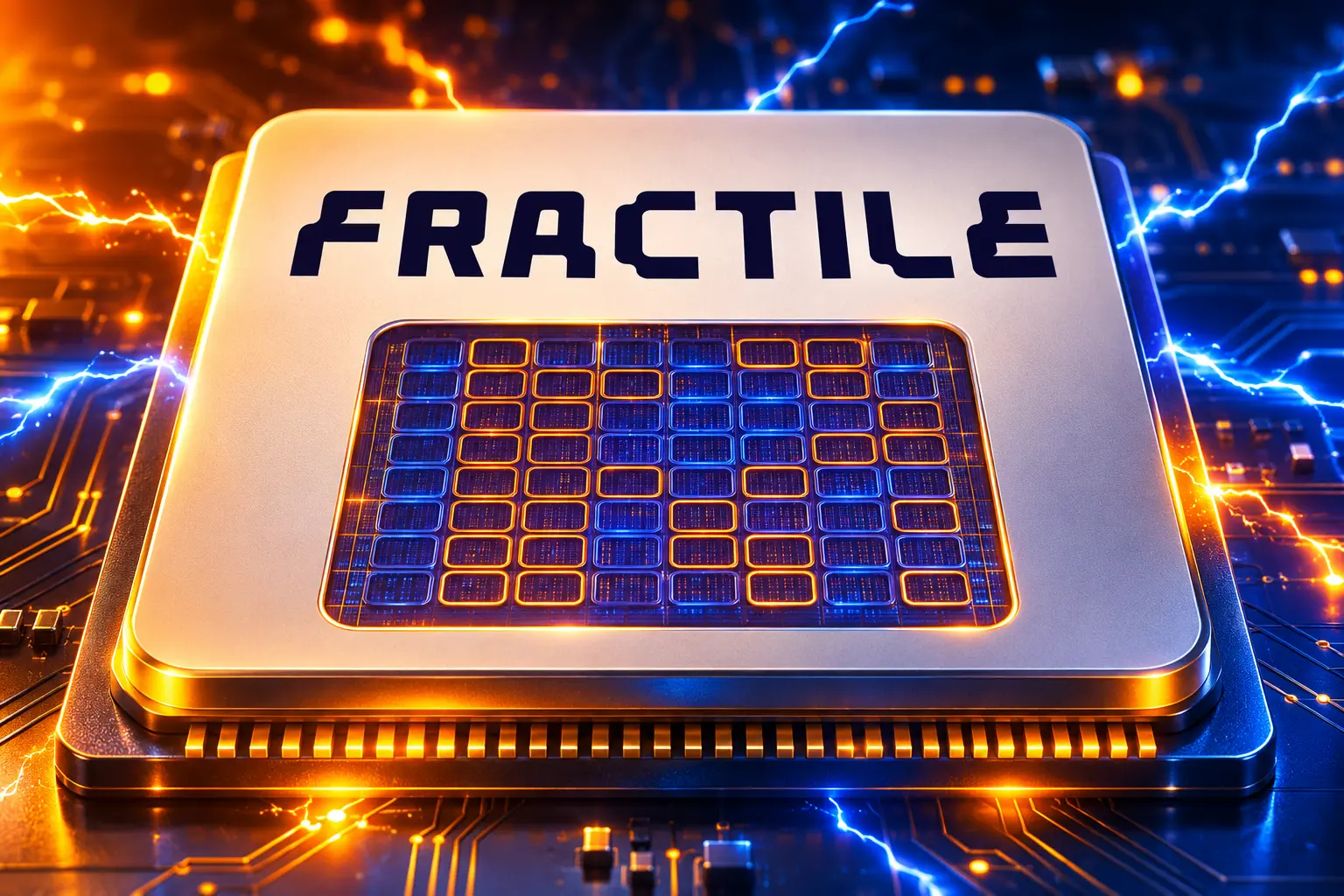
The Series C product is that pivot in silicon. Fractile said its first product-scale chip, which it will manufacture next year, will stack DRAM directly on top of the processor. Lightspeed’s write-up is more specific: the same memory that normally goes into high-bandwidth memory is packaged as stacked DRAM on top of the logic, for more bandwidth than HBM and more capacity than SRAM. Speed and scale on one chip, in the investor’s phrase.
THREE PLACES TO PUT THE MEMORY
- Off-chip HBM: GPUs and most hyperscaler accelerators keep big DRAM beside the compute die and pay a time and energy tax on every hop.
- On-die SRAM: Fast and close, but too small for long context, so attention still falls back to a GPU when the window grows.
- Stacked DRAM on logic: Fractile’s bet, still unshipped, that ordinary DRAM bonded on the processor can hold the model and feed it without the HBM straw.
Jacob Effron, a Redpoint managing director, said the design became clear “over many whiteboards in Bristol.” The compiler sits beside the silicon. Fractile is selling a rack-scale system, not a discrete part a cloud buyer drops into an existing NVIDIA cluster. That is the full-stack claim, and it is also the execution load: tape-out, packaging, boards, runtime and field software, all before a single paid inference job.
The Lead Money Came From Four U.S. Funds
Thrive Capital, Founders Fund, Lightspeed and Redpoint led. Alphabet’s CapitalG, BlackRock, DST Global, Elad Gil, Balderton, SV Angel, Shopify, Dragoneer, the UK Sovereign AI fund and the British Business Bank joined. The government named CapitalG, Lightspeed and Redpoint in its own statement. SV Angel added that the company is hiring in London, Bristol, Palo Alto and Taipei.
WHO ELSE IS ON THE CAP TABLE
- US growth funds: Thrive, Lightspeed, Redpoint, Founders Fund, CapitalG, BlackRock, DST, SV Angel, Dragoneer.
- UK and Canada: Balderton, Sovereign AI, the British Business Bank, Shopify.
- Earlier names still in: Accel, Factorial Funds, Kindred Capital, the NATO Innovation Fund, Oxford Science Enterprises, and Gelsinger as an angel.
The state’s two vehicles did not disclose cheque sizes. Notes attached to the government release say typical Sovereign AI equity cheques run around £1 million to £10 million, and that specific figures are commercially sensitive. Against $720 million, that is a stamp, not the fuel. The lead money is American. The letterhead is British.
A Homegrown Chip Win on Whitehall Letterhead
Kanishka Narayan, the AI minister, used the round to restate a familiar Whitehall complaint: British ideas, foreign factories. Jonathan Reynolds, the business secretary, called Fractile a British success story and pointed to plans to expand in Bristol. Joséphine Kant, an investment partner at Sovereign AI, said the team could compete with the very best globally. Leandros Kalisperas, chief investment officer of the British Business Bank, said the company was rearchitecting the hardware stack at a critical stage of growth.
For too long, Britain has produced some of the world’s best scientific ideas, only to see too much of the technology, industry and wealth they create built elsewhere. We are determined to change that.
Kanishka Narayan, AI minister, government statement, 11 November 2026
The release arrived a fortnight after the Budget added a further £140 million for Sovereign AI, £60 million for the fund and £80 million for an R&D procurement scheme, and after the Chancellor lifted the British Business Bank’s investment capacity by £5 billion to £30.6 billion. Separately, the UK’s compute roadmap still talks of up to £2 billion of compute spending through the rest of the decade. None of those Budget lines is Fractile’s money. They are the policy frame Whitehall wrapped around a US-led round.
Britain already has Arm, whose designs sit in billions of devices, and a small manufacturing base next to the US and Asia. Fractile is a design house with a TSMC-class foundry path, not a new fab in Bristol. The sovereign claim is that the company, the jobs and the IP stay on this island while the wafers are cut elsewhere. That is a real industrial choice. It is not the same thing as making the chips at home.
Graphcore’s Bristol Warning Is Still Fresh
Bristol has already had its NVIDIA challenger. Graphcore, founded in the same city, built an Intelligence Processing Unit that was architecturally original and still failed to break CUDA’s hold. It raised about $684 million, peaked at a $2.77 billion valuation in 2020, then posted $2.7 million in revenue against $205 million of losses in 2022. SoftBank bought the company in July 2024. Deal terms were not disclosed; later accounts put the price in the region of $500 million to $600 million, a fraction of the peak.
The IPU had research users. Hyperscalers stayed on GPUs. Software maturity, yield and switching costs did more damage than the original circuit idea. SoftBank has since put hundreds of millions more into the subsidiary, which is a second life, not a listed UK champion.
Fractile is not Graphcore. The bet is narrower: inference, not training, and memory placement, not a new parallel tile. Goodwin’s team has hired from Graphcore, NVIDIA and Imagination, which is both a talent pool and a reminder that the last Bristol run already trained those engineers. A $7 billion mark on unshipped parts is richer than Graphcore ever got, and it arrives before the test Graphcore actually sat: a chip in a customer rack, with software a lab will switch for.
What Has to Work Before Silicon Hits a Rack
Fractile said it will manufacture its first product-scale chip next year. Coverage around the round has treated 2027 as the data-centre window. Goodwin has said there is still a lot of work ahead, and that the new funding is what lets the company ship chips and systems. That is the whole test. The architecture can be right on a whiteboard and still miss power, yield, the compiler, or the six-month NVIDIA cadence Goodwin himself has called the real race.
WHAT WE KNOW
- The raise: $720 million Series C, four US leads, government funds on the paper at undisclosed size.
- The design: stacked DRAM on logic, after an SRAM start, sold as a rack with a compiler, not a drop-in GPU.
- The date: first product-scale chip to be manufactured next year, with data-centre deployment aimed at 2027.
WHAT IS UNCONFIRMED
- Benchmarks: no public, at-scale comparison against a deployed GPU cluster has been released.
- Customers: no named, signed volume buyer has been confirmed by Fractile.
- The state’s cheque: Sovereign AI and the British Business Bank have not said how much they put in.
The price on this round is for a bottleneck thesis, not for a chip a customer can buy. Token rate, cost per gigabyte of memory, and whether long-context agents stay on this silicon instead of flipping back to a GPU are questions for 2027, when the stack is in a rack or it is not. Until then, Fractile is a well-funded design team with a Bristol whiteboard and a $7 billion mark on the door.
Disclaimer: This article is news reporting and analysis of a completed private financing, and it is for information only. It is not investment advice, a solicitation to buy or sell any security, or a recommendation to participate in any fund that holds Fractile or its peers. Readers who are considering exposure to private technology companies, venture funds or semiconductor suppliers should consult a qualified financial adviser who can review their circumstances. Figures, investor lists, product dates and valuations reflect the company, government and investor statements available on 11 November 2026 and may change as filings, shipments and customer contracts appear.

One UI 9.5 Beta Puts the Galaxy S26 on Last Year’s Clock

DBS Puts a 24/7 USDC Window Inside the Bank

European Startups Head for $81 Billion as First Checks Shrink

US Stocks Lost $1.3 Trillion Before Nvidia’s Beat

Home Depot Bets on Finance Chief Richard McPhail as CEO

Aramco Crash Kills 14 Two Days After Oil Restart

Salah Captained Egypt to Their First World Cup Win

Zelda’s 40th Switch 2 Ships Without a Zelda Game

Apple Labor Day Deals Hide June’s Memory Price Hike

El Niño Puts Israel’s Needed Winter Rain on a Flood Clock
-
 BUSINESS5 months ago
Aramco Crash Kills 14 Two Days After Oil Restart
-
 NEWS6 months ago
Salah Captained Egypt to Their First World Cup Win
-
 GAMING2 months ago
Zelda’s 40th Switch 2 Ships Without a Zelda Game
-
 NEWS3 months ago
Apple Labor Day Deals Hide June’s Memory Price Hike
-
 NEWS4 months ago
El Niño Puts Israel’s Needed Winter Rain on a Flood Clock
-

 GAMING2 months ago
Palworld 1.0.4 Adds Palpedia Search After the 1.0 Launch
-

 NEWS4 months ago
Saudi Visa Routes Split Nigerian Travelers Into Two Speeds
-

 BUSINESS9 months ago
BAE’s 60-Year Saudi Franchise Now Runs Through Taif