
NEWS
European Tech Funding Hits €1.5 Billion With Thin Exits
Legora and Pigment led a €1.5 billion European tech week as Q3 markups stayed far ahead of actual exits.

European tech companies closed more than 65 funding deals worth over €1.5 billion in the week through 25 October, against four disclosed sales and no listing. Two of those cheques, both priced on 21 October, did most of the visible work.
Stockholm legal AI firm Legora took $550 million at an $8.8 billion post-money price. Paris planning software maker Pigment took $250 million at $2.3 billion. The rest of the tape was a long tail of smaller equity rounds plus a fat credit line, sitting on a third quarter that already ran through €27.8 billion in 732 deals.
Two Cheques Carried Most of the €1.5 Billion
The weekly list looks busy until the amounts are stacked. Legora’s round was the largest disclosed equity cheque. Pigment was next. UK small-business lender iwoca added a €185 million credit line, which is debt, not a new price on the equity. Swiss cancer-immunotherapy company Nouscom raised €120 million. After that, the cheques drop fast.
THE WEEK’S LARGEST DISCLOSED ROUNDS
| Company | Base | Amount | Price or type |
|---|---|---|---|
| Legora | Sweden | $550 million | $8.8 billion, Series E |
| Pigment | France | $250 million | $2.3 billion, Series E |
| iwoca | UK | €185 million | credit line |
| Nouscom | Switzerland | €120 million | equity, price not given |
| Blackwall | Estonia | $100 million | $2.2 billion, Series C |
| Daytona | Croatia-founded, New York | $60 million | $1 billion, Series B |
Those six lines are the week that will be remembered. The other 50-plus deals, from a £1 million UK pre-seed to a €540,000 Norwegian cheque, filled the count without moving the total. Private-market pricing also bunched: Legora, Pigment and Daytona were all marked at $1 billion or more inside a two-day window, a sprint in the private book rather than a broad thaw across seed.
The money went to tools that sit on work companies already pay for. Legal files. Company plans. Agent traffic on the public web. That is a different bet from another general chatbot, and it is why the large cheques clustered in vertical software instead of spreading evenly down the 65-deal list.
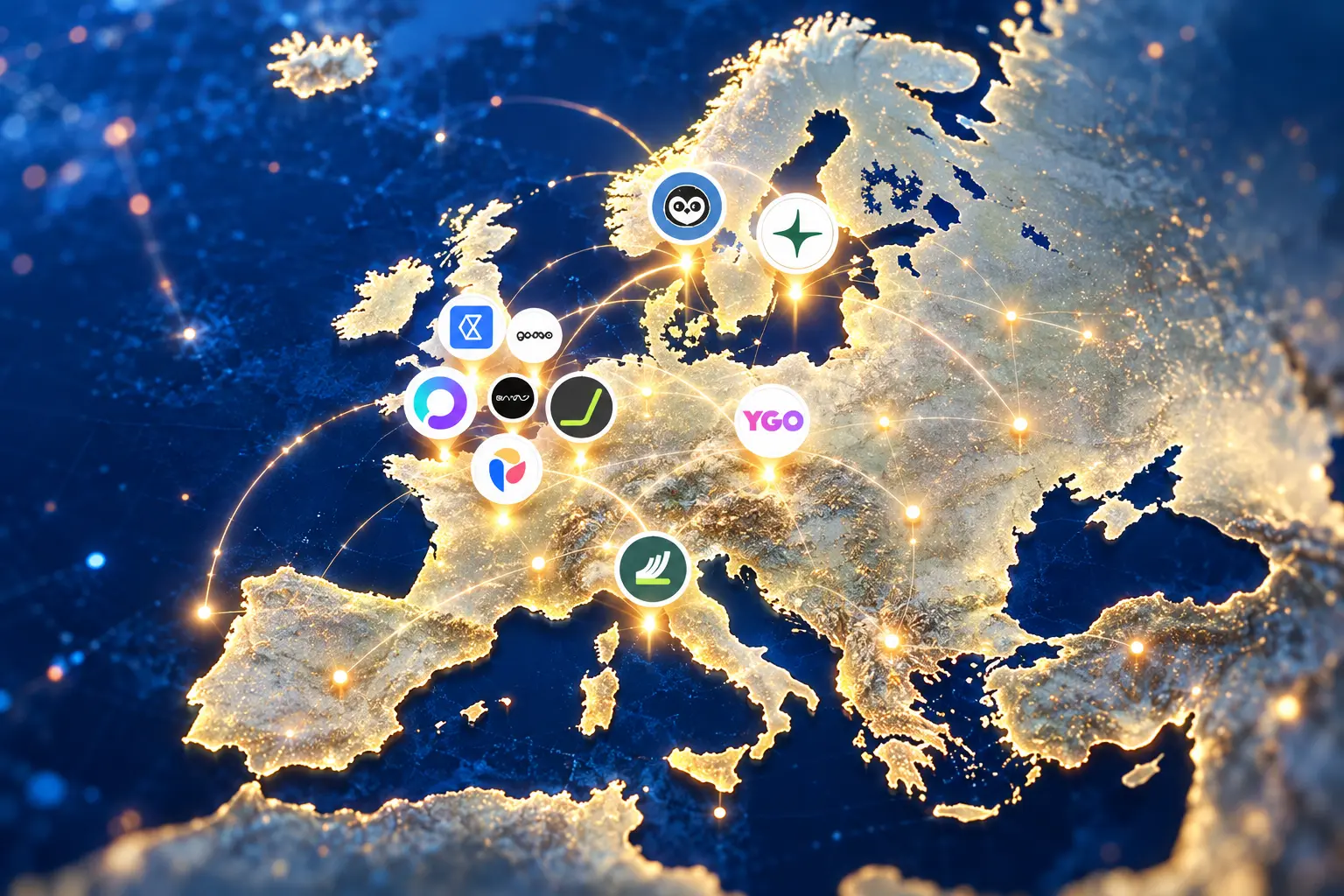
The UK Took 43 Percent of a Concentrated Quarter
The weekly print landed on a quarter that was already lopsided. European tech raised €27.8 billion in Q3 2026, up 32.4 percent from €21 billion a year earlier and more than two and a half times the €11 billion booked in Q3 2024. The rise was real. So was the concentration underneath it.
Q3 2026 EUROPEAN TECH FUNDING
- The total: €27.8 billion across 732 deals.
- The UK share: almost €12 billion in 188 deals, around 43 percent of all capital.
- AI and cloud: €6.7 billion and €6.4 billion, about 47 percent combined.
- The mega slice: five deals above €1 billion added up to €11.17 billion, about 40 percent of the quarter.
Those five cheques went to four companies: Mistral AI at €3 billion, Nscale at about €2.95 billion and €2.59 billion, Helsing at €1.58 billion, and Quantum Systems at €1.05 billion. Nscale also booked a further €787 million in July, taking its Q3 haul to about €6.3 billion. Beyond that group, deal sizes fall quickly.
Germany raised about €4.9 billion across 114 deals. France raised €4.0 billion from only 49 deals. Add the UK and the three markets took nearly three-quarters of the money. More than 2,630 investors showed up, with Innovate UK the most active by count, which tells you the small end of the market is still busy even as the euros pile into a few names. The quarter was also front-loaded into September, so the October weekly tape is the aftershock, not a new boom starting from scratch.
Legora’s $8.8 Billion Round Funds a US Push
Legora announced a $550 million Series E at $8.8 billion on 21 October, led by Atreides Management. New money came from Baron Capital, Capital Group, Fidelity Management & Research Company, Glade Brook Capital Partners and J.P. Morgan. Every major existing backer returned, including Accel, Benchmark, Bessemer, General Catalyst, ICONIQ, Insight, Menlo, Redpoint, Salesforce Ventures and Sands Capital.
The new price sits 57 percent above the $5.6 billion mark on the previous round. Annual recurring revenue is now more than $200 million. The United States is already Legora’s largest market by revenue, more than half of the AmLaw 50 are customers, and in-house legal teams made up more than 40 percent of new customers in the third quarter. The company has more than 1,000 staff across 18 offices and says more than 140,000 lawyers at more than 2,400 firms and in-house teams use the product in over 80 markets.
The opportunity in legal is enormous and we are still early. AI is changing the role of the lawyer, with more time for judgment and advice, and it is reshaping how law firms and in-house legal teams are organized and how their work gets done. We intend to lead that shift in the US and globally.
Max Junestrand, CEO and co-founder, Legora
The cap table is the tell. Mutual-fund names and a US lead are the buyers who show up when a private company is being prepared for a long hold, or for a US listing path, not for a quiet European trade sale. The $8.8 billion price also assumes law firms will keep paying as the product moves from draft work into judgment, a claim that has not been tested in a public market.
We have raised a $550 million Series E at a $8.8B valuation to accelerate our growth in the U.S. and globally, and deepen investment in the Legora aOS, our agentic operating system for legal work.@Atreidesmgmt leads this round, alongside new investors @BaronCapital,… pic.twitter.com/T2t3LC9Rx7
— Legora (@WeAreLegora) October 21, 2026
CFO David Eckstein said the firm wants every dollar of that $200 million-plus in ARR to be durable, with gross margins and retention holding as it scales. The cash is earmarked for North America, where it already has offices in New York, Denver, Chicago, Houston, San Francisco, Toronto and Mexico City, plus Europe and Asia-Pacific, and for the Legora aOS, the agent system lawyers work in.
The EU Fund Took the Lead at Pigment
Pigment’s $250 million Series E at $2.3 billion is the policy counterpart to Legora’s US cheque. The Scaleup Europe Fund, managed by EQT, led the round. World Innovation Lab joined, as did Greenoaks, ICONIQ, IVP and Meritech. Nvidia’s stake is still listed as planned, after Jensen Huang named Pigment during a France visit as part of a nearly $10 billion European push.
Pigment said annual recurring revenue passed $100 million earlier this year, doubling again. It also said 85 percent of new metrics on the platform are now created by an agent. Customers named in the release include Danone, DirecTV, Siemens, Snowflake, ServiceNow, Unilever, Anthropic, ElevenLabs and Uber. L’Oréal is moving salary planning for more than 95,000 staff onto the product.
Eléonore and Romain have built a global category leader from Paris, and that is exactly the kind of company the Scaleup Europe Fund was created to back.
Shannee Braun, managing director, EQT and Scaleup Europe Fund
That sentence is the second-order story. Europe spent years watching late-stage winners raise in California. The new fund is trying to write those cheques from Europe, on market terms, and to keep European AI firms on the continent instead of watching them reprice abroad. Co-founders Eléonore Crespo and Romain Niccoli said enterprise planning will change more in the next few years than it has in the last thirty, and that the cash will go into Graphite, Pigment’s compute engine, and the agents that run on it.
Estonia and Croatia Added Two Fresh Unicorns
Away from Paris and Stockholm, the week minted two new billion-dollar marks in markets that rarely set the European total. Estonia’s Blackwall raised $100 million at a $2.2 billion valuation in a Series C led by AVP, with Dawn Capital, MMC Ventures and Tera Ventures returning. Executive chairman Roi Carthy said that price is four times the 2025 round. The company sells bot, DDoS and agent-traffic tools through hosting providers rather than to websites one by one, and it wants to expand across 12 regions. It calls hosting a $200 billion market and says the product already sits in front of millions of sites.
Nikita Rozenberg, co-founder and CEO, said the web is becoming more automated and more fragmented, and that the new money is for a traffic layer hosts can resell. AVP’s Warda Shaheen called that front-door position the reason for leading. For a country of 1.4 million people, a $2.2 billion cybersecurity price is a reminder that the week’s map is wider than London, Munich and Paris even if those three cities still take most of the euros.
Croatian-founded Daytona, which is based in New York, raised $60 million in a Series B at a $1 billion price led by FirstMark Growth, taking total funding to $91 million. The company is building cloud infrastructure for long-running AI agents. Angels in the round included Stripe’s Patrick Collison, Shopify’s Tobi Lütke, Perplexity’s Aravind Srinivas, Zoom’s Eric Yuan, Datadog’s Olivier Pomel and Quora’s Adam D’Angelo, with Qualcomm Ventures, Samsung Next and Okta Ventures also in. Founder Ivan Burazin’s case is that agents spin up thousands of short, stateful jobs the old cloud was not built to host.
On 19 October in Berlin, Nvidia chief Jensen Huang named four German startups for planned investments under the same nearly $10 billion European commitment: Agile Robots, Avelios Medical, Mirelo and Reflex Aerospace. No amounts were attached. The week’s German tape also included YGO’s €8 million for travel infrastructure and a €5 million seed for Cellbox, which is a long way from a named cheque by the chip supplier.
The Exit Tape Had Four Names on It
Set against more than 65 raises, the sale list was short. None of the four disclosed transactions was a public listing. PitchBook’s Q3 European venture report said later-stage companies favoured debt financing because the IPO window was still a poor fit, which is the same pattern as iwoca’s €185 million credit line sitting near the top of a funding recap.
THE FOUR DISCLOSED SALES
- Workflex: the German firm is buying rhome.
- Provinzial: the Münster insurer is buying Cologne-based moneymeets.
- Standard Chartered: the bank is to acquire Zodia Custody in the UK.
- Omnidocs: the Dutch company is buying WoodWing and calling the combined group one of Europe’s larger document-management players.
Tracxn’s tally for the first nine months of 2026 found acquisitions down 27 percent to 815. That is the recycling problem behind the markup week. Capital can reprice Legora, Pigment, Blackwall and Daytona in private. It cannot come back to the funds that backed them until someone buys the shares, in a sale or on an exchange. Four names on an M&A list do not do that job for a €27.8 billion quarter.
The bounce is still a fundraising bounce. US institutions are underwriting a Swedish legal company whose growth is already American. Europe’s new scaleup fund is underwriting a Paris planning company so that cheque does not have to leave the bloc. Estonia and Croatia can now print unicorns in the same week as Nvidia tours Berlin. Until the exit tape gets longer than four quiet sales, those prices stay on private paper.
Frequently Asked Questions
How Fast Did Legora’s Annual Recurring Revenue Reach $200 Million?
Legora said it went from $1 million to $100 million in annual recurring revenue in less than 18 months, then added the next $100 million in less than six months. The company was founded in 2023 and launched its platform in October 2024, and it opened its first US office in spring 2025.
What Is the Scaleup Europe Fund?
The Scaleup Europe Fund is a commercially driven vehicle managed by EQT that targets €5 billion and pools public and private capital for European deep tech, AI apps and life sciences companies. EQT itself reports €341 billion in assets under management across the full company lifecycle.
Did Nvidia Disclose Cheque Sizes for Its Four German Startups?
No amounts were attached to the planned stakes in Agile Robots, Avelios Medical, Mirelo and Reflex Aerospace, which Huang named at the Invest in Germany Summit in Berlin on 19 October. The four sit inside a nearly $10 billion European commitment that also covers universities and research labs, and Nvidia already backs German firms including n8n, Neura Robotics and Black Forest Labs.
How Many New European Unicorns Did Tracxn Count Through September 2026?
Tracxn counted 41 new European tech unicorns in the first nine months of 2026, up from 16 in the same stretch a year earlier. That jump in private $1 billion-plus marks ran alongside the 27 percent drop in acquisitions, to 815, in the same nine-month book.

One UI 9.5 Beta Puts the Galaxy S26 on Last Year’s Clock

DBS Puts a 24/7 USDC Window Inside the Bank

European Startups Head for $81 Billion as First Checks Shrink

US Stocks Lost $1.3 Trillion Before Nvidia’s Beat

Home Depot Bets on Finance Chief Richard McPhail as CEO

Aramco Crash Kills 14 Two Days After Oil Restart

Salah Captained Egypt to Their First World Cup Win

Zelda’s 40th Switch 2 Ships Without a Zelda Game

Apple Labor Day Deals Hide June’s Memory Price Hike

El Niño Puts Israel’s Needed Winter Rain on a Flood Clock
-
 BUSINESS5 months ago
Aramco Crash Kills 14 Two Days After Oil Restart
-
 NEWS6 months ago
Salah Captained Egypt to Their First World Cup Win
-
 GAMING2 months ago
Zelda’s 40th Switch 2 Ships Without a Zelda Game
-
 NEWS3 months ago
Apple Labor Day Deals Hide June’s Memory Price Hike
-
 NEWS4 months ago
El Niño Puts Israel’s Needed Winter Rain on a Flood Clock
-

 GAMING2 months ago
Palworld 1.0.4 Adds Palpedia Search After the 1.0 Launch
-

 NEWS4 months ago
Saudi Visa Routes Split Nigerian Travelers Into Two Speeds
-

 BUSINESS9 months ago
BAE’s 60-Year Saudi Franchise Now Runs Through Taif