
BUSINESS
Egg Prices Fell 63 Percent After the March Record
USDA warned of 41% egg inflation in 2025; the spike hit $6.23 a dozen, then the flock rebuild left store eggs at $2.32.

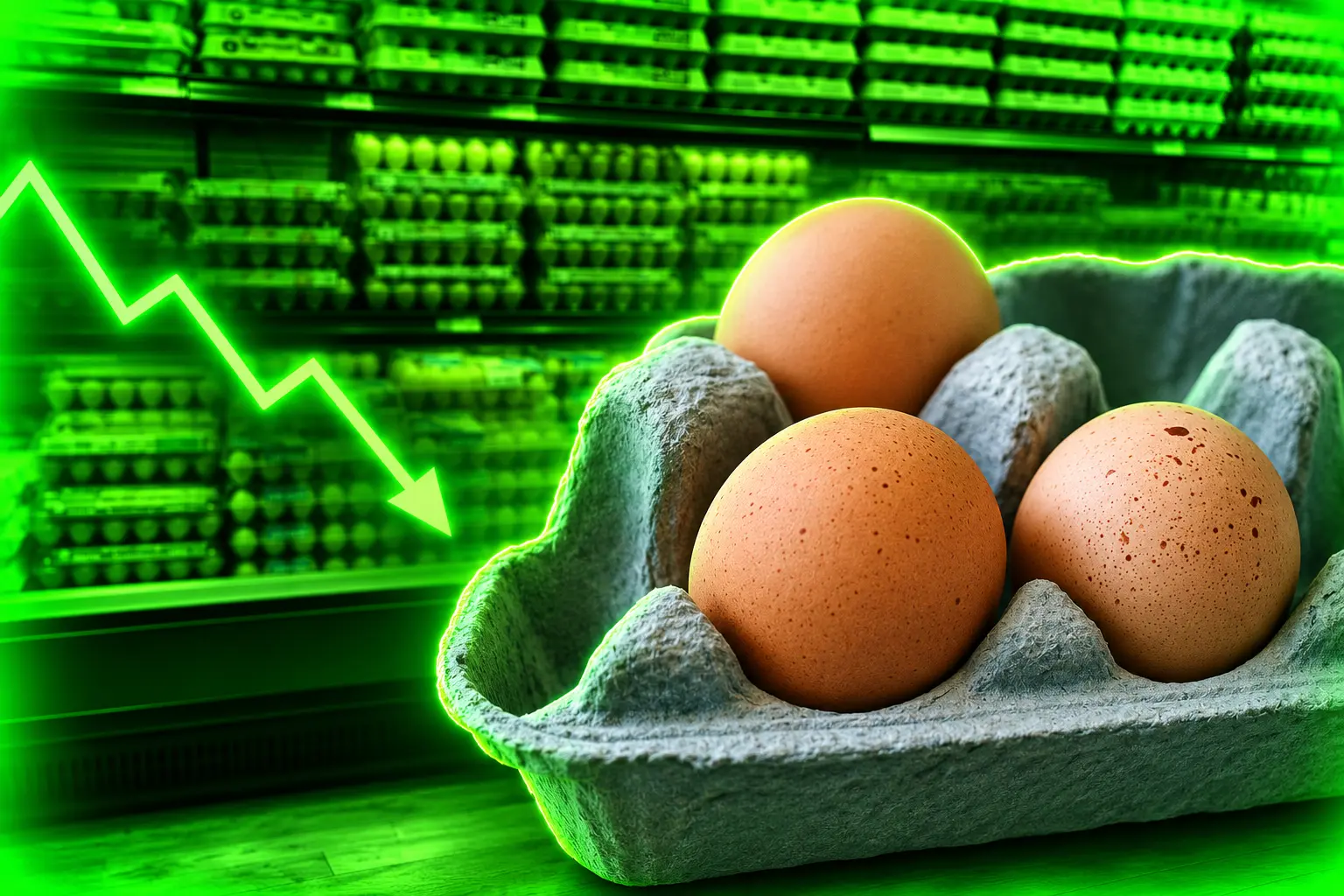
U.S. egg prices peaked at $6.23 a dozen in March 2025, then fell 63% to $2.32 by October 2026. Bird flu emptied barns first; the pullets raised into that shortage then filled them again.
The February 2025 alarm treated $4.95 as a ceiling that would keep rising. It was a midpoint. The same supply shock that printed the record paid for the glut that erased it.
March 2025 Set the Record at $6.23 a Dozen
The Bureau of Labor Statistics city average for a dozen Grade A large eggs was $4.82 in January 2023, then a new high of $4.95 in January 2025 after a $4.15 reading in December. February 2025 printed $5.90. March 2025 printed $6.23, the highest monthly average in the series, which starts in 1980.
USDA’s Food Price Outlook put January 2025 egg prices 53% above January 2024 on the consumer price index, a different series from the dollar-per-dozen average. The dollar series is the one shoppers recognize at the cooler.
THE BLS STORE AVERAGE, SELECTED MONTHS
| Month | Price per dozen |
|---|---|
| January 2023 | $4.82 |
| January 2025 | $4.95 |
| March 2025 | $6.23 |
| June 2026 | $2.14 |
| October 2026 | $2.32 |
The October 2026 store average of $2.32 a dozen sits 63% below that March peak. June 2026, at $2.14, was the low of the unwind. BLS did not publish an October 2025 average because of the lapse in federal appropriations, so that month has no year-earlier pair.
Wholesale moved faster than retail, which is the usual lag. USDA’s national benchmark for large white eggs sold loose at the plant peaked at $8.17 on March 3, 2025, and was $0.63 on November 10, 2026, a 92% drop. By November 12 it had bounced to $0.69, still 65% below the $1.99 reading a year earlier.
A 41% Forecast Built on Empty Barns
USDA’s January 2025 Food Price Outlook put the full-year rise in retail egg prices at 20.3%, with a high case of 45.3%. After another month of culls, the agency raised its 2025 egg forecast to 41.1%. About 30 million commercial layers were hit in January and February 2025, the Economic Research Service said, the worst two-month stretch of the outbreak to that point.
Megan Sweitzer, a research agricultural economist at USDA’s Economic Research Service, told the Agricultural Outlook Forum that the short run still pointed up, and that a peak and a drop were also likely, as in 2015 and 2022.
Knowing what we know about HPAI, it’s quite likely that prices could continue to go up in the short term. But it’s also likely in 2025 that there will be a peaking point and prices will drop as we’ve seen during other intense periods of HPAI in 2015 and 2022.
Megan Sweitzer, research agricultural economist, USDA Agricultural Outlook Forum
David Anderson, a professor at Texas A&M, said outbreaks were still cutting hen numbers and output, and that young pullets had to replace both normal turnover and birds lost to the virus. That replacement lag is the whole cycle. A hen culled in January is not a carton in March, and a pullet placed in March is a carton in the fall, which is when the $6.23 price started to work against itself.
Cal-Maine Booked $1.22 Billion, Then a Quarterly Loss
Cal-Maine Foods, the largest U.S. egg company, is the listed proxy for that cycle. For the fiscal year ended May 31, 2025, it reported net sales of $4.26 billion and net income of $1.22 billion, or $24.95 a diluted share, on an average selling price of $3.13 a dozen and 1.283 billion dozen sold. A year earlier the average price was $1.93. The company paid $330.3 million in dividends tied to those results.
Its own release said 40.2 million commercial layers and pullets were depopulated in calendar 2024, and 39.0 million more through May 2025. Those missing birds were the margin.
The next fiscal year reversed the ledger. For the year ended May 30, 2026, sales were $2.91 billion, down 31.7%, and net income was $316.7 million, down 74.0%, or $6.63 a share. Conventional shell-egg prices fell 50.9% across the year. The fiscal 2026 results showed a $35.9 million quarterly loss in the fourth quarter, or $0.76 a share, on sales of $552.6 million, down 49.9%. Operating loss was $58.8 million. A year earlier, fourth-quarter net income had been $342.5 million.
CAL-MAINE FOODS, FISCAL 2025 VS. FISCAL 2026
| Metric | FY2025 | FY2026 |
|---|---|---|
| Net sales | $4.26 billion | $2.91 billion |
| Net income | $1.22 billion | $316.7 million |
| Diluted EPS | $24.95 | $6.63 |
| Fourth-quarter net income | $342.5 million | -$35.9 million |
Conventional eggs, the commodity carton, took the hit. Fourth-quarter conventional sales were $210.8 million, with average price down 70.9% and volume up 3.1%, which is the signature of a glut rather than a demand collapse. That segment posted a $40.6 million operating loss against a $370.5 million profit a year earlier. Specialty shell eggs plus prepared foods rose to 53.0% of fourth-quarter sales, with prepared foods at 10.9%, or $60.4 million, as the company tried to step off the wholesale swing.
During the quarter, industry oversupply drove wholesale shell egg prices to historically low inflation-adjusted levels. This dynamic was largely supply-driven rather than demand-driven, and we continue to see favorable long-term demand fundamentals across our end markets.
Sherman Miller, president and CEO, Cal-Maine Foods fiscal 2026 earnings release
The windfall funded the pullets. The pullets funded the oversupply. The oversupply funded the loss. That is the joke the $6.23 dozen told on the people who collected it.
How the Flock Went From 292 Million Hens to a Glut
APHIS logged its first confirmed detections in commercial and backyard flocks of this outbreak on February 8, 2022. Detections still cluster in fall and spring, when wild birds move. The table-egg flock, the birds that fill grocery cartons, fell as low as 291.9 million hens on March 1, 2025, then rebuilt to 319.1 million on October 1, 2026, up 4.4% from a year earlier and still short of the 326 million head counted before the outbreak.
Each confirmed commercial layer flock is depopulated in full. The site is cleaned, sits empty, and waits on pullets that take months to reach lay, so a winter detection shows up as a spring price and a summer placement shows up as a fall carton. That lag is why the January 2025 shortage was still filling stores in late 2025 while wholesale was already sliding.
THE CULL, THE PEAK, AND THE REBUILD
- February 8, 2022: APHIS confirms HPAI in a U.S. commercial flock, the start of the outbreak still running.
- January 2023: The BLS store average hits $4.82 a dozen, the first modern record of the cycle.
- Calendar 2024: 40.2 million commercial layers and pullets are depopulated.
- January 2025: The store average reaches $4.95; USDA’s midpoint forecast is a 20.3% rise for the year.
- February 2025: Trader Joe’s caps sales at one dozen per customer per day; Waffle House adds a 50-cent-per-egg fee; USDA lifts the midpoint forecast to 41.1%.
- March 1, 2025: The table-egg flock bottoms at 291.9 million hens.
- March 2025: The store average peaks at $6.23; wholesale large whites hit $8.17 on March 3.
- Through May 2025: 39.0 million more commercial layers and pullets are depopulated.
- June 2, 2025: Waffle House takes the egg surcharge off the menu.
- June 2026: The store average hits $2.14, the low of the unwind.
- October 2026: The store average is $2.32; the flock is 319.1 million hens.
By the time the barns were full again, the price that had paid to fill them was gone. In some cities the national average already looked high. A Minneapolis Target was advertising cartons at $1.69 in November 2026, a local ticket well under the BLS mean, which is a mixed basket of conventional, cage-free, organic, and free-range cartons.
Waffle House Took Its Egg Surcharge off the Menu
Breakfast chains felt the spike in real time because eggs are the plate, not a garnish. Waffle House added a temporary 50-cent charge on every egg in early February 2025 rather than lift the whole menu, and a four-egg plate picked up $2. The chain, which serves 272 million eggs a year across about 2,000 restaurants, took the fee off as of June 2, 2025, and posted the line “Egg-cellent news…as of June 2, the egg surcharge is officially off the menu.” Some Denny’s locations ended a similar add-on in May.
Grocers rationed the carton while the cooler was short. Trader Joe’s said it was limiting egg purchases to one dozen per customer, per day, in every U.S. store because of ongoing supply trouble. Other national chains capped cartons per trip in the same weeks. Those caps tracked the empty barns, then faded as wholesale cracked.
WHAT STORES AND KITCHENS DID IN 2025
- Trader Joe’s: One dozen per customer per day in all U.S. stores, announced during the February shortage.
- Waffle House: A 50-cent-per-egg surcharge from early February 2025 through June 2, 2025.
- Denny’s locations: A per-egg add-on at some restaurants that came off in May 2025.
- Other grocers: Per-trip carton caps in February 2025 while wholesale was still near the $8.17 high.
The 2025 argument treated the cooler as a political scoreboard. Hen counts did the work. Once the pullets matured, the same market that could not keep a $4.95 dozen on the shelf could not keep a $6.23 dozen either, and the surcharge had nothing left to attach to.
Illinois and California Culls Have Not Recreated $6 Eggs
The virus did not leave. A commercial table-egg flock of 934,600 hens in Clinton County, Illinois, was confirmed infected in October 2026, the largest active U.S. outbreak at that moment. A Stanislaus County, California, flock of 1.3 million laying hens was confirmed on October 28, the first commercial detection in that state of the fall. Oregon confirmed 94,200 laying hens in Clackamas County on November 2, its first commercial case since October 2024.
The Illinois and California flocks together were about 2.2 million hens, or 0.7% of the 319.1 million table-egg layers NASS counted on October 1, 2026. That is a hole, not a 2025-sized hole. The national flock was still 4.4% larger than a year earlier, and wholesale in mid-November was $0.69, not $8.17.
Cage-free rules in California also split the pool. Eggs from caged houses in Iowa or Ohio cannot be swapped in to cover a Central Valley loss, so a 1.3 million-hen hit lands harder on California coolers than the national share implies. Even there, the arithmetic is a local squeeze, not a replay of March 2025.
Sherman Miller had already told investors that high-path AI was not behind the industry, and that recovery stays uneven. The fall detections fit that warning. They have not, so far, refit the $6.23 dozen, because the barns that were empty in March 2025 are mostly full, and full barns are a price ceiling until the next wave is large enough to empty them again.
The February 2025 record was a waypoint. March was the top. The pullets bought with that top were the surplus. A dozen Grade A large eggs at $2.32 in October 2026 is what that surplus looks like on a shelf, and $0.69 wholesale in November is what it looks like at the plant, even after Illinois and California took 2.2 million hens out.
Frequently Asked Questions
Why did U.S. egg prices hit $6.23 a dozen in March 2025?
Highly pathogenic avian influenza forced whole commercial layer houses to be depopulated, and replacement pullets take months to reach lay, so winter culls showed up as a spring shortage. Cal-Maine also tied its record fourth quarter of fiscal 2025 to high Easter demand against that thin supply. The BLS dollar average mixes conventional, cage-free, organic, and free-range cartons, so the $6.23 figure is a national mix, not one SKU.
How much did egg prices fall after the 2025 peak?
The BLS city average dropped from $6.23 in March 2025 to $2.14 in June 2026, then $2.32 in October 2026. That October reading is about 15% below its four-year median for October of $2.72. Wholesale large whites fell from $8.17 on March 3, 2025, to $0.63 on November 10, 2026.
Did Waffle House keep its 50-cent egg surcharge?
No. The fee, added in early February 2025, came off as of June 2, 2025, after 117 days. The chain serves 272 million eggs a year, so the add-on was a line-item on its highest-volume ingredient rather than a menu-wide hike, and it disappeared once wholesale had fallen far enough to make the extra 50 cents unnecessary.
What happened to Cal-Maine Foods after the 2025 price spike?
Fiscal 2025 net income of $1.22 billion became fiscal 2026 net income of $316.7 million and a fourth-quarter loss of $35.9 million. Specialty shell eggs plus prepared foods were 53.0% of fourth-quarter sales as the company pushed off commodity pricing, and it has said prepared-foods capacity should rise more than 60% from the end of fiscal 2026 through the first half of fiscal 2028.
Is bird flu still killing U.S. laying hens?
Yes. APHIS is still posting commercial detections, with fall and spring clusters tied to wild-bird migration, including the October 2026 Illinois flock of 934,600 hens, the October 28 California flock of 1.3 million, and the November 2 Oregon flock of 94,200. Those three together are a fraction of the 319.1 million table-egg hens counted on October 1, 2026, which is why store prices have not returned to $6.23.
Disclaimer: This article is news reporting on U.S. grocery prices, USDA forecasts, and the published financial results of Cal-Maine Foods. It is for information only and is not investment, trading, or farm-management advice, and it is not a recommendation to buy or sell any stock, commodity, or grocery product. Readers who plan to act on egg-market or company figures should consult a licensed financial adviser or a qualified agricultural economist who can review their own situation. Prices, flock counts, and company results are those published by the Bureau of Labor Statistics, USDA, APHIS, and Cal-Maine for the dates named in the article, and later prints can revise them.

One UI 9.5 Beta Puts the Galaxy S26 on Last Year’s Clock

DBS Puts a 24/7 USDC Window Inside the Bank

European Startups Head for $81 Billion as First Checks Shrink

US Stocks Lost $1.3 Trillion Before Nvidia’s Beat

Home Depot Bets on Finance Chief Richard McPhail as CEO

Aramco Crash Kills 14 Two Days After Oil Restart

Salah Captained Egypt to Their First World Cup Win

Zelda’s 40th Switch 2 Ships Without a Zelda Game

Apple Labor Day Deals Hide June’s Memory Price Hike

El Niño Puts Israel’s Needed Winter Rain on a Flood Clock
-
 BUSINESS5 months ago
Aramco Crash Kills 14 Two Days After Oil Restart
-
 NEWS6 months ago
Salah Captained Egypt to Their First World Cup Win
-
 GAMING2 months ago
Zelda’s 40th Switch 2 Ships Without a Zelda Game
-
 NEWS3 months ago
Apple Labor Day Deals Hide June’s Memory Price Hike
-
 NEWS4 months ago
El Niño Puts Israel’s Needed Winter Rain on a Flood Clock
-

 GAMING2 months ago
Palworld 1.0.4 Adds Palpedia Search After the 1.0 Launch
-

 NEWS4 months ago
Saudi Visa Routes Split Nigerian Travelers Into Two Speeds
-

 BUSINESS9 months ago
BAE’s 60-Year Saudi Franchise Now Runs Through Taif